

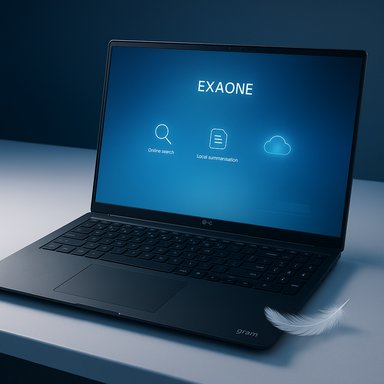
LG Electronics’ 2026 refresh of the Gram family pushes the series’ two long-running promises—extreme lightness and practical productivity—into a new phase by pairing aerospace-derived chassis materials with an on-device AI stack based on LG’s EXAONE family of models, turning the Gram from a simple ultraportable into a showcase for material engineering and embedded intelligence.
Background / Overview
LG’s Gram line has built its reputation on delivering large, usable screens in extremely light packages, frequently touting magnesium‑alloy construction and MIL‑grade durability as differentiators. The 2026 announcement doubles down on that engineering story by explicitly referencing aerospace-grade materials in the laptop’s shell while also integrating EXAONE‑derived AI features for offline productivity and assistant functions. This combination of advanced materials and on‑device AI positions the Gram at the intersection of two major 2025–26 PC trends: lightweight, ruggedized ultraportables and locally enabled generative AI features. What LG showed and what they claim:- A Gram chassis that emphasizes aerospace material engineering to reduce weight and maintain structural rigidity.
- Native on‑device AI features powered by models and tooling in the EXAONE ecosystem—LG’s homegrown family of large and hybrid AI models—enabling offline assistant capabilities, local summarization, and privacy‑friendly functions.
- Continuation of Gram’s productivity‑first hardware: large 16–17‑inch canvases, long‑life batteries, and Intel Core Ultra / Core Ultra V‑series silicon options in Copilot+/on‑device AI configurations.
Design and Materials: what “aerospace” actually means
The engineering claim
LG’s marketing (and media coverage) repeatedly refers to aerospace‑grade materials when describing Gram chassis construction. That label has a long history with Gram: past models used magnesium‑alloy and carbon‑reinforced magnesium blends to shave weight while maintaining MIL‑STD durability claims. LG’s product pages and prior press materials confirm magnesium alloys and carbon‑infused formulations in the Gram lineup—now refreshed with language that highlights aerospace engineering principles for lightness and stiffness.What buyers should infer from “aerospace material”
“Aerospace” on its own is marketing shorthand unless the vendor supplies a specific alloy designation, supplier, or independent materials test. Historically, laptop makers market magnesium‑lithium or nano carbon‑reinforced magnesium alloys as “aerospace type” because similar base materials are used in some aerospace and high‑performance industries. Those alloys provide high strength‑to‑weight ratios—but they are not the same as the specialized bulk materials used in certified airframe structures. LG’s prior documentation points to carbon nanotube‑reinforced magnesium alloy in some Grams and lists magnesium alloy as the body material on product pages—concrete technical descriptors, if not aerospace‑grade certification numbers.Strengths and likely benefits
- Substantial weight reduction: magnesium and related alloys are significantly lighter than aluminum or steel, enabling 16–17‑inch canvases without the usual mass penalty.
- Adequate stiffness and impact resistance for mobile use, when coupled with good internal bracing and MIL‑STD test passes.
- Better thermal behavior in some designs—thin magnesium parts can conduct heat away from hot zones more efficiently than plastic.
Limits and verification needs
- The phrase aerospace material doesn’t guarantee aerospace‑grade testing or certifications such as AMS (Aerospace Material Specifications). Unless LG publishes an alloy spec or third‑party materials testing, the claim remains a marketing shorthand rather than a provable, documented engineering standard.
- Long‑term surface wear, hinge durability, and repairability are all practical areas where material choice interacts with design. Independent teardowns and stress testing will show whether the claimed materials deliver real-world durability and serviceability.
Hardware: screens, silicon, and battery — the practical numbers
Platform and performance
In contemporary Gram updates, LG has been aligning with Intel’s Core Ultra family (and in select Gram Pro SKUs, Lunar Lake or Arrow Lake variants). For 2026, the product messaging keeps Gram in the productivity segment rather than gaming: choices emphasize multi‑core CPU performance, efficient integrated or entry discrete GPUs, and on‑board NPUs/accelerators to support Copilot+ and on‑device AI tasks. LG’s product pages and recent press material confirm high‑rate LPDDR5x memory options, up to 32 GB RAM, and Gen4/Gen5 NVMe storage in larger configurations. Expected practical specs (typical for recent Gram models and reiterated in LG’s 2025/26 updates):- Display: 16″ or 17″ WQXGA / WQXGA+ panels (2.5K-ish) tuned for productivity, not extreme brightness gaming—typical brightness ~400 nits on OLED or high‑quality LCD options.
- Memory: LPDDR5X up to 32 GB across Gram Pro SKUs.
- Storage: NVMe Gen4 (and higher) SSDs, 512 GB–2 TB options.
- Battery: large cells (72–90 Wh) designed for multi‑day light productivity; real world numbers depend heavily on panel, SoC, and workload.
Why the Gram remains relevant to productivity users
The Gram’s core value proposition—true large‑screen productivity with sub‑3‑lb mobility on some models—remains unique. For spreadsheet power users, remote professionals, and frequent flyers who need a roomy workspace without heavy luggage, the Gram’s engineering tradeoff is compelling: large panel + long battery life + light weight.What to test before buying
- Confirm the exact SKU: identical product names hide different panels, NPUs, and battery capacities.
- Independent battery and thermal tests for the SKU you plan to buy. Vendor “up to” figures are optimistic; labs provide realistic mixed‑use numbers.
- Verify NPU / Copilot+ readiness if on‑device AI is an explicit buying reason—some SKUs lack the silicon required for full offline features.
EXAONE and on‑device AI: what LG promises and what that means
The EXAONE family in brief
EXAONE is LG AI Research’s family of models ranging from EXAONE Deep (reasoning model) to hybrid open‑weight models such as EXAONE 4.0 and lighter, deployable variants. LG has publicly released and promoted multiple EXAONE versions as open‑weight or open‑source research artifacts, and the company has built an ecosystem of tools—ChatEXAONE, EXAONE Data Foundry, EXAONE On‑Premise—for enterprise and internal use. These releases are documented in LG’s PR streams and were covered by trade outlets, which show that EXAONE is being developed as both a research platform and a practical, deployable stack.How EXAONE shows up in the Gram
LG’s Gram updates include two complementary AI approaches:- Gram Chat On‑Device: a small, locally running model derived from EXAONE that enables offline features—local search of recent files, “time travel” through recently accessed content, and privacy‑centric assistant tasks.
- Gram Chat Cloud and cloud‑integrated features: where larger models such as GPT‑4o or full EXAONE variants run in the cloud for heavier tasks, calendar/email integration, and advanced multimodal processing. Early reporting indicates Gram ships with both modes to give users a balance of functionality and privacy.
Real capabilities and limitations
- Useful offline features: local summarization of documents, quick search across recent files, and fast note generation are feasible with a small, optimized model. These are meaningful productivity features for travelers and privacy‑conscious users.
- Not a substitute for large, multimodal cloud models: heavy reasoning, large‑context multi‑document synthesis, and high‑quality code generation typically remain cloud or server‑class tasks unless LG supplies much larger on‑device models and corresponding NPUs.
- Model provenance and updates: EXAONE’s open‑weight releases improve transparency, but buyers should ask how LG pushes model updates to devices, what telemetry is collected, and whether cloud processing is used implicitly. LG’s EXAONE lines include on‑premise options and enterprise agent tooling, signaling that LG is taking both cloud and local deployments seriously.
Privacy, security, and enterprise uses
LG claims enterprise‑grade options like EXAONE On‑Premise and ISO‑vetted internal agents for sensitive documents. For business customers, the availability of on‑premise models and verifiable data‑handling guarantees matters more than marketing claims—ask for explicit documentation and deployment guides if your organization will run sensitive workloads. For individuals, the tradeoff is simpler: local EXAONE‑derived models are privacy‑friendlier, but some advanced features will still route to cloud models unless explicitly stated otherwise.Market positioning and competitive landscape
Where Gram sits in 2026
LG is positioning the 2026 Gram as a premium productivity machine for users who need a large screen and long battery life without carrying heavy hardware. The addition of on‑device EXAONE features aims to shift part of the ‘AI advantage’ story from cloud‑centric marketing to real, local utility: offline assistant functions, document summarization, and device‑local recall of recent materials. This targets professionals who work in regulated environments, travel often, or want immediate AI assistance without upload latency.Competitors and comparative claims
- Apple: MacBook lineup continues to emphasize on‑device AI features in its own stack, but macOS and Apple Silicon are a different ecosystem with different app compatibility concerns.
- Lenovo / Dell / Asus: other PC makers are adding Copilot+ hardware and NPUs, plus competitive displays (OLED, MiniLED) and higher sustained performance. The Gram’s true differentiator remains its weight‑vs‑screen advantage and the pairing of EXAONE‑derived on‑device features.
Critical analysis — strengths, practical risks, and buyer guidance
Strengths
- Distinctive mobility: LG’s material choices continue to deliver one of the lightest large‑screen laptop experiences, giving Gram a unique niche for users who need a big canvas on the move.
- On‑device AI that’s practical: small EXAONE‑derived models provide immediate offline benefits—useful for privacy‑sensitive or offline environments. The hybrid local/cloud approach is sensible for delivering useful functionality without overpromising.
- Mature product lineage: LG’s Gram is no longer experimental; the brand has refined materials, chassis design, and service among successive generations.
Risks and caveats
- Marketing vs. engineering precision: “Aerospace material” is a strong marketing phrase but does not substitute for alloy specifications, third‑party materials testing, or lifecycle evidence. Independent teardowns and materials analyses will be the clearest verifier. Treat “aerospace” in marketing as directional, not prescriptive.
- SKU fragmentation and AI readiness: not every Gram SKU will include the NPUs or silicon necessary for full Copilot+/on‑device EXAONE features. Buyers who prioritize offline AI should confirm the SKU’s NPU/TOPS claims and verify which features are local vs cloud.
- Update, telemetry, and data handling: hybrid AI experiences create subtle data‑flow questions. Clear, device‑level privacy documentation and enterprise deployment options (on‑premise EXAONE builds) reduce risk but require concrete guarantees from LG.
Practical buying checklist
- Confirm the SKU string and the exact SoC / NPU reported TOPS if on‑device AI matters.
- Verify panel specifics (resolution, brightness, color gamut) for your workflow (photo, video, long‑form reading).
- Check independent battery and thermal reviews for the SKU you plan to buy. Don’t assume headline “up to” numbers are typical.
- Ask LG for documentation on which EXAONE features run locally, which require cloud access, and how model updates are delivered and audited.
- If durability or repairability matters, watch for early teardowns and warranty/repair data.
Why this matters for Windows users and enterprise buyers
The 2026 LG Gram shows how laptop makers are combining material engineering and AI integration to create differentiated products. For Windows users, the Gram’s promise of on‑device EXAONE features maps directly to real productivity benefits—faster local search/summarization and lower latency assistant tasks—without surrendering sensitive data to the cloud. For enterprise buyers, the potential to run EXAONE on‑premise offers a pathway to using LG’s AI stack inside corporate firewalls.However, the devil is in the details: unless LG publishes specific alloy specs, NPU TOPS numbers for the actual SKUs, and clear privacy/update policies for EXAONE on devices, many of the headline claims remain vendor promises that require independent verification. Early adopter enterprises and pros should therefore tie purchase decisions to contractually guaranteed documentation around model deployment, telemetry, and hardware specifications.
Conclusion
LG’s 2026 Gram refresh is an evolutionary, not revolutionary, step: it refines the Gram’s core virtues—large usable screens and low weight—while grafting a stronger AI story onto the chassis with EXAONE‑derived on‑device features. The use of aerospace‑style materials continues an established Gram tradition of magnesium‑based alloys that credibly reduce weight; however, “aerospace” remains a marketing phrase until proven by independent material disclosure or testing.Where the announcement is most consequential is in the AI stack: EXAONE’s family—ranging from lightweight on‑device models to hybrid open‑weight variants—gives LG a legitimate, in‑house path to deliver offline assistant experiences that matter in day‑to‑day productivity. For buyers, the practical guidance is straightforward: verify the specific SKU’s silicon and NPU capabilities, check independent battery and thermal results, and demand clarity around which AI features execute locally versus in the cloud.
LG has placed two complementary bets with the 2026 Gram: that buyers still value a truly light large‑screen laptop, and that meaningful local AI features will increasingly decide buyer preferences. Both bets are defensible—but both require third‑party verification to separate marketing from measurable advantage.
Source: 아시아경제 https://cm.asiae.co.kr/en/article/2026010110072410702/
