

LG has quietly lifted the curtain on a bold new UltraGear evo family that pushes 5K resolution into three very different gaming use cases: a 27‑inch 5K Mini‑LED powerhouse, a 39‑inch curved 5K2K Tandem WOLED ultra‑wide, and a record‑setting 52‑inch 5K2K large‑format display. The lineup leans heavily on high refresh‑rate dual‑mode operation and on‑device AI upscaling, presenting a clear signal that the next wave of premium gaming monitors will fuse extreme pixel counts, variable refresh strategies, and local AI processing to solve practical problems — from mini‑LED bloom to GPU overhead during upscale — while creating new procurement and compatibility trade‑offs for PC and console players alike.
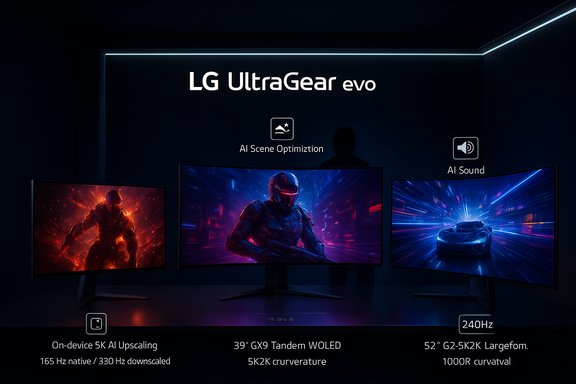
The UltraGear evo announcement arrives ahead of CES 2026 and comprises three headline models: the UltraGear evo GM9 (27GM950B), the UltraGear evo GX9 (39GX950B), and the UltraGear evo G9 (52G930B). LG positions each model to cover separate buyer needs — pixel‑dense mini‑LED brightness control, ultra‑wide OLED responsiveness, and a cinema‑scale gaming surface that attempts to replace multiple monitors — while standardizing a set of AI features across the family, including on‑device 5K AI upscaling, AI Scene Optimization, and AI Sound processing. These products are significant for three industry reasons:
The announcement sets the stage for a classic CES moment: impressive marketing claims that will need rigorous, independent verification. Buyers and enthusiasts should be excited by the technical ambition but sober about the necessary checks — lab HDR tests, AI upscaling fidelity analyses, cable/GPU compatibility confirmation, and clear burn‑in warranty terms — before committing. Early reporting and LG’s specs point to meaningful advancements, but real value will be determined by how these panels perform once reviewers run telemetry, latency, and artifact tests on production‑spec units.
Source: Notebookcheck LG unveils a trio of 5K gaming monitors, including a Mini LED model
 Background
The UltraGear evo announcement arrives ahead of CES 2026 and comprises three headline models: the UltraGear evo GM9 (27GM950B), the UltraGear evo GX9 (39GX950B), and the UltraGear evo G9 (52G930B). LG positions each model to cover separate buyer needs — pixel‑dense mini‑LED brightness control, ultra‑wide OLED responsiveness, and a cinema‑scale gaming surface that attempts to replace multiple monitors — while standardizing a set of AI features across the family, including on‑device 5K AI upscaling, AI Scene Optimization, and AI Sound processing. These products are significant for three industry reasons:- They push 5K (and 5K2K) beyond a niche studio territory into mainstream gaming marketing.
- They blend high refresh rates with extreme resolutions by offering dual‑mode refresh strategies.
- They bake on‑device AI into the display stack to promise visual and audio gains without taxing the GPU.
What LG announced: model by model
UltraGear evo GM9 — 27‑inch 5K Mini‑LED (27GM950B)
- Panel type: 27‑inch LCD with high‑density Mini‑LED backlight.
- Resolution & refresh: Native 5K (5120×2880 or vendor reported 5K) at 165 Hz, with a dual mode that switches to QHD (2560×1440) at up to 330 Hz for competitive play.
- Local dimming: 2,304 local dimming zones, positioned as a key anti‑bloom measure for mini‑LED; LG claims a Zero Optical Distance implementation to reduce haloing. Peak brightness claims sit around 1,250 nits and VESA DisplayHDR certification targets the higher HDR tiers depending on mode.
- AI features: On‑device 5K AI upscaling, AI Scene Optimization, and AI Sound for audio/enhancement, all designed to run on the monitor’s silicon rather than the host GPU. LG frames this as a way to upscale lower‑resolution content to 5K quality without GPU overhead.
UltraGear evo GX9 — 39‑inch 5K2K Tandem WOLED ultrawide (39GX950B)
- Panel type: 39‑inch Tandem WOLED (LG’s tandem emissive OLED stack).
- Resolution & shape: 5120×2160 (5K2K), 21:9 ultrawide aspect, 1500R curvature.
- Refresh & dual mode: 165 Hz at native 5K2K, with a 330 Hz WFHD (2560×1080) mode for ultra‑high‑frame competitive play. LG advertises 0.03 ms GtG response times and VESA DisplayHDR True Black 500 certification for OLED contrast.
- AI & extras: Same on‑device AI suite — 5K AI Upscaling, AI Scene Optimization, and AI Sound — plus OLED’s near‑instant response and perfect black levels. LG also highlights Dual Mode switching that avoids GPU upscaling when changing resolution modes.
UltraGear evo G9 — 52‑inch 5K2K large format (52G930B)
- Panel type & size: Massive 52‑inch, 12:9 effective aspect ratio intended to deliver “the vertical height of a 42‑inch 16:9 display” while adding width.
- Resolution & curve: 5K2K (5120×2160) with an aggressive 1000R curvature.
- Refresh: Up to 240 Hz, VESA DisplayHDR 600 certification claimed.
- Positioning: Sold as a possible single‑display replacement for multi‑monitor setups, with a focus on console/immersive living‑room gaming as well as PC usage.
Technical verification: separating LG claims from observable facts
The announcement contains a cascade of measurable claims. Independent reporting and press materials were used to cross‑check the most important ones.- The GM9’s 2,304 local dimming zones and peak brightness of ~1,250 nits are reported by multiple outlets covering the LG briefing. These figures are a straightforward marketing spec and will need lab verification to confirm real‑world HDR behavior.
- The GX9’s 0.03 ms GtG response figure and Dual Mode 165 Hz / 330 Hz split are repeated across briefings and early coverage; the response time figure is typical for WOLED Tandem claims but will depend on measurement methodology used by LG. Independent lag/response tests will be required to validate these numbers.
- The G9’s status as a 52‑inch 5K2K panel with 240 Hz is consistently stated in LG’s materials and press reporting, and no retail pricing or final firmware numbers were yet published at announcement.
What this means for gamers and creators
Performance and practical use
- High‑resolution productivity: A 5K canvas is excellent for creators who want more screen real estate without resorting to a multi‑monitor seam. The GX9 and G9’s vertical pixel counts make them useful for timeline work and large palettes.
- Competitive play: The dual‑mode approach targets two needs: native high‑resolution immersion (165 Hz at 5K) and raw competitive responsiveness (up to 330 Hz or 240 Hz at lower resolution). For serious esports players, the ultra‑high 330 Hz modes at WFHD or QHD will remain the go‑to.
- Console compatibility: Current consoles (PS5, Xbox Series X/S) top out at 4K/120 Hz in practical modes, so consoles will not natively drive 5K over current HDMI standards. Instead, consoles will benefit from the GX9/G9’s ability to downscale or accept 4K modes; the primary value for console players is the large immersive canvas and HDR handling.
Connectivity and GPU demands
Driving 5K at high refreshes is bandwidth‑intensive. Vendors have historically leaned on two approaches:- Use modern link standards (DisplayPort 2.1 or Thunderbolt 5) that increase raw pipe bandwidth.
- Use Display Stream Compression (DSC) over older physical links to enable higher effective resolutions and color depths.
Strengths — where LG appears to have pushed forward
- Ambitious technical mix: Combining 5K with Mini‑LED and OLED innovations shows LG is trying to eradicate classic compromises: brightness and color for LCDs, and contrast and refresh for OLED. The GM9’s dense zone count directly addresses a persistent Mini‑LED problem (blooming).
- Dual‑mode ergonomics: Allowing the same panel to switch between native high‑res refresh and high‑Hz lower‑res modes is a pragmatic solution for hybrid players who both create and compete.
- On‑device AI ambition: Offloading upscaling and scene/audio processing to monitor silicon could materially reduce GPU overhead and make high‑res displays more accessible for mid‑range machines — provided the algorithms behave and avoid temporal artifacts. Early coverage confirms LG intends on‑device processing, but independent tests will be decisive.
Risks, unknowns, and buyer cautions
- Real‑world mini‑LED performance vs. marketing: A claim of 2,304 dimming zones is headline‑grabbing, but anti‑bloom effectiveness depends on the dimming algorithm, LED density distribution, and panel/controller tuning. Lab tests will determine whether haloing remains visible on complex HDR scenes. Treat the zone number as a leading indicator, not proof of perfect local contrast.
- OLED burn‑in: The GX9’s Tandem WOLED panel promises great contrast and response but should be a considered risk for players who leave static HUDs on the screen for long sessions. Professional workflows and mixed‑content use can mitigate this, but buyers who expect truly permanent static UI may favor LCD/Mini‑LED options.
- Bandwidth and compatibility headaches: To realize the highest modes buyers must match GPU outputs, cable standards, and host drivers — an area that has historically caused user frustration at launch. Some early DP2.1 implementations in other monitors have required firmware workarounds. Expect a similar dance here; verify the exact supported link modes before purchase.
- AI claims need independent validation: LG’s promise of high‑quality 5K upscaling without GPU load is attractive, but upscaling fidelity, temporal stability, and artifact suppression all need third‑party image analysis. The company’s on‑device approach does raise fewer data privacy concerns than cloud processing, but the announcement lacks granular detail about where data or voice processing occurs and which features call home. Buyers should ask for explicit privacy/processing documentation.
- Price and support: No MSRPs were announced. Ultra‑dense mini‑LED arrays, large tandem OLED stacks, and an enormous 52‑inch chassis point to premium pricing. Evaluate warranty coverage for OLED burn‑in and local dimming wear, and consider return policies for a product class that historically sees firmware iterations post‑launch.
Buying guidance and checklist
- Confirm the exact SKU you are buying (region SKUs can differ).
- Match your GPU and cable to the monitor’s top mode: DP2.1 vs DP1.4 + DSC — check that your GPU driver supports the chosen mode.
- If choosing the GX9 OLED, confirm burn‑in protection modes and warranty coverage.
- For the GM9, ask for lab HDR measurements that show halo size and local contrast for mixed HDR scenes.
- Seek hands‑on or lab reviews that show AI upscaling comparisons, including temporal artifact checks.
- Consider desk ergonomics and stand/arm compatibility for the 52‑inch G9 — measure for depth, viewing distance, and mounting options.
Conclusion
LG’s UltraGear evo trio is a confident move to mainstream 5K across three distinct form factors, combining high refresh rates and on‑device intelligence with hardware steps that attempt to blunt long‑standing trade‑offs. The GM9’s dense mini‑LED array and anti‑bloom focus, the GX9’s Tandem WOLED speed and ultrawide real‑estate, and the G9’s audacious 52‑inch 5K2K scale each address different user problems while demanding serious attention to connectivity, GPU capability, and real‑world validation.The announcement sets the stage for a classic CES moment: impressive marketing claims that will need rigorous, independent verification. Buyers and enthusiasts should be excited by the technical ambition but sober about the necessary checks — lab HDR tests, AI upscaling fidelity analyses, cable/GPU compatibility confirmation, and clear burn‑in warranty terms — before committing. Early reporting and LG’s specs point to meaningful advancements, but real value will be determined by how these panels perform once reviewers run telemetry, latency, and artifact tests on production‑spec units.
Source: Notebookcheck LG unveils a trio of 5K gaming monitors, including a Mini LED model
