

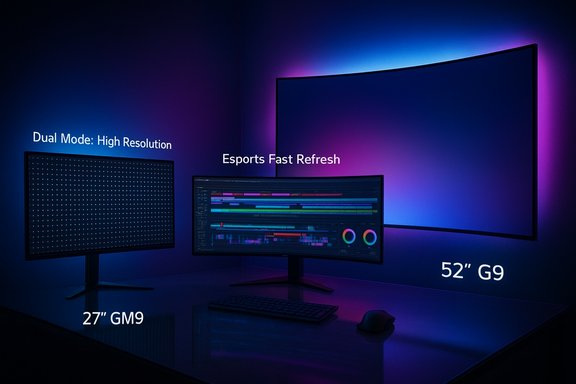
LG’s CES reveal of a new UltraGear evo family rewrites the playbook for premium gaming and creator monitors by mixing extreme resolutions, competitive refresh modes, and on‑device AI — and it marks a clear pivot toward hybrid display strategies that try to deliver both cinematic picture quality and esports‑grade responsiveness. The announcement covers three headline models: a 27‑inch 5K Mini‑LED, a 39‑inch Tandem WOLED ultrawide, and a 52‑inch 5K2K large‑format display — each adopting a “dual‑mode” approach that pairs a high‑resolution, high‑quality native mode with a lower‑resolution ultra‑high refresh mode aimed at competitive play.
CES 2026 has accelerated two related trends: first, manufacturers are pushing resolution and pixel density upward for creators and immersion; second, they are explicitly addressing competitive gamers by supplying lower‑resolution modes that trade pixels for absurdly high refresh rates. LG’s UltraGear evo family exemplifies both trends by packaging heavy hardware (Mini‑LED local dimming, tandem WOLED stacks) with an on‑display AI processing pipeline that promises perceptual upscaling and image optimization without taxing the host GPU. The move is strategic: it lets LG claim both “best picture” credentials and raw gaming performance in the same product line.
These products sit at the intersection of three hard engineering problems:
Bandwidth and compression: To move those pixels, monitors will rely on one of two paths:
Buyers chasing the 27" 1440p, 240 Hz+ VRR OLED “grail” should remain patient: the industry is moving quickly, but exact permutations of size, resolution, refresh rate, and emissive technology appear staggered across OEM roadmaps. If low latency and competitive advantage are your top priorities, the dual‑mode approach gives a practical compromise. If pixel density and color fidelity dominate your checklist, wait for independent lab validations of LG’s headline claims — and expect premium pricing for early adopters.
Concluding note: these announcements are a fast‑moving chapter in display evolution. The most important metrics won’t be marketing bullets but real‑world measurements of HDR tone mapping, bloom control, input latency, and the durability of emissive stacks under real use. Until independent reviews confirm the claims, treat the UltraGear evo slate as promising engineering with guardrails: optimism tempered by the need for verification.
Source: TechPowerUp LG Reveals its Full CES 2026 Monitor Lineup
 Background / Overview
CES 2026 has accelerated two related trends: first, manufacturers are pushing resolution and pixel density upward for creators and immersion; second, they are explicitly addressing competitive gamers by supplying lower‑resolution modes that trade pixels for absurdly high refresh rates. LG’s UltraGear evo family exemplifies both trends by packaging heavy hardware (Mini‑LED local dimming, tandem WOLED stacks) with an on‑display AI processing pipeline that promises perceptual upscaling and image optimization without taxing the host GPU. The move is strategic: it lets LG claim both “best picture” credentials and raw gaming performance in the same product line.These products sit at the intersection of three hard engineering problems:
- delivering reliable HDR highlights and color volume at high brightness,
- containing latency and ensuring pixel response for fast motion, and
- moving large pixel counts without breaking bandwidth constraints on current video links.
The Lineup, Model by Model
UltraGear evo GM9 — 27" 5K Mini‑LED (27GM950B)
- Panel: 27‑inch LCD with dense Mini‑LED backlight and a reported 2,304 local dimming zones.
- Resolution & refresh: Native 5K (reported 5120×2880) at 165 Hz; Dual Mode switches to QHD (2560×1440) at up to 330 Hz.
- Brightness / HDR: Peak brightness claims around 1,250 nits, VESA DisplayHDR targeting higher tiers.
- Extra: On‑device 5K AI upscaling and AI Scene Optimization intended to upscale lower‑res content to the panel’s native pixel count without GPU work.
UltraGear evo GX9 — 39" 5K2K Tandem WOLED ultrawide (39GX950B)
- Panel: 39‑inch Tandem WOLED (LG’s tandem emissive OLED stack), 21:9 curved format (1500R).
- Resolution & refresh: 5120×2160 (5K2K) at 165 Hz native, plus a WFHD (2560×1080) mode up to 330 Hz for competitive play.
- Response & HDR: LG advertises 0.03 ms GtG response times and VESA DisplayHDR True Black 500 for OLED contrast.
- Extra: Same on‑device AI suite and Dual Mode switching that avoids GPU upscaling.
UltraGear evo G9 — 52" 5K2K large‑format display (52G930B)
- Panel: 52‑inch, 5K2K (5120×2160) with a very aggressive curve (reported 1000R).
- Refresh: Up to 240 Hz at the larger size.
- Positioning: Marketed as a potential single‑display replacement for multi‑monitor setups and as a bridge between living‑room gaming TV and desktop monitor functionality.
Technology Deep Dive
Dual‑Mode Refresh: The practical idea
LG’s “Dual Mode” strategy is simple and pragmatic: offer a high‑density native mode for creative/immersion use (e.g., 5K at 165 Hz) and a low‑resolution, very high refresh mode for competitive gaming (e.g., QHD or WFHD at 330 Hz). This avoids the need for the GPU to real‑time upscale to the panel’s native pixels while giving players a clear, low‑latency path to higher frame rates. The approach recognises that many gamers prefer frame rate over native pixels for fast shooters, while creators need pixel real estate.Bandwidth and compression: To move those pixels, monitors will rely on one of two paths:
- native next‑generation physical links (DisplayPort 2.1 / Thunderbolt 5), or
- Display Stream Compression (DSC) over existing links to present practical throughput.
Mini‑LED vs WOLED vs QD‑OLED: Where the curve lies
- Mini‑LED with aggressive local dimming (as on the GM9) tries to combine LCD peak brightness and HDR specular highlights with reduced bloom through many dimming zones. The efficacy depends on zone count, LED pitch, and the dimming algorithm. Reported zone counts like 2,304 are impressive on paper, but the visible halo depends on how zones are distributed relative to pixel clusters.
- WOLED (Tandem WOLED): LG’s Tandem WOLED stacks layer multiple white OLED emitter stacks to increase brightness and longevity while allowing conventional color filtering or color‑conversion approaches. Tandem stacks reduce stress on any single emitter, improving longevity and brightness headroom. LG uses this in its GX9 ultrawide proposition.
- QD‑OLED: Uses blue OLED emitters with quantum‑dot color conversion layers to produce red and green. QD‑OLED tends to offer better color volume at high brightness and stronger peak saturation in some implementations, while WOLED often wins on color uniformity and long‑term panel maturity. Both emissive technologies come with trade‑offs: burn‑in risk, differential color aging, and different subpixel layouts that influence perceived sharpness and text clarity. Choosing between WOLED and QD‑OLED is a matter of priorities — brightness and saturated color vs. established driving logic and maturation of the stack.
Performance, Refresh Rates, and Practical Trade‑offs
Are refresh rates above 240 Hz pointless?
From an engineering and user‑experience perspective, the return on investment for refresh rates above 240 Hz depends on the user, the game, and the system:- Competitive players in fps titles, with specialized rigs and aim training routines, can feel the difference between 240 Hz and 330 Hz in controlled settings; muscle memory and frame timeliness matter.
- For the majority of gamers and for typical consumer GPUs, sustaining average framerates above 240 Hz is rare; power and cost increase for diminishing returns. The user comment that “any refresh rate over 240 Hz is pointless for most PCs” is defensible for mainstream builds, but not absolute: in a few high‑end esports setups, >240 Hz modes are meaningful.
Variable Refresh and latency
All three models are positioned with VRR (Variable Refresh Rate) support. For the competitive mode to matter, monitors must pair low input latency with VRR solutions such as NVIDIA G‑SYNC or AMD FreeSync and maintain frame persistence that doesn’t introduce inverse ghosting. The dual‑mode architecture helps here: lower resolution competitive modes are less GPU‑bound and thus allow higher sustained frame rates with lower frame times.GPU, cable and platform realities
Driving 5K at high refresh is bandwidth hungry. Practical deployment depends on:- GPU capability: only high‑end GPUs will sustain native 5K gaming at high refresh with quality settings; the 330 Hz competitive escape hatch acknowledges that trade.
- Video link: expect DSC or DisplayPort 2.1/Thunderbolt 5 requirements for full‑bandwidth uncompressed operation. Console compatibility is limited; current consoles are optimized for 4K/120 Hz or 4K/60 Hz in most cases, not 5K at >120 Hz.
Practical Buying Guide: The 27" 1440p 240Hz+ VRR OLED Grail
The user comment frames a popular “grail” spec: 27", 1440p, 240 Hz+ VRR, OLED. Here’s how the landscape looks and what buyers should consider:- Define priorities: image fidelity (creators), input latency (competitors), or a hybrid experience.
- If you want OLED pixel response and perfect blacks at 27", expect WOLED or QD‑OLED options to appear — but LG’s 27" announcements in this cycle were higher resolution (5K Mini‑LED) rather than a 27" 1440p OLED. That means the exact grail may still be a near‑term product coming from other OEMs or a later LG refresh.
- If 240 Hz+ is non‑negotiable, check for models that offer a native 240 Hz or a dual mode with a lower‑res ultra‑high refresh; verify whether the monitor uses VRR standards you need (G‑SYNC/FreeSync).
- Expect trade‑offs: QD‑OLED and WOLED each present brightness and color advantages; check for measured color volume, HDR consistency, and firmware features like pixel shifting or screen savers to mitigate burn‑in.
- Confirm the advertised refresh is supported in the native resolution you will use.
- Verify which VRR standards the monitor supports and whether certification (G‑SYNC Compatible, FreeSync Premium) is present.
- Ask whether the monitor requires DisplayPort 2.1 or uses DSC for target modes; confirm your GPU and cable support.
- Wait for independent lab measurements on brightness, color gamut, and response times, especially for claims like “0.03 ms GtG.”
Strengths, Opportunities and Risks — Critical Analysis
Notable strengths
- Ambitious product segmentation: LG’s three‑pronged strategy addresses creators and competitive gamers simultaneously, offering a unique value proposition for mixed workflows.
- On‑monitor AI processing: Offloading upscaling and certain scene optimizations to monitor silicon can reduce GPU overhead for creators and streamers, potentially delivering better perceived image quality on lower‑bandwidth sources. The approach is sensible if implemented without intrusive artifacts.
- High local dimming counts on Mini‑LED: If realized in the GM9, the 2,304 local dimming zones would materially reduce bloom relative to earlier Mini‑LED designs, enabling richer HDR specular highlights while remaining brighter than current OLEDs in many scenes.
Potential risks and open questions
- Vendor‑reported numbers need lab validation: Claims for peak brightness, zonal counts, and sub‑millisecond GtG are marketing coordinates until independent testing confirms them. Metrics like “0.03 ms” depend hugely on measurement method. Treat these as promises to verify at CES and in review labs.
- Burn‑in and longevity on emissive panels: WOLED and QD‑OLED carries inherent burn‑in risk under prolonged static UI/HUD usage. LG’s tandem stacks aim to mitigate some lifetime issues, but usage patterns and brightness targets still shape longevity risk.
- Bandwidth and real‑world performance: Driving 5K at 165 Hz (or switching to 330 Hz at QHD) will push GPU and cable ecosystems to their limits. Users must check for DSC, DP 2.1, or next‑gen connectivity requirements. Failure to match host hardware will mean compromised color depth or compressed streams.
- Complexity and price: Combining Mini‑LED, tandem WOLED, high refresh rates, and AI silicon raises BOM cost. Pricing will likely position these models in the premium bracket, limiting adoption to enthusiasts and professionals initially.
- AI feature opacity and privacy: On‑device AI promises to keep data local for upscaling, but claims referencing multi‑AI ecosystems elsewhere in LG’s CES slate raise questions about cloud routing and data handling. Buyers should demand clear privacy and update policies for any feature that involves voice or cloud‑based model calls.
How to Evaluate LG’s Claims at CES and When Reviews Arrive
- Watch for measured HDR tests with small specular highlights, dark scenes and mixed brightness to judge actual halo control.
- Demand color‑space verification: Intertek or other third‑party certifications for gamut are meaningful; check delta‑E and gray‑scale over brightness ranges.
- Compare upscaling artifacts across a battery of low‑bitrate sources; AI upscaling looks good in canned demos but can hallucinate details in real footage.
- Inspect firmware options: are gamer modes user‑configurable, can AI features be disabled, and is there a clear burn‑in mitigation plan for OLED modes?
Final Assessment
LG’s UltraGear evo family is a significant step toward hybrid monitors that try to satisfy both creators and competitive gamers. The engineering approach — combine high pixel counts with a competitive low‑res mode and embed AI upscaling on the monitor — is pragmatic and forward‑looking. If LG’s claims about zonal dimming, AI fidelity, and tandem WOLED performance hold up under independent testing, these models could reshape expectations for what a premium gaming/creator monitor should be.Buyers chasing the 27" 1440p, 240 Hz+ VRR OLED “grail” should remain patient: the industry is moving quickly, but exact permutations of size, resolution, refresh rate, and emissive technology appear staggered across OEM roadmaps. If low latency and competitive advantage are your top priorities, the dual‑mode approach gives a practical compromise. If pixel density and color fidelity dominate your checklist, wait for independent lab validations of LG’s headline claims — and expect premium pricing for early adopters.
Concluding note: these announcements are a fast‑moving chapter in display evolution. The most important metrics won’t be marketing bullets but real‑world measurements of HDR tone mapping, bloom control, input latency, and the durability of emissive stacks under real use. Until independent reviews confirm the claims, treat the UltraGear evo slate as promising engineering with guardrails: optimism tempered by the need for verification.
Source: TechPowerUp LG Reveals its Full CES 2026 Monitor Lineup
