

LifeLabs’ rapid pivot to cloud economics and customer experience shows how disciplined FinOps, a pragmatic governance model, and a single managed partner can turn a costly, fragmented Azure footprint into predictable capacity for new digital services.
LifeLabs is Canada’s largest provider of laboratory testing and diagnostic services, performing more than 112 million tests annually and serving millions of customers across Ontario and British Columbia. LifeLabs had already run customer-facing systems in the cloud, but as demand surged—driven in part by a government partnership to scale testing services—the company ran into a familiar enterprise pain point: independently deployed cloud applications, managed across multiple vendor relationships, were generating spiraling cost and operational complexity on Microsoft Azure. Kyndryl was engaged to help LifeLabs consolidate and govern its Azure estate. The engagement focused on creating a FinOps-driven operating model using Kyndryl Bridge together with Azure tooling to deliver visibility, tagging-based accountability, cost optimization, and governance processes that align cloud consumption with business priorities.
Source: Kyndryl LifeLabs
 Background
LifeLabs is Canada’s largest provider of laboratory testing and diagnostic services, performing more than 112 million tests annually and serving millions of customers across Ontario and British Columbia. LifeLabs had already run customer-facing systems in the cloud, but as demand surged—driven in part by a government partnership to scale testing services—the company ran into a familiar enterprise pain point: independently deployed cloud applications, managed across multiple vendor relationships, were generating spiraling cost and operational complexity on Microsoft Azure. Kyndryl was engaged to help LifeLabs consolidate and govern its Azure estate. The engagement focused on creating a FinOps-driven operating model using Kyndryl Bridge together with Azure tooling to deliver visibility, tagging-based accountability, cost optimization, and governance processes that align cloud consumption with business priorities. What LifeLabs needed and why it mattered
Running customer-facing healthcare applications at scale exposes three interlocking risks: rising cloud run costs, fractured operational ownership, and the potential for degraded customer experience when cost-cutting is pursued without governance. LifeLabs’ architecture had multiple deployments managed by separate service partners; the result was limited visibility into who consumed what Azure services, poor forecasting, and no unified intake or policy for new cloud spending. For a healthcare services provider, unpredictable costs are more than a budget problem. They directly compete with funds for product development and patient-facing capabilities. LifeLabs’ leaders needed to free up budget to invest in new customer experiences—online booking, digital results delivery, and mobile lab services—while maintaining robust security and compliance required for health data.The solution: FinOps + Kyndryl Bridge + Azure
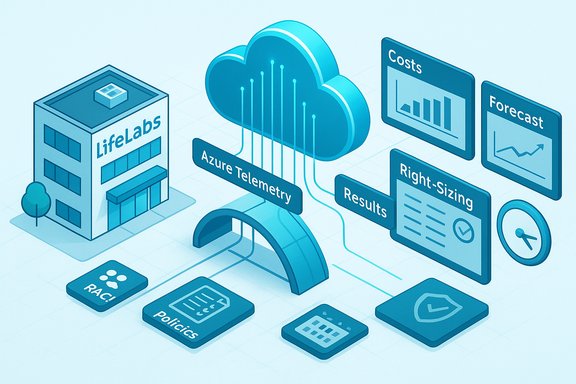
LifeLabs and Kyndryl built a targeted FinOps program that combined people, process, and platform. The program’s scope and deliverables included:- Centralized cost visibility and chargeback by using Azure telemetry and Kyndryl Bridge to map costs to business services.
- A tagging strategy to link cloud resources to business units, projects, and SLAs so spending could be attributed and governed.
- Formal roles and responsibilities (RACI model) between IT and business stakeholders to remove ambiguity in “who owns what” for Day 2 operations and new feature intake.
- Policies and intake procedures to require justification and forecasted ROI for any new cloud service consumption.
Measured outcomes (vendor-reported)
According to the Kyndryl customer story, the joint program delivered the following outcomes within a short remediation cycle:- 35–40% annual savings on cloud spending, freeing capacity for new customer experiences.
- Consolidation of cloud resources to reduce Day‑2 operational cost and complexity.
- Reliable forecasting of IT costs tied to business initiatives—enabling clearer investment decisions.
- 6 months from assessment to full remediation and governance adoption.
- A recurring weekly cadence for reviewing current and projected service consumption to drive continuous improvement.
Why the approach worked: analysis of key strengths
1. Visibility first, remediation second
Visibility into resource consumption is the prerequisite for any credible FinOps program. LifeLabs’ use of Azure telemetry—exposed through Kyndryl Bridge—allowed engineering and finance stakeholders to see what was consuming services, why, and which workloads could be right-sized or consolidated. This is the classic “measure before you act” pattern that avoids blunt, experience‑degrading cuts.2. Tagging + RACI = accountability
A disciplined tagging strategy linked technical artifacts to business owners. That linkage, combined with a RACI model, moved cost decisions upstream to the stakeholders who understood the business impact—rather than leaving engineers to make ad‑hoc cost choices. It converted cost optimization into a governance question, not only a technical one.3. Short, pragmatic timeline
The reported six‑month timeline from assessment to remediation shows the benefit of targeted governance efforts versus large-scale platform re-engineering. When teams lean on managed services and a repeatable program (Kyndryl Bridge patterns + Azure native tooling), low-friction wins are achievable and finance teams can reinvest savings quickly.4. Business-safe optimization
By defining intake procedures and policies, LifeLabs ensured that optimization decisions preserved customer experience and compliance. In healthcare, cost optimization that reduces capacity or availability is unacceptable; the program’s governance design prevented such outcomes by requiring business-level sign-off for service reductions.5. Platform synergy with existing digital services
LifeLabs is already using Microsoft technologies to extend patient-facing services—examples include Dynamics 365 and Power Platform for scheduling and field services—which means the FinOps work directly accelerates product work rather than competing with it. Consolidating cloud operations around Azure simplifies engineering alignment across digital channels.Risks, caveats, and what to watch for
No transformation is without tradeoffs. The LifeLabs story is instructive but also highlights areas enterprises should evaluate carefully before assuming the same results.1. Vendor‑reported results need independent validation
The headline savings and timeline are compelling but come from the service provider and the customer. Enterprises should insist on transparent baseline metrics, documented remediation steps, and, where possible, third‑party validation or clear reproducible audits before projecting identical savings. The 35–40% figure should be treated as a credible, vendor‑reported outcome but not universal.2. Governance is cultural, not just technical
Tagging, intake policies, and RACI models require behavioral change across finance, product, and engineering. Without executive backing and sustained governance cadence, tagging schemes degrade and shadow spend reappears. The weekly review cadence reported by LifeLabs is one mitigation; teams starting similar programs should budget for change management and periodic tagging hygiene.3. Hidden operational cost and complexity
Consolidating resources and implementing continuous monitoring introduces operational tasks: policy enforcement, chargeback mechanics, rightsizing automation, and exception workflows. These deliver recurring operating costs—human and platform—that need to be balanced against the savings. A clear TCO (total cost of ownership) model for the FinOps program itself is essential.4. Data residency, security and regulatory compliance
LifeLabs operates in regulated healthcare contexts. Any centralized cloud management must conform to Canadian privacy frameworks (federal and provincial). PIPEDA governs private-sector handling of personal information in Canada, and Ontario’s PHIPA sets specific rules for personal health information. Programs must ensure contracts, data residency, encryption, and access controls meet these statutory obligations. Failure to explicitly incorporate legal controls into FinOps governance risks non‑compliance and reputational harm.5. The risk of re‑centralizing control vs. agility
Consolidation reduces duplication, but it can also create a new bottleneck if the centralized team becomes the single gatekeeper for innovation. LifeLabs’ model mitigated this by linking governance to business owners and by keeping intake processes lightweight; others must design fast exception paths to avoid slowing product teams.Practical checklist for organisations planning the same move
- Establish a single source of truth for cloud consumption (billing + telemetry).
- Design and enforce a tagging taxonomy before aggressive cleanup work.
- Create a RACI matrix linking business outcomes to cloud resources.
- Run a month‑by‑month baseline to quantify opportunity (what to retire, resize, consolidate).
- Define intake policy: new cloud services must have business justification and cost forecast.
- Stand up weekly consumption reviews with finance and product stakeholders.
- Include security, privacy and legal early—healthcare requires compliance artifacts and data‑protection proofs.
How this ties into broader Microsoft + Kyndryl patterns
LifeLabs’ engagement reflects Kyndryl’s wider strategy of pairing its managed services palette—Kyndryl Bridge, advisory, and operations—with Microsoft cloud tooling to deliver predictable outcomes. Kyndryl’s public communications emphasize scale (thousands trained on Microsoft tech) and productized delivery patterns that accelerate adoption across industries. For healthcare organizations already invested in Microsoft stacks—Dynamics 365, Power Platform, Azure—the operational and governance work is additive: it reduces friction between product teams and platform capacity while enabling predictable cost models for digital services such as LifeLabs’ MyVisit home lab booking system.What success looks like in month 6, month 12, and beyond
- Month 6: Baseline completed, tagging enforced, initial rightsizing and consolidation executed, predictable forecasting enabled. Businesses begin to see freed budget for prioritized features.
- Month 12: Governance process institutionalized—regular reviews, chargeback or showback models in place, automation for routine rightsizing, and continuous improvement loops established.
- Year 2+: Organization shifts from firefighting cloud bills to proactively using cloud economics as a lever for business outcomes—launch cadence accelerates because cost uncertainty is reduced. The FinOps program becomes a competitive advantage rather than an internal tax.
Essential technical controls for healthcare FinOps on Azure
- Use role-based access control (RBAC) to limit who can create or modify cloud resources.
- Enforce subscription and management group structure aligned to business units.
- Automate tagging at provisioning time and run continuous compliance checks for missing/incorrect tags.
- Instrument cost alerts tied to service budgets, not just subscriptions.
- Integrate telemetry with a single dashboarding and remediation pipeline (the Kyndryl Bridge pattern is one commercial path).
Final assessment: strengths, tradeoffs and recommendation
LifeLabs’ story is a pragmatic blueprint for healthcare organizations that need to convert scale into sustainable spending and product investment. The core strengths are straightforward: centralize visibility, attach costs to business value, and operationalize accountability. The reported 35–40% savings and a six‑month remediation timeline show that targeted governance can produce meaningful headroom for product work—provided the program is executed with discipline. However, the program’s success depends on honest measurement, realistic expectations about ongoing operating costs, and close integration of privacy, security, and legal controls—especially in regulated healthcare markets where PIPEDA and provincial health acts like Ontario’s PHIPA apply. Recommendation for teams planning similar work:- Start with a narrow scope and demonstrate measurable wins (3–6 months).
- Treat tagging and governance as living artifacts and budget for ongoing enforcement.
- Demand transparent baseline data and an auditable remediation plan from any managed partner.
- Fold privacy and security into the FinOps KPIs, not as an afterthought.
Appendix — Further reading and tools mentioned
- Kyndryl’s LifeLabs customer story (FinOps program summary).
- Kyndryl Bridge and platform capabilities for continuous transformation and cloud cost optimization.
- LifeLabs’ digital services and MyVisit powered by Microsoft Dynamics 365 and Power Platform.
- PIPEDA (federal privacy law guidance) and Ontario PHIPA for personal health information governance.
Source: Kyndryl LifeLabs
