

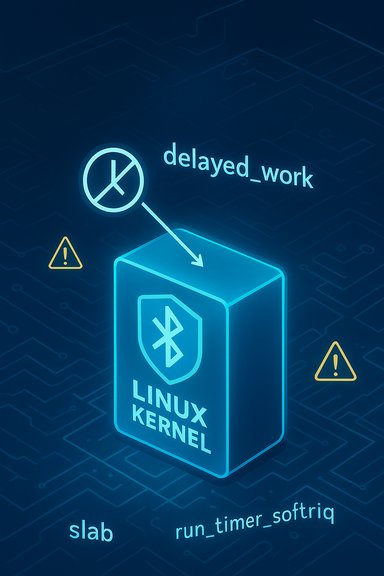
A small, surgical change in the Linux Bluetooth stack has been published under CVE-2024-58241: “Bluetooth: hci_core: Disable works on hci_unregister_dev.” The bug is a teardown/timer race in the HCI core that allowed delayed work (timers) to run against an HCI device after the device structure had begun to be torn down, producing slab-use-after-free and kernel oopses. Upstream maintainers accepted a minimal defensive fix that cancels pending works synchronously during hdev removal; distributions and vendors are rolling fixes and advisories. The pragmatic takeaway for administrators and device vendors is straightforward: install vendor-supplied kernel updates (or backport the one-line change), reboot into the patched kernel, and, if immediate patching is impossible, remove or disable Bluetooth stack components until the fix can be applied.
Bluetooth in Linux uses an HCI (Host Controller Interface) abstraction where each physical or virtual Bluetooth controller is represented by an hci_dev (often abbreviated hdev). The Bluetooth MGMT and core subsystems schedule asynchronous work (workqueue items and delayed_work timers) to handle periodic and deferred activities such as mesh send completions, discovery timeouts, and other housekeeping. When an HCI device is removed (hot-unplug, driver unload, reset), that removal path must ensure no scheduled callbacks will run after hdev is freed. Failure to cancel those pending or running works creates classic lifetime-ordering races where a worker function accesses freed memory. The reported defect is one such omission: a specific delayed work item was not cancelled during hci_unregister_dev, allowing a timer callback to run after the device structure had been freed. Why this matters operationally: such races typically manifest as kernel warnings, KASAN slab-use-after-free reports in sanitized builds, and in production kernels as kernel oopses or panics — resulting in downtime for endpoints, gateways, or IoT appliances that depend on Bluetooth services. In testbeds, automated BlueZ mesh tests and sanitizer runs reliably exposed the flaw, which is why the fix was accepted quickly.
Source: MSRC Security Update Guide - Microsoft Security Response Center
 Background
Bluetooth in Linux uses an HCI (Host Controller Interface) abstraction where each physical or virtual Bluetooth controller is represented by an hci_dev (often abbreviated hdev). The Bluetooth MGMT and core subsystems schedule asynchronous work (workqueue items and delayed_work timers) to handle periodic and deferred activities such as mesh send completions, discovery timeouts, and other housekeeping. When an HCI device is removed (hot-unplug, driver unload, reset), that removal path must ensure no scheduled callbacks will run after hdev is freed. Failure to cancel those pending or running works creates classic lifetime-ordering races where a worker function accesses freed memory. The reported defect is one such omission: a specific delayed work item was not cancelled during hci_unregister_dev, allowing a timer callback to run after the device structure had been freed. Why this matters operationally: such races typically manifest as kernel warnings, KASAN slab-use-after-free reports in sanitized builds, and in production kernels as kernel oopses or panics — resulting in downtime for endpoints, gateways, or IoT appliances that depend on Bluetooth services. In testbeds, automated BlueZ mesh tests and sanitizer runs reliably exposed the flaw, which is why the fix was accepted quickly.What the vulnerability is (technical summary)
- The problem is an omission in the HCI core’s teardown path: a delayed work item (a scheduled worker) was not cancelled when the HCI device was unregistered.
- If that delayed work (timer) later ran, its callback could reference freed memory inside the now-destroyed hci_dev structure, producing a slab-use-after-free and resulting kernel oops/crash.
- The upstream fix adds the missing synchronous cancellation for that delayed work during hci_unregister_dev, matching the defensive pattern already applied to other MGMT-managed timers and work items.
Affected scope and platforms
- Component: Linux kernel Bluetooth HCI core (hci_core) and the MGMT-managed delayed works that rely on hdev state.
- Affected kernels: upstream mainline and stable branches predating the applied patch; distributions and vendors that have not yet backported the fix may ship vulnerable kernels. Public tracker snapshots list the issue in 2024/2025 kernel change feeds and map the fix into stable branches.
- Typical devices at risk:
- Linux desktops and laptops that expose Bluetooth radios (especially if Bluetooth Mesh or other delayed-work-heavy features are enabled).
- Gateways and IoT appliances that act as mesh relays or controllers.
- Development/test hosts and CI infrastructure that run Bluetooth stress tests or expose HCI devices to automation.
- VM images or cloud images that include unpatched kernels or that enable Bluetooth passthrough for testing.
How the bug was found and why the fix is minimal
Automated fuzzing and sanitizer infrastructure (KASAN + syzbot and automated BlueZ test suites) detected intermittent crashes and use-after-free traces under mesh stress tests. The debugging traces showed the mesh_send_done timer occasionally fired after the hdev had been removed, which is a textbook missing cancellation problem on device removal. Upstream maintainers accepted the fix quickly, and the patch is intentionally conservative — it adds synchronous cancellation of the remaining delayed work during hci_unregister_dev so the device cannot be freed while any associated worker is still executing or scheduled to run. The defensive pattern exactly mirrors other existing cancellations and is therefore low risk to backport and test. Why minimal fixes matter: a one-line or one-call fix that enforces safe cancel semantics is preferred because it avoids large refactors, minimizes regression risk, and is straightforward to backport into stable branches — important for embedded vendors who maintain long-lived device kernels.Exploitability and real-world risk — what administrators should believe (and what to treat cautiously)
What is known and verified:- The bug causes slab-use-after-free and kernel oops/panics when triggered in testbeds; this is confirmed by KASAN traces and BlueZ mesh reproducer logs.
- Upstream kernel maintainers applied a commit to cancel the missing work during unregistration; the patch is present in stable branch merges and referenced by major vulnerability trackers.
- Use-after-free bugs are in principle valuable for exploitation chains that aim for privilege escalation or arbitrary code execution. However, turning this specific race into a reliable RCE would require additional heap manipulation primitives and would depend on platform mitigations (KASLR, SMEP/SMAP, CFI, etc.. Public records at disclosure time do not include a proof-of-concept that achieves RCE from this exact bug. Treat RCE claims as theoretical unless a demonstrable PoC appears.
- Most likely immediate impact: Denial-of-service (kernel oops, reboot, hung worker threads).
- Escalation potential: Theoretical and environment-dependent; a high-value target should treat the UAF as a serious primitive and patch promptly.
- Attack prerequisites: Local access or radio proximity to exercise Bluetooth MGMT flows, or ability to trigger device removal/teardown sequences that race with scheduled works.
How to detect whether you are affected
- Determine your running kernel:
- uname -r
- For distributions: check package changelogs and CVE mappings rather than relying solely on CVE strings.
- Check the MGMT source if you build kernels from source:
- Inspect net/bluetooth/mgmt.c (or equivalent in your tree) and verify there is a cancel_delayed_work_sync call for the mesh_send_done (or the omitted work item) in the device removal path (mgmt_index_removed / hci_unregister_dev). Absence of that call suggests the pre-patch code.
- Look for telemetry indicators:
- Kernel logs (dmesg, journalctl -k) that show KASAN slab-use-after-free reports referencing mesh_send_done, hdev, run_timer_softirq, or mgmt_pending_remove.
- Repeated kernel oops or unexplained reboots on Bluetooth-enabled hosts.
- BlueZ mesh test failures or deterministic hangs in test harnesses (if you run automated testbeds).
- Distribution advisories:
- Check your vendor’s security tracker (Debian/Ubuntu/SUSE/Red Hat) for package updates and fixed kernel versions that include the upstream commit. Trackers list the fix and often map it to specific kernel package releases; consult your vendor advisory for precise package names and versions.
Remediation and mitigation — prioritized playbook
Immediate (short window: hours-to-days)- Patch first: Install vendor-provided kernel updates that include the upstream fix and reboot into the patched kernel. This is the only full remediation.
- If you cannot update immediately:
- Disable Bluetooth for hosts that do not require it (desktop/laptop targets). On Linux: stop/mask the BlueZ bluetooth service (systemctl stop bluetooth; systemctl mask bluetooth). On Windows-managed endpoints, disabling the Bluetooth adapter or the Bluetooth Support Service provides equivalent reduction in exposure for Windows hosts that interact with Linux VMs or test nodes.
- Unload and blacklist Bluetooth kernel modules where possible (e.g., modprobe -r bluetooth; add blacklist entry). Note: if Bluetooth is built into the kernel (not modular), this will require a reboot into a patched kernel.
- For gateways and appliances that act as mesh relays, isolating them from untrusted radio domains until patched reduces the risk of local attackers triggering the condition.
- For device vendors and OEMs: backport the minimal upstream commit into your kernel tree, rebuild firmware images, and execute device-specific validation (hot-plug, mesh-send cancel tests, and KASAN-enabled reproducer tests where practical). The upstream fix is intentionally small and designed to backport cleanly.
- Add the fix to your CI test suite: include mesh teardown semantics and delayed-work cancellation checks as part of regression tests to avoid similar omissions in future patches.
- Confirm kernel package changelog mentions the upstream commit or stable merge that implements the cancellation.
- Re-run the reproducer in a controlled lab (KASAN-enabled builds if possible) to confirm absence of prior traces.
- Monitor kernel logs for recurrence (KASAN/warn/oops) and preserve vmcore/kdump if a crash occurs.
Practical steps for mixed Windows/Linux environments
Many WindowsForum readers manage mixed environments where Linux VMs, WSL2 kernels, and dual-boot machines coexist. Here are practical, platform-specific notes:- WSL2: WSL2 uses a Microsoft-distributed kernel binary for Windows. Do not assume an upstream Linux CVE does or does not affect the WSL2 kernel; verify the WSL kernel version (wsl --status and examine the kernel binary) and watch Microsoft’s advisories for VEX/CSAF attestations if they explicitly list the CVE. Treat each artifact individually.
- Azure / cloud images: Use vendor attestations for Microsoft-curated Azure Linux images; for third-party Marketplace images, rely on the vendor’s advisory. Do not assume Azure attestations cover non‑Azure Linux artifacts.
- Desktop/Enterprise Windows endpoints that interact with Linux testing hosts: If you run Bluetooth testbeds or pass through Bluetooth devices to VMs, include kernel patching into your patch window for the host images and disable passthrough where feasible until patches are applied.
Detection & hunting playbook (security operations)
- Hunting queries to add to your pipeline:
- journalctl -k | grep -iE "mesh_send_done|mgmt_pending_remove|run_timer_softirq|KASAN"
- dmesg | grep -i -E "use-after-free|slab|kasan|hci_unregister_dev"
- Add EDR/host detection for:
- Repeated Bluetooth service crashes and restarts.
- Unplanned kernel oops and reboots on Bluetooth-enabled hosts.
- Local processes interacting with HCI sockets (suspicious use of raw Bluetooth IOCTL invocations).
- For managed fleets, ensure memory capture/ kdump is enabled on critical assets so forensic analysis can preserve kernel traces if a crash is observed.
Why the upstream response is credible — strengths and remaining risks
Strengths- The fix is small and consistent with existing defensive patterns in the HCI teardown code; that reduces regression risk and makes backports straightforward.
- Multiple independent trackers (NVD, OSV, SUSE, Debian/Ubuntu pages and distribution advisories) reflect the same technical summary and point to the upstream commits that implement the cancellation. That independent corroboration increases confidence in the diagnosis and the fix path.
- The long tail of embedded devices and OEM kernels: many appliances and industrial IoT devices run custom or frozen kernel trees. Even though the patch is trivial, OEM rollout windows (certification, QA testing) can delay delivery, leaving those devices vulnerable for months or longer.
- Public exploit code: as of the current advisories, there is no confirmed public exploit that chains this particular race to remote code execution; that absence is not a guarantee of safety. Organizations that run high-value targets or manage dense Bluetooth deployments should treat the vulnerability as high priority.
Concrete, numbered remediation checklist (operational)
- Inventory endpoints and appliances with Bluetooth capability: uname -r; lsmod | grep -i bluetooth; enumerate devices used as gateways or mesh controllers.
- Map kernel package versions to vendor advisories for your distribution(s). Prioritize systems that serve as radios, gateways, or testbeds.
- Deploy vendor kernel updates that include the upstream cancellation commit. Reboot into patched kernels.
- If immediate patching is not possible: disable Bluetooth services or unload/blacklist Bluetooth modules on non-essential systems. Test for operational impact before mass disabling.
- For embedded/OEM devices: backport the upstream fix, rebuild firmware, and run device‑level regression tests that exercise hot-unplug and delayed-work teardown scenarios.
Validation and what to watch for after patching
- Confirm kernel changelogs reference the upstream commit or stable merge that performs the cancel_work/_delayed_work_sync call in the hci_unregister_dev removal path.
- Re-run reproducer tests in a staging environment, preferably with KASAN-enabled builds if feasible, to ensure no regression.
- Monitor kernel logs for the absence of previously seen KASAN stack traces and oopses for at least one full maintenance window after patch deployment.
Conclusion
CVE-2024-58241 is a compact but meaningful reminder that asynchronous work and device lifetimes must be carefully paired in kernel code. The problem and the remedy are both straightforward: cancel remaining delayed work synchronously during hdev unregistration so no callback can run against freed memory. The upstream patch is minimal and low-risk, making it an excellent candidate for rapid backporting and vendor rollouts. Practically, administrators and vendors should prioritize kernel updates and, where immediate updates are impossible, use conservative mitigations (disable Bluetooth, unload modules, isolate gateways) to reduce exposure. Keep an eye on your kernel logs for KASAN/oops signatures, and validate vendor advisories and package changelogs before declaring systems remediated. Caution: kernel.org commit pages referenced by some trackers were inaccessible during verification attempts (HTTP 403 responses), so commit-level verification in this article relies on aggregator pages and distribution advisories that reference the upstream patches. Where precise commit text is required for a compliance process, retrieve the stable branch merge/commit directly from a kernel mirror you can access or from your distribution’s patched source package to avoid relying on mirrored metadata.Source: MSRC Security Update Guide - Microsoft Security Response Center
