

A recently assigned CVE, CVE-2025-68324, patches a classic kernel glitch in the Linux IMM parallel-port SCSI driver that allowed a use-after-free to occur when a delayed work item was still pending as the driver instance was torn down — the fix adds a synchronous cancellation to ensure the delayed work is fully stopped before memory is freed.
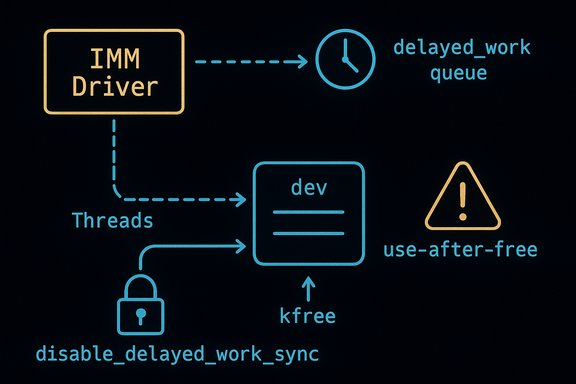
The vulnerability affects the Linux kernel's scsi: imm driver, historically used to support certain parallel-port SCSI host adapters. The bug arises from the interaction between the kernel's delayed work mechanism and device teardown logic: a delayed work item called imm_tq is created and scheduled to process SCSI commands, but when the device is detached the driver could free its device structure while that delayed work was still queued or executing. That creates a race where the work callback (imm_interrupt) can dereference memory that has been kfreed, producing a use-after-free. This class of problem — asynchronous work items outliving the object they reference — is well-known in kernel development. The common fix (used here) is to synchronously cancel or disable the work item in the detach path so the driver guarantees no callback will run after the memory is freed. The patch authors add the call that enforces that guarantee.
This approach aligns with established kernel patterns and is consistent with fixes applied across multiple subsystems where cyclic or delayed work items race with teardown. The acceptance and staging merge of the patch indicate agreement with this approach.
Source: MSRC Security Update Guide - Microsoft Security Response Center
 Background / Overview
The vulnerability affects the Linux kernel's scsi: imm driver, historically used to support certain parallel-port SCSI host adapters. The bug arises from the interaction between the kernel's delayed work mechanism and device teardown logic: a delayed work item called imm_tq is created and scheduled to process SCSI commands, but when the device is detached the driver could free its device structure while that delayed work was still queued or executing. That creates a race where the work callback (imm_interrupt) can dereference memory that has been kfreed, producing a use-after-free. This class of problem — asynchronous work items outliving the object they reference — is well-known in kernel development. The common fix (used here) is to synchronously cancel or disable the work item in the detach path so the driver guarantees no callback will run after the memory is freed. The patch authors add the call that enforces that guarantee. What exactly went wrong: a technical walk-through
The actors: imm_tq, imm_queuecommand, imm_detach, imm_interrupt
- imm_tq — a delayed work item initialized in imm_attach used to process queued SCSI commands asynchronously.
- imm_queuecommand — schedules imm_tq (via schedule_delayed_work when a SCSI command needs handling.
- imm_detach — executes when the parallel-port SCSI host adapter is removed; it cleans up the imm_struct and frees its memory.
- imm_interrupt — the work function that runs in process/context of the workqueue and dereferences fields inside imm_struct.
The root cause: asynchronous cancellation guarantees were absent
The crux is a common kernel API misunderstanding or omission: functions like cancel_delayed_work remove a work item from a queue but do not wait for a currently executing instance to finish. In contrast, cancel_delayed_work_sync (or disable_delayed_work_sync will block until any running instance finishes and prevent new invocations. The fix added the synchronous cancellation in imm_detach so the driver no longer frees imm_struct while any imm_tq execution could still reference it.Patch and upstream response
The fix was submitted as a kernel patch and discussed on the kernel mailing lists; maintainers applied the change to the scsi-staging tree for kernel 6.19 (and relevant stable trees) after review. The patch author explicitly documented the race and wrote a minimal change that calls the synchronous cancellation API in the detach path. The kernel maintainer reply indicates the patch was accepted for 6.19/scsi-staging. This is an example of a focused, low-risk kernel patch: one insertion to make teardown synchronous, with a clearly stated "Fixes:" line referencing an older commit and a standard Signed-off-by chain. Those are reliable indicators the change is narrowly targeted and upstream-appropriate.Who is affected and how severe is the risk?
Affected component and attack surface
- Component: the IMM parallel-port SCSI driver within the Linux kernel's SCSI stack.
- Attack surface: local — the only realistic attacker is someone with local code execution or access to the system who can interact with the IMM device or its driver paths (e.g., by generating SCSI requests or triggering device removal). This is not a remote network-facing driver vulnerability. Several vulnerability databases and distribution trackers list the issue as a kernel-level UAF and do not indicate a remote attack vector.
Likely impact
- Denial-of-service (kernel crash): most likely — a use-after-free frequently results in kernel oops/panic causing system instability.
- Privilege escalation or arbitrary code execution: possible but less likely; exploitation of kernel UAFs for arbitrary code execution requires precise control and favorable conditions like predictable heap layout, exploitation mitigations bypass, and often architectural specifics. For commodity hardware and this particular driver (which is niche), broad real-world exploitation is unlikely but not impossible.
- Scope and ubiquity: low-to-moderate — modern systems rarely rely on legacy parallel-port SCSI adapters, so many deployments may not be exposed; however, any system that does use the imm driver or enables related legacy modules in the kernel is potentially impacted. Distribution trackers and OSV entries map the CVE to distro kernel packages for tracking.
CVSS / public exploit data
At the time the issue was assigned a CVE, authoritative feeds provided descriptions but did not universally publish a CVSS v3/v4 score or evidence of public exploitation. That said, patch acceptance and publication of a CVE suggest responsible disclosure channels and an upstream fix were in place before broad public exploit details were circulated. Treat claims of active exploitation as unverified unless specific exploit details are publicly demonstrated or proprietary security advisories confirm them.Why the stack is vulnerable: delayed work + kfree is a dangerous pattern
The kernel workqueue API provides convenient mechanisms for deferred processing. However, deferred execution means callbacks may outlive the context that scheduled them. If a driver uses kfree or otherwise releases resources in teardown without ensuring deferred callbacks have finished, it creates a class of race conditions:- Scheduling the work item: schedule_delayed_work (or schedule_work pushes a task to a workqueue later executed in process context.
- Teardown: driver removes device, possibly calling kfree or putting references that drive memory frees.
- Window of vulnerability: if teardown proceeds before the work item completes, the callback will access stale pointers.
- Synchronous cancellation: disable_delayed_work_sync or cancel_delayed_work_sync before freeing the object.
- Reference counting: increment/decrement a reference that keeps the object alive while the work runs.
- Single-threaded guarantees: use device removal ordering that prevents concurrent scheduling or ensure dispositive locks that cover work scheduling and teardown.
How to detect if you’re exposed
- Check whether the imm driver is present on your system:
- Run lsmod | grep imm or modinfo imm to see if the module is loaded or available.
- Check dmesg / journalctl for lines referencing imm or parallel-port SCSI detection.
- Verify your kernel version and whether your distribution shipped the patched kernel:
- uname -r for the running kernel.
- Consult your distribution's security tracker or kernel changelog for CVE-2025-68324 to see whether the fix is included in the kernel package you use; Ubuntu, Debian and OSV trackers have entries for the CVE and map it to kernel updates.
- If you do not use parallel-port SCSI hardware and the module is not loaded (and not auto-loadable), risk is effectively zero for that host — though caution is always warranted on multi-purpose systems.
Remediation and mitigation guidance
- Primary fix: Update the kernel to a version that includes the upstream patch. Kernel trees that received the change include staging for 6.19 and associated stable branches; distribution security updates incorporating the patched kernel should be applied promptly. Check your vendor's security advisory or the distribution tracker to identify the correct package.
- Short-term mitigations (if immediate kernel update is not possible):
- Unload or blacklist the imm module if the hardware is not present or not needed:
- rmmod imm (requires the module is not in use).
- Add a blacklist entry (e.g., create /etc/modprobe.d/blacklist-imm.conf with the line "blacklist imm") to prevent automatic loading after reboots.
- Avoid physical detachment operations or hardware-level reconfiguration that might trigger imm_detach until you update.
- Use kernel lockdown and access controls to limit local untrusted users from interacting with device nodes that could trigger the vulnerable path.
- For system builders and vendors: backport the minimal upstream patch to your stable kernels if you ship older kernels — the change is intentionally tiny and should be low-risk to backport compared with larger refactors.
- Testing: After patching or backporting, validate by:
- Scenarios that previously reproduced the issue (if you have a test harness).
- Running kernel memory error detectors like KASAN in a controlled test environment if reproducing a UAF is necessary for QA. KASAN often flags UAFs during stress testing.
Practical steps for sysadmins (concise checklist)
- Identify: lsmod | grep imm; uname -r.
- Cross-check: consult your distribution's security tracker for CVE-2025-68324 and the kernel package that contains the fix.
- Patch: apply vendor kernel updates, or build/install a kernel with the upstream patch.
- Mitigate if necessary: rmmod/blacklist imm if the module isn't required.
- Verify: reboot into the new kernel, confirm imm is absent or the kernel includes the patch via changelog, and monitor logs for related warnings.
Why this matters beyond imm: a recurring class of kernel bugs
Although this CVE touches a niche driver, it is representative of a widespread pattern in kernel drivers: asynchronous work + premature teardown = use-after-free. Over the last several years, kernel review and static analysis have repeatedly found similar issues across networking, storage, and platform drivers. The fix pattern applied here — use of the synchronous cancellation APIs — is a stabilizing best practice and is being applied across multiple subsystems when such races are discovered. The author of this patch, and other submitters referenced in related threads, have previously contributed similar UAF fixes in other drivers, indicating the pattern is common and actively being mitigated.Risk analysis and critical assessment
Strengths of the fix and response
- Minimal, narrowly focused patch: the change is a single insertion that eliminates the race without redesigning code paths, reducing regression risk.
- Upstream acceptance: kernel maintainers applied the patch into scsi-staging and recognized the rationale, accelerating distribution adoption.
- Transparent disclosure and tracking: multiple security trackers and distribution advisories have recorded the CVE, enabling administrators to identify vulnerable package versions and apply updates.
Remaining concerns and limitations
- Exposure is local and hardware-specific: while that limits widespread exploitation, systems with legacy or unusual hardware may remain vulnerable if not patched.
- Potential for other similar bugs: the presence of one UAF due to delayed work suggests other drivers might have analogous issues; a comprehensive audit of delayed-work usage across in-tree drivers remains necessary.
- Backport burden: embedded and long-term-support kernels may require careful backporting; vendors must validate backports to avoid regressions on customized kernels.
Unverified or unverifiable points (flagged)
- Assertions about active exploitation in the wild are not substantiated by the public trackers at the moment. Treat any claim of active exploitation as tentative until validated by vendor advisories or security research reports.
- Precise CVSS scoring and exploitability metrics were not universally published in the initial feeds; follow your vendor's advisory for final severity assessments.
The maintainer perspective: why synchronous cancellation is preferred here
Kernel maintainers generally prefer minimal, correct fixes that preserve existing driver behavior while eliminating race conditions. Rewriting imm to use an elaborate refcounting scheme could be heavier and risk introducing regressions; calling disable_delayed_work_sync in the detach path is idiomatic and correctly blocks until any running work finishes, making the subsequent kfree safe.This approach aligns with established kernel patterns and is consistent with fixes applied across multiple subsystems where cyclic or delayed work items race with teardown. The acceptance and staging merge of the patch indicate agreement with this approach.
Timeline and disclosure notes
- Patch submission and discussion occurred on kernel mailing lists in late 2025; maintainers applied the change to scsi-staging for kernel 6.19 as part of normal review cycles. The CVE entry and distributor trackers were populated in mid-December 2025, recording the fix and mapping it to distribution kernels for patching. Administrators should use those trackers to find the exact patched package for their OS.
Conclusion — practical takeaways
CVE-2025-68324 is a targeted, fixable kernel use-after-free that underlines a perennial driver-development pitfall: asynchronous work must be definitively canceled before associated memory is freed. The accepted patch implements synchronous cancellation in imm_detach, which is a straightforward and robust remedy. Systems that do not use the IMM parallel-port SCSI driver are effectively unaffected, but any host with legacy parallel SCSI hardware or with the imm module loaded should receive the patched kernel from their distribution or apply the upstream change. Administrators should:- Prioritize kernel updates that include the imm fix (CVE-2025-68324).
- If immediate patching is not possible, unload or blacklist the imm driver on affected hosts.
- Use this as an audit prompt: scan in-tree drivers for similar delayed-work teardown patterns and ensure synchronous cancellation or reference counting safeguards are present.
Source: MSRC Security Update Guide - Microsoft Security Response Center
