

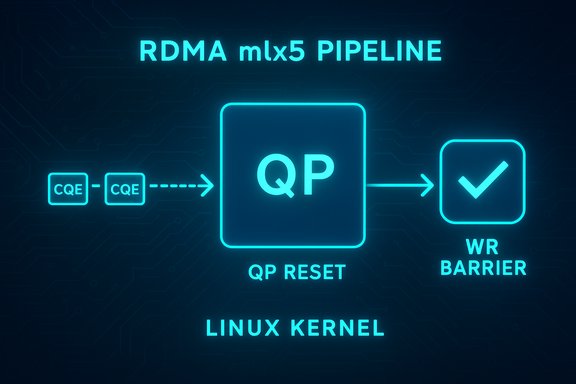
The Linux kernel received a targeted fix for a race in the RDMA mlx5 driver that could leave work requests unaccounted for during recovery of the UMR Queue Pair (QP), tracked as CVE‑2025‑21892; the patch adds a final, barrier work request to guarantee completion of outstanding WRs before the QP transitions to RESET, preventing lost completion events and tasks getting stuck.
RDMA (Remote Direct Memory Access) stacks used in high-performance computing, storage fabrics and low-latency networking rely on precise ordering between Work Requests (WRs), Completion Queue Events (CQEs) and Queue Pair (QP) state transitions. The Mellanox/NVIDIA mlx5 driver implements hardware offloads and recovery logic for UMR (User Memory Region) QPs that are used to manage pinned user memory for RDMA operations. In the reported defect, the kernel’s recovery path could move a QP to the RESET state before the driver had a reliable signal that all outstanding WRs and their flushed CQEs had been delivered or observed — a timing gap that produces lost CQEs and, in some cases, tasks blocked indefinitely. Put simply: if the driver transitions to RESET while the firmware silently discards certain flushed CQEs (as permitted by the IB spec), higher-level code can end up waiting for completions that never arrive, leading to hung tasks and stalled RDMA operations. The patch implements a minimal barrier that makes the driver wait for a final CQE before performing that state change.
Immediate action plan (recommended):
Source: MSRC Security Update Guide - Microsoft Security Response Center
 Background / Overview
RDMA (Remote Direct Memory Access) stacks used in high-performance computing, storage fabrics and low-latency networking rely on precise ordering between Work Requests (WRs), Completion Queue Events (CQEs) and Queue Pair (QP) state transitions. The Mellanox/NVIDIA mlx5 driver implements hardware offloads and recovery logic for UMR (User Memory Region) QPs that are used to manage pinned user memory for RDMA operations. In the reported defect, the kernel’s recovery path could move a QP to the RESET state before the driver had a reliable signal that all outstanding WRs and their flushed CQEs had been delivered or observed — a timing gap that produces lost CQEs and, in some cases, tasks blocked indefinitely. Put simply: if the driver transitions to RESET while the firmware silently discards certain flushed CQEs (as permitted by the IB spec), higher-level code can end up waiting for completions that never arrive, leading to hung tasks and stalled RDMA operations. The patch implements a minimal barrier that makes the driver wait for a final CQE before performing that state change. Why this matters to WindowsForum readers and mixed estates
Many Windows-centric environments still host Linux guests, containers, or specialized network appliances that implement RDMA for storage and clustering workloads. A kernel-level hang or stuck RDMA worker in a Linux guest or appliance can cascade into application timeouts, VM host instability, or degraded hybrid services that Windows teams rely on for backup, replication or HPC workflows.- High-performance clusters and scale‑out storage using mlx5 NICs are the highest‑value targets for this defect.
- The impact is primarily availability (hangs, blocked tasks, degraded throughput), not data disclosure or integrity corruption in reported advisories.
Technical anatomy — what went wrong
QP states, WRs and CQEs (brief primer)
- A Work Request (WR) is posted to a QP to perform RDMA send/receive or memory operations.
- The hardware generates Completion Queue Events (CQEs) to acknowledge finished WRs (success, error, or flushed).
- A QP travels through states (e.g., RTS → SQError → RESET). Recovery often requires flushing outstanding WRs and then resetting the QP to clear erroneous states.
The race and its result
- During an error/recovery path the mlx5 driver would schedule the QP transition to RESET.
- The transition could occur before the final set of flushed CQEs had been produced or observed.
- Firmware behavior in this condition allows discarding flushed CQEs on RESET; the driver’s earlier assumptions therefore became invalid.
- The observable result: blocked kernel tasks, hung RDMA operations, and degraded appliance behavior (hung worker threads waiting on completions).
The patch: a barrier WR
The upstream fix is surgical and conceptually simple:- Before moving the QP to RESET, the driver reuses a failed/ready WR and posts a final WR whose sole purpose is to act as a barrier.
- The driver waits for a CQE corresponding to that final WR. For an error-state QP the CQE received will typically be IB_WC_WR_FLUSH_ERR, but its status is irrelevant — the CQE is only a confirmation that the hardware has flushed all outstanding WRs and that no further CQEs remain pending.
- Once the CQE for the barrier WR arrives, the driver safely transitions the QP to RESET and, as appropriate, back to RTS. This guarantees that no outstanding WRs survive across the RESET boundary.
Verified timelines, severity and vendor tracking
- The CVE entry and multiple Linux distribution trackers list the disclosure and upstream patching in late March 2025 (published 2025‑03‑27).
- Most public trackers classify the issue as moderate — the principal impact is availability (blocked tasks), and the most widely quoted CVSS ratings sit in the medium range (examples: CVSSv3 ~4.6). Different vendors have slightly different scoring depending on their exposure model.
- Multiple downstream advisories (Debian, Ubuntu, Oracle, Amazon Linux, Red Hat trackers and OSV aggregators) have ingested the fix or mapped the upstream commit into vendor packages — check vendor-specific advisories for backport timing and fixed-package names.
Exploitability, proof‑of‑concept and realistic risk
- There is no widely reported, publicly released proof‑of‑concept that converts this race into remote code execution or privilege escalation as of the disclosure window; the practical and repeatable result is an availability fault (blocked tasks). Treat claims of immediate RCE or privilege escalation as unverified without a reproducible exploit chain.
- The attack surface is narrow: you need access to the RDMA subsystem and the ability to exercise UMR QPs on mlx5 hardware. In most datacenter deployments that means local or tenant-adjacent access (for example, a malicious guest in an environment that exposes passthrough RDMA capabilities). The potential for a multi‑stage exploit exists in theory — lifecycle and race defects are sometimes components in larger exploit chains — but no such chain has been documented publicly.
- Operationally, the principal observable impact is a hung kernel thread tied to RDMA resource cleanup (the public trace shows “task rdma_resource_l blocked for more than 120 seconds” and stack frames inside mlx5_ib teardown code), which is a clear detection signal if you are monitoring kernel logs closely.
Detection, telemetry and triage guidance
Watch for kernel logs and hung-task traces consistent with the reported call stack. Useful signals include:- dmesg / journalctl -k showing hung tasks tied to RDMA/mlx5, e.g., messages complaining about tasks blocked for more than 120 seconds or wait_for_completion hang points in mlx5 code paths.
- Stack frames referencing mlx5r_umr_post_send_wait, mlx5r_umr_revoke_mr, __mlx5_ib_dereg_mr, or similar mlx5_ib symbols.
- Sudden, repeatable stalls or long-running operations during MR deregistration, QP recovery, or when software triggers QP RESET sequences.
- Capture dmesg and kernel logs immediately; hangs are ephemeral and can be lost on reboot.
- If reproducible in test, capture full stack traces (vmcore if possible) while exercising UMR deregistration and QP recovery.
- Validate whether the running kernel contains the upstream commit by checking vendor changelogs or the kernel’s patchset; vendor advisories or package changelogs will usually list the fixed commit.
Mitigation and remediation recommendations (practical checklist)
Patching the kernel is the definitive remediation. The fix is small and intentionally surgical, but because it changes driver behavior you must follow normal kernel update discipline.Immediate action plan (recommended):
- Inventory: locate hosts running mlx5-capable NICs or systems that enable RDMA/UMR QP functionality (hypervisors, storage servers, HPC nodes).
- Confirm patch presence: verify your distribution or vendor kernel package includes the CVE fix or the upstream commit. For vendor kernels, request explicit confirmation from the vendor that the backport has been applied.
- Test patch: deploy the patched kernel in a staging environment and run RDMA stress tests that exercise MR deregistration and QP recovery logic. Validate that prior hang reproductions no longer occur.
- Schedule production rollouts with the usual reboot windows; kernel patches require reboots. Communicate expected maintenance windows to stakeholders dependent on RDMA services.
- Short-term mitigations if you cannot patch immediately: avoid administrative flows that trigger QP recovery or MR deregistration at scale; limit access to management operations that can start these sequences; and isolate RDMA hosts from untrusted tenants. Blacklisting mlx5 is possible but will remove NIC functionality — treat this as a last resort.
Critical analysis — strengths of the fix, residual risks and operational implications
Strengths- The upstream change is minimal and conceptually robust: using an in-band final WR as a barrier leverages the same hardware semantics the stack already relies upon, keeping the code localized and easy to review. That makes the fix safer to backport into stable kernel series.
- The patch addresses the root synchronization issue rather than masking symptoms; a reliable barrier prevents future subtle races of the same family.
- Vendor backport lag: embedded appliances and vendor-supplied kernels commonly lag upstream merges. Systems that do not receive timely vendor updates remain exposed to the availability issue until patched. Operational inventories should prioritize these hosts.
- The fix prevents the observed hang condition but does not alter firmware behavior; hardware that silently discards CQEs on RESET still behaves according to the IB spec. The driver must therefore continue to use synchronization primitives reliably — the patch enforces one such primitive, but other, unrelated races could still exist in complex RDMA flows.
- Theoretical exploit chains remain possible in principle; lifecycle races sometimes appear as building blocks for more complex primitives when combined with allocator behavior or other kernel bugs. No public evidence supports such an escalation here, but defenders should remain cautious and keep systems patched.
- Because the change requires a kernel update, test windows and reboots are unavoidable. For production RDMA clusters, schedule coordinated maintenance and perform functional failover tests.
Step‑by‑step remediation checklist (1‑2‑3)
- Identify in-scope hosts: list systems with mlx5 drivers or RDMA-capable NICs.
- Check vendor advisories and kernel package changelogs for CVE‑2025‑21892 or the upstream commit.
- Apply the vendor/distribution kernel update that includes the patch, reboot, and validate RDMA operations with your usual test harness.
- Monitor kernels post-patch for regression traces and confirm the hung-task symptom no longer reproduces.
- For appliances, confirm vendor firmware/kernel image timelines and arrange image updates where applicable.
Final assessment
CVE‑2025‑21892 is a pragmatic, medium‑impact kernel synchronization bug: it can cause RDMA tasks to block and services that depend on timely completion of Work Requests to stall. The upstream fix is deliberately minimal and correct — posting a final barrier WR and waiting for its CQE is an appropriate, low‑risk remedy that aligns with RDMA semantics. The decisive operational risk is not an immediate remote compromise but rather the real-world availability impact on RDMA-heavy infrastructure and hybrid deployments where Linux guests or appliances play a mission‑critical role. Administrators should prioritize patching RDMA hosts, confirm vendor backports for appliances, and validate recovery flows in staging before rollout. Continue to monitor vendor advisories, and treat any claims of remote code execution or privilege escalation linked to this CVE as unverified until a concrete, reproducible exploit is published. The fix restores deterministic behavior to a delicate part of the mlx5 recovery path; the remaining work for operators is classic systems engineering — inventory, test, patch, and verify — to prevent a localized kernel hang from turning into a larger outage.Source: MSRC Security Update Guide - Microsoft Security Response Center
