

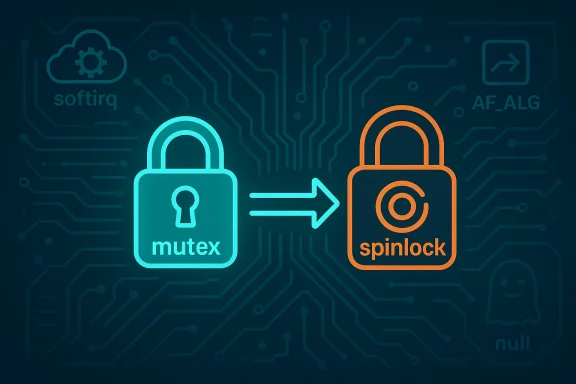
A subtle but consequential bug in the Linux kernel’s crypto subsystem was fixed upstream in May 2025: CVE-2025-37808 addresses a synchronization mistake—the null crypto algorithm was being protected by a sleeping mutex while it can be freed in softirq context via AF_ALG, so maintainers changed the protection to a spinlock to prevent kernel crashes and denial-of-service conditions.
The Linux kernel exposes cryptographic primitives to userland through a kernel crypto API and the AF_ALG socket interface (commonly used by user-space programs that want to offload or reuse kernel crypto implementations). One of those primitives is the “null” algorithm, a no-op transform used in places where a crypto API requires an algorithm object but no actual cryptography is needed. Under certain usage patterns the default null algorithm object can be freed from softirq context, but the original code used a mutex to protect access to that object—an unsafe choice when the object can be accessed from atomic (softirq/interrupt) context. The fix replaces the mutex with the appropriate form of spinlock to make the protection safe for softirq entry.
This is a classic kernel correctness/availability issue rather than a confidentiality or code-execution bug: the primary impact is denial of service—a crash, oops, or hang—because sleeping locks cannot safely be acquired when code is running in an atomic context. Several distributors and vulnerability databases recorded the issue with a medium severity rating (CVSS v3.1 ~5.5) and emphasized the availability impact as the dominant risk.
The fix itself is simple and correct: kernel maintainers replaced an inappropriate sleeping lock with an atomic-safe spinlock, aligning the code with core kernel locking rules. That minimal footprint helps vendors backport and roll out patches quickly, but administrators must still manage coordination, testing, and reboots across their fleets. Where vendors are slow to publish packages, organizations must make a risk-based decision: apply the upstream patch via a controlled backport-and-build process, or mitigate exposure through workload isolation until the vendor-supplied kernel is available.
Source: MSRC Security Update Guide - Microsoft Security Response Center
 Background / Overview
The Linux kernel exposes cryptographic primitives to userland through a kernel crypto API and the AF_ALG socket interface (commonly used by user-space programs that want to offload or reuse kernel crypto implementations). One of those primitives is the “null” algorithm, a no-op transform used in places where a crypto API requires an algorithm object but no actual cryptography is needed. Under certain usage patterns the default null algorithm object can be freed from softirq context, but the original code used a mutex to protect access to that object—an unsafe choice when the object can be accessed from atomic (softirq/interrupt) context. The fix replaces the mutex with the appropriate form of spinlock to make the protection safe for softirq entry.This is a classic kernel correctness/availability issue rather than a confidentiality or code-execution bug: the primary impact is denial of service—a crash, oops, or hang—because sleeping locks cannot safely be acquired when code is running in an atomic context. Several distributors and vulnerability databases recorded the issue with a medium severity rating (CVSS v3.1 ~5.5) and emphasized the availability impact as the dominant risk.
Why this matters: softirqs, AF_ALG, and locking rules
Linux kernel contexts fall into categories with strict rules about what you can and cannot do. Two short, essential rules explain the bug and the fix:- Code running in interrupt or softirq (bottom half) context cannot sleep; therefore it must never call functions or acquire locks that may sleep. Kernel documentation and guidance are explicit about this: mutexes (and many other primitives) may sleep and so are not safe in interrupt/softirq context; spinlocks are the primitive designed for atomic contexts.
- The AF_ALG pathway exposes kernel crypto objects to userland and can cause those objects (including the default/null algorithm) to be freed from softirq-handled paths. If a user context holds a sleeping lock while a softirq path attempts to free or access the same object, the result is undefined behavior up to kernel oops/panic. For this reason, kernel maintainers substitute spinlocks (or the _bh variants that disable softirqs) where appropriate.
Technical anatomy of the defect and the fix
What went wrong
- The kernel’s default null algorithm object was protected by a mutex in some code paths.
- The null algorithm can be freed from softirq context through the AF_ALG interface (the user-space to kernel crypto glue).
- Because mutex acquisition may sleep (it’s a sleeping lock), code that might be entered from softirq context cannot safely hold or attempt to acquire a mutex. That mismatch created a race that could lead to use-after-free, NULL dereferences, or oops conditions when the softirq path freed the algorithm while another context held the mutex—or conversely when an atomic context attempted to acquire a sleeping lock.
The corrective change
- Maintainers replaced the sleeping mutex protection with a spinlock or a spinlock variant (such as spin_lock_bh/spin_unlock_bh where softirq protection is required). That makes the lock acquisition safe in atomic contexts, since spinlocks do not sleep and, when combined with the “_bh” variants, can disable softirqs during the critical section to avoid concurrent softirq entry on the same CPU. Kernel commit references for the upstream patch are included in public CVE records and distro advisories.
Why the patch is low-risk—but not trivial
- Replacing a mutex with a spinlock is mechanically simple and preserves the intended serialized access to the shared object.
- However, spinlocks must only protect very short critical sections (they busy-wait and waste CPU if held long), and code that runs while holding a spinlock must not call any function that can sleep. The change therefore requires careful review to ensure no sleeping or blocking calls remain inside the protected region. Kernel reviewers judged the change appropriate and merged the fix into the stable trees.
Impact: availability and attack scenarios
- The vulnerability is classified with high availability impact: an attacker or malformed workload that can trigger the affected code path may provoke kernel crashes, causing loss of service for the host or guest workloads. Because AF_ALG is a local interface, the likely exploitation scenarios are local or via containerized workloads that can exercise AF_ALG. Distributions and vendors list this as a locally exploitable denial-of-service (DoS) with a low privilege requirement in many contexts.
- CVSS v3.1 vector strings reported by distributors describe the vector as Local, low complexity, low privileges required, no confidentiality/integrity impact, but high availability impact—hence the mid-range score around 5.5 with availability singled out as the consequence to prioritize.
- Exploitation likelihood: public data (EPSS and vendor notes) indicated low to negligible public exploit activity for this specific CVE. Scanners and threat models therefore treat it as an availability risk rather than a mass-exploitable remote code execution. That said, the vulnerability can be relevant for multi-tenant hosts, CI runners, or systems where untrusted local code runs—places where an attacker can trigger AF_ALG behavior to produce instability.
Which systems are affected? Vendor and distro posture
- The bug is in the Linux kernel upstream; as such, any distribution or product that ships an affected kernel revision may be vulnerable until patched. Distributors including Ubuntu, SUSE, Amazon Linux, Red Hat-derived ecosystems and others recorded or published advisories referencing CVE-2025-37808 and the upstream fixes.
- Not all vendors apply every upstream fix on all stable kernel branches. Some vendor kernels were patched promptly on the supported branches; others reported "no fix planned" for certain end-of-life or long-term branches. Scanning and vulnerability management tools (Nessus, Tenable, distro trackers) flagged unpatched installations where vendors had not yet supplied backports. Administrators muss advisory and package lists for exact kernel versions and available updates.
- Cloud vendor attestations (e.g., Azure Linux) and product-specific inventories are helpful but scoped to the named product: Microsoft’s practice of attesting that “Azure Linux includes this open-source library and is therefore potentially affected” is an example of product-level disclosure that does not necessarily prove or disprove exposure across all Microsoft artifacts—absence of a public attest is not proof of absence. Use vendor advisories and kernel patch lists to confirm the exact kernel builds in your images.
Vendor responses and patch status (what admins should look for)
- Upstream kernel commits addressing the mutex→spinlock change were merged into the stable trees; those commits are referenced by public CVE aggregators and distro advisories. Administrators should consult their vendor’s security advisories (Ubuntu/SUSE/Amazon/Red Hat/Oracle) to identify the patched package names and the kernel versions that include the backport.
- Common vendor remediation patterns:
- Kernel package updates (recommended): install the vendor-supplied kernel package that includes the backport.
- Backport patches: for enterprises that maintain long-term kernel branches, vendors may publish patch fragments to be applied and built into internal kernels.
- Workarounds are limited and often impractical: because this is a kernel-level locking correctness problem, the only reliable fix is patch-and-reboot for most installations.
- Monitor vendor trackers (Ubuntu Security Notices, SUSE CVE pages, Amazon ALAS, Red Hat Errata) for the exact package names and CVE mappings in your distribution. Several vendors (Amazon, SUSE, Ubuntu) have already released advisories and fixed kernels for affected branches; confirm whether your deployment’s kernel build ID is listed as fixed.
Practical mitigation and remediation steps (step-by-step)
- Inventory affected systems
- Run a kernel-version inventory across your fleet and map kernel builds to vendor advisories for CVE-2025-37808. Use your configuration management or CMDB to identify systems running kernels in the vulnerable ranges.
- Prioritize patching
- Prioritize public-facing hosts, multi-tenant hypervisors, CI runners, and systems that run untrusted or container workloads. Those systems present the greatest risk for a local DoS.
- Apply vendor-supplied kernel updates
- Install the updated kernel package provided by your distribution vendor and schedule a maintenance window for a reboot. This is the only straightforward, supported remediation for most environments. Confirm the kernel ABI and package names match the vendor advisory.
- Backport if required
- If you maintain an internal kernel branch, obtain the upstream patch referenced in distributor advisories (the kernel commit IDs are publicly listed in CVE trackers) and apply the patch to your branch; fully test the backport and reboot.
- Short-term compensating controls (where kernel update is not immediately possible)
- Limit local account access and execution of untrusted containers or workloads until patched.
- Isolate affected hosts from environments that allow arbitrary local code execution.
- Monitor for kernel oops/BUG messages and unexpected reboots; escalate when observed.
- Post-patch verification
- After updating and rebooting, verify the new kernel version is active and monitor logs (dmesg, journald) for absence of the previous oops messages. Where possible, run a smoke test exercising AF_ALG code paths in non-production to ensure no regressions occur.
Detection guidance: what to watch for
- Kernel oops or panic messages referencing crypto code paths, NULL dereferences, or use-after-free in crypto/* parts of the stack. Check dmesg and system journal entries for suspicious oops messages following AF_ALG activity.
- Recurrent hostkernel crashes or service interruptions that correlate with workloads performing crypto operations (for example, applications that use AF_ALG or container images that call into kernel crypto). Use log aggregation to correlate crashes with workload activity.
- Vulnerability scanners and configuration management tools will flag the presence of an unpatched kernel package; treat those scan results as high-priority remediation tickets where the host is in a high-risk role (e.g., hypervisor, shared CI runner).
Critical analysis: strengths of the fix and residual risks
Strengths
- The upstream patch is narrowly targeted: swapping a mutex for a spinlock is a minimal semantic change that addresses the root cause (sleeping lock in atomic-path exposure) without reshaping the architecture of the crypto subsystem. That makes the patch easy to review, backport, and deploy. Public kernel trees and distributors accepted the change quickly, indicating good consensus.
- The fix aligns with long-standing kernel locking principles: use sleeping locks for user-context-only data, and spinlocks for contexts that may be entered from interrupts or softirqs. This makes the change conceptually correct and sustainable.
Residual risks and caveats
- Replacing a mutex with a spinlock carries performance and functional risk if the protected code path ends up doing too much work or calls sleeping functions while holding the spinlock. Kernel reviewers generally audit for these hazards, but regressions can be subtle—especially in distribution backports where the surrounding code may differ. Administrators should test patched kernels in realistic workloads.
- Not all vendor kernels are patched simultaneously. Some enterprise or long-term kernels may receive backports; others may be designated "no fix planned" for older branches. This heterogeneity means some fleets will be patched quickly while others remain exposed—forcing administrators to make risk-based decisions about upgrades, backports, or workload migration. Tenable and other scanner vendors flagged hosts where vendor fixes were not available.
- The fix addresses the immediate synchronization error in the default null algorithm, but similar code patterns may exist elsewhere in the kernel (or in external modules) where sleeping locks accidentally protect data touched from atomic contexts. Organizations should treat this CVE as a reminder to scan for similar locking patterns in custom kernel modules or backported code.
Practical recommendations for sysadmins and security teams
- Patch quickly where possible, and schedule reboots for kernel updates urgently for hosts in high-exposure roles (multi-tenant, CI runners, shared build infrastructure).
- For hosts that cannot be immediately patched, reduce exposure by restricting local untrusted execution, isolating shared systems, and applying tighter access controls around user namespaces and container runtimes.
- When deploying patched kernels, validate that the update includes the upstream commit IDs or vendor advisory numbers listed in public CVE trackers; do not rely solely on a package version number without checking vendor advisories.
- Integrate kernel OOPS/panic detection into your monitoring: automatic alerts on repeated kernel oopses allow fast triage if a latent issue remains.
- Review internal kernel modules and backports for risky locking patterns—specifically, the misuse of sleeping locks in code paths reachable from softirqs, tasklets, or interrupt contexts. This CVE provides a focused audit target.
Final assessment and context
CVE-2025-37808 is a textbook example of a correctness bug that can have outsized operational impact: a trivial-seeming locking choice (mutex vs spinlock) crosses an important context boundary and creates a path to kernel instability. The underlying vulnerability does not appear to have been weaponized for remote code execution or widespread remote exploitation, but its availability impact is real and relevant for environments where local or containerized workloads may be adversarial or untrusted. Distro and vendor advisories place the CVSS score in the medium range while emphasizing high availability impact specifically—information IT teams should use to prioritize remediation.The fix itself is simple and correct: kernel maintainers replaced an inappropriate sleeping lock with an atomic-safe spinlock, aligning the code with core kernel locking rules. That minimal footprint helps vendors backport and roll out patches quickly, but administrators must still manage coordination, testing, and reboots across their fleets. Where vendors are slow to publish packages, organizations must make a risk-based decision: apply the upstream patch via a controlled backport-and-build process, or mitigate exposure through workload isolation until the vendor-supplied kernel is available.
Conclusion
CVE-2025-37808 is an urgent but manageable Linux kernel availability vulnerability: it illustrates how small synchronization mistakes in kernel-space can translate into large operational consequences if left unpatched. The technical remedy—switching to spinlocks in code paths that can be touched from softirq—is correct and compact, and vendor patches were made available across mainstream distributions. Systems administrators should treat this as a high-priority patching item for hosts that run untrusted local workloads or provide multi-tenant services, apply vendor updates and reboots promptly, and use this incident as an occasion to audit kernel modules and backports for improper locking in atomic contexts.Source: MSRC Security Update Guide - Microsoft Security Response Center
