

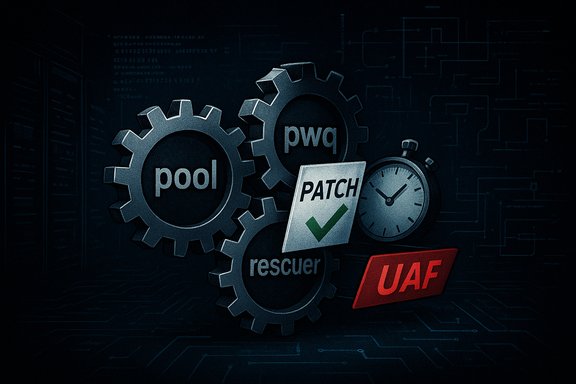
The Linux kernel fix for CVE-2025-21786 corrects a subtle but dangerous ordering error in the workqueue cleanup path that created a use-after-free window: the patch moves the code that drops the workqueue pool reference (
The Linux workqueue subsystem provides the kernel’s mechanism for deferring work into kernel threads and pooled worker contexts. Over many kernel releases workqueues have been hardened and refactored to improve performance and scalability, but the concurrency invariants they rely on are brittle: a missed reference or a premature drop can create a window where asynchronous worker code executes against freed memory — a classic use-after-free bug.
CVE-2025-21786 was assigned after maintainers and reporters observed such a race introduced by a refactor that changed the logic around reaping workers. In short, the commit that introduced the regression attempted to reap ordinary worker threads but did not correctly handle the special rescuer thread, and it removed the wait that ensured the rescuer had left the pool before the pool’s reference count was decremented. The upstream fix is to reorder the teardown so the pool’s reference is maintained until the rescuer detachment completes, and then release the
Use-after-free in kernel contexts is especially dangerous: unlike userland programs, kernel crashes can take down entire machines (leading to service outages), and memory-safety errors in the kernel are often leveraged as primitives in escalation chains. While public reporting for CVE-2025-21786 labels it primarily as availability-impacting and not remotely exploitable for arbitrary code execution, the presence of a use-after-free in the kernel demands urgent remediation where exposed.
Action checklist:
Administrators should treat this as an availability-first risk and patch affected kernels promptly, particularly on multi-tenant, cloud, or I/O-intensive hosts. Confirm fixes by mapping upstream commit IDs to vendor package versions and by validating patched kernels in a pilot set before broad deployment. Centralized kernel logging, kdump capture, and a prioritized rollout plan will reduce both operational risk and the chance of surprise downtime from this or similar kernel lifecycle races.
Source: MSRC Security Update Guide - Microsoft Security Response Center
pwq) so it happens only after the rescuer thread has been detached from the pool, eliminating a race that could let the rescuer run against freed pool state.
 Background
The Linux workqueue subsystem provides the kernel’s mechanism for deferring work into kernel threads and pooled worker contexts. Over many kernel releases workqueues have been hardened and refactored to improve performance and scalability, but the concurrency invariants they rely on are brittle: a missed reference or a premature drop can create a window where asynchronous worker code executes against freed memory — a classic use-after-free bug.CVE-2025-21786 was assigned after maintainers and reporters observed such a race introduced by a refactor that changed the logic around reaping workers. In short, the commit that introduced the regression attempted to reap ordinary worker threads but did not correctly handle the special rescuer thread, and it removed the wait that ensured the rescuer had left the pool before the pool’s reference count was decremented. The upstream fix is to reorder the teardown so the pool’s reference is maintained until the rescuer detachment completes, and then release the
pwq. This is not an academic change: a live rescuer running while the pool object is being torn down can access freed structures and cause kernel list corruption, memory corruption, or immediate kernel oops/panic. The practical consequence for operators is availability loss — a kernel crash or panic — in systems that exercise the affected code paths. Technical overview: what went wrong and how the patch fixes it
The actors: pool, pwq and rescuer
- The pool (unbound workqueue pool) holds shared state and references for a group of workers.
- The pwq is the per-pool workqueue reference that must remain valid while asynchronous rescuer or worker threads may still access pool state.
- The rescuer is a special worker used by the workqueue implementation to rescue tasks that cannot be scheduled normally; it has a distinct lifecycle and must be detached explicitly during pool teardown.
kthread_stop and removed the detach_completion wait in put_unbound_pool (the pool teardown path). The omission meant the code could call the put on the pool’s pwq reference too early — before the rescuer had been fully detached and stopped. If the rescuer was still running, it could access pool structures that had just been freed, producing a use-after-free. Root cause
The bug is an ordering/race problem: cleanup code released a reference that should have been held until all asynchronous contexts that might touch the pool were guaranteed to be finished. The specific regression was introduced by a change that replaced an earlier, safer sequence with a more compact reap logic but failed to handle the rescuer special-case and eliminated the wait that serialized rescuer shutdown.Use-after-free in kernel contexts is especially dangerous: unlike userland programs, kernel crashes can take down entire machines (leading to service outages), and memory-safety errors in the kernel are often leveraged as primitives in escalation chains. While public reporting for CVE-2025-21786 labels it primarily as availability-impacting and not remotely exploitable for arbitrary code execution, the presence of a use-after-free in the kernel demands urgent remediation where exposed.
The fix
The fix is intentionally surgical and minimally invasive: hold the pool’s reference until after the rescuer has been detached, and only thenput the pwq. In practice that means moving the code that decrements the pool reference (the put of pwq) so it executes after the detachment and join/stop of the rescuer thread. This restores the lifecycle guarantee that no rescuer will run once the pool object has been released. Kernel maintainers favored this local, targeted ordering change because it avoids broad architectural rewrites while closing the observed race. Affected releases and distribution mapping
Multiple vulnerability trackers and distro security pages mapped CVE-2025-21786 to affected kernel versions and distribution packages.- Upstream kernel tracking and vulnerability pages show that the regression affects kernel series around the 6.13 window and earlier stable branches that carried the faulty commit; the patched commit was merged into the stable trees and backported into distribution kernels.
- Debian’s security tracker lists fixed package versions across several suites (for example,
6.12.33-1in unstable/trixie and remediation in backported stable packages for bookworm and bullseye variants where applicable). Administrators should consult their distribution’s tracker to identify the exact package version that includes the fix for the kernel version they run. - Ubuntu published its advisory with a CVSS-based assessment and status updates, and lists this CVE with a publication date of 27 February 2025 and later package updates for affected Ubuntu images. The Ubuntu page also provides the vendor-level prioritization used to decide update rollouts.
- Major security aggregators (Aqua Security, Rapid7, CVE-details) confirm the same technical description and list affected kernels and vendor advisories. Use at least two independent vendor/tracker mappings to verify whether your kernel packages are impacted and which package version contains the fix.
Exploitability, impact profile and operational risk
Exploitability
- Attack vector: local. The race requires a thread context that can trigger pool teardown and potentially leave the rescuer thread active in the window where
pwqis dropped. It is not a trivial unauthenticated remote exploit. - Remotely exploitable: publicly reported mappings indicate no direct remote exploitation vector; most trackers label it as a local or adjacent vector where a local process or guest VM could exercise the vulnerable path.
Impact
- Primary impact: availability. The likely observable consequences are kernel warnings, oopses, or panics that force reboots and downtime. Because the kernel can crash unpredictably, dependent services, mounted filesystems, or hypervisor guests may be disrupted as well.
- Secondary impact: memory corruption. While the public record does not document a reliable remote code execution chain built from this specific bug, kernel use-after-free defects are highly valuable for escalation chains when combined with other primitives. Treat the presence of a UAF as a high-risk condition for sensitive or multi-tenant environments.
- CVSS: different sources report slight variations in scores; Ubuntu’s advisory and other trackers place the issue in a medium-to-high operational severity band because of the high availability impact even though attack complexity is local. Use vendor guidance to assess priority; for multi-tenant hosts and storage or I/O heavy servers, prioritize higher.
Who should be most concerned
- Cloud hosts and virtualization platforms where untrusted guests or containers may exercise kernel paths that touch workqueues.
- Multi-tenant servers, CI runners, and shared build/test infrastructure.
- Appliances and embedded devices that run custom or vendor-supplied kernels and may not receive immediate backports.
- Storage or I/O heavy servers that frequently create and destroy pooled workqueue contexts.
Detection: signs, logs and forensics
Detecting an instance of this exact race in production is largely opportunistic: once a crash occurs a kernel oops or panic will be logged, and the stack trace is the primary forensics artifact.- Look for kernel oops traces and panic logs that mention the workqueue subsystem, rescuer, or unbound pool functions in the backtrace.
- Search
dmesgandjournalctl -kfor recent oops traces that includeworkqueue,put_unbound_pool,pwq, orrescuersymbols. - Collect persistent crash evidence: configure kdump/vmcore capture to retain crash dumps for postmortem; kernel oops traces are transient across reboots and are lost unless saved or forwarded to centralized logging.
- If you rely on vendor kernels, examine vendor changelogs for the presence of the upstream commit IDs that implemented the fix; mapping the commit to a package is the most definitive verification method.
Mitigation and patching guidance
The single best mitigation is to install a vendor-supplied kernel that contains the upstream fix. Prioritize hosts based on exposure and impact.Action checklist:
- Inventory: identify hosts running kernels and builds that include the
workqueuesubsystem and map the kernel package version to upstream commit IDs. Use your distribution’s security tracker and the upstream stable commit mapping to confirm exposure. - Patch: apply the vendor-supplied kernel update that includes the fix. For Debian/Ubuntu this typically means upgrading to the kernel package versions noted in their advisories; appliance vendors may supply a specific OEM update.
- Reboot: kernel-level fixes require a restart into the patched kernel — schedule maintenance windows as appropriate.
- Validate: after patching, exercise the workload that previously triggered instability in a controlled test environment when possible, and monitor kernel logs for residual oopses.
- Compensating controls (temporary): if you cannot patch immediately, limit untrusted local user access and isolate multi-tenant or guest VMs; consider disabling features that create/unbind pools frequently if feasible, but note that kernel behavior can be complex and disabling features may not fully mitigate the race without the patch.
- Vendor follow-up: for vendor kernels (e.g., vendor-supplied enterprise distributions), confirm with the vendor that the backport applied the upstream commit intact; vendors occasionally modify context around backports, and a direct commit hash mapping is the safest verification.
Recommended monitoring and post-patch operations
- Centralize kernel logs: ship
dmesg/kernel logs to a centralized SIEM and alert on oops/panic patterns or stack traces referencingworkqueue,put_unbound_pool, orrescuer. - Preserve crash artifacts: enable kdump or vmcore collection on critical hosts to allow detailed postmortems for any future crashes.
- Staged rollout: for large fleets, pilot the fixed kernel in a representative cohort (storage hosts, hypervisors, multi-tenant nodes) before broad rollout to watch for regressions.
- SLA & HA planning: treat kernel-level availability fixes as high-priority for systems with tight SLAs. Use redundancy and failover to maintain service continuity during kernel upgrades and reboots.
- Vendor coordination: for appliances, embedded devices or managed images, coordinate with the OEM or marketplace image maintainers to validate backports and request updated images where necessary.
Why this matters beyond a single bug
CVE-2025-21786 is a reminder of two persistent realities in kernel maintenance:- Small ordering mistakes in teardown or reference management can produce catastrophic availability failures. The kernel’s complex concurrency model demands extreme care around reference lifecycles and deferred work.
- Patching the kernel is not just a technical exercise; it is a supply-chain and operational challenge. Backports, vendor kernels, appliance images and cloud images all create a long tail that administrators must map and manage.
Practical checklist for system administrators (concise)
- Inventory kernels that may include the regression and map to vendor advisory versions.
- Apply vendor/OS vendor kernel updates that include the upstream fix.
- Reboot hosts into the patched kernel during a controlled maintenance window.
- Enable and test kdump/vmcore capture and centralize kernel logs for fast triage.
- If immediate patching is impossible, isolate untrusted workloads and tighten local access controls.
Conclusion
CVE-2025-21786 exposed a textbook kernel concurrency regression: a workqueue pool’s reference was dropped too early, allowing the rescuer thread to run against freed pool state and creating a use-after-free that threatens system availability. The upstream response — holding the pool reference until the rescuer is detached and moving thepwq put until after that detachment — is a small, correct, and low-risk remediation that restores the necessary lifecycle guarantee.Administrators should treat this as an availability-first risk and patch affected kernels promptly, particularly on multi-tenant, cloud, or I/O-intensive hosts. Confirm fixes by mapping upstream commit IDs to vendor package versions and by validating patched kernels in a pilot set before broad deployment. Centralized kernel logging, kdump capture, and a prioritized rollout plan will reduce both operational risk and the chance of surprise downtime from this or similar kernel lifecycle races.
Source: MSRC Security Update Guide - Microsoft Security Response Center
