

A small, defensive change landed in the upstream Linux kernel to address CVE‑2025‑40193 — a local input‑validation bug in the Xtensa simdisk procfs handler that could let an attacker supply an arbitrarily large size to memdup_user_nul and trigger a kernel crash — the fix adds an explicit input size check in proc_write_simdisk to prevent malformed userspace input from reaching memdup_user_nul.
The reported problem is narrow in scope but important in practice: a procfs write handler exposed by the Xtensa simdisk implementation accepted an unbounded size from userspace and passed that size to memdup_user_nul, which duplicates a user buffer into kernel memory. If the size is crafted maliciously (extremely large or otherwise invalid), the memdup_user_nul call can be driven into error paths that result in kernel warnings, oopses, or a crash. Public vulnerability trackers summarize the remedy as “add input size check in proc_write_simdisk,” reflecting a straightforward hardening of the sysfs/proc entry to reject bad lengths before any kernel-side copy attempt. Why this matters: even small input‑validation holes in kernel sysfs/procfs handlers matter because they run in kernel context. A local, unprivileged actor who can write to the affected proc entry may be able to crash the host kernel, producing denial‑of‑service on embedded appliances, developer boards, CI runners, or multi‑tenant systems where Xtensa simulation components are present. Distributors and downstream vendors have already mapped the upstream patch into stable trees and released fixes for affected kernel package versions.
CVE‑2025‑40193 is a textbook example of how a single missing size check in a procfs/store handler can translate into a damaging local denial‑of‑service in kernel space — the remedy is straightforward, but the operational work is inventorying, patching, and corralling long‑tail firmware. Operators should treat the vulnerability as high‑value for availability protection: patch quickly where possible, apply compensations while rolling out fixes, and confirm remediation by inspecting kernel changelogs or the patched handler in your kernel tree.
Source: MSRC Security Update Guide - Microsoft Security Response Center
 Background / Overview
The reported problem is narrow in scope but important in practice: a procfs write handler exposed by the Xtensa simdisk implementation accepted an unbounded size from userspace and passed that size to memdup_user_nul, which duplicates a user buffer into kernel memory. If the size is crafted maliciously (extremely large or otherwise invalid), the memdup_user_nul call can be driven into error paths that result in kernel warnings, oopses, or a crash. Public vulnerability trackers summarize the remedy as “add input size check in proc_write_simdisk,” reflecting a straightforward hardening of the sysfs/proc entry to reject bad lengths before any kernel-side copy attempt. Why this matters: even small input‑validation holes in kernel sysfs/procfs handlers matter because they run in kernel context. A local, unprivileged actor who can write to the affected proc entry may be able to crash the host kernel, producing denial‑of‑service on embedded appliances, developer boards, CI runners, or multi‑tenant systems where Xtensa simulation components are present. Distributors and downstream vendors have already mapped the upstream patch into stable trees and released fixes for affected kernel package versions. Technical anatomy: what was actually wrong
The vulnerable pattern
At the heart of the issue is a classic insufficient‑validation / unchecked parameter pattern:- A procfs store/write handler exposed a textual input from userspace that the handler parsed as a length or size.
- That parsed length was passed directly to memdup_user_nul — a kernel helper that safely copies a NUL‑terminated string from userspace into kernel memory up to a specified maximum.
- Without a defensive upper bound on the length, an attacker could pass a very large value (or otherwise malformed value) that would cause memdup_user_nul to behave unexpectedly or lead kernel code into error paths, ultimately provoking kernel instability.
Why memdup_user_nul needs a guard
memdup_user_nul is a copying primitive designed to read a NUL‑terminated string from userspace. It operates in kernel context and relies on caller-supplied length semantics and user memory being accessible. If the caller passes an unreasonable maximum (for example, a deliberately huge value), the copying helper may return an error or cause excessive kernel-side activity; in the worst case, bugs in downstream handling of the result can lead to oopses or crashes. The correct defensive pattern is to validate the incoming numeric parameter first — ensure it’s non‑negative, within an expected operational range, and reasonably bounded — then call memdup_user_nul with a constrained size. Public vulnerability descriptions for CVE‑2025‑40193 describe exactly this change.The upstream fix: surgical and low‑risk
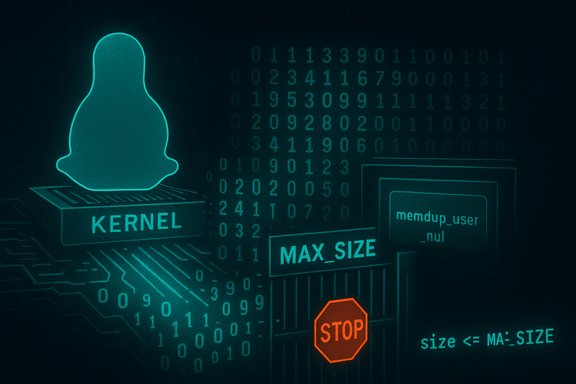
The patch applied upstream is intentionally small and targeted: the proc_write_simdisk handler now checks the parsed input length against an upper bound before calling memdup_user_nul. This prevents attacker-controlled, pathological lengths from reaching the copy helper and eliminates the immediate crash vector. Public trackers and package advisories reference the stable kernel commits that implement the guard and list the fixed package versions where distributors have included the change. Why this is the right fix:- It’s low‑regression — the existing semantics for valid callers are unchanged.
- It converts an implicit “trust user” assumption into an explicit contract: “only lengths ≤ N are accepted.”
- It’s easy to backport to stable kernel branches and vendor kernels, which reduces the time window for vulnerable releases to linger in production images.
Exposure, attack model, and real‑world risk
Attack vector and preconditions
- Vector: Local — the vulnerability requires writing to the specific procfs entry (proc_write_simdisk) exposed by the Xtensa simdisk component.
- Privileges required: Low — an unprivileged local user who can write to the proc entry (or a daemon running as a low‑privilege account) can trigger the code path.
- User interaction: None required beyond being able to execute a write to the proc node (which may be possible in many embedded/dev environments or misconfigured images).
Who should worry most
- Embedded devices and development boards that include Xtensa simulation or kernel components and expose procfs entries to local accounts.
- Build farms, CI/CD runners, test benches, and virtualization environments that mount or run toolchains or images including the vulnerable kernel code.
- Vendor kernels and OEM firmware images where kernel updates are slow or rare — those images can retain the vulnerable handler for long periods.
Detection and verification
Operators need to confirm whether their kernels include the upstream guard. Two practical verification approaches:- Distribution advisories: check your distribution’s security tracker or kernel changelog to identify the package version that includes the stable commit(s) referenced by CVE trackers. Debian’s tracker and OSV entries list fixed package versions for common distributions.
- Kernel source inspection: if you build your own kernels, inspect the Xtensa simdisk proc_write_simdisk implementation in your tree and look for an explicit size bound (a clamp or a check that rejects sizes beyond a defined MAX). If that check is absent, the kernel tree is unpatched. (Note: some public git mirrors may be restricted for automated fetches; if git.kernel.org is inaccessible from your environment, rely on distribution changelogs.
- uname -r and map the running kernel to distribution security advisories.
- Inspect package changelogs (dpkg‑debug, rpm -q --changelog) for upstream commit IDs or CVE mappings.
- If you can reproduce the environment in a lab, attempt to write an obviously invalid value to the simdisk proc entry in a controlled test and watch kernel logs (dmesg/journalctl) for faults — do this only in isolated lab systems. Flag any kernel oops messages for immediate investigation.
Mitigation and remediation guidance
Definitive remediation
- Install a kernel package from your vendor/distribution that includes the upstream fix referenced by CVE‑2025‑40193, and reboot into the patched kernel. Distribution advisories (Debian, Ubuntu, Red Hat, etc. map the upstream commit into specific package releases — use them to identify the correct package version.
- If you produce your own kernels, pull the relevant stable commits into your tree (the public CVE entries reference the commit IDs), rebuild, and deploy across your estate.
Short‑term compensations if you cannot patch immediately
- Restrict access to the proc entry: tighten permissions or use a local policy to prevent unprivileged user writes to the affected procfs node.
- Restrict local code execution: enforce stricter local execution policies (e.g., limit which accounts can run arbitrary build/test jobs), use SELinux/AppArmor policies to block writes to the node, and reduce the attack surface from untrusted processes.
- For multi‑tenant hosts, isolate workloads using stronger namespaces and cgroups so guest or tenant processes cannot access host-level proc nodes.
- Monitor kernel logs for repeated oops or faults tied to simdisk or memdup_user_nul and consider isolating suspect hosts pending patch rollout.
Patching realities: backports, vendor lag, and long tails
This is a classic “small fix, large tail” scenario. The upstream change is small and suitable for stable backports, but embedded, vendor, and OEM kernels often lag upstream by months. The Debian tracker shows the status across many packaged kernels and lists fixed and still‑vulnerable package versions — that mix underscores how some images will remain unpatched for a long time. Operators must therefore:- Prioritize patching for systems that expose untrusted local writers, CI systems, and multi‑tenant hosts.
- Confirm vendor backports: don’t assume a distribution bump implies the upstream commit is present — check changelogs for the actual commit IDs associated with the CVE.
Exploitability and PoC status
At disclosure, public trackers describe the vulnerability as a local denial‑of‑service vector and do not report any confirmed in‑the‑wild exploitation achieving code execution or privilege escalation. The immediate risk is service interruption rather than data exfiltration. That said, any kernel crash in a multi‑tenant context is a high‑value asset to attackers wishing to cause disruption; weaponization is simple for DoS even if escalation to RCE typically requires additional primitives. Use of this flaw in chained attacks cannot be ruled out in principle.Hunting and incident response
- Look for kernel oops traces mentioning memdup_user_nul or stack frames that point to the proc_write_simdisk handler. If a host produces an oops after a suspicious proc write, preserve logs and isolate the host for forensic capture.
- Correlate local job execution, build logs, or cron tasks with crash timelines — automated pipelines that write to proc/sys nodes are a common accidental trigger.
- If you suspect targeted misuse, capture memory and disk images before reboot (where practical) and preserve the offending inputs (the write payload) for analysis in a sandboxed environment.
- After patching, validate by replaying the test case in a controlled lab and confirming the kernel no longer oops for the same malformed input.
Broader lessons and risk management
- Kernel code that accepts user‑controlled lengths must always clamp and validate those lengths. The simdisk fix is another example of an identical defensive pattern applied across subsystems (netdevsim, sysfs/proc handlers, device drivers).
- Small validation fixes have outsized operational value: they avoid crashes, reduce incident volume, and are typically low‑regression and easy to backport.
- The long tail problem remains the dominant operational risk: embedded devices, vendor kernels, and firmware images that are not regularly updated create exposure windows that persist long after upstream fixes exist. Inventory, SBOMs, and firmware rebuild processes are the practical defenses against long‑tail exposure.
Quick prioritized checklist for administrators
- Inventory: Identify hosts that run kernels built from versions prior to the upstream stable commits referenced by CVE‑2025‑40193. Use package changelogs and vendor advisories to map CVE → package → kernel version.
- Test: Stage the updated kernel in a canary ring and verify functionality for workloads that interact with Xtensa simdisk features (if any).
- Deploy: Roll out patched kernels in waves and reboot hosts into the new kernel.
- Mitigate: If immediate patching is impossible, restrict access to the affected proc node and isolate untrusted local execution.
- Monitor: Watch kernel logs for memdup_user_nul or simdisk traces and be prepared to isolate and collect forensic artifacts if crashes recur.
Final assessment: strengths and residual risks
Strengths- The upstream fix is small, targeted, and low‑risk — it implements the standard defensive programming pattern (validate input before copying).
- The change is easy to backport; distributions can (and have) shipped fixes quickly.
- Public trackers and package maintainers have cataloged and mapped the CVE, which helps operators identify and remediate affected kernels.
- The long tail of embedded and OEM kernels: many devices may remain vulnerable until vendors issue updated firmware or images.
- Local‑only vector does not imply low operational impact — multi‑tenant hosts and shared CI systems can be trivially disrupted by a local crash primitive.
- Some claims about specific product inclusion or exploitation status may change rapidly — always verify vendor advisories and package changelogs for the most current remediation status. If a claim cannot be cross‑checked against vendor/distro advisories or canonical CVE pages, treat it cautiously.
CVE‑2025‑40193 is a textbook example of how a single missing size check in a procfs/store handler can translate into a damaging local denial‑of‑service in kernel space — the remedy is straightforward, but the operational work is inventorying, patching, and corralling long‑tail firmware. Operators should treat the vulnerability as high‑value for availability protection: patch quickly where possible, apply compensations while rolling out fixes, and confirm remediation by inspecting kernel changelogs or the patched handler in your kernel tree.
Source: MSRC Security Update Guide - Microsoft Security Response Center
