

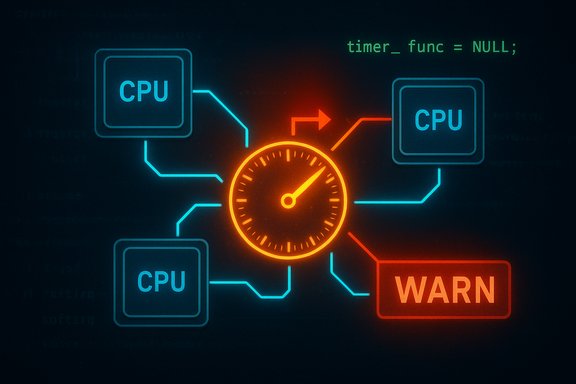
The Linux kernel received a small but important patch that closes CVE-2025-68214 — a race in timer_shutdown_sync that could clear a timer’s function pointer while that timer was still active on another CPU, leaving a pending timer with a NULL callback and triggering a WARN_ON inside expire_timers.
Background / Overview
Kernel timers are a deceptively subtle part of the Linux kernel: they sit between interrupt context, softirq handling, and normal process context and must juggle lifetimes, concurrency, and callback execution without introducing races that can crash or destabilize a system. The vulnerability fixed as CVE-2025-68214 arises from exactly this interplay — a teardown routine clearing the timer’s function pointer unconditionally while another CPU may be executing the timer callback. The result is a pending timer whose function pointer is NULL; the next expiry cycle detects that and trips a WARN_ON, producing kernel warnings or oopses. The upstream fix is intentionally conservative: only clear the timer’s function pointer when the timer is actually being detached, and avoid clearing it merely because shutdown semantics were requested. This preserves the invariant that a running or pending timer has a valid function pointer while leaving the detach path responsible for final cleanup. The change is narrow, has a clear rationale, and was propagated into stable trees and downstream vulnerability databases.The technical anatomy: how the race happens
The actors: timer_shutdown_sync, expire_timers, and running_timer
At the center of this issue are three moving parts:- timer_shutdown_sync — a routine used to synchronously shut down a timer (often called during teardown or module unload).
- expire_timers — the softirq handler that iterates timers and invokes their callback functions when they fire.
- base->running_timer — an internal field used while a timer callback is executing to mark the currently running timer on a timer base.
Plain-language sequence (simplified)
- CPU1: expire_timers sets base->running_timer = timer and runs the callback.
- Meanwhile, CPU0 calls timer_shutdown_sync intending to “shutdown” the timer; the routine clears timer->function = NULL as part of its shutdown steps even if the timer is still running.
- Later, when the timer remains pending and expire_timers executes on some CPU, it sees that the timer’s function pointer is NULL and hits WARN_ON_ONCE(!fn), producing a kernel warning or oops.
Why this matters operationally
- Availability risk: The immediate impact is availability. WARN_ON checks and oopses in expire_timers may not by themselves permit privilege escalation, but kernel warnings and oopses can destabilize systems, crash services, or trigger host reboots in production environments.
- Predictable denial-of-service: The race can be triggered deterministically under the right conditions. For operators running workloads that exercise timers heavily (real-time workloads, embedded systems, or certain drivers), this may be reproducible and thus usable as a Denial‑of‑Service vector.
- Scope and exposure: The bug is in generic timer shutdown code and therefore can affect any kernel build that contains the vulnerable timer implementation and the unpatched shutdown behavior. Downstream distribution packaging and vendor backports determine how broadly systems remain exposed. Public vulnerability mirrors and OSV listings show the CVE published on December 16, 2025 and cross-referenced into vendor trackers.
What changed in the fix
The upstream fix is deliberately minimal and defensive:- Do not clear the timer function pointer unconditionally. The corrected logic only clears timer->function when the timer is actually being detached during shutdown (i.e., when detach_if_pending indicates detachment). If the timer is currently running, the function pointer is left intact so the pending timer remains valid until it is safely detached after the callback completes.
- Preserve lifetime invariants. Leaving the function pointer intact while the timer is running avoids the transient state where expire_timers would encounter a NULL callback and trigger a WARN_ON.
Verification and cross-references
Multiple independent trackers record the same technical root cause and the same remedy:- Public vulnerability aggregation and OSV entries summarize the race and the fix semantics, including published timestamps and downstream references.
- Distribution security pages and CVE mirrors (for example SUSE and CVE details) present the same description and list the upstream commits that contain the fix.
Additionally, the general pattern of timer races and correct shutdown semantics is documented and analyzed in internal operational notes and kernel discussion threads; these describe how incorrectly ordered timer deletes or function-pointer clears have historically produced KASAN reports, WARN_ONs, and kernel oopses. Those artifacts underline why the fix chooses a conservative, lifetime-preserving approach.
Impact assessment and exploitability
- Exploitability: The bug is not a remote code-execution vector as disclosed. It is a race/time-of-check-time-of-use style bug that yields warnings or oopses rather than direct memory corruption exploitable for arbitrary code execution when disclosed. Public trackers currently mark it as an availability issue rather than a privilege escalation or remote RCE.
- Attack surface: Local or adjacent attack vectors — an attacker or misbehaving process capable of instigating timer shutdown sequences or otherwise influencing timer behavior on a target machine — could force the race. On multi‑tenant hosts, untrusted guests or containers that interact with kernel subsystems which register timers are higher-risk.
- Likelihood: Deterministic under some timing windows — not trivial to trigger in every environment but reproducible on kernels and workloads that exercise the offending sequences.
Who should prioritize patching
- Public cloud hypervisors and multi-tenant hosts where an untrusted tenant can cause kernel-level timers to fire or be torn down.
- Embedded appliances and network devices that rely on precise timer semantics and are sensitive to kernel WARNs or oopses.
- Real-time and low-latency systems where timers and softirq interactions are frequently exercised.
- Development or CI environments that run kernel-debug builds (KASAN, debug objects) because these will surface races and WARNs more reliably and may generate noisy failures during test runs.
Practical mitigation and remediation guidance
Primary remediation is straightforward:- Install vendor or distribution kernel updates that include the upstream fix (package updates that reference CVE-2025-68214 or the stable commit IDs).
- Reboot into the patched kernel to ensure the fixed code is active.
- Inventory: enumerate kernel versions (uname -r) and confirm whether installed packages include the upstream commit or reference CVE-2025-68214 in their changelog.
- Pilot: apply updates to a small pilot group of hosts, exercise representative timer-heavy workloads and driver stacks, and monitor kernel logs for WARN_ON traces.
- Staged rollout: deploy to production in waves with monitoring windows and rollback plans.
- Post-deploy monitoring: watch kernel logs (journalctl -k or dmesg) for WARN_ON_ONCE(!fn) or call traces referencing expire_timers or timer_shutdown_sync for 7–14 days after deployment.
- Avoid running untrusted guests or workloads on vulnerable hosts.
- Constrain driver-module loading/unloading operations in maintenance windows.
- If feasible for test/non-production environments, reproduce the timing window to verify mitigations or to harden watchdog/monitoring rules. Note: such workarounds are brittle and not substitutes for installing a patched kernel.
Detection, hunting, and forensics
Look for these signatures in host logs or monitoring pipelines:- Kernel WARN_ON traces that reference expire_timers, timer_shutdown_sync, call_timer_fn, or a WARN_ON_ONCE(!fn) check.
- Softirq-related backtraces with frames in timer expiry paths.
- Repeated oopses correlated with driver/module teardown or timer shutdown events.
- journalctl -k | egrep -i 'expire_timers|timer_shutdown_sync|WARN_ON|call_timer_fn'
- dmesg | grep -i 'WARN_ON_ONCE'
Critical analysis: strengths of the fix and remaining caveats
Strengths
- Surgical nature: The upstream patch is minimal and targeted at the incorrect clearing of the function pointer. Minimal changes reduce regression risk and simplify backports.
- Preserves invariants: The fix preserves the invariant that a pending or running timer must have a valid function pointer, restoring the kernel’s assumptions rather than adding complex synchronization.
- Easy to verify: The presence of the fix can be verified by matching commit IDs in kernel changelogs or vendor package notes, making distribution validation straightforward.
Caveats and residual risks
- Backport timing: Some vendors and embedded vendors take longer to backport fixes; long‑tail exposures remain possible in vendor kernels that lag upstream.
- Related timer races: The kernel contains many timer-related code paths. Fixing this specific hazard does not eliminate other timer lifetime or concurrency issues that may exist in drivers or subsystems. System integrators should remain vigilant.
- False sense of security: Because the fix addresses WARN_ON conditions (availability), teams might deprioritize updates compared with memory-corruption or RCE fixes. However, availability losses in production — especially on hypervisors — can be as damaging as other classes of bugs.
- Testing surface: Real-time or heavily loaded systems should be carefully tested after applying updates; the minimal change is unlikely to cause regressions, but timing-sensitive systems merit careful validation.
Developer recommendations (longer-term)
To reduce similar classes of bugs in future releases, kernel and driver authors should:- Avoid clearing function pointers or other callback references before confirming a timer or worker is detached; prefer detach semantics that guarantee nobody will call into freed function pointers.
- Use canonical shutdown patterns (e.g., detach_if_pending, cancel_work_sync, timer_shutdown_sync semantics) consistently and document invariants in the code.
- Where possible, prefer explicit reference-counting or RCU read-side protection around structures that own timers so that the outer object cannot be freed while a timer callback might still run. This reduces the need for brittle timing assumptions.
- Add dedicated unit or integration tests that exercise shutdown and teardown paths under concurrency (stress harnesses, syzbot-style fuzzing, and KASAN-enabled CI) to detect races early. Internal kernel history and public advisories show KASAN and syzbot often reveal these timing races before field incidents occur.
Timeline and disclosure notes
- CVE-2025-68214 was published in mid-December 2025; public vulnerability trackers and OSV entries recorded the issue and referenced upstream stable commits that implement the fix. Distributors and vendors are mapping the patch into their stable kernels and backports as part of normal CVE workflows.
- The upstream decision to make a narrow fix rather than a heavy redesign is consistent with prior kernel practice: correct the invariant violation and ship a small, testable patch into stable trees so downstream vendors can backport reliably.
Conclusion
CVE-2025-68214 is a reminder that timers are runtime invariants, not merely helper utilities. Minor-seeming operations — like clearing a function pointer during shutdown — can create a small window where kernel invariants are violated and WARN_ONs or oopses occur. The upstream fix is conservative, correct, and low-risk: do not clear the timer’s function pointer unless the timer is being detached. Operators running kernels that may host untrusted workloads or that exercise timers heavily should prioritize vendor-supplied kernel updates, verify backports against upstream commits, and monitor kernel logs for the characteristic traces described above. In environments where immediate patching is impossible, short-term mitigations and stricter workload segregation reduce exposure, but the only reliable mitigation is to apply the patched kernel and reboot into it.Source: MSRC Security Update Guide - Microsoft Security Response Center
