

A straightforward but dangerous null-pointer oversight in the Linux kernel’s FPGA test code — tracked as CVE‑2025‑38274 and disclosed in July 2025 — has been patched upstream after maintainers confirmed that the fpga_mgr_test_img_load_sgt() helper can pass a NULL pointer into sg_alloc_table(), producing a kernel NULL dereference that results in an immediate denial‑of‑service when triggered.
The vulnerability centers on a test-oriented FPGA manager helper found under the kernel’s FPGA test code. The vulnerable function allocates memory for a scatter‑gather table (sgt) using a KUnit allocation helper but fails to verify that the allocation succeeded before passing the pointer into sg_alloc_table(), which ultimately invokes memset() on the target buffer. If the allocation fails, that memset() will be invoked on a NULL pointer and the kernel will typically hit an oops or panic.
This is an availability‑first defect: exploitation yields a reliable local crash of kernel code — a classic null pointer dereference — rather than a data leak or straightforward remote code execution. Public trackers and vulnerability databases published the CVE in July 2025 and record the upstream fix: add an explicit allocation check (the patch uses a KUnit assertion macro to validate the returned pointer) so that the NULL case is handled before control flows into sg_alloc_table().
Although the bug is tiny in code size, its operational impact is clear: anywhere the vulnerable test helper exists and can be reached by an attacker with local access, a trivial trigger can produce immediate, repeatable denial‑of‑service for the host.
Key operational consequences:
Why this pattern is surprisingly common and still dangerous
This patch was accepted into the upstream kernel trees and is the canonical fix. Distributors and vendors are expected to backport the change into their stable kernel tracks and publish fixed package versions; many tracker feeds and advisories note the relevant stable commit IDs and reference backports for supported kernels.
Administrators should consult their vendor’s kernel-security advisory or package changelog to confirm whether the fix has been backported into the exact kernel package their systems run. If a vendor package is not yet available, operators should weigh mitigations or temporary controls until a patched package is installed.
Two practical inventory checks:
Caveat: Because vendor kernels can be heavily patched or backported, mere presence of a file path does not necessarily prove the vulnerable code is present — check the vendor changelog and applied patch lists to confirm the presence or absence of the fix.
If your fleet includes kernels built with testing scaffolding or KUnit support, or if you run images that might include test drivers, treat this CVE as a high‑priority availability risk: inventory affected artifacts now, apply vendor patches as soon as they’re available, and implement temporary mitigations (blacklisting modules, restricting device access, and monitoring kernel logs) until your patch window is complete. Small code defects like this one are simple to fix — but they are also simple for an attacker with local access to weaponize, so rapid, evidence‑driven remediation matters.
Source: MSRC Security Update Guide - Microsoft Security Response Center
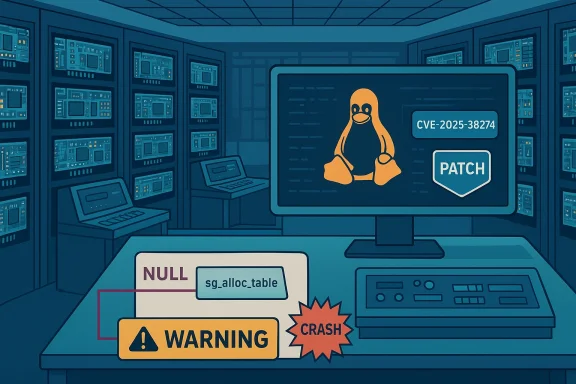 Background / Overview
The vulnerability centers on a test-oriented FPGA manager helper found under the kernel’s FPGA test code. The vulnerable function allocates memory for a scatter‑gather table (sgt) using a KUnit allocation helper but fails to verify that the allocation succeeded before passing the pointer into sg_alloc_table(), which ultimately invokes memset() on the target buffer. If the allocation fails, that memset() will be invoked on a NULL pointer and the kernel will typically hit an oops or panic.This is an availability‑first defect: exploitation yields a reliable local crash of kernel code — a classic null pointer dereference — rather than a data leak or straightforward remote code execution. Public trackers and vulnerability databases published the CVE in July 2025 and record the upstream fix: add an explicit allocation check (the patch uses a KUnit assertion macro to validate the returned pointer) so that the NULL case is handled before control flows into sg_alloc_table().
Although the bug is tiny in code size, its operational impact is clear: anywhere the vulnerable test helper exists and can be reached by an attacker with local access, a trivial trigger can produce immediate, repeatable denial‑of‑service for the host.
Why this matters: availability at kernel level is escalation of operational risk
A kernel NULL pointer dereference is not a subtle failure — it is a crash that typically kills the current kernel thread, often prints a backtrace or oops report, and in some configurations can panic the entire system. For servers, embedded appliances, or multi‑tenant hosts, the result is immediate operational pain: service interruption, forced reboots, or manual intervention to recover.Key operational consequences:
- Immediate DoS: A local attacker can cause the kernel to fault; if that kernel thread is central to a subsystem or device, the outage can cascade to service loss.
- Repeatability: The same trigger can be invoked repeatedly to keep systems unavailable.
- Inventory complexity: Whether a host is vulnerable depends on kernel configuration (what test drivers are compiled in), the presence of KUnit or test modules, and vendor backports — meaning simple version checks alone may not be sufficient to determine exposure.
- Patchability tradeoffs: The upstream fix is small and low risk, but rolling it into production kernels requires distribution- or vendor‑level backports and validation; until those are installed, many systems could remain exposed.
Technical anatomy: what exactly goes wrong
At a high level, the defective sequence follows this pattern:- The helper fpga_mgr_test_img_load_sgt() needs a scatter‑gather table (sgt) structure to manage a test image’s memory mapping.
- It calls a KUnit allocator (a testing‑time allocator wrapper) such as kunit_kzalloc() to reserve that structure.
- The code did not verify the allocation result. It then calls sg_alloc_table() with the pointer (sgt) as an argument.
- Internally, __sg_alloc_table() will attempt to zero the table memory via memset(). If the pointer was NULL, the memset() becomes a NULL pointer dereference.
- The kernel hits a fault and emits an oops/panic trace.
Why this pattern is surprisingly common and still dangerous
- Allocation helpers may return NULL on memory pressure or unusual test harness environments; defensive checks are mandatory in kernel code.
- The vulnerable code lives under a tests directory; developers sometimes assume test-only code is less risky — but shipped kernels and vendor builds can and do include test scaffolding depending on how they were built. This makes exposure dependent on build-time choices and vendor backports, not just upstream version numbers.
- The remedy is trivial and low‑risk, which is why maintainers accepted the correction quickly; still, the operational step of getting patched kernels into production remains the heavy lift.
Scope: who is actually affected?
Exposure depends on multiple factors. The most relevant are:- Kernel configuration: the vulnerable code is in the FPGA test helper path. If a kernel image is built without the test driver or KUnit test harness support, that kernel will not expose the vulnerable code path.
- Module presence: in some builds the FPGA test code may be compiled as a loadable module; in those cases, modules not loaded by default reduce exposure unless an attacker can load them.
- Local access: the attack vector is local. An adversary needs the ability to trigger the test helper (for example, by running kernel tests, exercising a test device, or otherwise calling into the driver).
- Distribution and vendor backports: maintainers in major distributions frequently cherry‑pick small defensive fixes into supported kernel branches. Whether your distro and kernel series include the correction is the key operational question.
- Developer machines and CI runners that use kernels compiled with testing helpers or KUnit enabled.
- Appliance or OEM builds where upstream test code was inadvertently included.
- Systems where unprivileged local users can interact with device nodes or trigger module load behavior related to FPGA test interfaces.
- Cloud images and virtualized guests that expose kernel modules for device passthrough or testing.
Proof and patch provenance
Upstream maintainers committed a narrow change to ensure the KUnit allocation is checked before use. The public CVE entries and vulnerability trackers describe the same remediation: check the result of kunit_kzalloc() (or use KUNIT_ASSERT_NOT_ERR_OR_NULL()) and avoid calling sg_alloc_table() with a NULL pointer.This patch was accepted into the upstream kernel trees and is the canonical fix. Distributors and vendors are expected to backport the change into their stable kernel tracks and publish fixed package versions; many tracker feeds and advisories note the relevant stable commit IDs and reference backports for supported kernels.
Administrators should consult their vendor’s kernel-security advisory or package changelog to confirm whether the fix has been backported into the exact kernel package their systems run. If a vendor package is not yet available, operators should weigh mitigations or temporary controls until a patched package is installed.
Exploitability and attacker model
Exploitability is straightforward in the local attacker model:- Attack vector: Local (AV:L). The attacker must have local code execution or an account capable of interacting with kernel test interfaces or device nodes.
- Complexity: Low. The bug is a NULL dereference that can be triggered by simply causing the allocation to fail and calling the function with the resulting NULL — a trivial programming oversight that yields a deterministic fault in many contexts.
- Privileges required: Low — an unprivileged local user might be sufficient, depending on the device node permissions and module load settings.
- Impact: Availability (A:H). The crash is immediate and can be repeated to sustain denial‑of‑service.
Detection: how to discover vulnerable systems in your estate
Because exposure is build‑ and packaging‑dependent, detection requires artifact inspection and runtime checks.Two practical inventory checks:
- Inspect kernel configuration:
- On Linux hosts, check /boot/config-$(uname -r) (or packaged kernel config) for options that indicate FPGA drivers, KUnit, or test helper build options. Search for entries referencing FPGA, KUNIT, or test drivers in drivers/fpga/tests.
- Inspect kernel modules and installed drivers:
- Look in /lib/modules/$(uname -r)/kernel/drivers/fpga for test‑related modules or object files.
- Use modinfo or lsmod to check for loaded FPGA test modules. If the code is present as a module but not loaded, record the module name and prevent loading until patched.
- Kernel oops or BUG traces showing a memset() on a NULL pointer within sg_alloc_table() or a backtrace that references fpga_mgr_test_img_load_sgt() are clear signatures of hitting this code path.
- Repeated unexplained kernel crashes during test runs or when exercising FPGA test interfaces are red flags.
Caveat: Because vendor kernels can be heavily patched or backported, mere presence of a file path does not necessarily prove the vulnerable code is present — check the vendor changelog and applied patch lists to confirm the presence or absence of the fix.
Mitigations and immediate actions for administrators
Short term (immediate, minimal disruption):- Inventory and isolate:
- Identify hosts whose kernel images include FPGA test code or KUnit test harness features.
- Isolate any hosts that are multi‑tenant, run untrusted workloads, or expose device nodes to non‑trusted users until they’re patched.
- Restrict access:
- Harden permissions on device nodes that could invoke FPGA manager test paths.
- Use module blacklisting if the test code is built as a loadable module and if blacklisting is supported in your environment. This prevents accidental or malicious module loading until a patch is applied.
- Monitor kernel logs:
- Enable and watch system logs for kernel oopses referencing sg_alloc_table(), memset on NULL, or explicit traces to fpga_mgr_test_img_load_sgt().
- Configure alerting in your monitoring stack for repeated kernel oops events.
- Apply vendor patches:
- Prioritize kernel package updates that include the upstream fix. Contact your distribution or vendor to obtain backported kernel updates if they are not yet available in the standard repos.
- For managed cloud images, check the vendor’s advisory and update images or instances per their guidance.
- Rebuild or reconfigure:
- Where vendors are slow to backport and you build your own kernels, apply the upstream commit into your internal kernel trees and rebuild, taking care to validate and test the new kernel before deployment.
- Consider rebuilding production images with test drivers disabled unless you explicitly require them for your workloads.
- Hardening and process improvements:
- Strengthen build pipelines to exclude test-only code from production kernels by default.
- Add checks in CI to detect presence of test drivers in release artifacts.
- Treat KUnit-test helpers and test-only scaffolding as sensitive artifacts that shouldn't be present in production images without review.
- Audit all allocation calls in kernel code for missing NULL checks; small defensive fixes consistently prevent a large class of availability bugs.
- Add tests that simulate allocation failure for test harness code paths and validate defensive behavior.
How to prioritize this CVE in your patch window
Prioritization should be driven by exposure and operational risk:- High priority
- Hosts that run production multi‑tenant workloads and that include FPGA test code or allow unprivileged module load.
- Devices and appliances with remote management interfaces that may let untrusted actors trigger local test code.
- CI or build infrastructure where untrusted inputs could be elevated to actions that trigger kernel test helpers.
- Medium priority
- Developer and engineering workstations where test code is present but only trusted users have access. Patch in regular cadence.
- Single‑tenant servers that run internal services but do not expose unprivileged local access to untrusted users.
- Lower priority
- Hosts whose kernels are built specifically without FPGA test code and where artifact scans confirm absence of the vulnerable path. Still perform an explicit verification — absence of an MSRC attestation or CVE mention for a vendor artifact is not proof of absence.
For cloud and managed‑image operators
If you publish or consume prebuilt images:- Confirm whether your published images include the vulnerable test driver and whether the vendor or upstream has published a backport.
- For cloud operators, consult your image supply chain and vendor advisories — the presence of a single vulnerable artifact in a marketplace image or appliance may mean many customer instances are exposed.
- If you manage images for customers, notify image consumers, update images promptly, and provide migration guidance for existing instances.
Developer analysis: why the fix is correct and low risk
The upstream remediation — check the result of the KUnit allocation helper and fail gracefully instead of calling sg_alloc_table() with NULL — is a textbook defensive correction. It narrows the attack surface without technological rework of the FPGA subsystem. Key reasons this approach is safe:- It restores correct error-path semantics: if an allocation fails, the function should not continue as if the allocation succeeded.
- The change is localized to the allocation check, minimizing regression risk.
- The fix is amenable to stable-tree backporting, so distribution maintainers can merge it into supported releases with a straightforward review and test cycle.
Caveats and unverifiable points you should check in your environment
A few items cannot be universally asserted without inspection:- Whether a given distribution’s shipped kernel includes the specific vulnerable file in the compiled image depends on build configuration and on vendor backports. Do not assume vulnerability or non‑vulnerability solely from upstream CVE text; verify package-level changelogs and applied patches for your distribution.
- The exact module name and the ways to trigger the helper vary by build; use artifact inspection and log correlation rather than assumed module names.
- Public exploit telemetry for this CVE is limited; absence of PoC code does not mean exploitation risk is negligible for local attackers in hostile or shared environments.
Practical checklist: actions to take right now
- Inventory:
- Search /lib/modules/$(uname -r)/kernel/drivers/fpga and your package assets for drivers/fpga/tests.
- Inspect /boot/config-$(uname -r) for test/KUnit/fpga-related build flags.
- If you find the driver:
- Plan for an immediate kernel package update; consult your distro/vendor security advisory.
- If you cannot update quickly, block module load for the offending module and restrict unprivileged device node access.
- Monitoring:
- Add alerting for kernel oopses that reference memset() on NULL or backtraces naming sg_alloc_table() / fpga_mgr_test_img_load_sgt().
- Correlate any repeated crashes to recent local test runs, module loads, or unprivileged activity.
- Communication:
- Notify your SRE/security teams and document which images and hosts are vulnerable.
- For cloud operators, publish image‑level guidance to customers and update affected images.
Conclusion
CVE‑2025‑38274 is a small, easily fixed kernel defect with an outsized potential for operational disruption in environments where the vulnerable FPGA test helper exists and is reachable. The technical root cause — a missing NULL check after a KUnit allocation — is trivial to remedy, and upstream maintainers applied a narrow, low‑risk fix. The hard work for operators is not the code change itself but the usual operational tasks: discovering which artifacts carry the vulnerable code, obtaining vendor or distribution backports, and safely rolling updated kernels into production.If your fleet includes kernels built with testing scaffolding or KUnit support, or if you run images that might include test drivers, treat this CVE as a high‑priority availability risk: inventory affected artifacts now, apply vendor patches as soon as they’re available, and implement temporary mitigations (blacklisting modules, restricting device access, and monitoring kernel logs) until your patch window is complete. Small code defects like this one are simple to fix — but they are also simple for an attacker with local access to weaponize, so rapid, evidence‑driven remediation matters.
Source: MSRC Security Update Guide - Microsoft Security Response Center
