

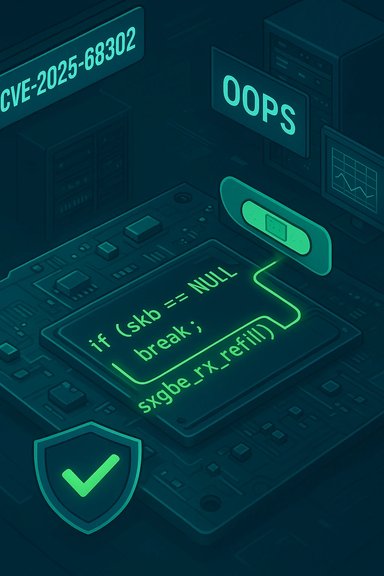
The Linux kernel received a small but important defensive patch addressing a potential NULL-pointer dereference in the Samsung SXGBE Ethernet driver’s receive path — tracked as CVE‑2025‑68302 — that can cause a kernel oops when the driver attempts to dereference a NULL skb (socket buffer). The change is intentionally minimal (add a control-flow break to route the error case to the existing refill logic) and has been recorded in upstream stable branches and picked up by distributors; operators should treat this as an availability risk and apply vendor-supplied kernel updates or temporary mitigations on affected hosts as soon as feasible.
Actions for mixed estates:
However, operational friction comes from:
Source: MSRC Security Update Guide - Microsoft Security Response Center
 Background
What was disclosed
The issue is a classic null pointer dereference in the SXGBE driver’s receive routine sxgbe_rx: when the driver’s logic encounters a NULL skb it logs an error but then proceeds to use (dereference) the skb on the very next line. The upstream fix changes the control flow so the code stops processing and transitions to the refill path (sxgbe_rx_refill rather than touching the NULL pointer. The defect was discovered during code review and recorded publicly on December 16, 2025 under CVE‑2025‑68302.Why this matters
A NULL dereference in kernel space typically produces an OOPS (kernel fault) or panic. That’s an availability problem: a crashed kernel disrupts services, can trigger automated reboots or failover actions, and complicates forensic collection because ephemeral logs may be lost on reboot. Because the attack vector is local and the bug is limited to crashing the kernel rather than producing memory-corruption primitives, the practical risk is denial‑of‑service rather than data disclosure or remote code execution. Several trackers and vendors rate the issue as medium (commonly CVSSv3 ≈ 5.5) and classify the vector as local with an availability impact.Overview: what the SXGBE driver is and where it runs
The driver
SXGBE is the Linux in-tree driver for the Samsung SXGBE Ethernet IP block (often configured via CONFIG_SXGBE_ETH); when compiled as a module it appears as samsung-sxgbe. It’s used across SoC and embedded platforms from Samsung and may be present in server and embedded images compiled for those boards.Typical exposure scenarios
- Embedded devices and appliances built on Samsung SoCs that include the driver in their kernel image.
- Distribution kernels that include the SXGBE driver (desktop, server or IoT images).
- Virtual machines or containers using images that include the driver (for example vendor-supplied cloud images or custom appliance images).
Inventory is the first step: whether the driver is present depends on how your kernels were built (module vs built‑in) and whether the platform uses the Samsung NIC IP.
Technical analysis
The faulty pattern
The vulnerable code path is straightforward: a receive routine checks for a condition where the skb pointer may be NULL and logs an error message, but then the very next statement dereferences skb anyway. That single missing control-flow exit converts a handled error into a kernel crash. This class of defect is common across NIC drivers and is typically fixed by one of two patterns: explicitly return or break out of the receive loop when skb is NULL, or add a robust NULL-check before any dereference. The SXGBE patch uses the former pattern — add abreak so processing flows to the refill logic already used by peer drivers. The upstream fix
Upstream maintainers applied a tiny, surgical change that prevents the erroneous dereference by short-circuiting the path whenskb == NULL. The fix is consistent with how other drivers handle the same corner case (for example xgmac_rx in some calxeda drivers) and is present in stable kernel commits that have since been tracked by distributors. Where upstream practice favors minimal diffs, the patch reduces regression risk and makes vendor backports straightforward. Public vulnerability databases and package trackers list the kernel commit ranges and stable backports that include the fix. On exploitability and impact
- Attack vector: Local — an attacker must be able to run code or otherwise exercise the driver’s receive path on the host (unprivileged process, untrusted container or local tenant).
- Privileges: Low — many local operations that interact with NIC stacks or inject traffic can be performed without elevated privileges in some environments.
- Impact: Availability — kernel OOPS or panic leading to a crash or service interruption.
- Remote exploitation: there is no public proof that this bug can be triggered remotely without local access; public trackers label it a local DoS risk rather than a remote RCE.
Affected kernels, distributions and commit traces
What to look for in vendor trackers
Distributors have already mapped the CVE to package versions and upstream commit IDs. For example, Debian’s security tracker lists fixed versions (for example 5.10.247-1 in bullseye-security and fixed entries in unstable) and maps the upstream commits to kernel package updates you can use to identify whether a host is patched. SUSE and other vendors similarly list the issue and classify it as moderate (CVSSv3 ≈ 5.5).Kernel commits and references
Multiple vulnerability aggregators reference a set of stable commits on kernel.org that contain the fix; those commits are used by maintainers to create backports into stable branches. Public databases list these kernel.org commit IDs (they’re referenced by the CVE metadata), but direct fetching of certain raw commit pages may be blocked or rate-limited depending on your access — the summaries and distribution mappings remain authoritative for operational patching. If you require the exact commit diff, consult your distribution’s changelog or the kernel stable tree via git.kernel.org or your vendor’s advisory. Note: the kernel commit list is referenced by trackers such as CVEDetails/OSV and by distributors; if you need to validate a packaged kernel against the upstream fix, look for the commit IDs listed in those advisories.Detection and triage: what to hunt for
Immediate indicators
- Kernel logs (dmesg or journalctl -k) containing:
- “NULL pointer dereference”
- “kernel oops”
- stack frames mentioning samsung-sxgbe, sxgbe_rx, or similar symbols.
- Repeated network interface failures or host reboots correlated with traffic bursts on Samsung-based NICs.
Quick triage commands
- Check for module presence:
- lsmod | egrep -i 'sxgbe|samsung'
- modinfo samsung-sxgbe
- Confirm kernel version and package changelog:
- uname -a
- apt changelog linux-image-$(uname -r) (Debian/Ubuntu) or rpm -q --changelog kernel (RHEL/SUSE variants)
- Search dmesg for oops traces:
- dmesg | egrep -i 'NULL pointer dereference|sxgbe|samsung-sxgbe|sxgbe_rx'
- journalctl -k --no-pager | egrep -i 'sxgbe|NULL pointer dereference'
Remediation and mitigation
Definitive fix — apply patched kernels
- Identify affected hosts that load the samsung-sxgbe driver; prioritize systems where the driver is built into the running kernel or loaded as a module.
- Apply your distribution or vendor kernel update that explicitly lists CVE‑2025‑68302 or includes the upstream stable commit(s) referenced in vendor advisories.
- Reboot into the updated kernel.
Short-term mitigations for risk reduction
If you cannot apply a kernel update immediately, consider temporary mitigations (test first — these actions may impact networking and services):- Unload or blacklist the module on hosts that do not need the physical NIC functionality provided by SXGBE:
- echo "blacklist samsung-sxgbe" > /etc/modprobe.d/blacklist-sxgbe.conf
- rmmod samsung-sxgbe
Note: removing the module will cause the NIC to stop functioning and will disrupt traffic; only use on non-production or isolated systems or where NIC redundancy exists. - If the driver is built-in (not modular), temporary mitigation is limited to host isolation or moving workloads to patched hosts.
Operational checklist
- Inventory: list hosts that have the driver present, including VMs and container images that may include it.
- Patch testing: boot patched kernels in a test network prior to wide deployment, monitor NIC behavior under representative workloads.
- Monitoring: add dmesg/journal watch rules to detect OOPS traces and automate alerting.
- Backport awareness: embedded vendors and appliance suppliers sometimes backport fixes to OEM kernels; check vendor advisories for their timelines and packages.
Practical guidance for Windows-dominant environments
Many Windows environments still host Linux elements: VMs, guest appliances, WSL instances, and edge appliances. Treat CVE‑2025‑68302 as a cross-platform operational risk because a Linux kernel crash in a VM or appliance can interrupt Windows-hosted services, monitoring, or automation tied to that image.Actions for mixed estates:
- Include Linux kernel packages and appliance images in your asset inventory and vulnerability management scans.
- Prioritize update pipelines for images that run on Windows hypervisors, cloud hosts, or management hosts.
- If appliance vendors supply the kernels (firmware/kernel images), track their advisories for backported patches.
Why small kernel fixes matter — and when to act fast
Small, surgical kernel fixes like this one are low-risk to apply but can have high operational value: they close a deterministic crash path without changing functionality. Because the fix is tiny and clearly defensive (add a break or NULL check), maintainers have accepted and backported it widely, making vendor updates the right remediation path.However, operational friction comes from:
- Embedded and OEM kernels that may lag upstream backports.
- Hosts where the driver is built into the kernel (requires full-image update and reboot).
- Multi‑tenant or cloud hosts where local DoS primitives can be weaponized by co-tenants.
Final recommendations (concise)
- Inventory immediately: find hosts with samsung-sxgbe (lsmod/modinfo/grep in image builds).
- Patch: deploy vendor/distribution kernels that include the upstream stable commits referenced for CVE‑2025‑68302. Confirm the package changelog lists the CVE or the upstream commit IDs.
- Temporary mitigation: if patching is not immediately possible and the NIC is non-essential, consider blacklisting/unloading the module as a stopgap. Test first.
- Monitor: add kernel OOPS/dmesg alerts for sxgbe symbols and NULL pointer traces; preserve logs/cores when a crash occurs.
- Review vendor images: embedded appliances and OEM kernels often lag — contact vendors or check their security advisories for backports.
Closing analysis — strengths and residual risks
The positive points:- The fix is tiny, conservative and easy to backport; upstream maintainers prefer this style of patch, which lowers regression risk.
- Public trackers and distributors have rapidly ingested the CVE and produced package mappings, enabling straightforward remediation for most environments.
- Vendor/OEM kernels or long-tail embedded images may lag — those devices often remain exposed for extended windows.
- Local attackers or misconfigured tenants in multi‑tenant hosts can weaponize kernel DoS primitives for disruption even without a public exploit for remote compromise.
- Some commit pages and raw diffs may be subject to access controls or temporary fetch limitations; when precise upstream diffs are required for advanced validation, rely on distribution changelogs or the kernel stable tree via authenticated or permitted access. (In other words, the patch content is well-documented by distributors and aggregators, but direct raw commit retrieval may sometimes be blocked by hosting restrictions.
Source: MSRC Security Update Guide - Microsoft Security Response Center
