

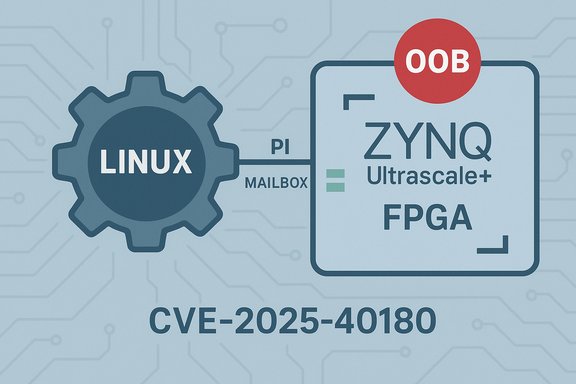
The Linux kernel has been updated to close CVE-2025-40180, a local vulnerability in the Xilinx ZynqMP IPI mailbox driver where a cleanup loop started at the wrong array index and could read or write past the end of an allocated array — a classic out‑of‑bounds access that maintainers fixed with a small, surgical bounds correction in the driver code.
Background
The Zynq UltraScale+ MPSoC family (and related Versal devices) includes an Inter‑Processor Interrupt (IPI) mailbox mechanism used for short, trusted messages between processors and firmware components. In Linux this functionality is exposed via the zynqmp‑ipi mailbox driver (module name zynqmp‑ipi‑mailbox), which is present in many upstream kernels where Xilinx/AMD SoC support is enabled. The driver is used to place messages into protected buffers and to kick the remote agent via interrupt registers; it is compiled into distributions where CONFIG_ARCH_ZYNQMP and mailbox support are enabled. Upstream reporting and vulnerability databases catalog the issue as CVE‑2025‑40180 with a concise description: the cleanup loop in the mailbox driver started at the wrong index for a zero‑indexed array, allowing an access past the array bounds. The NVD entry and multiple vulnerability trackers list the kernel commits that close the defect and link back to the stable kernel patch set.What exactly went wrong
At a technical level, the bug is an indexing error in a cleanup loop. The driver maintained an array that tracks mailbox resources (message buffer descriptors, IRQ entries or similar bookkeeping structures). On teardown/unbind the driver iterated that array to free resources. Because the loop initiated at an incorrect index for a zero‑based array, the loop could step beyond the last valid element and attempt to clean or reference memory outside the allocated structure.This is a bounds‑check error — not a subtle heap metadata corruption or complex allocator bug — but in kernel space even a single out‑of‑bounds read or write can cause:
- Kernel oops/panic and system instability (availability impact).
- Corruption of adjacent kernel structures (possible integrity impact).
- In particular alignments and allocation patterns, an out‑of‑bounds write may be more serious and could in theory be chained to privilege escalation, though no public proof‑of‑concept for such an escalation has been published for this CVE at disclosure.
Who and what is affected
Affected code lives in drivers/mailbox/zynqmp‑ipi‑mailbox.c in the upstream kernel sources. The driver is compiled on kernels that enable ZynqMP architecture support and mailbox hardware support; that covers mainstream Linux kernel series where Zynq/Versal support appears (various 5.x and 6.x branches as shown in the kernel configuration database). In practical terms:- Embedded appliances, OEM images and SoC distributions that ship vendor kernels for ZynqMP/Versal hardware are the primary population at risk. These devices often run vendor‑maintained kernel trees and can lag upstream fixes.
- Development boards and gateways using Zynq UltraScale+ (for example in industrial, networking or edge computing roles) are in scope when the kernel includes the zynqmp‑ipi mailbox driver.
Severity, exploitability and real‑world risk
Key, verified points:- Attack vector: local. The vulnerable path is reached on driver teardown/unbind flows; an attacker generally needs local access to invoke the driver paths or be able to cause device unbind events. Multiple trackers mark the vector as local and the complexity as low.
- Primary impact: availability. The most immediate outcome is a kernel oops or panic due to an OOB access; kernel instability and forced reboots are realistic. Several vendors classify availability and integrity impacts as non‑trivial in their CVSS assessment.
- Public exploit code: not observed at disclosure. There is no authoritative public proof‑of‑concept demonstrating privilege escalation or remote code execution stemming from this specific off‑by‑one in zynqmp‑ipi; published advisories treat the issue as an operational DoS or potential kernel memory corruption vector rather than a reliable RCE path. That said, out‑of‑bounds writes in privileged kernel code are high‑value primitives for attackers who already have local footholds. Exercise caution and prioritize remediation based on exposure.
Upstream patch and how it was fixed
Upstream maintainers accepted a minimal patch that corrects the loop index to respect standard zero‑based indexing and/or adds explicit ARRAY_SIZE bounds checks before indexing. The fix is conservative and intentionally narrow — kernel maintainers prefer this approach because it reduces regression risk while eliminating the immediate memory safety hazard.A few public project commits and logs show the change set and the contributor authoring the cleanup. Vendor trees and kernel logs show small diffs — one or two lines changed — consistent with a single incorrect loop index. Maintainers then propagated the change into stable‑tree backports so distributions could pick it up without invasive rework. This style of corrective change is consistent with many kernel bug fixes where a sentinel or index assumption was violated; maintainers often replace implicit sentinels with explicit bound checks to ensure safety under malformed inputs or unexpected state. For context on that pattern, see analogous defensive fixes in other kernel subsystems where array iteration used a sentinel rather than an explicit bounds guard.
How to confirm whether your systems are vulnerable or patched
- Inventory devices and kernels:
- Identify machines that run on Xilinx ZynqMP / Versal hardware, or that use vendor kernels built for those platforms.
- Check whether the kernel configuration includes CONFIG_ZYNQMP_IPI_MBOX / the module zynqmp‑ipi‑mailbox. Many upstream kernel configurations and driver databases document where the driver is present.
- Map kernel package to upstream commit:
- The definitive check is to match your packaged kernel’s changelog or git commit list to the upstream stable commit(s) that fix CVE‑2025‑40180. Advisories and OSV entries list the kernel commit references; confirm those commit IDs appear in your distribution’s kernel package changelog.
- Runtime signs of vulnerability:
- Look for kernel oops, panic or dmesg traces related to zynqmp‑ipi or mailbox cleanup during driver unload/unbind operations.
- If you can safely reproduce a driver unbind (for example in a controlled lab or testboard environment), wrap the operation in kernel logging capture (journalctl -k / dmesg) and check for OOB‑related stack traces.
- Verify presence of fix:
- Confirm the package changelog or vendor advisory explicitly references CVE‑2025‑40180 or the upstream commit hashes. Vendors tend to list either the CVE or the upstream stable commit in package notes.
Remediation and mitigation steps
Priority remediation is to install vendor or distribution kernel updates that contain the upstream fix and to reboot into the patched kernel.Short‑term mitigations for environments that cannot immediately patch:
- Restrict access to the device nodes and management interfaces that can cause the mailbox driver to unbind or to be exercised by unprivileged processes. Use file permissions, udev rules, SELinux/AppArmor policies or container capability restrictions to limit who can trigger the relevant ioctls or device events.
- For development/test systems, avoid automated or untrusted scripts that manipulate IPI/remoteproc device nodes until a patched kernel is installed.
- In extreme cases where an unpatched kernel must remain in use, consider blacklisting or unloading the zynqmp‑ipi module on systems that do not require it. This is a blunt control and may break legitimate cross‑processor communication; apply with care and test.
- Identify impacted hosts (inventory ZynqMP/Versal hosts).
- Check for the kernel package that contains the zynqmp‑ipi driver and map to upstream commit IDs.
- Obtain vendor patches or updated kernel packages that list CVE‑2025‑40180 or contain the upstream commit.
- Stage and test the patched kernel in a pilot ring (validate device functionality).
- Deploy the patched kernels to production and reboot hosts.
- Monitor kernel logs for residual errors.
Detection and post‑patch verification
Detection guidance:- Search kernel logs (dmesg, journalctl -k) for mailbox‑related oops traces, stack frames referencing zynqmp‑ipi‑mailbox or functions in drivers/mailbox.
- If kmemleak or other kernel memory diagnostics are available in your build, run tests that exercise driver bind/unbind to detect leaks or invalid accesses.
- For multi‑tenant hosts, add alerts for unexpected kernel oops frequency increases and correlate with device operations or firmware/remoteproc activity.
- After installing a patched kernel, execute representative device messaging and unbind/rebind flows and confirm no OOB traces appear.
- Confirm package changelogs explicitly list either CVE‑2025‑40180 or the upstream patch commit IDs that the security trackers reference.
Why the kernel team’s approach matters (analysis)
The fix for CVE‑2025‑40180 follows a well‑tested kernel maintenance pattern: prefer small, focused patches that remove the erroneous assumption (wrong start index) and add explicit bounds checks or ARRAY_SIZE guards. This approach minimizes regression risk, simplifies backporting into long‑lived stable branches, and addresses the immediate memory safety concern without reworking higher‑level driver design.Strengths of this approach:
- Fast to review and backport — distributions and vendors can push fixes quickly into stable kernels and vendor images.
- Low regression risk — small changes to loop indices or bounds checks are less likely to introduce new logic errors.
- Focused mitigation — removes the immediate memory safety hazard.
- Patching upstream does not automatically remediate all vulnerable devices; embedded images, OEM kernels and older vendor trees may remain unpatched for months.
- An out‑of‑bounds fix eliminates this specific primitive, but kernel code often contains multiple memory‑safety hazards; discovery of one does not guarantee absence of others in adjacent code paths.
- Conservative fixes do not replace the need for broader code audits on high‑risk subsystems (mailbox and remoteproc paths that interact with firmware and cross‑processor buffers). For detection and defence‑in‑depth, teams should still harden device access controls and monitoring.
Practical guidance for Windows‑centric administrators
Many Windows administrators run Linux kernels indirectly in mixed environments (VMs, WSL, containers, network appliances). The practical steps for Windows‑facing operations teams:- Inventory: enumerate any Linux guests, edge appliances, embedded gateways, or vendor devices in the estate that use Zynq UltraScale+ or Versal hardware or that are managed by vendors who may ship kernel variants.
- Coordinate: map vendor firmware/kernel advisories to device types and prioritize patch windows for devices that process untrusted content or operate in multi‑tenant contexts.
- Monitor: watch for kernel oops events in logs from Linux guests and appliances integrated into Windows monitoring. Kernel crashes in VMs or container hosts can have downstream impacts on Windows services and automation.
- Verify: confirm vendor patch notes or kernel package changelogs reference CVE‑2025‑40180 or include the upstream stable commit.
Final assessment and recommendations
CVE‑2025‑40180 is a straightforward code correctness vulnerability — an indexing error in the zynqmp‑ipi mailbox cleanup loop — that was corrected with a small upstream patch. While the bug itself is not a complex heap‑corruption primitive, it can cause kernel crashes and, depending on allocation layout, could enable adjacent memory corruption. The most likely real‑world impact is denial‑of‑service on affected systems; exploit chains elevating to privilege escalation are possible in theory but not publicly demonstrated for this CVE at disclosure.Recommended actions, in order:
- Treat any ZynqMP/Versal device running an unpatched kernel as high priority for kernel updates — patch, reboot, and validate.
- If immediate patching is impossible, apply compensating controls: restrict access to device nodes and untrusted processes that can exercise mailbox/unbind flows, and monitor kernel logs for OOPS.
- Validate vendor package changelogs to ensure the upstream commit is present before declaring remediation complete. Do not rely solely on CVE numbers — confirm commit IDs or package changelog lines.
Source: MSRC Security Update Guide - Microsoft Security Response Center
