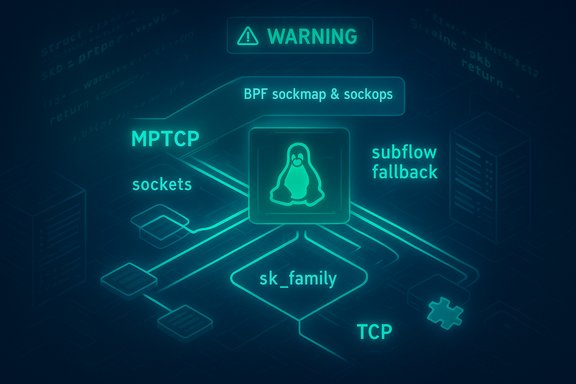
The Linux kernel received a targeted fix for CVE‑2025‑68227 — a subtle MPTCP (Multipath TCP) interaction with the sockmap/BPF subsystems that could cause incorrect protocol fallback handling and an associated kernel warning — and operators should treat it as a correctness/robustness patch that still warrants rapid verification and staged rollouts across hybrid estates.
Multipath TCP (MPTCP) extends TCP to allow a single logical connection to use multiple network paths. That extension hooks into the kernel’s socket protocol machinery and interacts with other in‑kernel extensibility mechanisms such as BPF sockmap and BPF sockops, which let userspace or in‑kernel BPF programs replace socket protocol handlers (sk_prot) for custom read/write semantics.
CVE‑2025‑68227 was published in mid‑December 2025 and describes a logic error in the MPTCP accept/fallback path: when a server has MPTCP enabled but a client connects with a plain TCP SYN (no MPTCP handshake), the kernel’s subflow fallback code restores the native TCP protocol pointer (sk_prot) on the subflow. If a sockmap or BPF sockops has previously replaced sk_prot for that socket class, comparing sk_prot against the native protocol pointer is insufficient and can lead to incorrect assignment of socket operations (sk->sk_socket->ops) during accept/fallback handling. The upstream remedy replaces the sk_prot comparison with a comparison based on the more generic sk_family, avoiding the sockmap interference and preventing the observed WARNING during accept. This is a logic/correctness fix rather than an obvious remote code‑execution flaw. The immediate operational symptom reported in test traces is a kernel WARNING (and the risk of mis-set socket ops), not a confirmed remote arbitrary code execution. Nevertheless, kernel correctness issues that affect socket behavior and object lifetimes are worth prioritizing, especially on hosts that accept untrusted BPF programs or run multi‑tenant workloads.
Immediate mitigations:
Action items for operators:
Source: MSRC Security Update Guide - Microsoft Security Response Center
 Background / Overview
Multipath TCP (MPTCP) extends TCP to allow a single logical connection to use multiple network paths. That extension hooks into the kernel’s socket protocol machinery and interacts with other in‑kernel extensibility mechanisms such as BPF sockmap and BPF sockops, which let userspace or in‑kernel BPF programs replace socket protocol handlers (sk_prot) for custom read/write semantics.CVE‑2025‑68227 was published in mid‑December 2025 and describes a logic error in the MPTCP accept/fallback path: when a server has MPTCP enabled but a client connects with a plain TCP SYN (no MPTCP handshake), the kernel’s subflow fallback code restores the native TCP protocol pointer (sk_prot) on the subflow. If a sockmap or BPF sockops has previously replaced sk_prot for that socket class, comparing sk_prot against the native protocol pointer is insufficient and can lead to incorrect assignment of socket operations (sk->sk_socket->ops) during accept/fallback handling. The upstream remedy replaces the sk_prot comparison with a comparison based on the more generic sk_family, avoiding the sockmap interference and preventing the observed WARNING during accept. This is a logic/correctness fix rather than an obvious remote code‑execution flaw. The immediate operational symptom reported in test traces is a kernel WARNING (and the risk of mis-set socket ops), not a confirmed remote arbitrary code execution. Nevertheless, kernel correctness issues that affect socket behavior and object lifetimes are worth prioritizing, especially on hosts that accept untrusted BPF programs or run multi‑tenant workloads.
What went wrong — technical anatomy
The subsystems involved
- MPTCP (net/mptcp): provides the multipath-aware TCP ULP (upper layer protocol) and subflow management.
- sockmap / BPF sockops: BPF helpers can update a socket’s protocol operations by changing
sk_prot, which lets sockmap provide alternativepsock_update_sk_protsemantics, custom read/write helpers, etc. - Accept/fallback path: when a subflow must “fall back” from MPTCP to plain TCP (for example, a peer that doesn’t support MPTCP), the kernel swaps protocol pointers and makes other cleanup adjustments.
sk->sk_prot against a native protocol pointer assumes sk_prot was never modified by external mechanisms. That assumption breaks in the presence of sockmap/BPF, which intentionally replaces protocol handlers for routing packets through custom hooks. The vulnerable code used sk->sk_prot for a protocol identity check; if sockmap had replaced sk_prot, the comparison was no longer meaningful. The correct, robust test is to compare the socket family (sk_family), which is orthogonal to BPF‑driven sk_prot overrides. Observable symptom
Upstream debug/test output showed a kernel WARNING originating innet/mptcp/protocol.c during mptcp_stream_accept. The traced stack was consistent with accept/fallback logic running when sk_prot had been altered by sockmap flows. The change to use sk_family removed the condition that triggered the warning and avoided accidentally setting sk->sk_socket->ops incorrectly. Why this fix matters
- Correctness over clever assumptions: Kernel networking code often assumes invariants that were true historically. BPF’s growth means those invariants are less reliable; replacing protocol detection logic with a family‑based check removes an assumption that sockmap can invalidate.
- Low‑regression, surgical remedy: The upstream patch is minimal — change the comparison field — which reduces risk of regressions and simplifies backporting to stable kernels and vendor trees. That pragmatic approach aligns with kernel maintenance best practices.
- Prevents noisy or dangerous warnings: Kernel WARNINGS in the accept path can destabilize instrumentation and, in some kernels, trigger panic paths or crash dumps. Eliminating a false positive/misassignment avoids follow‑on operational impact.
Affected systems and realistic exposure
- Kernels and versions: The fix was merged into the upstream stable kernel trees; individual distribution mappings depend on vendor backports. Operators should map upstream commit IDs (the stable commit(s) referenced by advisories) to their packaged kernel changelogs. Android and vendor kernel trees that track stable commits will also show the fix in their histories.
- Who is most at risk:
- Hosts that permit unprivileged or loosely restricted BPF sockops/sockmap workloads (developer machines, permissive containers, CI runners).
- Multi‑tenant nodes and cloud images where guest code can interact with local BPF tooling.
- Appliances or embedded devices that expose MPTCP features and run vendor kernels that lag upstream. Long‑tail embedded images are the typical operational exposure because vendors often delay or omit backports.
- Attack vector: Local or local‑adjacent. Exploitation would require being able to influence sockmap/BPF updates or otherwise cause the specific accept/fallback scenario while
sk_prothas been changed by sockmap hooks. There is no authoritative report of remote, unauthenticated exploitation observed at disclosure.
Patch, verification and vendor responses
Upstream kernel maintainers merged a small patch that changes the comparison used inmptcp_stream_accept/mptcp_fallback_tcp_ops from sk->sk_prot to a check on sk_family. The patch is intentionally conservative and targeted so distributions can backport it into stable branches easily. The commit appears in mainstream kernel histories and vendor trees (including kernel/common repositories that vendors use). Practical verification steps:- Check your running kernel version: uname -r.
- Inspect your distribution’s kernel package changelog or security advisory for the relevant upstream stable commit(s) or an explicit mention of CVE‑2025‑68227.
- If you build kernels from source, verify the commit ID is present in your git history (the stable commit messages include “mptcp: Fix proto fallback detection with BPF”).
Short‑term mitigations and operational playbook
If you cannot immediately install patched kernels, apply compensating controls and a staged remediation plan.Immediate mitigations:
- Restrict BPF/sockmap usage:
- Set kernel.unprivileged_bpf_disabled = 1 where appropriate to block unprivileged bpf loads.
- Restrict capabilities so that only trusted administrators or processes have CAP_BPF or CAP_SYS_ADMIN.
- For highly sensitive multi‑tenant nodes, consider isolating or removing untrusted BPF‑based tooling (Cilium, XDP filters, Falco, etc. until patches are applied.
- Inventory: list hosts where MPTCP is enabled (check for CONFIG_MPTCP or module presence) and identify systems that allow BPF sockops/sockmap updates.
- Acquire: obtain vendor kernel packages that reference the upstream stable commit or explicitly mention CVE‑2025‑68227.
- Test: stage patched kernels in a pilot group that mirrors production workloads and BPF use cases. Run representative MPTCP/eBPF workloads and selftests.
- Deploy: roll out in waves (pilot → staging → production), monitor kernel logs and service behavior after each wave.
- Verify: confirm package changelogs or kernel source includes the fix; confirm absence of the prior WARNING in kernel logs.
- Enable persistent systemd journal and kdump/vmcore collection so that any kernel WARN or OOPS traces are preserved for triage. Kernel warnings in accept paths can be ephemeral; capturing vmcore helps vendor triage.
Detection and hunting guidance
Key telemetry and log signals to watch for:- Kernel WARNING/OOPS traces referencing
net/mptcp/protocol.candmptcp_stream_acceptstack frames. These traces are the direct symptom that the upstream patch addresses. - Unexpected or recent sockmap/BPF sockops program loads around the time of a socket accept or crash; bpftool can list recent attachments and program types to correlate events.
- For mixed Windows/Linux estates, correlate Linux VM crashes (dmesg, vmcore) with service outages on Windows hosts (for example, storage or authentication services hosted on Linux guests). Kernel instability in a guest can cascade to host‑level operational impact.
- journalctl -k | egrep -i 'mptcp_stream_accept|mptcp|sockmap|bpf_sock'
- bpftool prog show and bpftool map show to find sockmap/sockops activity near an incident timestamp.
Strengths of the upstream approach — and residual risks
Strengths:- The patch is small and well‑scoped — a single comparison field change — making it easy to backport and low risk for regression. That favors rapid distribution updates.
- The change addresses an invariant assumption (that
sk_protconveys protocol identity) by using a more robust attribute (sk_family) that BPF sockmap changes don’t modify. This adheres to robust kernel design principles.
- Long tail of unpatched devices: embedded appliances, vendor images, and specialized appliances often lag upstream. Those remain the highest operational risk because vendors may not release timely backports. Inventory and vendor coordination are critical.
- Operational exposure variance: systems that heavily use BPF sockmap/sockops (observability, networking acceleration) are more likely to see the problematic interplay. Desktop hosts that don’t run sockmap programs are at much lower risk.
- Chaining concerns: although the fix addresses a correctness/warning condition, kernel semantics bugs are sometimes useful to attackers who already have local code execution. Treat any kernel UAF, lifetime, or protocol dispatch bug as an important fix even when immediate escalation is not obvious.
Practical guidance by audience
- Cloud operators and multi‑tenant infrastructure teams:
- Prioritize hosts that accept untrusted workloads, CI runners, and container hosts that permit BPF. Harden unprivileged bpf, restrict CAP_BPF, and schedule kernel updates and reboots.
- Enterprise server teams:
- Map distro kernel packages to upstream commits, stage updates, and validate MPTCP/eBPF workloads in staging. Ensure rollback plans and monitor kernel logs for regressions.
- Appliance and embedded maintainers:
- Contact vendors for fixed images if you rely on vendor kernels. For custom images, rebuild with the patched upstream kernel and validate. Embedded vendors are frequently the longest patch backlog.
- Developer and workstation admins:
- Isolate developer workflows that require unprivileged BPF into dedicated VMs. Keep workstation kernels updated and avoid running untrusted BPF programs on host systems.
How to confirm a host is remediated
- Confirm the running kernel package or source tree includes the upstream commit labeled with the MPTCP proto fallback fix. Inspect package changelog or git history.
- Reproduce representative MPTCP and sockmap flows in a test environment and verify no WARNINGs appear in
dmesgorjournalctl -k. - Verify bpftool output and any sockmap attachments behave as expected after the update.
- Ensure crash dump/collectors are enabled so any late traces are preserved for analysis.
Conclusion
CVE‑2025‑68227 is a focused, low‑regression fix addressing a cross‑subsystem assumption between MPTCP accept/fallback logic and BPF sockmap/sockops manipulation ofsk_prot. The upstream fix — switching the identity test to sk_family — is small, straightforward, and backportable, which should enable rapid distribution updates. Despite its modest immediate severity (no public in‑the‑wild RCE reported at disclosure), the interaction highlights a broader theme: as in‑kernel programmable tooling (BPF) grows, kernel code must avoid brittle assumptions about mutable protocol dispatch state.Action items for operators:
- Inventory MPTCP/BPF exposure and prioritize hosts that accept untrusted BPF or serve multi‑tenant workloads.
- Apply vendor kernel updates that include the upstream fix and roll them out in a staged, tested manner.
- If patching is delayed, restrict unprivileged BPF usage, tighten CAP_BPF/CAP_SYS_ADMIN grants, and monitor kernel logs for MPTCP/accept warnings.
- Preserve kernel diagnostics (journal + kdump/vmcore) to capture any transient WARN/OOPS traces for forensic work.
Source: MSRC Security Update Guide - Microsoft Security Response Center