

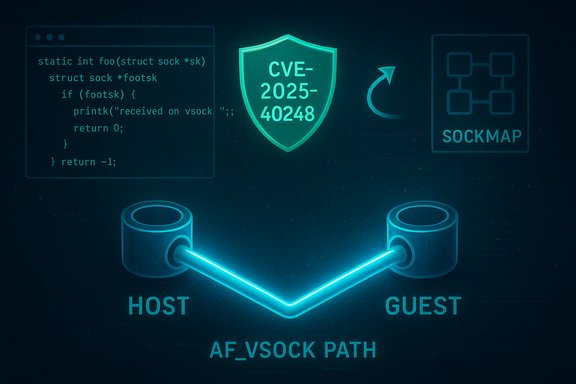
The Linux kernel received a targeted fix for a subtle but potentially dangerous race in the AF_VSOCK transport: during a blocking connect, if a signal or timeout arrived after the socket had already reached an established state, the code could disconnect or reset that already-established socket and leave the kernel transport in inconsistent state — leading to hangs, WALRUS-like lingering counts, sockmap violations, warnings and even use-after-free/null-pointer dereferences. This issue is tracked as CVE-2025-40248 and has been patched upstream; distributions and vendors are mapping the upstream fixes into stable kernel updates now.
Source: MSRC Security Update Guide - Microsoft Security Response Center
 Background
What is AF_VSOCK and why it matters
AF_VSOCK (vsock) is a special socket family designed to provide efficient, guest-to-host and guest-to-guest communication in virtualized environments without exposing traditional network stacks. It’s widely used in virtualization platforms and guest tooling for telemetry, agent communication, and cloud-init-style flows. Because vsock runs inside the kernel and integrates with virtual I/O transport layers (notably virtio-based transports), bugs in its core state machine can have outsized operational impact: a small logic error can corrupt in-kernel transport state, affect multiple users, or destabilize the guest or host.Summary of the defect (high level)
During a connect call, the kernel must be careful about how it reacts to signals or timeouts. For sockets that are not yet established, cancellation on signal/timeout is an expected and useful behavior: userland often relies on a signal to abort a pending connection attempt. However, CVE-2025-40248 describes a case where connect could act on a signal/timeout even after the socket transitioned into an established state. Resetting or disconnecting an already-established socket from the connect path created several unsafe races:- connect could call vsock_transport_cancel_pkt → virtio_transport_purge_skbs, racing with concurrent sendmsg calls that invoke virtio_transport_get_credit, leaving vvs->bytes_unsent permanently elevated and confusing SOCK_LINGER handling.
- connect could reset a connected socket’s state while the socket was being placed in a sockmap, breaking sockmap invariants and producing WARNs.
- connect could flip a socket from SS_CONNECTED back to SS_UNCONNECTED, enabling a transport change or drop after the socket had reached TCP_ESTABLISHED-like semantics — a timing window that could be exploited by concurrent sendmsg or connect activity, potentially causing use-after-free or null-pointer dereference.
What was changed upstream
Patch rationale and core fix
Kernel maintainers decided the correct approach is to not disconnect an already-established socket in response to a signal/timeout arriving inside connect. The essence of the patch is simple and defensive: once the socket is confirmed established (e.g., sk->sk_state == TCP_ESTABLISHED semantics inside the vsock code path), connect returns without attempting to reset or disconnect the socket in response to signals or timer expiry. Connect-time cancellation logic is preserved only for sockets that are still unconnected; those unconnected sockets can be reset safely so userland can retry. This preserves the invariants that established sockets:- are allowed to linger or be handled by SOCK_LINGER semantics,
- can be placed into sockmap safely,
- and won't be subject to mid-flight transport reassignments due to an in-flight connect cancellation.
Why this is the right defensive choice
- It keeps lifecycle semantics simple: an established socket’s lifecycle is not abruptly rewound by a late-arriving signal inside the connect path.
- It reduces complicated cross-call races between connect, sendmsg, and other socket-manipulating paths like the sockmap placement logic.
- The minimal change reduces the chance of regressions: rather than rewrite transport or socket lifecycle semantics, the fix enforces a clear boundary and stops the connect path from making unsafe state transitions post-establishment.
Technical analysis: what can go wrong and why operators should care
The race and its practical effects
At the heart of the problem are small timing windows where two operations cross: the connect path (which manages connection establishment and certain cancellation semantics) and active I/O paths (for example sendmsg and the virtio transport's credit accounting). If connect decides to disconnect an already-established socket in response to a signal/timeout, the following concrete problems were observed and reported:- Persistent elevation of vvs->bytes_unsent: if a purge and a get-credit race collide, bytes that were supposed to be accounted for as sent/cleared can remain counted as unsent indefinitely, confusing higher-level logic that depends on accurate counts for SOCK_LINGER and graceful shutdown. This can lead to attempts to linger sockets incorrectly or to application-level hangs on shutdown.
- Sockmap invariants broken: when kernel data structures such as sockmap assume a socket will never be removed from the map except via certain controlled paths, an unexpected disconnect can leave stale references or trigger WARNs when the kernel later accesses the map. WARNs are not just noisy — they indicate internal inconsistency that can cascade into crashes.
- Post-establishment transport change: flipping SS_CONNECTED back to SS_UNCONNECTED effectively allows a transport to be changed or dropped after TCP_ESTABLISHED-like behavior. That window may enable use-after-free conditions if another CPU thread or process references memory that the transport cleanup has freed. Null-pointer dereference paths were mentioned in upstream descriptions as plausible outcomes.
Exposure model: who and what is vulnerable
- Local or guest vectors only: exploitation requires code running on the host or guest that can perform socket operations on the vsock transport. This is not a remotely exploitable, unauthenticated network-facing flaw in the usual sense. However, for hosted environments, cloud/VPS guests or containers, a misbehaving guest can produce host-side instability if host vsock endpoints are involved.
- Shared and multi-tenant environments are higher risk: in clouds, platform providers, CI runners, or any multi-tenant host where untrusted code may be able to create or operate vsock connections, the practical risk is significant because an unprivileged tenant can trigger repeated instability or denial-of-service.
- Desktop-only systems with no virtualization vsock usage are lower risk: typical desktops that do not expose or use vsock transports (no KVM guests using vsock sockets, no Docker/VM tooling that relies on the kernel vsock path) are unlikely to be impacted. Still, Windows-oriented operations that interact with Linux via WSL or run Linux VMs should be aware: kernel oopses in the guest can cascade into service disruptions for hosted management workflows.
Confirming the fix and vendor actions
Upstream and database entries
Multiple vulnerability databases and vendor trackers recorded the issue and the upstream fix, with the entry registered as CVE-2025-40248 and published in early December 2025. The NVD entry and independent trackers summarize the exact problem and list the rationale of "Do not disconnect socket on signal/timeout; keep the logic for unconnected sockets." SUSE, Tenable and other distributors have published advisory entries describing the same upstream change and the expected remediation: install kernel updates that include the upstream change. These independent corroborations confirm the description and the accepted remediation path.Microsoft MSRC listing
The user-provided MSRC vulnerability page points to CVE-2025-40248. The MSRC page is an index entry in Microsoft’s Security Update Guide; it often aggregates CVE metadata for customers tracking vulnerabilities affecting hybrid environments. Note: some vendor web pages are rendered dynamically and may require JavaScript; when that prevents a fetch, consult NVD or your distro security tracker for canonical details. The MSRC listing in this case matches the broader public records. Treat the MSRC record as an index pointer rather than the authoritative kernel patch source.Practical mitigation guidance (operational checklist)
Apply the patch is the primary remedial action. Beyond that, operators should follow these prioritized, verifiable steps.Immediate (first 24–72 hours)
- Inventory systems that run kernels with vsock support:
- Query hosts and VMs for CONFIG_VSOCK/AF_VSOCK and for loaded vsock modules.
- Identify virtualization hosts, guest images, CI runners, and appliances that use vsock for agent or management traffic.
- Patch kernels:
- Apply distribution-supplied kernel updates that explicitly list CVE-2025-40248 or include the upstream commit that implements the defensive check in connect.
- For vendor-provided or embedded kernels, open a vendor ticket requesting the backport or updated firmware.
- Prioritize shared hosts and multi-tenant infrastructure:
- If you operate multi-tenant hosts (cloud, CI, lab infrastructure), prioritize these for patching because local/guest attack vectors are realistic there.
Medium-term (one week to one month)
- Add detection and monitoring:
- Hunt for kernel WARNs and OOPS traces referencing vsock, virtio_transport, or sockmap in dmesg/journalctl -k and SIEM logs. Kernel OOPS traces are ephemeral; capture vmcore or save dmesg immediately if you see repeated traces.
- Monitor application-level symptoms: repeated EBUSY or unexpected application hangs on sendmsg to vsock endpoints.
- Apply compensating controls if patching is delayed:
- Reduce untrusted local access: disallow or tightly constrain who can create vsock connections or load vsock-related modules.
- Isolate affected hosts from high-value management networks to reduce blast radius while awaiting vendor updates.
For service owners and developers
- Harden userspace behavior:
- Avoid relying on fragile semantics of connect cancellations to perform critical transport cleanup. The kernel fix enforces safer behavior, but application designs that expect mid-connect cancellation to drop an already-established socket should be revised.
- Add defensive retries/timeouts in user code:
- Where a connect may be interrupted and retried, ensure retry logic can handle EBUSY, unexpected socket states, or transient failures without hanging the process.
How to validate a patch has been applied
- Check your kernel package changelog for the upstream commit ID: most distributors map stable kernel commits into package changelogs; look for entries referencing the vsock connect patch or CVE-2025-40248. If the vendor changelog is opaque, match the package’s source tree against the upstream kernel tree.
- Inspect kernel sources (if accessible): search for the inserted state check in the connect path that prevents a signal/timeout from disconnecting an established socket (the same check visible in the upstream patch). The presence of the explicit sk->sk_state == TCP_ESTABLISHED check around the signal/timeout block is the fix fingerprint.
- Post-patch testing: in a controlled test environment, attempt a tightly-raced sequence that previously produced WARNs or hangs and confirm the kernel no longer transitions an established socket back to an unconnected state under signal/timeout. Note: reproduce only in isolated lab environments — do not run stress tests on production hosts.
Risk assessment and real-world exploitability
Severity and likely impact
- The public tracking entries classify this as a stability/availability bug with possible memory-safety implications (use-after-free/null-pointer deref) in a narrow timing window. That combination means the highest immediate risk is denial-of-service and unpredictable kernel WARNs or oopses; the escalation vector to remote code execution is not demonstrated in public records. Multiple independent trackers and the upstream patch discussion corroborate this classification.
Exploitability
- This is not an unauthenticated, remote execution vulnerability: an attacker needs local or guest-level access to exercise the vsock transport. That said, in platform-as-a-service or multi-tenant virtualization environments, a guest or container with modest privileges can trigger these kernels races, making the practical exploitability non-negligible for cloud hosts.
Likely real-world vectors
- Intentional weaponization into a reliable exploit chain (e.g., RCE) is not currently demonstrated in public feeds. The more realistic and observed vector is operational disruption: repeated triggering of the race to cause hangs, blocked application calls, and kernel WARNs — all of which lead to service outages and require reboots or manual remediation. Treat the absence of a public PoC as limited comfort; prioritize fixes where exposure exists.
Strengths of the upstream fix and remaining risks
Notable strengths
- The fix is minimal and surgical, limiting scope and reducing regression risk.
- It enforces clearer lifecycle boundaries for sockets, preventing a wide class of races without architectural changes.
- Distributors can backport the change cleanly into stable trees, so administrators can receive fixes through normal kernel update channels.
Potential residual risks
- Vendor lag: embedded and vendor-forked kernels often lag upstream; operators of appliances and vendor-supplied images must press vendors for backports or replacement images.
- Detection limitations: kernel OOPS traces disappear on reboot; if a host reboots or if logs are not captured quickly, evidence of an incident is lost. Implement immediate log capture for kernel messages when troubleshooting.
- Compositional risk: while this fix addresses the specific connect race, other race conditions in adjacent sendmsg/virtio transport accounting or in sockmap interactions could remain; this is a class of concurrency bugs that require vigilance across the kernel’s networking stack.
Actionable recommendations — concise checklist
- Immediately identify hosts that run kernels with vsock support and prioritize updates for multi-tenant hosts.
- Apply vendor/distribution kernel updates that include the CVE fix; verify by checking package changelogs or source trees.
- If you cannot patch immediately, limit untrusted local access and isolate affected hosts from critical management networks.
- Add kernel OOPS/WARN monitoring to your alerting rules (dmesg/journalctl -k) and preserve vmcore or saved logs for forensic analysis when a crash occurs.
- Validate fixes in test environments and confirm absence of WARNs under stress tests that previously reproduced the issue.
Conclusion
CVE-2025-40248 is a targeted, predictable example of a concurrency bug in a kernel transport: small state-machine mistakes at connect/timeout boundaries can cascade into availability failures and even memory-safety hazards. The upstream response — refuse to retroactively disconnect an already-established vsock on a late-arriving signal/timeout — is conservative, correct, and low-risk. For most operators, the practical steps are straightforward: inventory vsock usage, apply vendor kernel updates, and add kernel-level monitoring to detect lingering traces of the defect. Multi-tenant and host providers should treat this as a high-priority patch because the local/guest attack vector is realistic in shared infrastructure. The remediation path is available and surgical; the operational task now is rapid identification and deployment.Source: MSRC Security Update Guide - Microsoft Security Response Center
