

The Linux kernel received a targeted fix in November 2025 for a subtle but potentially dangerous memory-handling bug in its TLS decryption path: when asynchronous TLS decryption attempts fail to create a safe clone of incoming packet memory (via tls_strp_msg_hold), the kernel must wait for existing async decryptions to complete — otherwise a use‑after‑free (UAF) or write-into‑userspace condition can occur. This change closes a race that could otherwise allow kernel code to operate on freed network buffers or overwrite user memory after recv has already returned, and distributions have begun shipping backports and patched kernels to eliminate the window of exposure.
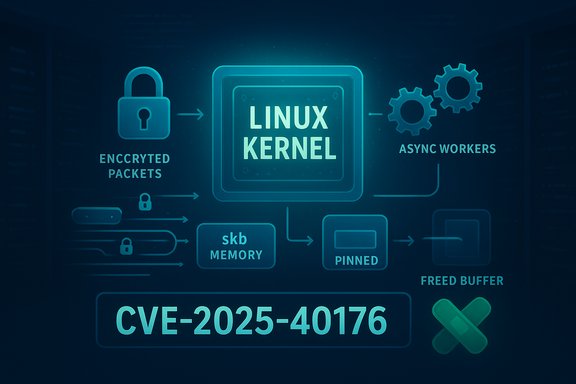
The Linux kernel's in-kernel TLS support and related crypto paths perform asynchronous decryption to offload expensive operations and improve throughput for high-bandwidth workloads. To keep the network receive path safe when decryptions are performed off the immediate receive stack, the kernel clones or otherwise pins incoming socket buffer (skb) memory so the decryptor can reference it without racing with the networking stack's free paths.
The root of CVE‑2025‑40176 is the failure scenario in that protective clone step. Async decryption calls tls_strp_msg_hold to create a clone of the input skb. If that allocation or clone operation fails, but the code proceeds to hand work to an async decryptor, the decryptor may still access memory that the networking stack or caller frees after recv returns. The consequence is classic kernel memory-safety failure modes: use‑after‑free on the skb and writes into user-space memory after the userspace caller believes the receive is complete. The upstream fix is simple in concept: when tls_strp_msg_hold fails, wait for any pending asynchronous decryptions to complete before returning — removing the race window.
From an operational risk viewpoint, even if an individual CVE does not include a public exploit, the recurrence of memory-lifetime races in kernel crypto paths illustrates a systemic challenge. Vendors, distribution maintainers, and integrators should prioritize regressions and add unit/integration tests that exercise failure paths (cloning, allocation failures, and async queueing) in addition to the happy-path performance tests that dominate CI/CD suites.
Operationally, the remediation follows the well-worn pattern: patch kernels, verify backports, reboot, and monitor. The long-term lesson for operators and maintainers is to expand testing to include error and allocation-failure paths for complex asynchronous subsystems such as crypto, TLS, and I/O stacks. Such tests are often missing from performance-dominated CI pipelines but catch exactly the kind of timing and lifetime mistakes that underlie this CVE. Administrators should treat this CVE as actionable: inventory, patch with confirmed vendor packages, and monitor for residual symptoms. Despite low public exploit telemetry, the memory-safety nature of the flaw and the privileged execution context demand prompt remediation and careful validation.
Concluding checklist (concise)
Source: MSRC Security Update Guide - Microsoft Security Response Center
 Background
The Linux kernel's in-kernel TLS support and related crypto paths perform asynchronous decryption to offload expensive operations and improve throughput for high-bandwidth workloads. To keep the network receive path safe when decryptions are performed off the immediate receive stack, the kernel clones or otherwise pins incoming socket buffer (skb) memory so the decryptor can reference it without racing with the networking stack's free paths.The root of CVE‑2025‑40176 is the failure scenario in that protective clone step. Async decryption calls tls_strp_msg_hold to create a clone of the input skb. If that allocation or clone operation fails, but the code proceeds to hand work to an async decryptor, the decryptor may still access memory that the networking stack or caller frees after recv returns. The consequence is classic kernel memory-safety failure modes: use‑after‑free on the skb and writes into user-space memory after the userspace caller believes the receive is complete. The upstream fix is simple in concept: when tls_strp_msg_hold fails, wait for any pending asynchronous decryptions to complete before returning — removing the race window.
What the patch changes — a technical overview
How the original flow created a race
- Incoming TLS-encrypted packets are received into skbs owned by the network stack.
- For performance, TLS decryption may be performed asynchronously: the stack queues a decrypt request referencing the skb and returns control sooner.
- To ensure the decryptor sees valid memory, tls_strp_msg_hold clones or pins an skb reference for the async worker to use.
- If allocation/clone fails, but the code does not block for outstanding decrypt requests, the recv path can return while an async worker still references or will reference that skb.
- If the original skb is freed or repurposed, the async worker can dereference freed memory — producing UAF — or, in the worst case, write to regions that revert to userland buffers after recv returns.
Why waiting is the correct, minimal fix
Waiting for pending requests is a defensive and conceptually minimal change: it preserves the semantics that any worker referencing skb memory must finish before the path that could free that memory returns. Alternatives — such as always forcing synchronous decrypts or disallowing async decryption entirely on failure — would be heavier-handed and could measurably degrade throughput in high-performance stacks. The upstream patch instead narrows the wait condition to the failure case, keeping the common fast path intact while closing the race window when memory cloning is not possible. The change is surgical but materially reduces the risk of UAFs or cross-boundary writes.Who is affected
The vulnerability is a Linux kernel issue; any distribution or appliance shipping kernels that include the vulnerable TLS async code path before the upstream fixes is potentially affected. Distribution trackers and vendor advisories have already mapped vulnerable ranges and backported fixes to many stable kernel trees.- Debian's security tracker maps fixed versions into multiple suites and lists precise package builds that include the remediation (for example, 6.1.158-1 for the linux-6.1 tree and other fixed package mappings). Administrators should consult vendor package changelogs to confirm backport inclusion before declaring systems patched.
- SUSE categorized the issue as having "important" severity with a CVSS v3 mapped score of 7.0 in its advisory, highlighting the combined confidentiality/integrity/availability potential if memory is corrupted by the bug. SUSE's assessment underscores the seriousness of kernel memory faults even when a practical exploit leading to remote code execution has not been demonstrated.
- OSV/third-party trackers list the upstream commits and vendor backports and enumerate downstream advisories such as Ubuntu, Debian and other vendors flagged by automated imports; these resources confirm that the fix exists upstream and is being packaged across distributions.
Potential consequences and realistic threat model
Immediate technical impact
- Use‑after‑free (UAF) within the kernel context: the async decryptor may reference freed skb memory, which can lead to kernel oopses, panics, or potentially exploitable memory corruption depending on allocator behavior and timing.
- Writes into user-space memory after recv returns: if the code incorrectly writes decrypted output into buffers that userland now controls, data corruption or information disclosure scenarios are possible. The advisory language explicitly highlights both the UAF and the post-recv write conditions.
- Availability and integrity impacts are immediate and observable (crashes, incorrect data delivered), while confidentiality impact depends on how and where memory reuse overlaps with sensitive buffers. SUSE and OpenCVE flag high impact components in those axes.
How easy is exploitation?
Public data suggest this is not currently being widely weaponized and that the attack complexity is non-trivial in many contexts. OpenCVE reports a very low EPSS score and frames the attack vector as locally reachable with significant complexity, though the exact scoring and exploitability assessments vary by tracker. Converting a kernel UAF into a reliable remote code execution chain is difficult and requires precise control of allocator state, timing, and other environmental factors; nonetheless, kernel UAFs must be treated seriously because they are frequently the precursors to privilege escalation in skilled hands. Security operators should therefore treat this as a high-priority engineering and operational problem — patch promptly and validate — even if no active mass exploitation campaign has been observed. The absence of public proof-of-concept is not a justification to delay remediation where the kernel runs in exposed or high-value environments.Patching, mitigation, and operational checklist
Apply these steps in order. The guidance is intentionally procedural so operators and sysadmins can include it in runbooks.- Inventory: Identify all systems running Linux kernels that might include the vulnerable TLS async paths. Query hosts for kernel versions (uname -r) and cross-reference vendor changelogs and distro advisories for the fixed package versions. For containerized or immutable workloads, enumerate base images and rebuild pipelines.
- Confirm vendor mapping: Check your distribution or appliance vendor for published advisories and package versions that explicitly reference CVE‑2025‑40176 or include the upstream stable commit. Use vendor changelogs to ensure the backport is present. Debian and SUSE trackers provide concrete package mappings to use as a reference.
- Test and stage: For servers in production, stage the updated kernel in a controlled environment. Validate key services (networking, TLS endpoints, virtual appliances) and run workload tests at expected concurrency levels to ensure the wait-for-pending logic does not introduce regressions. The upstream change is targeted and should not affect common fast paths, but integration testing is mandatory.
- Deploy: Update packages and reboot hosts in a rolling fashion to maintain availability. For devices or appliances that do not receive vendor updates promptly, engage the vendor for firmware or build guidance. If your infrastructure relies on static kernels (appliances, embedded devices), plan vendor coordination as a priority.
- Validate: After patching, verify the kernel changelog or package metadata references the upstream commit(s) associated with the fix. Sample command flow:
- On Debian/Ubuntu: dpkg -l | grep linux-image && apt changelog linux-image-<version>
- On RPM-based systems: rpm -q --changelog kernel | grep -i 40176
- Or inspect /usr/src/linux-headers-<version>/changelog if present
- Monitor: Add or tune monitoring rules to catch kernel oopses, KASAN reports (if enabled), and anomalous recv/decryption error patterns. For high-value environments, increase logging around TLS decryption errors and network receive failures.
- Forensics and rollback planning: If you observed instability tied to this code path prior to patching (e.g., unexplained kernel oopses on TLS flows), collect crash dumps and preserve pre-patch system images for forensic analysis. After patching, reconcile crash frequency and verify the symptom disappears.
Detection and hunting guidance
Look for the following signals in logs and telemetry. These are practical, high-signal indicators that correlate with the bug’s failure modes:- Kernel oops/panic messages correlated to network receive or crypto stack symbols. Crash logs that reference TLS/crypto symbols or thread stacks waiting on async decrypt operations are high value.
- Increase in recv anomalies from user-space processes that consume TLS data and then report memory or I/O corruption, especially when those applications handle high concurrency TLS sockets.
- KASAN or other kernel memory-sanitizer reports (if compiled into test kernels) that flag use-after-free in skb/crypto call stacks during stress tests.
- Service-layer anomalies: repeated connection resets, corrupted decrypted payloads, or sudden application-level data corruption aligned with network heavy-load windows.
Wider context: why this class of bug matters
Kernel crypto and TLS stacks are particularly sensitive: they bridge user-facing network formats with privileged memory and drivers. Historically, similar races and misuse of crypto transform objects produced release/use‑after‑free errors, memory leaks, or crashes in other kernel subsystems — for example, AEAD transform reuse issues in SMB multichannel processing and other crypto lifecycles that produced KASAN-detected UAFs and host instability. These prior incidents underscore why careful lifetime management — especially around asynchronous work and owner references — is critical. The pattern in CVE‑2025‑40176 maps to broader lessons: asynchronous work that references shared memory must either own that memory or synchronize so the owner cannot free it until the worker completes.From an operational risk viewpoint, even if an individual CVE does not include a public exploit, the recurrence of memory-lifetime races in kernel crypto paths illustrates a systemic challenge. Vendors, distribution maintainers, and integrators should prioritize regressions and add unit/integration tests that exercise failure paths (cloning, allocation failures, and async queueing) in addition to the happy-path performance tests that dominate CI/CD suites.
Strengths of the upstream response — and remaining caveats
What upstream and distributors did well:- The kernel maintainers produced a narrowly scoped fix that addresses the race without wholesale disabling of async crypto, preserving performance while improving safety. The upstream commits and stable backports make the remediation explicit.
- Major distro trackers (Debian, SUSE) rapidly mapped the issue into their advisory pipelines and flagged package versions that include the fix. This reduces operator friction for patching.
- Embedded and appliance devices: many edge devices and vendor appliances embed specific kernel trees and have long patch windows. These devices commonly lag in addressing kernel fixes and may remain exposed until vendors provide firmware updates. This is a repetitive and operationally hard problem for supply-chain security.
- No guaranteed RCE vs. DoS distinction: while the primary observable consequences reported are UAFs and writes that map to availability/integrity concerns, kernel UAFs are the traditional starting point for escalations by skilled exploit developers. Public trackers do not confirm RCE in the wild; treat any claim of escalation as unverified until corroborated.
- Patch verification: operators must verify that their particular distribution package includes the precise upstream commit(s) — distribution backports sometimes reorganize or omit commits in ways that change behavior. Confirm by package changelog and vendor advisory.
Practical recommendations for WindowsForum readers and administrators
- Prioritize patching for network-facing servers and appliances that terminate TLS with in-kernel stacks or forward TLS flows through kernel-managed crypto. These are the highest‑impact targets.
- For cloud or multi-tenant environments, accelerate kernel package updates and perform rolling reboots to ensure uniform patch levels. Kernel memory bugs can be quietly exploited in co‑tenant scenarios where timing and allocator control can be improved by an attacker.
- Inventory: add kernel version checks and package-changelog verification into your vulnerability-management tooling so that CVE‑2025‑40176 is not marked as “patched” until the vendor-mapped package is present. Use the Debian and SUSE advisories as mapping references.
- Testing: include failure-path tests that simulate allocation failures for skb cloning and exercise concurrent async decrypt workloads. If possible, run stress profiles on staging hosts to detect regressions or unexpected side effects.
- Vendor engagement: for appliances and embedded devices that do not have a clear patch path, open a support case with the vendor and demand a timeline. If the vendor cannot provide patches, apply network-level compensating controls (restricting access to management interfaces, network segmentation, or TLS termination at a hardened perimeter).
Final analysis and closing notes
CVE‑2025‑40176 is a concrete example of how a small failure-case omission can produce dangerous kernel memory semantics when asynchronous workers and network receive lifecycles intersect. The upstream fix — waiting for pending decryptions when tls_strp_msg_hold fails — is an appropriately scoped correction that eliminates the race without wholesale performance tradeoffs.Operationally, the remediation follows the well-worn pattern: patch kernels, verify backports, reboot, and monitor. The long-term lesson for operators and maintainers is to expand testing to include error and allocation-failure paths for complex asynchronous subsystems such as crypto, TLS, and I/O stacks. Such tests are often missing from performance-dominated CI pipelines but catch exactly the kind of timing and lifetime mistakes that underlie this CVE. Administrators should treat this CVE as actionable: inventory, patch with confirmed vendor packages, and monitor for residual symptoms. Despite low public exploit telemetry, the memory-safety nature of the flaw and the privileged execution context demand prompt remediation and careful validation.
Concluding checklist (concise)
- Inventory affected hosts and kernels.
- Confirm vendor package includes the upstream fix (check changelog).
- Stage and test patched kernels under realistic TLS load.
- Deploy updates across production with rolling reboots.
- Monitor kernel logs for oops/KASAN traces and TLS decryption anomalies post‑patch.
Source: MSRC Security Update Guide - Microsoft Security Response Center
