

A subtle but consequential race in the Linux kernel’s memory-control-group (memcg) ID management has been fixed: CVE-2024-43892 describes an insufficiently synchronized idr_remove() path on mem_cgroup_idr that could let multiple memcgs acquire the same ID and, in concrete fleets, has been linked to intermittent list_lru-based kernel crashes and denial-of-service behaviour.
Memory control groups (memcgs) are a core kernel facility used to account and limit memory usage for containers, processes, and hierarchical resource domains. To manage compact numeric identifiers for memcgs, the kernel maintainers introduced an ID radix-tree (IDR) mapping (mem_cgroup_idr) in a commit that decoupled memcg IDs from CSS IDs. That change solved an earlier cgroup creation problem but implicitly relied on external synchronization guarantees when modifying the IDR. When idr_remove() was left unprotected, concurrent offlines of memcgs could race and corrupt the ID space.
Operators observing hard-to-track, low-frequency kernel crashes that referenced list_lru internals — list_lru_add(), list_lru_del(), and reparenting logic — traced the root cause to situations where either a memcg ID entry was missing or multiple memcgs shared an ID. The practical result: when one memcg was offlined and its cleanup ran, list_lru bookkeeping for other memcgs could be torn down mistakenly, causing later accesses to crash the kernel. (lkml.indiana.edu)
This is an availability-centered bug: it does not expose secrets or grant privilege escalation directly, but it can produce deterministic and sustained service disruption when triggered. The NVD records this vulnerability with a CVSS v3.1 base score of 4.7 (Medium) reflecting the local attack vector and the availability impact.
Why a small change matters: IDR is a compact, widely used kernel primitive, and the fix avoids larger, more invasive refactors of memcg allocation paths while closing the precise race window that caused duplicates and missing entries. The corrective pattern — protect shared IDR state with an internal lock and use idr_preload appropriately — is a standard kernel hygiene practice and is low-risk to backport to stable trees. (lkml.indiana.edu)
Short-term (emergency) steps
Actionable bottom line for WindowsForum readers running Linux-based infrastructure or appliances:
Source: MSRC Security Update Guide - Microsoft Security Response Center
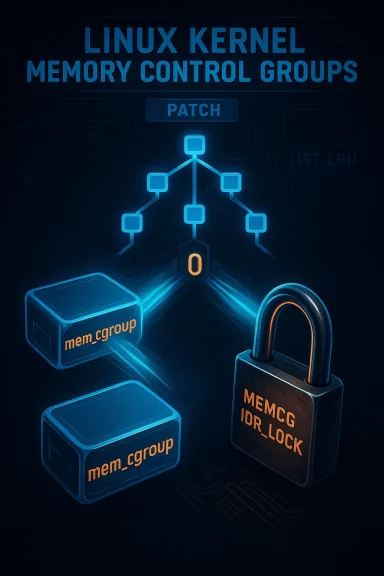 Background / Overview
Memory control groups (memcgs) are a core kernel facility used to account and limit memory usage for containers, processes, and hierarchical resource domains. To manage compact numeric identifiers for memcgs, the kernel maintainers introduced an ID radix-tree (IDR) mapping (mem_cgroup_idr) in a commit that decoupled memcg IDs from CSS IDs. That change solved an earlier cgroup creation problem but implicitly relied on external synchronization guarantees when modifying the IDR. When idr_remove() was left unprotected, concurrent offlines of memcgs could race and corrupt the ID space.Operators observing hard-to-track, low-frequency kernel crashes that referenced list_lru internals — list_lru_add(), list_lru_del(), and reparenting logic — traced the root cause to situations where either a memcg ID entry was missing or multiple memcgs shared an ID. The practical result: when one memcg was offlined and its cleanup ran, list_lru bookkeeping for other memcgs could be torn down mistakenly, causing later accesses to crash the kernel. (lkml.indiana.edu)
This is an availability-centered bug: it does not expose secrets or grant privilege escalation directly, but it can produce deterministic and sustained service disruption when triggered. The NVD records this vulnerability with a CVSS v3.1 base score of 4.7 (Medium) reflecting the local attack vector and the availability impact.
Why this happened: a technical primer
IDR and external synchronization
The Linux kernel’s IDR API provides a convenient way to allocate compact integer IDs for kernel objects. However, the API commonly expects callers to provide locking around sequences of modifications when multiple code paths might interact with the same IDR concurrently. In the memcg case:- idr_alloc() and idr_replace() were already performed from contexts protected by cgroup_mutex (css callbacks), giving them mutual exclusion.
- idr_remove() — the operation that deletes entries when a memcg goes offline — could be invoked from contexts that were not always holding the same global protection, allowing concurrent removal operations on different memcgs to race against allocations or replacements.
Observable failure mode: list_lru corruption
The symptom that tipped operators off was not “weird IDs in an IDR” but low-frequency, hard-to-diagnose crashes in list_lru code paths. Under the race, two memcgs can be assigned the same numeric ID in mem_cgroup_idr. Later, when one of these memcgs is offlined, cleanup routines will remove list_lru_one buckets for that numeric ID — which now belong to multiple memcgs — leaving the other memcg(s) without the expected list_lru_one and therefore in an inconsistent state. Subsequent list_lru accesses then crash. This explains the diversity of crash signatures seen in fleets: the underlying fault is a corruption of memcg bookkeeping, but the clinical manifestation touches many list_lru call sites. (lkml.indiana.edu)The upstream fix: what changed in the code
The kernel fix is small and surgical: maintainers added a dedicated spinlock around all IDR operations on mem_cgroup*idr and adjusted allocation routines to use a preload/lock/alloc sequence so the critical idr** calls are atomic with respect to one another. Concretely:- A new spinlock (memcg_idr_lock) was introduced.
- idr_alloc() calls were wrapped in a helper that preloads, takes the spinlock, calls idr_alloc(), releases the spinlock, and completes the preload.
- idr_remove() calls in mem_cgroup_id_remove() were similarly protected with the spinlock.
- idr_replace() that publishes an ID after onlining is now performed under the same spinlock. (lkml.indiana.edu)
Why a small change matters: IDR is a compact, widely used kernel primitive, and the fix avoids larger, more invasive refactors of memcg allocation paths while closing the precise race window that caused duplicates and missing entries. The corrective pattern — protect shared IDR state with an internal lock and use idr_preload appropriately — is a standard kernel hygiene practice and is low-risk to backport to stable trees. (lkml.indiana.edu)
Impact and exploitability — realistic attacker model
Threat model and reachability
- Attack vector: Local only (AV:L). The operations that manipulate memcgs are performed by privileged users or by subsystem code paths that typically require capabilities (e.g., NET_ADMIN or root) or control over cgroup lifecycle. In many systems, user namespaces or container runtimes that permit unprivileged creation/management of cgroups increase the practical exposure.
- Privileges required: Low to moderate local privileges depending on host configuration. In hardened hosts without unprivileged cgroup manipulation, exploitation by an unprivileged user is harder; in multi-tenant clouds or CI systems where tenant workloads can create or drop cgroups, the risk is meaningful.
Consequences
- Availability: The primary impact is high — a kernel crash, panic, or persistent disruption of memory accounting and reclamation operations, depending on how list_lru corruption triggers downstream faults. Service processes may be killed, containers may lose memory-control protections, and hosts may become unstable until reboot or kernel upgrade.
- Confidentiality / Integrity: There is no public evidence that this race leads directly to arbitrary code execution or data exfiltration. However, kernel availability faults are often part of larger chains; availability primitives can facilitate escalation in complex exploit scenarios. Treat this as an operational availability risk first.
Exploitability in the wild
At disclosure time and in follow-ups from vulnerability trackers, there was no confirmed, widespread exploitation campaign for CVE-2024-43892; public proof-of-concept code was not reported. Nonetheless, operators in large fleets observed the related panics and backtraced them to this race, giving this bug real operational burndown priority beyond mere academic severity scores. Given the relatively low complexity to cause concurrent memcg offlines on misconfigured hosts, the practical advice is to treat it as a patch-now item for exposed systems.Which systems are affected
- Any Linux kernel build that includes the memcg changes that introduced the separate memcg IDR (commit 73f576c04b94) and has not applied the protective spinlock fix is in scope. That maps to akernel series that carried the original commit. (lkml.indiana.edu)
- Many major distributions and vendors issued advisories and kernel updates that map the CVE to specific packages — Amazon Linux, Red Hat, SUSE, Ubuntu, Debian and others tracked and released fixes or backports. However, packaging and backport timelines vary by vendor and kernel branch; operators must confirm the exact fixed package for their distribution.
- Embedded appliances and vendor kernels that lag behind mainline trees are a particular concern: appliances that manage cgroups or run workloads that create/delete cgroups frequently could have latent, low-frequency crashes. The same root cause pattern appears elsewhere in device drivers and has historically been a hard-to-diagnose fleet problem.
Patching and mitigation guidance — practical checklist
Apply vendor-supplied kernel updates as the authoritative remediation path. The fix is small and has been backported into many venprefer those packages over home-rolled workarounds. For environments where immediate patching is difficult, the bulk of exposure mitigation is operational.Short-term (emergency) steps
- Inventory: Determine which hosts are running vulnerable kernt inventory for kernels and package versions flagged by vendor advisories (check vendor CVE trackers).
- Reduce attack surface: Prevent untrusted users/containers from creating or destroying memcgs. Remove capabilities (drop CAP_SYS_ADMIN or NET_ADMIN where not required), disable unprivileged user namespaces, and avoid exposing cgroup creation operations to multi-tenant workloads.
- Isolate management networks: If devices or appliances cannot be patched immediately, place them behind protected management VLANs and block untrusted adjacent hosts from performing orchestration workflows that create/delete cgroups.
- Monitor: Increase log monitoring for list_lru warnings, kernel oopses referencing list_lru functions, and sudden memcg offlining events. Configure centralized kernel-logging ingestion and set alerts on relevant tracebacks.
- Apply vendor kernel updates: Install vendor-supplied kernels or livepatches that include the mem_cgroup_idr synchronization fix and reboot as required. Validate post-reboot that the kernel package version includes the backported commit.
- Validate fix presence: For teams building custom kernels, confirm the memcg_idr*lock and helper wrapper are present in mm/memcontrol.c and that idr** operations on mem_cgroup_idr are performed under that lock (the upstream patch shows the exact changes and commit context). (lkml.indiana.edu)
- Test in staging: Run container churn tests and heavy cgroup create/delete workloads to exercise concurrency paths before promoting patched kernels to production. Measure for any regressions in memory-management latency or functional regressions.
Detection and forensic indicators
- Kernel oops traces that include list_lru functions (list_lru_add, list_lru_del) and references to memcg onlining/offlining are strong signals for the underlying race. These are the same traces reported by fleets that connected intermittent crashes to mem_cgroup_idr races. (lkml.indiana.edu)
- Look for records of memcg online/offline events at high concurrency during test or production workloads (orchestrators performing many small job startups/shutdowns). If offlines cluster with kernel warnings, investigate memcg ID registration stttps://nvd.nist.gov/vuln/detail/cve-2024-43892)
- Forensic approach: collect sanitized kernel logs, the lastkmsg or crash dump, and relevant dmesg output. If possible, reproduce the conditions in a staging lab by rapidly creating and dropping memcgs under heavy CPU concurrency; that helps validate whether the kernel in use contains the fix.
Operational risk analysis — strengths and residual risks
Strengths ream remedy is minimal and narrowly scoped: introducing a spinlock and wrapping idr operations avoids broad structural changes and is low-risk for regressions.- Multiple vendors accepted and backported the fix into stable kernels, demonstrating that the change is safe for production use and can be deployed across distribution branches. (lkml.indiana.edu)
- The fix eliminates the specific idr race but does not change memcg ownership semantics or add per-tenant quotas; other memcg-related races or resource exhaustion vectors still exist and should be independently audited. Infrastructure that still allows untrusted cgroup lifecycle control remains exposed to availability faults in other memcg paths.
- Backport fragmentation: some distributors may delay or omit backports for older or vendor-swizzled kernel branches. Devices with long-life-cycle kernels (embedded appliances, vendor appliances) may remain unpatched; such devices should be inventoried and prioritized.
- Observability gaps: intermittent race conditions often require good telemetry to detect. Teams lacking centralized kernel logging, crash dump collection, or robust staging environments may miss the issue until customers observe outages. Strengthen observability for long-tail reliability bugs.
Recommended playbook for IT and SRE teams
- Inventory and classify:
- Use configuration management and image scanning to find hosts with kernels from the affected families.
- Flag multi-tenant hosts, CI runners, and any system that allows user-driven cgroup creation as high-priority.
- Patch rapidly:
- Coordinate a rolling kernel upgrade with service owners. Where vendor livepatches are available, evaluate for use but verify that the vendor’s livepatch covers this specific commit.
- For appliances with vendor kernels: contact the vendor for a firmware/kernel patch schedule or plan isolation if the vendor cannot deliver timely fixes.
- Harden capabilities:
- Remove unneeded capabilities from containers (drop CAP_SYS_ADMIN/CAP_NET_ADMIN).
- Disable unprivileged user namespaces where not required.
- Increase telemetry:
- Collect and centralize kernel logs, enable kdump/crashkernel where possible, and configure alerts for list_lru and memcg-related oopses.
- Test choreography:
- After patching, run churn tests that mimic production container/job creation patterns to validate that the race no longer reproduces.
- Post-incident review:
- If you observed incidents attributable to this bug, document the sequence, add guards in orchestration to avoid concurrent offline/onlines or reduce concurrency temporarily, and add the remediation to your standard image baseline.
Cross-verification and provenance
The facts presented here are cross-checked against multiple authoritative sources:- The NVD entry provides the canonical CVE summary and the CVSS scoring for CVE-2024-43892.
- The upstream patch and mailing-list POST that introduce memcg_idr_lock and protect idr_alloc/idr_remove/idr_replace are available in the kernel mailing-list archives and show the exact code modifications (mm/memcontrol.c). That patch is the definitive technical record of the change. (lkml.indiana.edu)
- Vendor trackers and advisories (Amazon ALAS, Red Hat, OSV/OSV.dev) map the CVE to distribution package updates and backports; these are the authoritative channels for applying fixes to packaged kernels.
Final assessment and conclusions
CVE-2024-43892 is a representative example of how concurrency assumptions at the kernel-data-structure level can cause low-frequency, high-impact availability faults. The root cause—unprotected idr_remove() calls against mem_cgroup_idr—was subtle, produced widely varying crash signatures (making diagnosis difficult), and had real operational impact in production fleets. The upstream remediation is focused, corrects the synchronization gap with a dedicated spinlock, and is already packaged by major vendors. (lkml.indiana.edu)Actionable bottom line for WindowsForum readers running Linux-based infrastructure or appliances:
- Treat CVE-2024-43892 as a patch-priority item for hosts that allow local or tenant-driven cgroup lifecycle operations.
- Prefer vendor-supplied kernel packages or livepatches, verify the presence of the memcg_idr synchronization commit in your kernel, and stage updates with churn tests that stress cgroup create/delete paths.
- Improve observability for kernel oopses and proactively restrict untrusted processes from creating or destroying memcgs until kernels are updated.
Source: MSRC Security Update Guide - Microsoft Security Response Center