

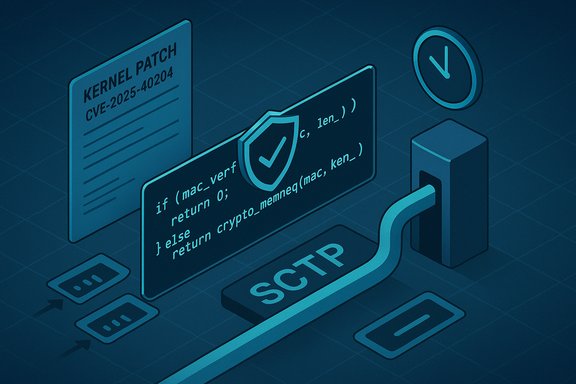
The Linux kernel update that closed CVE-2025-40204 was a surgical but important hardening: the SCTP code was performing a MAC (message authentication code) comparison using a timing‑dependent routine, and maintainers replaced that comparison with a constant‑time helper to remove a potential timing side‑channel. This change is small in lines but significant in principle — MAC checks that leak timing information can, in the right attacker model, be used to recover bits of authentication material or make PSK/identity enumeration materially easier — and the kernel team has backported the fix into stable trees and distribution updates to eliminate that vector.
SCTP (Stream Control Transmission Protocol) is a transport‑layer protocol used in niche but important deployments: telecom signaling, carrier/enterprise gateways, some clustered systems, and other specialized network appliances. Like any authenticated protocol, SCTP relies on MACs to validate the integrity and authenticity of critical control chunks. If the code that compares MACs takes a shorter or longer amount of time depending on how many bytes match, an attacker who can accurately measure response timing can infer information about the MAC value — a classical timing side‑channel. Kernel developers prefer to eliminate these risks by ensuring all MAC comparisons run in constant time (that is, execution time is independent of the inputs). Timing attacks are not always practical on noisy, high‑latency public networks, but they can be practically useful in low‑noise scenarios: co‑located adversaries in cloud environments, on‑path observers with fine time resolution, or attackers who can provoke thousands to millions of repeated operations to average out noise. That makes even a small timing leak worth fixing in security‑critical code paths.
Administrators should prioritize inventory, apply vendor kernel updates and reboots, and harden exposure for services that accept SCTP traffic until the kernel updates are widely deployed. Where patches are delayed, apply network mitigations and increase telemetry retention for high‑value assets. The change is small, but it matters — constant‑time comparisons are a foundational defensive practice for cryptographic verification, and removing this timing channel removes yet another avenue attackers could exploit in targeted scenarios.
Source: MSRC Security Update Guide - Microsoft Security Response Center
 Background
SCTP (Stream Control Transmission Protocol) is a transport‑layer protocol used in niche but important deployments: telecom signaling, carrier/enterprise gateways, some clustered systems, and other specialized network appliances. Like any authenticated protocol, SCTP relies on MACs to validate the integrity and authenticity of critical control chunks. If the code that compares MACs takes a shorter or longer amount of time depending on how many bytes match, an attacker who can accurately measure response timing can infer information about the MAC value — a classical timing side‑channel. Kernel developers prefer to eliminate these risks by ensuring all MAC comparisons run in constant time (that is, execution time is independent of the inputs). Timing attacks are not always practical on noisy, high‑latency public networks, but they can be practically useful in low‑noise scenarios: co‑located adversaries in cloud environments, on‑path observers with fine time resolution, or attackers who can provoke thousands to millions of repeated operations to average out noise. That makes even a small timing leak worth fixing in security‑critical code paths. What changed (technical summary)
The upstream patch replaces a standard, early‑exit comparison with the kernel’s constant‑time helper for memory comparisons.- The vulnerable pattern used a raw
memcmpstyle comparison that returns as soon as a mismatch is observed. This yields runtime proportional to the length of the matching prefix. - The patch includes the crypto utilities header and switches the comparison to
crypto_memneq(a constant‑time helper that deliberately scans every byte and produces a single aggregated result), ensuring timing does not depend on the compared data. The patch edits appear in the SCTP source files that perform MAC verification.
Why constant‑time matters for MAC comparisons
A MAC comparison is an equality check over a fixed number of bytes. If that comparison returns faster when the first N bytes match, an attacker who can measure the time between sending a candidate packet and observing the system’s response can distinguish correct prefixes of the MAC. Repeating and carefully aggregating measurements can allow an attacker to reconstruct the MAC one byte at a time — especially when:- The attacker can control or repeatedly trigger the code path that performs the check.
- Network jitter, scheduling noise, and path variability are minimized (for example, when the attacker is on the same host network or colocated in the same rack or cloud instance).
- The attacker can run large numbers of trials and apply statistical analysis to average out noise.
memcmp for crypto_memneq or other constant‑time helpers in cryptographic verification paths. Scope, affected systems, and patch status
- Affected code: Linux kernel SCTP MAC verification code paths that predate the merged fix in the stable trees. The change is in SCTP source files (for example
net/sctp/sm_statefuns.candnet/sctp/sm_make_chunk.c). - Affected versions: the CVE is attributed to the upstream Linux kernel and therefore applies to any distribution kernel that contains the pre‑fix commits. Distribution trackers and OSV list the vulnerability and map fixed versions to specific distribution packages. Debian’s security tracker lists fixed package versions and backports for various releases; operators should consult their distro security tracker for precise package numbers for their releases.
- Patch availability: the upstream commit was merged into the stable kernel trees and staged for backports; stable kernel releases and distribution updates (for example, the Debian fixes) include the change. Maintain stable kernel channels and distribution advisories are the canonical way to get the fix into production kernels.
Exploitability and operational risk
- Remote exploitation: public records indicate this CVE is not a remote‑code execution primitive; it’s a timing side‑channel hardening. Many public trackers mark its exploitable probability as low to minimal in widespread internet conditions. That assessment reflects the practical difficulty of reliably measuring microsecond differences across noisy internet paths.
- Targeted danger: risk is higher for targeted attackers who can reduce noise — for example, co‑located attackers on the same host or LAN, attackers with on‑path visibility in low‑latency environments, or actors who can trigger repeated handshake/packet attempts and aggregate many timing samples.
- In‑the‑wild evidence: at disclosure there were no authoritative public reports of exploitation in the wild tied to this CVE. That absence reduces immediate urgency for some environments, but it should not be read as justification to delay patching — timing channels are often escalated into practical attacks when combined with other weaknesses or privileged positions.
- If your Windows estate includes Linux VMs, containers (host kernel exposure), WSL2 instances, network appliances, telecom gateways, or embedded devices, those components can be affected until their kernels are patched.
- Multi‑tenant environments and cloud hosts are higher risk because local attackers or co‑tenants may obtain the low‑noise observation capability needed to exploit timing channels.
Detection, telemetry, and triage guidance
Detection of timing attacks is inherently difficult — by design the attacker’s signal is hidden in microsecond timing differences. Instead, defenders should focus on:- Patch status: inventory kernels and packages and confirm the presence of the upstream stable commits or vendor package versions that include the fix. Use
uname -rfor running kernel versions and consult your distribution’s security tracker for backport mappings. - High‑frequency probes: monitor for unusual, high‑volume SCTP control traffic or repeated authentication failures originating from single IPs or small IP ranges; these patterns can indicate probing to conduct timing measurements. Correlate with firewall logs, IDS/IPS alerts, and NGINX/HAProxy logs if those load balancers front SCTP‑capable services.
- Local telemetry: for hosts that present higher risk (multi‑tenant, telecom stacks, critical gateways), increase logging retention around handshake/packet handling and capture high‑resolution network timing where feasible. Preserve logs or memory snapshots when suspicious behavior is detected because kernel changes are only active after a reboot.
- Post‑patch validation: reboot into the updated kernel and validate that the new kernel changelog references the upstream commit or that the distribution security advisory lists the CVE as addressed. Run representative SCTP workloads and ensure no regressions in packet handling.
Mitigation options (when immediate patching is not possible)
There is no safe, feature‑preserving hotfix that eliminates the timing leakage without a kernel update and reboot. Short‑term compensations include:- Restrict SCTP exposure: if the service accepts untrusted SCTP traffic, firewall access (ACLs) to trusted networks until the kernel can be updated.
- Rate limit and throttle: apply rate limits to handshake attempts or unusual authentication flows to raise the cost of mass probing.
- Reduce attacker vantage: in cloud environments, harden tenant isolation and avoid colocating high‑value targets with untrusted tenants when possible.
- Vendor coordination: for embedded appliances and vendor‑shipped network boxes that embed kernels, open a support ticket that references the CVE and request a firmware/package update schedule. Many embedded devices require vendor action because they use statically‑built kernels and do not automatically receive upstream patches.
Practical remediation playbook (step‑by‑step)
- Inventory — Run a discovery to list systems with SCTP enabled or that run custom kernels:
- Check running kernel:
uname -r. - Check for SCTP module:
lsmod | grep sctpormodinfo sctp. - Identify appliances and firmware images that embed Linux kernels.
- Map — Consult your distribution security tracker or vendor advisory for the package versions that include the fix. Debian, Ubuntu and other major distributions map upstream commits to fixed package versions; confirm which release line you run and the corresponding fixed kernel package.
- Patch — Schedule kernel package updates and reboots, prioritizing:
- Multi‑tenant hosts and cloud VM hosts.
- Telecom gateways, NAT/edge appliances, and devices exposed to untrusted networks.
- Systems that accept public SCTP traffic.
- Validate — Reboot into the updated kernel, confirm package/changelog references the fix, run SCTP smoke tests, and monitor logs for unexpected errors.
- Monitor — Add SIEM rules or log alerts for repeated SCTP AUTH failures or suspicious ClientHello/handshake patterns and retain longer network‑telemetry windows for high‑value systems.
Critical analysis — strengths, weaknesses, and residual risks
Strengths of the response- Surgical fix: the change uses an established crypto helper (
crypto_memneq/crypto‑*helpers) rather than ad‑hoc code, minimizing risk of regression while removing the timing leak. - Fast upstream action and stable backports: the kernel team integrated the fix into stable trees and coordinated with stable maintainers, enabling distributions to ship patches quickly. That makes remediation straightforward for environments that apply vendor updates.
- Distribution and vendor lag: upstream merges do not instantly patch every downstream system. Embedded appliances, network appliances, and vendor kernels frequently lag upstream by months, leaving a long tail of vulnerable devices. This supply‑chain lag is the central operational risk for this and similar kernel fixes.
- Measurement advantage scenarios: while internet‑scale exploitation is unlikely for most deployments, low‑noise, low‑latency internal networks, cloud colocations, or on‑path monitoring can make timing channels exploitable. Administrators should not dismiss the CVE solely because public exploit telemetry is absent.
- Incomplete telemetry: timing attacks are stealthy and hard to detect with ordinary logs; absence of proof of exploitation is not proof of absence. Keep stronger retention of network captures for high‑value services and plan for forensic capture if suspicious activity is observed.
- Any claim that the bug has been weaponized for remote RCE should be treated as unverified unless a reproducible proof‑of‑concept or incident report is published. Public trackers at disclosure showed no authoritative evidence of in‑the‑wild exploitation for this CVE.
Why Windows administrators should care
Many Windows environments are mixed estates: virtualization hosts, container farms, VPN gateways, and management appliances often run Linux components or rely on Linux‑based services. A kernel timing leak in SCTP that remains unpatched on those components can introduce an indirect path for lateral reconnaissance or authentication probing that affects Windows‑hosted workloads (for example, by degrading trust in PSK mechanisms used for secured links). Treat Linux kernel security bulletins and distribution advisories as part of your Windows patching workflow when those Linux components are in your infrastructure.Conclusion
CVE‑2025‑40204 is a textbook example of a micro‑hardening that fixes a real, if narrow, class of risk: timing leaks in MAC verification. The engineering fix — replacing a timing‑dependent comparison with a constant‑time helper — is the right, low‑risk approach and has been merged into stable kernels and distribution updates. The practical exploitation difficulty on noisy public networks keeps the immediate threat low for most deployments, but the risk is meaningful in low‑noise contexts and the supply‑chain reality (embedded appliances, vendor kernels) means remediation windows can be long.Administrators should prioritize inventory, apply vendor kernel updates and reboots, and harden exposure for services that accept SCTP traffic until the kernel updates are widely deployed. Where patches are delayed, apply network mitigations and increase telemetry retention for high‑value assets. The change is small, but it matters — constant‑time comparisons are a foundational defensive practice for cryptographic verification, and removing this timing channel removes yet another avenue attackers could exploit in targeted scenarios.
Source: MSRC Security Update Guide - Microsoft Security Response Center
