

Mark Russinovich, Microsoft Azure’s chief technology officer, has quietly turned a 40‑year‑old Apple II utility he wrote as a teenager into a sobering demonstration: modern large language models can decompile raw machine code, reason about its control flow, and surface real bugs in firmware-level programs — a capability that lowers the technical bar for both defenders and attackers and shines a harsh light on the security of the billions of microcontrollers that run the physical world.
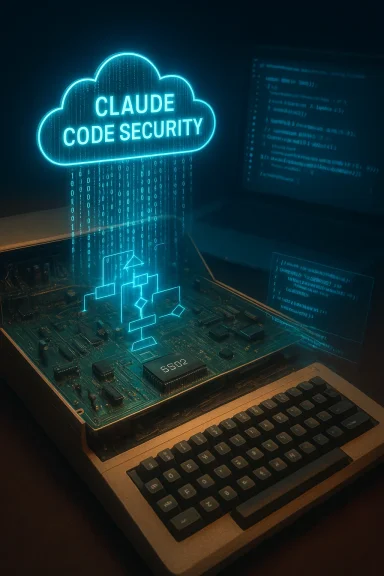
Mark Russinovich’s anecdote is simple and human: he fed the assembled 6502 machine code for an Apple II utility he wrote in May 1986 to Anthropic’s Claude model, and Claude reported a silent incorrect behavior in the program’s error handling and even suggested a fix — an observation that, while unsurprising to vintage‑computing enthusiasts, matters enormously when you scale the capability to modern firmware fleets.
Anthropic framed this capability as part of a broader product narrative for Claude Code Security, a set of features and demonstrations the company has used to argue that its models can autonomously audit code and find previously unknown vulnerabilities across a range of software artifacts. Press reporting and vendor briefings tied Claude to large audits that reportedly identified hundreds of issues in open‑source projects, illustrating the model’s capacity to reason about data flow and program state rather than merely matching textual patterns.
Why does this small, human story matter? Because the target in the demo — 6502 machine language running on an Apple II — is functionally identical, in security posture if not in performance, to the vast body of embedded firmware that still runs appliances, industrial controllers, medical devices, automotive subsystems, routers, and remote telemetry units. Market and industry reports estimate that microcontroller shipments number in the tens of billions and that far more devices contain MCU family silicon than there are PCs. The scale is critical: a capability that can reason about raw machine code at scale changes the threat model for decades‑old and little‑audited firmware.
Industry and government responses will need to be pragmatic and multidisciplinary: better engineering practices for firmware, investment in secure update infrastructure, legal frameworks that incentivize maintenance, and operational tools that combine human expertise with AI acceleration. The clock is ticking: the capability to find problems is already here, and the opportunity to secure the installed base — before those findings translate rapidly into widespread exploitation — is finite. The time to act is now.
Source: Digg Microsoft Azure CTO says Claude found Vulnerabilities in his old Apple II code | technology
 Background
Mark Russinovich’s anecdote is simple and human: he fed the assembled 6502 machine code for an Apple II utility he wrote in May 1986 to Anthropic’s Claude model, and Claude reported a silent incorrect behavior in the program’s error handling and even suggested a fix — an observation that, while unsurprising to vintage‑computing enthusiasts, matters enormously when you scale the capability to modern firmware fleets.Anthropic framed this capability as part of a broader product narrative for Claude Code Security, a set of features and demonstrations the company has used to argue that its models can autonomously audit code and find previously unknown vulnerabilities across a range of software artifacts. Press reporting and vendor briefings tied Claude to large audits that reportedly identified hundreds of issues in open‑source projects, illustrating the model’s capacity to reason about data flow and program state rather than merely matching textual patterns.
Why does this small, human story matter? Because the target in the demo — 6502 machine language running on an Apple II — is functionally identical, in security posture if not in performance, to the vast body of embedded firmware that still runs appliances, industrial controllers, medical devices, automotive subsystems, routers, and remote telemetry units. Market and industry reports estimate that microcontroller shipments number in the tens of billions and that far more devices contain MCU family silicon than there are PCs. The scale is critical: a capability that can reason about raw machine code at scale changes the threat model for decades‑old and little‑audited firmware.
What exactly happened: the Apple II case (a concise timeline)
- Russinovich provided an assembled 6502 Apple II binary — the Enhancer utility he wrote in 1986 — to Anthropic’s Claude model for analysis.
- Claude identified that when a target line number could not be found, the program advanced the program counter instead of signaling an error, producing silent incorrect behavior. The model suggested checking the processor’s carry flag and invoking an error handler as a corrective measure.
- Anthropic and subsequent reporting positioned this demonstration as an example of decompilation + semantic analysis performed by Claude Code Security — the same approach that Anthropic used to claim discovery of hundreds of previously unknown vulnerabilities across modern open‑source projects.
How LLMs can reverse engineer machine code (explained)
Modern LLMs are not traditional decompilers. They are statistical models trained on enormous corpora that include source code, documentation, binary analysis writeups, textbooks, and possibly disassembly examples. But several factors make them capable de‑facto binary analysts:- Pattern generalization at scale: LLMs have seen huge numbers of code snippets, idioms, and low‑level patterns during training. That exposure lets them infer likely semantics from opcode sequences, interrupt tables, and common calling conventions.
- Contextual reasoning: Larger models can maintain longer reasoning chains, allowing them to reconstruct control‑flow graphs, reason about flag behavior (carry/zero/overflow), and follow data flows through memory and stack operations.
- Tooling and plugins: When combined with on‑model or off‑model binary analysis tools (disassemblers, emulators, symbolic engines), an LLM can orchestrate a multi‑step workflow: disassemble bytes, annotate instructions, emulate execution paths, and propose fixes. This is the architecture behind many modern LLM‑assisted code‑analysis systems.
Why this is a systemic concern: the scale and exposure of firmware
It’s tempting to treat a hobbyist Apple II utility as quaint. That would be a mistake. The same classes of issues — off‑by‑one errors, silent fall‑through behavior, unchecked return codes — persist in firmware across product generations. The global MCU ecosystem is massive:- Industry estimates put microcontroller shipments in the billions annually, with cumulative installed bases that number in the tens of billions of units across consumer, automotive, industrial, and infrastructure markets. Reports compiled by market research firms and analysts consistently show multi‑billion unit volumes and a market value measured in tens of billions of dollars.
Dual‑use dynamics: why defender advantage may be temporary
LLM‑based auditing tools are valuable for defenders; they can accelerate root cause analysis, reduce manual reverse‑engineering time, and surface dangerous patterns in binary blobs. But the same capabilities are accessible to attackers. The Russinovich demo is a canary for the dual‑use nature of these tools.- Offensive actors can feed commodity firmwares, open‑source drivers, or extracted ROM images into the same models and quickly obtain candidate vulnerabilities and exploit ideas.
- The gap between finding a vulnerability and exploiting it is real, but that gap is narrowing. Publicly reported model‑driven analyses have already accelerated vulnerability triage, and specialized, attacker‑grade pipelines could automate exploit‑generation over time.
- The discovery problem — finding bugs — is becoming cheaper and faster.
- The remediation problem — patching devices at scale — remains hard and often requires supply‑chain coordination, field recalls, or hardware replacement.
Technical risks: concrete failure modes in firmware that LLMs can expose
AI‑assisted binary analysis excels at finding certain classes of errors that are common in firmware:- Silent incorrect behavior / unchecked branch outcomes: As in the Apple II demo, firmware that fails to signal or trap error cases can create undefined behavior exploitable as logic corruption.
- Input validation at peripheral boundaries: UART/USB/fieldbus stacks often assume framed or sanitized input. LLMs that can reason about parsers can highlight paths where malformed packets bypass checks.
- State machine desynchronization: Devices that manage mode transitions (bootloader ↔ runtime) frequently contain race or ordering bugs that can be abused to force a device into an unexpected state.
- Privilege and access assumptions: MCU firmware that trusts external components (sensor ICs, boot ROMs, shared memory) creates systemic trust relationships that are ripe for exploitation if assumptions are violated.
- Weak cryptographic usage and key management: LLMs can flag incorrect uses of crypto primitives, reused keys, or insecure RNG construction in embedded code.
Practical mitigation steps for organizations and vendors
Theble. Here are concrete, prioritized actions that engineering teams, OEMs, and incident response units should adopt now:1. Inventory and categorize firmware assets
- Maintain a canonical inventory of production firmware images, cryptographic manifests, and device IDs.
- Prioritize devices by exposure: internet‑connected routers, OT gateways, and automotive telematics units should be top of the list.
2. Treat firmware like application code
- Add firmware artifacts to source control and CI/CD. Store build artifacts, compiler versions, and link maps so that reproduction is possible.
- Integrate automated static analysis, fuzzing, and SCA (software composition analysis) into the firmware pipeline. Combine classical binary tools with LLM‑assisted reasoning to reduce false positives and speed triage.
3. Use defense‑in‑depth on device
- Enforce firmware signing and Secure Boot where possible; require bootloaders to verify image authenticity before execution.
- Harden out‑of‑band update mechanisms: authenticate updates, require multi‑factor update authorization for industrial devices, and segment update channels. (Be aware of certificate lifecycle: poorly timed certificate expirations can themselves cause mass device failures if not managed.)
4. Adopt a vulnerability‑forward remediation policy
- Expect your audit pipeline to find issues faster; align patch windows, testing capacity, and logistics to shrink mean time to remediation.
- For devices that cannot be patched remotely, design compensating controls — network segmentation, allow‑listing, and telemetry to detect anomalous behavior.
5. Establish red/blue workflows that include LLMs
- Use LLMs to augment both offensive (red team) and defensive (blue team) analyses, but do so in controlled environments. Treat model outputs as hypotheses requiring verification via emulation or instrumentation, not as stand‑alone proofs.
6. Share telemetry and indicators
- Proactively share indicators of firmware abuse with industry ISACs, maintain curated exploit telemetry, and contribute to coordinated disclosure when systemic findings emerge.
Legal, policy, and ecosystem considerations
The Russinovich demonstration exposes wider policy questions:- Liability and product lifecycle: How will regulators demand secure lifecycle support for embedded devices that last a decade or more? Consumers and industrial buyers cannot realistically upgrade tens of millions of deployed devices quickly.
- Disclosure norms for AI‑found vulnerabilities: When a model finds vulnerabilities in widely used open‑source libraries or vendor firmware, who receives the initial report? Vendor coordination and responsible disclosure frameworks will be tested at scale as automated audits produce more findings.
- Dual‑use regulation: Banning or severely limiting LLM‑assisted analysis is neither realistic nor desirable; defenders need the capability. Instead, governance should focus on access controls, model‑use agreements, and operational constraints that reduce mass automated exploitation.
The research and tools landscape: what’s available now
Academic and industry work already shows both the promise and limits of automating vulnerability discovery:- Benchmarks comparing models’ ability to find and exploit software issues show variation by model and by task; a model can be excellent at ideation yet still require human verification for reliable exploitability.
- Evolutionary fuzzing, symbolic execution, and targeted coverage‑guided fuzzers remain powerful complements to LLM reasoning: they validate speculative paths and trigger edge conditions that models may flag. Combining LLMs for hypothesis generation and classical tooling for verification is a practical recipe.
Strengths and limitations of the demonstration — a critical appraisal
Strengths (what the demo proves)
- Reality check: The Russinovich example demonstrates that LLMs can operate meaningfully at a low level, not just at the source‑code or documentation layer. That semantic depth matters.
- Speed: Where a human reverse‑engineer might spend hours to reconstruct intent and probable fixes, a well‑prompted model can produce targeted hypotheses in minutes.
- Scalability: The same approach can be automated and applied to large binary corpora, enabling rapid surface discovery across many firmware families.
Limitations and caveats
- Verification needed: Model outputs are suggestions — disassembly errors, misidentified calling conventions, or hallucinated register semantics are real risks. Every AI‑surfaced bug requires human verification and preferably dynamic testing.
- Exploit gap remains: Finding a vulnerable logic path is not the same as developing a working exploit, particularly against constrained embedded stacks. For many devices the engineering effort to exploit remotely remains nontrivial.
- Data and model bias: LLMs reflect their training data. For very obscure chips or proprietary instruction sets with little public training data, model accuracy will be lower.
- Operational constraints for defenders: Many vendors lack the logistics to patch at scale quickly; discovery without remediation capability can increase risk if findings leak.
What readers and IT teams should do next (checklist)
- Audit: Conduct a prioritized firmware inventory and subject high‑exposure images to combined LLM + classical binary analysis.
- Harden update paths: Verify cryptographic signing and update authentication for all devices you ship or support.
- Segment: Apply network segmentation and allow‑listing for devices with limited patchability.
- Plan remediation: Build operational plans that shrink patch windows for critical devices and coordinate vendor disclosures.
- Train staff: Teach incident responders and firmware engineers how to validate AI findings (emulation, logging, fuzz harnesses).
- Engage peers: Share indicators and playbooks with industry groups and ISACs to accelerate community defenses.
Conclusion
The image of a 6502 binary typed into a magazine being audited by a cloud‑scale AI model cuts through jargon and hype: it is a demonstrable, human‑scale illustration of a capability with systemic consequences. LLMs that can decompile and reason about machine code make vulnerability discovery dramatically cheaper and faster. That is a boon to defenders who need to audit decades of forgotten firmware, and simultaneously a clarifying threat to defenders who must patch or compensate for those vulnerabilities at scale.Industry and government responses will need to be pragmatic and multidisciplinary: better engineering practices for firmware, investment in secure update infrastructure, legal frameworks that incentivize maintenance, and operational tools that combine human expertise with AI acceleration. The clock is ticking: the capability to find problems is already here, and the opportunity to secure the installed base — before those findings translate rapidly into widespread exploitation — is finite. The time to act is now.
Source: Digg Microsoft Azure CTO says Claude found Vulnerabilities in his old Apple II code | technology