

Logicall is building a unified data and AI logistics platform on Microsoft Azure with HSO, using Microsoft Fabric, Purview, Power BI, Entra, and integration services to create a governed operational datastore, customer portal, near real-time APIs, dashboards, and future AI agents. The company’s bet is not merely that cloud analytics will make logistics prettier on a screen. It is that logistics, a business built on motion, exceptions, and promises, now depends on whether every participant can trust the same data at the same moment.
That is the interesting part of Microsoft’s latest customer story. Logicall is not being presented as a company buying a dashboard package. It is being presented as a logistics operator trying to turn data into a core operating system for the business, and Microsoft’s cloud stack into the place where that operating system lives.
The logistics industry has always been a data business pretending to be a transport business. Every shipment creates a trail of orders, milestones, exceptions, documents, location updates, customer messages, customs events, invoices, and service-level commitments. The hard part is not producing data; it is making that data coherent enough to run the company.
Logicall’s move reflects that reality. The company describes the platform as a shared foundation for operational processes and analytics across the organization, not as a side project for reporting teams. That distinction matters because the traditional split between “systems that run the business” and “systems that analyze the business” is becoming a liability.
In a warehouse, a late scan is not just an analytics defect. It can become a missed delivery promise, a customer service ticket, a planning error, and eventually a margin problem. In freight forwarding, parcel management, road transport, and fulfillment, the same shipment may pass through multiple systems and handoffs before the customer ever sees a status update.
Logicall’s stated ambition is to create one trusted source of truth across those workflows. That phrase is overused in enterprise technology, but in logistics it has a sharper meaning: if the portal, API, planner, operations team, customer dashboard, and predictive model disagree, the business is slower than its competitors even if its trucks are moving.
That is a tidy architecture diagram, but the customer story is really about organizational compression. Microsoft wants enterprises to believe that aligning around one ecosystem reduces the cost of stitching together data platforms, governance tools, identity systems, analytics software, and AI services. Logicall appears to have accepted that premise, with the caveat that the convenience comes with real dependency.
The company’s own language acknowledges the risk. Committing to one ecosystem can accelerate delivery, improve compliance posture, and make it easier to adopt new platform features as Microsoft ships them. It can also concentrate architectural, commercial, and skills risk in one vendor relationship.
That tradeoff is not unique to Microsoft. AWS, Google Cloud, Snowflake, Databricks, SAP, Oracle, and Salesforce all push variations of the same strategic gravity. What makes Microsoft’s pitch powerful is that many companies already live in Microsoft identity, productivity, BI, and enterprise application environments. Fabric and Copilot are designed to make the next step feel less like a migration and more like an extension of what the business already uses.
For Logicall, the stack is therefore both a technical choice and a governance choice. The company is not just asking where to store data. It is asking which platform becomes the default place where data definitions, access rules, analytics, APIs, dashboards, and AI behavior converge.
A logistics platform cannot simply ingest everything and declare victory. It must decide what a shipment is, what a milestone means, how customer-specific exceptions map into common workflows, which events are authoritative, and how to reconcile latency between operational systems. It must support standardization without flattening every business unit into a fantasy of uniformity.
That is especially difficult in a buy-and-build model, where companies grow through acquisition, expansion, or the layering of new services. Every acquired business tends to arrive with its own systems, terms, reports, customer habits, and data scars. The platform has to move fast enough to support growth while imposing enough order to prevent the whole data estate from becoming a museum of past decisions.
Logicall’s emphasis on a shared data language is therefore central. AI systems do not rescue messy semantics; they amplify them. A model trained or prompted against inconsistent operational data may produce confident nonsense, and a dashboard built on disputed definitions can become a political artifact rather than an operational tool.
This is where Microsoft Purview enters the story as more than a compliance checkbox. A catalog, governance layer, and access model help determine whether data can be reused safely across teams, portals, APIs, and analytics products. Governance is often treated as the brake pedal, but in an AI-ready platform it is also the steering wheel.
For logistics, that pitch is well tuned. A supply chain platform needs to combine batch history, real-time events, operational status, customer-facing analytics, and predictive signals. A delayed shipment is not useful only as a line in yesterday’s report; it may need to trigger a customer notification, a planning adjustment, or a risk score while there is still time to act.
Microsoft’s own supply chain reference patterns increasingly describe Fabric as a way to unify logistics feeds, ERP data, vendor networks, dashboards, and real-time intelligence. Logicall’s use case maps neatly onto that story. It wants dashboards and reporting, but it also wants near real-time APIs based on a generic data model.
That last point is important. A Power BI dashboard may satisfy internal management, but APIs are how a logistics provider becomes embedded in a customer’s operations. If customers can integrate directly into Logicall’s platform and consume consistent milestone, track-and-trace, and status data, the platform becomes part of the customer’s own process architecture.
The danger is that “unified” can become another word for “centralized bottleneck.” Fabric may reduce fragmentation, but it does not automatically solve domain ownership, data quality incentives, cost control, or lifecycle management. A unified platform still needs disciplined engineering practices, release management, observability, and clear accountability when the data is wrong.
But the sequence matters. Logicall is describing AI as the next layer after structured, governed, trusted data. That is a more credible framing than the common enterprise fantasy in which generative AI floats above broken systems and magically compensates for years of data neglect.
In practice, AI agents in logistics will need to know which data they can trust, which actions they are allowed to take, which customers have special handling requirements, and when to escalate to a human. They will need identity-aware access, auditability, and strong guardrails because a wrong answer in logistics can become a missed shipment, a failed service commitment, or a customer relationship problem.
Copilot for Power BI is the lower-risk end of that spectrum. AI-assisted analysis can help users ask questions of data, generate summaries, and explore patterns faster. It is useful, but it is not the same as allowing agents to intervene in planning, customer communication, or operational execution.
The more ambitious future is agentic logistics: systems that can detect a disruption, understand its business impact, recommend alternatives, notify the right parties, and perhaps execute approved changes. That future depends less on model glamour than on whether the underlying data platform can provide reliable state, governed access, and traceable decisions.
Logicall’s future-proof customer portal is therefore not a decorative layer. Track-and-trace dashboards, milestones, communication tools, and customer integrations are the visible face of the platform. They convert internal data discipline into external service quality.
That matters because logistics customers increasingly expect consumer-grade transparency in business-to-business supply chains. They want accurate status information, proactive communication, and integration into their own planning systems. “Where is my shipment?” is no longer a simple customer service question; it is an API requirement, a dashboard requirement, and an operational trust requirement.
Near real-time APIs based on a generic data model could give Logicall a stronger integration story. Instead of building one-off customer feeds for every major account, the company can expose consistent data products with secure access and a shared catalog. That is how a logistics provider starts to behave more like a platform company.
Still, customer-facing transparency raises the stakes. Once customers rely on a portal or API, data latency and inconsistency become contractual irritants, not internal cleanup tasks. The more successful the platform becomes, the less tolerance there will be for vague definitions and manual reconciliation.
That is particularly true in logistics, where domain knowledge matters. A generic cloud partner can deploy tools, but designing an operational datastore for logistics requires understanding milestones, carriers, customer commitments, warehousing events, freight flows, parcel processes, and exception management. The technology platform is only as good as the business model it encodes.
HSO’s announcement describes a long-term partnership rather than a short implementation. That is the realistic version of this kind of program. The first release may deliver dashboards, integrations, and a better data foundation, but the operating model continues to evolve as new customers, locations, services, and AI use cases are added.
This is also why Microsoft customer stories should be read with both interest and caution. They are useful signals of product direction and customer ambition, but they are not postmortems. They tell us what has been built and what is planned, not yet how the platform behaves under every operational stress or whether the promised efficiencies will materialize at scale.
The better interpretation is that Logicall is making a serious platform commitment at the right layer of the business. The outcome will depend on execution: data quality, adoption, governance, cost management, and the ability to keep building without turning the platform into another monolith.
That architecture has consequences for administrators. Identity and access become central not just to applications, but to data products and AI experiences. Conditional access, least privilege, audit trails, and role design are no longer background security chores; they define who can see, query, export, automate, or expose operational data.
It also has consequences for data teams. Fabric’s appeal is partly that it brings different data roles into one environment, but that does not eliminate specialization. Data engineers, BI developers, governance leads, integration architects, and security administrators still need clear boundaries and shared practices.
For developers, the key signal is the move toward reusable APIs and generic data models. Logistics customers do not want another PDF report. They want machine-readable, secure, consistent data they can integrate into their own systems. That pushes enterprise developers toward event-driven patterns, contract-first API design, and better observability around integration failures.
For business users, Power BI and Copilot promise easier access to insight, but they also require discipline. Natural language analytics can make exploration faster, yet users still need to understand definitions, data freshness, and the limits of generated summaries. The more accessible analytics becomes, the more important semantic governance becomes.
Microsoft is capitalizing on that exhaustion. Fabric, Purview, Power BI, Azure AI, Entra, and Copilot are not merely products; they are components of a consolidation thesis. If the customer keeps more of its data estate inside Microsoft’s orbit, Microsoft can offer convenience, governance alignment, and AI features that appear faster because the platform boundaries are already negotiated.
The upside is real. A single ecosystem can reduce architectural ambiguity, simplify procurement, and give IT teams a more consistent security and compliance model. It can also make it easier to hire and train around a known stack, especially in organizations already standardized on Microsoft 365 and Azure.
The downside is also real. Platform consolidation can create cost opacity, migration friction, and strategic dependency. If a critical data platform, BI layer, governance system, identity model, and AI experience are all tied to one vendor’s roadmap, the customer gains speed but loses some bargaining power and architectural optionality.
That does not make Logicall’s choice wrong. It makes it consequential. The companies that succeed with this model will be those that treat Microsoft’s stack as a foundation for disciplined product engineering, not as a magic abstraction layer over business complexity.
The reason is simple. Logistics AI needs context. It needs to understand whether an event is normal or exceptional, whether a missed milestone matters, whether a delay affects a premium customer, whether a warehouse has capacity, whether a carrier update is authoritative, and whether an automated response is permitted.
Those answers live in data models, business rules, identity systems, integration contracts, and governance policies. They do not live solely inside large language models. The AI layer may be the most visible part of the future platform, but the competitive advantage will come from the operational substrate beneath it.
This is why Logicall’s story is more interesting than another generic AI announcement. The company is doing the unglamorous work first. It is building the conditions under which AI might become operationally useful rather than theatrically impressive.
If the platform succeeds, the result will not simply be smarter dashboards. It will be faster onboarding, cleaner integrations, fewer manual handoffs, better customer visibility, and more room for automated decision support. Those are the places where AI becomes economically meaningful.
That is the interesting part of Microsoft’s latest customer story. Logicall is not being presented as a company buying a dashboard package. It is being presented as a logistics operator trying to turn data into a core operating system for the business, and Microsoft’s cloud stack into the place where that operating system lives.
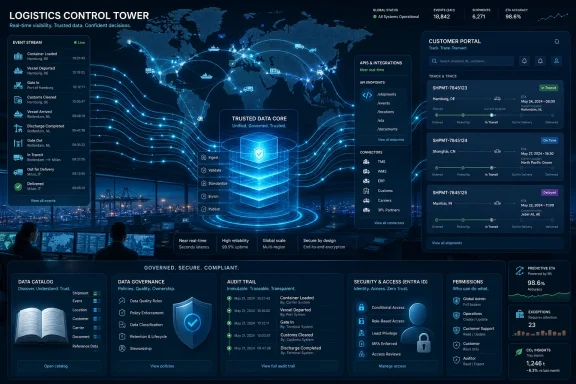 Logicall Turns a Logistics Upgrade Into an Operating Model Bet
The logistics industry has always been a data business pretending to be a transport business. Every shipment creates a trail of orders, milestones, exceptions, documents, location updates, customer messages, customs events, invoices, and service-level commitments. The hard part is not producing data; it is making that data coherent enough to run the company.Logicall’s move reflects that reality. The company describes the platform as a shared foundation for operational processes and analytics across the organization, not as a side project for reporting teams. That distinction matters because the traditional split between “systems that run the business” and “systems that analyze the business” is becoming a liability.
In a warehouse, a late scan is not just an analytics defect. It can become a missed delivery promise, a customer service ticket, a planning error, and eventually a margin problem. In freight forwarding, parcel management, road transport, and fulfillment, the same shipment may pass through multiple systems and handoffs before the customer ever sees a status update.
Logicall’s stated ambition is to create one trusted source of truth across those workflows. That phrase is overused in enterprise technology, but in logistics it has a sharper meaning: if the portal, API, planner, operations team, customer dashboard, and predictive model disagree, the business is slower than its competitors even if its trucks are moving.
Microsoft Sells the Stack, but the Stack Is Not the Strategy
The Microsoft ingredients are familiar to anyone watching Redmond’s enterprise playbook in 2026. Azure supplies the cloud foundation. Microsoft Fabric provides the unified analytics layer. Purview handles governance and cataloging. Power BI turns data into dashboards and analysis. Entra controls identity and access. Copilot for Power BI adds AI-assisted analytics, while integration services connect operational processes, portals, APIs, and customer systems.That is a tidy architecture diagram, but the customer story is really about organizational compression. Microsoft wants enterprises to believe that aligning around one ecosystem reduces the cost of stitching together data platforms, governance tools, identity systems, analytics software, and AI services. Logicall appears to have accepted that premise, with the caveat that the convenience comes with real dependency.
The company’s own language acknowledges the risk. Committing to one ecosystem can accelerate delivery, improve compliance posture, and make it easier to adopt new platform features as Microsoft ships them. It can also concentrate architectural, commercial, and skills risk in one vendor relationship.
That tradeoff is not unique to Microsoft. AWS, Google Cloud, Snowflake, Databricks, SAP, Oracle, and Salesforce all push variations of the same strategic gravity. What makes Microsoft’s pitch powerful is that many companies already live in Microsoft identity, productivity, BI, and enterprise application environments. Fabric and Copilot are designed to make the next step feel less like a migration and more like an extension of what the business already uses.
For Logicall, the stack is therefore both a technical choice and a governance choice. The company is not just asking where to store data. It is asking which platform becomes the default place where data definitions, access rules, analytics, APIs, dashboards, and AI behavior converge.
The Real Work Is the Boring Work Microsoft Demos Skip
The most revealing line in the story is not about AI. It is about the difficulty of designing a generic data model, reusable components, and scalable solutions while still supporting critical customer processes. That is the work that rarely survives a keynote demo.A logistics platform cannot simply ingest everything and declare victory. It must decide what a shipment is, what a milestone means, how customer-specific exceptions map into common workflows, which events are authoritative, and how to reconcile latency between operational systems. It must support standardization without flattening every business unit into a fantasy of uniformity.
That is especially difficult in a buy-and-build model, where companies grow through acquisition, expansion, or the layering of new services. Every acquired business tends to arrive with its own systems, terms, reports, customer habits, and data scars. The platform has to move fast enough to support growth while imposing enough order to prevent the whole data estate from becoming a museum of past decisions.
Logicall’s emphasis on a shared data language is therefore central. AI systems do not rescue messy semantics; they amplify them. A model trained or prompted against inconsistent operational data may produce confident nonsense, and a dashboard built on disputed definitions can become a political artifact rather than an operational tool.
This is where Microsoft Purview enters the story as more than a compliance checkbox. A catalog, governance layer, and access model help determine whether data can be reused safely across teams, portals, APIs, and analytics products. Governance is often treated as the brake pedal, but in an AI-ready platform it is also the steering wheel.
Fabric Is Becoming Microsoft’s Default Answer to Data Sprawl
Microsoft Fabric’s role in the Logicall platform fits the broader arc of Microsoft’s data strategy. Fabric is Microsoft’s attempt to collapse data engineering, real-time analytics, data science, warehousing, and Power BI into a more unified software-as-a-service experience. The promise is less plumbing, fewer copies, and a more consistent path from raw operational data to business insight.For logistics, that pitch is well tuned. A supply chain platform needs to combine batch history, real-time events, operational status, customer-facing analytics, and predictive signals. A delayed shipment is not useful only as a line in yesterday’s report; it may need to trigger a customer notification, a planning adjustment, or a risk score while there is still time to act.
Microsoft’s own supply chain reference patterns increasingly describe Fabric as a way to unify logistics feeds, ERP data, vendor networks, dashboards, and real-time intelligence. Logicall’s use case maps neatly onto that story. It wants dashboards and reporting, but it also wants near real-time APIs based on a generic data model.
That last point is important. A Power BI dashboard may satisfy internal management, but APIs are how a logistics provider becomes embedded in a customer’s operations. If customers can integrate directly into Logicall’s platform and consume consistent milestone, track-and-trace, and status data, the platform becomes part of the customer’s own process architecture.
The danger is that “unified” can become another word for “centralized bottleneck.” Fabric may reduce fragmentation, but it does not automatically solve domain ownership, data quality incentives, cost control, or lifecycle management. A unified platform still needs disciplined engineering practices, release management, observability, and clear accountability when the data is wrong.
AI Arrives Only After the Data Estate Learns Discipline
Logicall’s AI ambitions are framed sensibly: automation in planning, operations, customer service, and decision making. That is exactly where logistics companies should be looking. The industry is full of repetitive decisions, exception handling, customer status questions, capacity tradeoffs, and planning constraints that can benefit from machine assistance.But the sequence matters. Logicall is describing AI as the next layer after structured, governed, trusted data. That is a more credible framing than the common enterprise fantasy in which generative AI floats above broken systems and magically compensates for years of data neglect.
In practice, AI agents in logistics will need to know which data they can trust, which actions they are allowed to take, which customers have special handling requirements, and when to escalate to a human. They will need identity-aware access, auditability, and strong guardrails because a wrong answer in logistics can become a missed shipment, a failed service commitment, or a customer relationship problem.
Copilot for Power BI is the lower-risk end of that spectrum. AI-assisted analysis can help users ask questions of data, generate summaries, and explore patterns faster. It is useful, but it is not the same as allowing agents to intervene in planning, customer communication, or operational execution.
The more ambitious future is agentic logistics: systems that can detect a disruption, understand its business impact, recommend alternatives, notify the right parties, and perhaps execute approved changes. That future depends less on model glamour than on whether the underlying data platform can provide reliable state, governed access, and traceable decisions.
The Customer Portal Is Where the Platform Becomes Visible
Enterprise data platforms often fail politically because their benefits remain abstract. A lakehouse, catalog, or integration framework may be essential, but few customers care how elegant the architecture is. They care whether they can see what is happening, whether the data is current, and whether they can act without chasing emails.Logicall’s future-proof customer portal is therefore not a decorative layer. Track-and-trace dashboards, milestones, communication tools, and customer integrations are the visible face of the platform. They convert internal data discipline into external service quality.
That matters because logistics customers increasingly expect consumer-grade transparency in business-to-business supply chains. They want accurate status information, proactive communication, and integration into their own planning systems. “Where is my shipment?” is no longer a simple customer service question; it is an API requirement, a dashboard requirement, and an operational trust requirement.
Near real-time APIs based on a generic data model could give Logicall a stronger integration story. Instead of building one-off customer feeds for every major account, the company can expose consistent data products with secure access and a shared catalog. That is how a logistics provider starts to behave more like a platform company.
Still, customer-facing transparency raises the stakes. Once customers rely on a portal or API, data latency and inconsistency become contractual irritants, not internal cleanup tasks. The more successful the platform becomes, the less tolerance there will be for vague definitions and manual reconciliation.
HSO’s Role Shows Why Cloud Transformation Is Still a Services Business
Microsoft gets the platform halo, but HSO’s presence is a reminder that enterprise transformation rarely happens by subscription alone. The hard work sits between technology and process: mapping systems, designing models, integrating workflows, rationalizing reports, training teams, and translating business exceptions into reusable architecture.That is particularly true in logistics, where domain knowledge matters. A generic cloud partner can deploy tools, but designing an operational datastore for logistics requires understanding milestones, carriers, customer commitments, warehousing events, freight flows, parcel processes, and exception management. The technology platform is only as good as the business model it encodes.
HSO’s announcement describes a long-term partnership rather than a short implementation. That is the realistic version of this kind of program. The first release may deliver dashboards, integrations, and a better data foundation, but the operating model continues to evolve as new customers, locations, services, and AI use cases are added.
This is also why Microsoft customer stories should be read with both interest and caution. They are useful signals of product direction and customer ambition, but they are not postmortems. They tell us what has been built and what is planned, not yet how the platform behaves under every operational stress or whether the promised efficiencies will materialize at scale.
The better interpretation is that Logicall is making a serious platform commitment at the right layer of the business. The outcome will depend on execution: data quality, adoption, governance, cost management, and the ability to keep building without turning the platform into another monolith.
Windows Shops Should Notice the Entra-to-Power-BI Through Line
For WindowsForum readers, the Logicall story is not only a logistics story. It is a case study in how Microsoft wants enterprise IT architecture to look: Entra for identity, Azure for infrastructure, Fabric for data, Purview for governance, Power BI for the business interface, Copilot for AI assistance, and APIs tying the whole thing into operational workflows.That architecture has consequences for administrators. Identity and access become central not just to applications, but to data products and AI experiences. Conditional access, least privilege, audit trails, and role design are no longer background security chores; they define who can see, query, export, automate, or expose operational data.
It also has consequences for data teams. Fabric’s appeal is partly that it brings different data roles into one environment, but that does not eliminate specialization. Data engineers, BI developers, governance leads, integration architects, and security administrators still need clear boundaries and shared practices.
For developers, the key signal is the move toward reusable APIs and generic data models. Logistics customers do not want another PDF report. They want machine-readable, secure, consistent data they can integrate into their own systems. That pushes enterprise developers toward event-driven patterns, contract-first API design, and better observability around integration failures.
For business users, Power BI and Copilot promise easier access to insight, but they also require discipline. Natural language analytics can make exploration faster, yet users still need to understand definitions, data freshness, and the limits of generated summaries. The more accessible analytics becomes, the more important semantic governance becomes.
Vendor Consolidation Is a Shortcut With a Price Tag
Logicall’s decision to align with one ecosystem reflects a broader industry mood. After years of assembling best-of-breed stacks, many enterprises are tired of integration tax. They want fewer seams, fewer vendors, fewer contracts, and a clearer path to AI.Microsoft is capitalizing on that exhaustion. Fabric, Purview, Power BI, Azure AI, Entra, and Copilot are not merely products; they are components of a consolidation thesis. If the customer keeps more of its data estate inside Microsoft’s orbit, Microsoft can offer convenience, governance alignment, and AI features that appear faster because the platform boundaries are already negotiated.
The upside is real. A single ecosystem can reduce architectural ambiguity, simplify procurement, and give IT teams a more consistent security and compliance model. It can also make it easier to hire and train around a known stack, especially in organizations already standardized on Microsoft 365 and Azure.
The downside is also real. Platform consolidation can create cost opacity, migration friction, and strategic dependency. If a critical data platform, BI layer, governance system, identity model, and AI experience are all tied to one vendor’s roadmap, the customer gains speed but loses some bargaining power and architectural optionality.
That does not make Logicall’s choice wrong. It makes it consequential. The companies that succeed with this model will be those that treat Microsoft’s stack as a foundation for disciplined product engineering, not as a magic abstraction layer over business complexity.
The Logistics AI Race Will Be Won in the Data Model
The phrase “AI-ready” has become one of the most abused labels in enterprise technology. In Logicall’s case, it has a concrete meaning: governed data, a central operational datastore, a generic model, secure access, a catalog, analytics, APIs, and a plan for automation. That is more substantial than a chatbot bolted onto a reporting tool.The reason is simple. Logistics AI needs context. It needs to understand whether an event is normal or exceptional, whether a missed milestone matters, whether a delay affects a premium customer, whether a warehouse has capacity, whether a carrier update is authoritative, and whether an automated response is permitted.
Those answers live in data models, business rules, identity systems, integration contracts, and governance policies. They do not live solely inside large language models. The AI layer may be the most visible part of the future platform, but the competitive advantage will come from the operational substrate beneath it.
This is why Logicall’s story is more interesting than another generic AI announcement. The company is doing the unglamorous work first. It is building the conditions under which AI might become operationally useful rather than theatrically impressive.
If the platform succeeds, the result will not simply be smarter dashboards. It will be faster onboarding, cleaner integrations, fewer manual handoffs, better customer visibility, and more room for automated decision support. Those are the places where AI becomes economically meaningful.
The Fine Print Logicall’s Platform Bet Leaves for IT Leaders
The concrete lesson from Logicall’s Microsoft program is that AI transformation begins much earlier than model selection. It begins when a company decides that its data model, access design, integration strategy, and customer-facing transparency are part of the product.- Logicall is using Azure, Microsoft Fabric, Purview, Power BI, Entra, Copilot for Power BI, and Microsoft Integration Services as the core components of a unified logistics data platform.
- The platform is intended to create a central operational datastore and a single source of truth across internal teams, customers, portals, APIs, dashboards, and predictive models.
- The hardest engineering problem is not dashboard creation, but designing reusable data models and components that can support multiple locations and critical operational processes.
- The AI roadmap depends on governed, trusted data before intelligent agents can safely support planning, operations, customer service, and decision making.
- The customer portal and near real-time APIs may become the most commercially visible pieces of the platform because they turn internal data discipline into customer-facing service quality.
- The Microsoft ecosystem approach offers speed and consistency, but it also increases the importance of cost governance, architectural discipline, and vendor-risk management.
References
- Primary source: Microsoft
Published: 2026-06-15T17:30:10.347646
Loading…
www.microsoft.com - Related coverage: hso.com
Loading…
www.hso.com - Related coverage: logicall.com
Loading…
logicall.com - Official source: learn.microsoft.com
Loading…
learn.microsoft.com - Official source: azure.microsoft.com
Loading…
azure.microsoft.com - Related coverage: linkedin.com
Loading…
www.linkedin.com