

Logitech’s CEO Hanneke Faber has stirred the tech pond by calling out a growing trend she sees as AI for the sake of AI: standalone, AI-first consumer gadgets that, in her words to Bloomberg, are “a solution looking for a problem that doesn’t exist.” Her remark lands oddly because Logitech itself has been among the first mainstream peripheral makers to bake AI shortcuts and integrations directly into everyday devices — not as a separate gizmo, she argues, but as productivity features people can actually use. The row between platform-level AI, experimental hardware, and real-world utility is widening, and Logitech’s stance crystallises an important debate: are we designing helpful, integrated AI tools — or simply manufacturing novelty hardware to satisfy hype cycles?
Hanneke Faber’s remarks were reported as part of an interview with Bloomberg that several outlets subsequently picked up. Her core point was sceptical: dedicated AI devices — clip-on wearables and pocket squares that promise ambient intelligence — frequently fail to solve a concrete user problem, even as they cost consumers and demand ecosystems to support them. Multiple news outlets carried the quote and linked it to the recent high-profile misfires in consumer AI hardware, most notably the Humane Ai Pin and the Rabbit R1 — devices that generated media excitement but then struggled in reviews and market execution. At the same time, Faber isn’t an AI denier. In October she told a Fortune conference audience that Logitech uses AI agents in meetings and that she’d even be open to the idea of an AI-powered board member — remarks she used to underline the type of AI Logitech favours: agents that enhance productivity rather than replace core device experiences with novelty hardware.
Logitech’s approach — integrating AI into existing devices with clear utility, maintaining software platforms like Logi Options+, and piloting agent features inside enterprise workflows — points to a conservative but responsible path. That strategy reduces the risk of bricked devices and disappointed customers while offering incremental, verifiable productivity gains.
Nevertheless, the landscape is fluid. If OpenAI and other deep-pocketed teams produce genuinely useful ambient hardware that people want to use every day, the market will pivot. The healthier outcome for consumers and enterprises is a market that prizes problem-first design, clear support commitments, and meaningful AI features — wherever they live: in mice, in meetings, or in new form factors that finally pass the test of everyday utility.
Note on sourcing and verification: public reporting of Hanneke Faber’s Bloomberg interview has been widely syndicated; however, the Bloomberg piece behind the original interview may be paywalled and not directly accessible in every jurisdiction. Where possible, this article cross-referenced Logitech’s own product documentation and multiple independent reviews and reports to verify product claims and post-launch outcomes. Statements about product shutdowns, review findings, and quotes from Faber’s Fortune remarks are corroborated by independent reporting and vendor documentation; any remaining ambiguities in paywalled sources are noted above with caution.
Source: theregister.com Logitech chief says ill-conceived gadgets put the AI in FAIL
 Background: where the conversation came from
Hanneke Faber’s remarks were reported as part of an interview with Bloomberg that several outlets subsequently picked up. Her core point was sceptical: dedicated AI devices — clip-on wearables and pocket squares that promise ambient intelligence — frequently fail to solve a concrete user problem, even as they cost consumers and demand ecosystems to support them. Multiple news outlets carried the quote and linked it to the recent high-profile misfires in consumer AI hardware, most notably the Humane Ai Pin and the Rabbit R1 — devices that generated media excitement but then struggled in reviews and market execution. At the same time, Faber isn’t an AI denier. In October she told a Fortune conference audience that Logitech uses AI agents in meetings and that she’d even be open to the idea of an AI-powered board member — remarks she used to underline the type of AI Logitech favours: agents that enhance productivity rather than replace core device experiences with novelty hardware. Overview: two divergent approaches to putting AI into the world
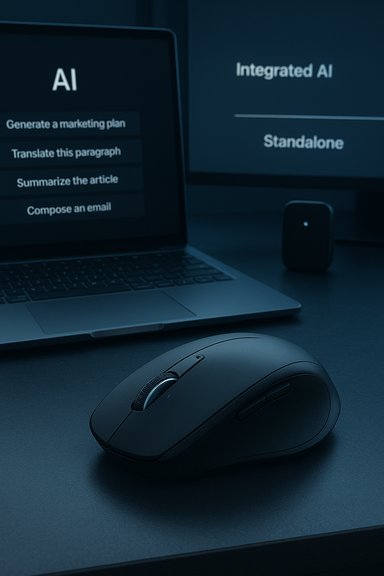
AI in the consumer hardware market is following two clear, competing paths:- Embedded intelligence in existing hardware — add meaningful AI features to keyboards, mice, webcams, and conferencing gear where they assist productivity (Logitech’s approach).
- AI-first, standalone gadgets — produce entirely new hardware whose raison d’être is the AI experience itself (the Humane Ai Pin, Rabbit R1, and the proposed OpenAI / Jony Ive device fall into or are associated with this camp).
Why Faber’s phrase matters: “solution looking for a problem”
When a chief executive says “solutions looking for problems,” it’s shorthand for a product-market fit failure on a broad scale. The risks she’s identifying are practical and commercial:- User friction: New devices require onboarding, charging, pairing, and an ecosystem. If the core value isn’t dramatically superior, users will revert to existing tools.
- Ecosystem cost: Manufacturers must build and maintain cloud services, privacy controls, and long-term support to justify a hardware purchase; failing that, devices become electronic waste.
- Perception vs. utility: A shiny demo or a designer prototype can attract headlines but not sustained user adoption if the day-to-day benefits are marginal.
Logitech’s counterpoint: integrate AI where it helps
Logitech’s product roadmap shows a preference for AI as an enhancement rather than the headline feature of a standalone gadget. Examples:- The Signature AI Edition M750 (Signature AI Edition) mouse ships with a dedicated AI button that launches the Logi AI Prompt Builder, an interface that helps users generate, rephrase, and refine ChatGPT prompts without breaking flow. The function is embedded in Logitech’s Options+ software and requires a ChatGPT account to run. This is explicitly positioned as a productivity shortcut, not a new hardware category.
- The MX Master 4 exemplifies the “enhancement” strategy: it introduces an Actions Ring — a radial shortcut menu mapped to the thumb button — and includes ready-made shortcuts to ChatGPT, Perplexity, Gemini, and Microsoft Copilot through the Logi Options+ ecosystem. It adds haptic feedback and more precise control for established workflows rather than creating a second device ecosystem. The MX Master 4’s integration into a software platform (Options+) shows Logitech’s intent to scale AI features through software and plugins rather than through specialized, single-purpose hardware.
Benefits of embedding AI into existing peripherals
- Lower switching cost: Users keep their workflows and add value without buying new hardware.
- Sustained software updates: AI features can be refined via software, improving longevity and enabling governance and privacy updates without replacing the device.
- Consolidated ecosystems: Centralised software (Logi Options+) allows Logitech to curate integrations and control privacy, data flows, and feature rollouts.
Case studies: what went wrong (and right) with recent AI hardware flops
Humane Ai Pin — hype, failure, and a hard shutdown
The Humane Ai Pin launched with major fanfare and lofty claims about rethinking personal computing. But between delivery and adoption, it faced persistent criticism: the voice interactions were inconsistent, the price and subscription model were controversial, and delivering a compelling, always-on AI experience proved more complex than the demos implied. The business ultimately discontinued sales and shut down server-side support, leaving many early adopters with effectively bricked devices and complicated refund dynamics. That outcome crystallises the sustainability and support risk for standalone AI hardware.Rabbit R1 — imaginative design, weak execution
Ambitious as a pocket assistant, the Rabbit R1 tried to act as an intermediary AI device to manage smartphone interactions. Reviewers criticised the interface, responsiveness, and battery life — features central to a companion device’s survival. The R1’s problems reinforced the lesson that building a small, specialised hardware companion is not simply a matter of applying an LLM API to a new enclosure; the interaction model, latency, reliability, and app ecosystem must be nearly flawless. Both cases show how a combination of over-promising, product complexity, and fragile service economics can send an AI gadget from prototype to obsolescence in under a year.The governance and consumer-protection angle
When hardware requires cloud services, the vendor implicitly asks consumers to trust long-term support and data stewardship. Abrupt service shutdowns (or device “bricking”) raise real legal and ethical questions:- Who is responsible for supporting hardware that depends on a vendor’s cloud?
- What level of refund or compensation is owed when core advertised features disappear?
- How should warranty and returns policy adapt to subscription-dependent hardware?
Where Logitech’s caution helps — and where it might hold them back
Logitech’s cautious approach to AI-first hardware has clear strengths:- Product reliability: Focusing AI on existing hardware means less risk of launching a fragile, unsupported hardware ecosystem.
- User-centred value: Embedding assistant shortcuts and meeting agents addresses discrete productivity problems that professionals face every day.
- Sustainability: Software updates can extend device usefulness, aligning with circular-economy goals and reducing e-waste.
- Missed platform opportunity: If a new category of ambient AI hardware becomes genuinely useful, failure to participate could mean ceding a strategic platform advantage to new entrants.
- Perception of timidity: In a market that prizes “first movers,” being conservative can be read as a lack of vision — even if the strategy is prudent.
- Dependence on partners: By integrating third-party AI services (e.g., ChatGPT, Copilot) rather than vertically integrating models, Logitech may become dependent on external AI providers’ pricing, policies, and uptime.
The OpenAI/Ive wildcard: what happens if ambient AI arrives properly
There’s another thread in this story: OpenAI’s collaboration with veteran designer Jony Ive. Executives from the project recently said the team has working prototypes and expects a market-ready product in less than two years. If OpenAI and Ive deliver a device that genuinely offers new, low-friction experiences without the support and privacy failures of previous attempts, it could reshape the market for AI hardware — and test Logitech’s thesis at scale. The difference would be whether that device solves day-to-day problems above and beyond what a smartphone + AI assistant can already do. If such a product is broadly useful, it will create a new category to which incumbent peripheral makers will need to respond — either by integrating into a new ecosystem or by attacking the category with their own distinctive advantages: ergonomics, platform partnerships, and enterprise relationships.Practical advice for IT teams and consumers navigating the AI hardware era
- Prioritise interoperability: Choose devices that integrate with established platforms and can be managed centrally (software-defined features reduce replacement risk).
- Demand clear service guarantees: For any hardware reliant on cloud services, require explicit SLAs or refund policies that cover discontinued features.
- Favour upgradeable value: Devices baked to accept software updates and third-party integrations are preferable to single-purpose gadgets.
- Assess governance controls: For agentic features (meeting agents, auto-actions), validate data handling, consent flows, and audit trails.
- Pilot before deploy: Run controlled trials for new AI features in real workflows before rolling them out enterprise-wide.
Taking stock: strengths, risks, and where the industry should go next
Logitech’s public critique of “ill-conceived” AI gadgets is as much a market signal as it is a product stance. It highlights several durable lessons:- Strength: focus on user-centred utility. AI is most valuable when it reduces friction in the tasks people perform every day — not when it asks them to adopt new rituals without clear benefit.
- Risk: overreliance on third-party models. Embedding AI via external providers accelerates feature delivery but introduces dependencies that can complicate pricing and uptime.
- Governance concern: AI agents and autonomy demand oversight. The speed of agentic AI adoption requires governance frameworks that many companies have not yet built.
- Opportunity: hybrid models could win. Software-defined AI within existing, well-engineered hardware could be the sweet spot for many users — balancing novelty and practicality.
Conclusion: design for the problem, not the press cycle
The current wave of AI hardware experiments has delivered important lessons. Design, documentation, and durable support must follow product theatre; otherwise, even the most elegant gadget risks becoming a cautionary tale. Hanneke Faber’s argument — that too much of what we’re seeing in AI hardware is a solution looking for a problem — is a useful corrective if it forces manufacturers to ask: “What concrete, repeatable problem does this device solve better than what users already have?”Logitech’s approach — integrating AI into existing devices with clear utility, maintaining software platforms like Logi Options+, and piloting agent features inside enterprise workflows — points to a conservative but responsible path. That strategy reduces the risk of bricked devices and disappointed customers while offering incremental, verifiable productivity gains.
Nevertheless, the landscape is fluid. If OpenAI and other deep-pocketed teams produce genuinely useful ambient hardware that people want to use every day, the market will pivot. The healthier outcome for consumers and enterprises is a market that prizes problem-first design, clear support commitments, and meaningful AI features — wherever they live: in mice, in meetings, or in new form factors that finally pass the test of everyday utility.
Note on sourcing and verification: public reporting of Hanneke Faber’s Bloomberg interview has been widely syndicated; however, the Bloomberg piece behind the original interview may be paywalled and not directly accessible in every jurisdiction. Where possible, this article cross-referenced Logitech’s own product documentation and multiple independent reviews and reports to verify product claims and post-launch outcomes. Statements about product shutdowns, review findings, and quotes from Faber’s Fortune remarks are corroborated by independent reporting and vendor documentation; any remaining ambiguities in paywalled sources are noted above with caution.
Source: theregister.com Logitech chief says ill-conceived gadgets put the AI in FAIL
