

Logitech’s Signature Slim Solar+ K980 lands in India as a bold iteration of an old idea: a full-size, laptop‑style keyboard that claims to eliminate charging and disposable batteries by harvesting light from any source and storing it in a proprietary, long‑life battery. The company’s Logi LightCharge system is presented as the core innovation — a narrow light‑absorbing strip plus energy‑efficient electronics and a rechargeable hardpack battery the company projects will last up to 10 years, and that, once fully charged, can reportedly run the keyboard for up to four months in complete darkness. These claims and the product’s regional pricing — Rs. 12,295 on Logitech’s India store with a limited‑time Amazon offer around Rs. 10,995 — were confirmed in local coverage and the global product announcement. This feature unpacks what the K980 is, how Logi LightCharge works in practice, who will benefit, and where the practical trade‑offs lie. Coverage from global outlets and hands‑on commentary was reviewed to verify technical claims and place the K980 against competing designs and real‑world expectations. Major manufacturer claims are cross‑checked with Logitech’s product documentation and independent coverage to give readers a clear, critical view of the keyboard’s strengths and caveats.
Solar‑powered peripherals are not new — Logitech itself shipped a solar keyboard (K760) years ago — but the approach has been niche because of compromises: poor charging under dim lighting, limited power budgets, and the absence of wired fallbacks for emergency charging. The Signature Slim Solar+ K980 revives the concept with modern materials, tighter software integration, and enterprise‑grade provisioning for IT teams. Logitech frames it as a sustainability and convenience play: remove alkaline waste, reduce cable clutter, and let employees forget about charging. Logitech formally announced the K980 on September 24, positioning the keyboard as a “powered by light” product for consumers and businesses, and providing a business SKU that supports Logi Bolt and Logitech Sync for centralized deployment. The global MSRP in the U.S. is $99.99 for the universal variant; India pricing was later published for the retail market.
Logitech’s return to light‑powered keyboards is an instructive case of incremental innovation: practical, constrained engineering choices that prioritize convenience and sustainability over maximal feature sets. The K980 won’t replace every keyboard on desks, but for the right workflow and workspace the promise of “never think about charging again” is both real and achievable — as long as that desk stays lit.
Source: FoneArena.com Logitech Signature Slim Solar+ K980 wireless keyboard with Logi LightCharge technology launched in India
 Background — why Logitech revived solar keyboards
Solar‑powered peripherals are not new — Logitech itself shipped a solar keyboard (K760) years ago — but the approach has been niche because of compromises: poor charging under dim lighting, limited power budgets, and the absence of wired fallbacks for emergency charging. The Signature Slim Solar+ K980 revives the concept with modern materials, tighter software integration, and enterprise‑grade provisioning for IT teams. Logitech frames it as a sustainability and convenience play: remove alkaline waste, reduce cable clutter, and let employees forget about charging. Logitech formally announced the K980 on September 24, positioning the keyboard as a “powered by light” product for consumers and businesses, and providing a business SKU that supports Logi Bolt and Logitech Sync for centralized deployment. The global MSRP in the U.S. is $99.99 for the universal variant; India pricing was later published for the retail market. What the K980 is — hardware, layout and ergonomics
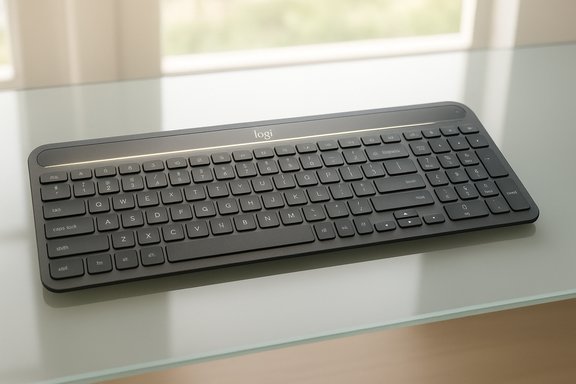
- Full‑size layout with numeric keypad and dedicated meeting/shortcut keys.
- Low‑profile scissor switches tuned for a laptop‑style typing feel; Logitech rates key lifespan up to 10 million keystrokes.
- Slim chassis and minimalist aesthetics — the graphite model emphasizes recycled materials in key parts of the plastic chassis.
- No USB‑C charging port on the consumer model — the keyboard is designed to be charged only by light (the Business model uses a Logi Bolt receiver and offers enterprise features).
Key hardware and usability points
- Easy‑Switch multi‑device pairing (up to three devices) via Bluetooth or the Logi Bolt USB‑C receiver.
- AI Launch Key and Action Key for one‑press access to assistants (Copilot on Windows, Gemini on ChromeOS by default) and customizable macros through Logi Options+ and Logi Tune.
- On/off power switch and a battery indicator LED, plus LightCheck in the Logi app to confirm whether ambient lighting is sufficient for charging.
Logi LightCharge explained — the practical mechanics
Logi LightCharge is the branded system Logitech uses to describe the combination of:- a narrow, top‑edge photovoltaic strip that harvests ambient light (sunlight or artificial),
- an energy‑efficient keyboard design (low standby and active draw), and
- a proprietary rechargeable hardpack battery engineered and tested with a projected operational lifetime.
- Minimum charging threshold: Logitech specifies approximately 200 lux as the minimum ambient illuminance required for the keyboard to charge from typical office or home lighting. That threshold is roughly equivalent to a well‑lit office or bright home room rather than dim ambient lighting.
- Reserve capacity when dark: Once fully charged, Logitech claims the K980 can run up to four months in total darkness. That figure is a measure of the reserve the battery provides and is repeated across product documentation and independent reporting.
Pricing and availability in India
Regional rollouts followed the global announcement. In India the K980 was listed at approximately Rs. 12,295 on Logitech’s India store; local retail promotions listed a limited‑time Amazon offer at around Rs. 10,995, which is consistent with early local coverage and press reports. Global MSRP remains $99.99 for the universal variant. Pricing can be expected to vary with periodic promotions, retailer margins, and regional taxes.What this means for real users — strengths and practical benefits
- Near‑zero maintenance: For many desk workers the primary benefit is the end of manual charging routines and alkaline battery replacements. In a well‑lit office the keyboard keeps itself topped up and, in practice, removes a small recurring friction point.
- Sustainability credentials: The graphite model uses a high percentage of post‑consumer recycled plastics (Logitech cites ~70–73% PCR for the keyboard body in business documentation), reduced packaging carbon, and a rechargeable hardpack designed to reduce single‑use battery waste. These are tangible benefits for greener desktop setups.
- Enterprise manageability: The business SKU supports Logi Bolt and Logitech Sync, making large‑scale deployment and remote firmware or policy management straightforward for IT shops. That matters for corporate fleets where consistency and security are priorities.
- Productivity features: The AI Launch Key, programmable F‑row, Smart Actions in Logi Options+, and compatibility with Flow for multi‑machine workflows make the keyboard attractive to users who value small automation boosts.
Trade‑offs and real‑world caveats
No product is without compromise. The K980’s design choices introduce specific limitations buyers should weigh.1) No wired emergency fallback
The consumer K980 lacks USB‑C charging — if the battery is fully depleted you must expose it to sufficient light to recharge or replace the removable hardpack. That is a deliberate, minimalist decision but a practical vulnerability for users who frequently work in dim environments or in night‑shift scenarios. Competitors that include a USB‑C emergency port or wired operation offer a safety net the K980 intentionally forgoes.2) Dependence on workspace lighting
The 200 lux threshold is realistic for a well‑lit office, but not for many bedrooms or low‑light home workspaces. Users whose desks receive little ambient light will either have to use a desk lamp or accept reduced uptime between exposures to daylight or bright interiors. In practice, users should test their workspace light level if they expect the “set‑and‑forget” promise to hold.3) Typing feel and ergonomics
Logitech tuned the K980 for a quiet, laptop‑style experience with low travel scissor switches. That suits many office typists, but enthusiasts or writers who prefer deeper, more tactile mechanical switches — or keyboards with adjustable tilt legs and palm rests — will find the K980 less suited to longform typing comfort. Independent reviews noted the keyboard is serviceable but not an MX Keys replacement for typists who prize premium feel.4) Photovoltaic durability and maintenance
Photovoltaic strips can accumulate dust, oils, and surface wear that degrade efficiency over time. Logitech builds the material for everyday use, and the battery is designed to be replaceable, but the long‑term behavior of the solar strip under daily use and spills is a practical unknown until longer field data are available. Buyers should be prepared to keep the strip clean and to expect some efficiency decline over many years.5) Privacy and corporate policy with AI integration
The AI Launch Key is a convenience feature but also a potential policy vector. When the key opens Copilot, Gemini, or another cloud assistant, organisations must understand how that integration interacts with data protection rules and clipboard handling. IT teams deploying the business SKU should control mappings and access to cloud assistants per corporate policy.How the claims were verified and where caution is needed
- Charging threshold (200 lux): Confirmed on Logitech’s product page and repeated in the press release; independent coverage from The Verge and TechRadar repeats the same number, indicating consistent messaging by Logitech and media. This value is credible and actionable for real‑world testing.
- Four months in complete darkness: Also stated in Logitech documentation and corroborated across multiple outlets. This is a manufacturer claim describing reserve capacity; real life will vary with usage patterns (key actuation rates, LED indicators, wireless activity). Consider it a credible specification, but expect variance.
- Battery lifespan (up to 10 years): Logitech frames this as a projection based on testing; it is not an empirical decade‑long field study. Multiple outlets repeat the 10‑year claim but correctly attribute it as a manufacturer projection. Treat this as a design goal and projection rather than a proven outcome.
- User‑replaceability and spare parts: Some independent outlets report Logitech confirmed the battery hardpack is user‑replaceable and that spare parts will be supplied (iFixit mentioned in coverage as a parts partner), but full details on replacement ease and part availability vary by market; best practice is to verify local spare part availability and replacement guidance before assuming immediate user access in all regions. This is a partially verifiable claim that needs local confirmation.
Comparison with alternatives
- Logitech MX Keys family: Offers a richer typing experience, full backlighting, and USB‑C charging. If you prioritise typing feel and backlight for low‑light sessions, the MX Keys still leads. The K980’s unique advantage is self‑charging rather than tactile premium.
- Lenovo and other vendors’ solar designs: Some competitors blend solar plus USB‑C backup or tilt legs; the Lenovo solar model, for example, includes a wired fallback in some SKUs. Those boards trade some “set‑and‑forget” purity for safety‑net convenience. The K980 opts for purity: a strictly light‑dependent power model on consumer SKUs.
- Rechargeable wireless keyboards with USB‑C: These are ubiquitous and typically offer fast emergency charging; they are less green in everyday life unless recharged often from renewable sources. The K980’s selling point is a lower lifecycle environmental cost if the battery and solar strip endure as projected.
Practical buying checklist (quick guide)
- Confirm your workspace lighting level — measure or approximate whether your desk sees at least 200 lux regularly. If not, plan to use a desk lamp positioned to illuminate the solar strip.
- Decide whether a wired emergency option matters. If yes, consider alternative keyboards with USB‑C fallback.
- Test typing feel if possible — K980 is tuned for low‑profile, laptop‑style keys, not deep mechanical feedback.
- For enterprise buyers, evaluate the business SKU for Logi Bolt and Sync integration and confirm replacement battery/part logistics within your region.
- If sustainability is a priority, confirm the device’s recycled material percentage for the color/region you intend to buy and review Logitech’s warranty/service terms.
Final analysis — who should buy the K980?
The Signature Slim Solar+ K980 is an attractive product for buyers whose desks are reliably well lit and who value convenience and sustainability over the absolute premium typing experience. It is particularly well suited to:- Office workers who want a low‑maintenance keyboard they never have to plug in or swap batteries for.
- Organizations that prioritize simplified device fleets with manageable, centrally controlled deployments (business SKU).
- Users who prefer a sleek, minimalist desk with fewer cables and eco‑friendly materials.
- Night‑shift or low‑light users who need immediate wired recovery options.
- Typists who demand the tactility of higher‑end mechanical boards or backlit keys.
- Buyers who are skeptical of manufacturer longevity projections and prefer products proven in long‑term third‑party field tests.
Closing verdict
Logitech’s Signature Slim Solar+ K980 is a thoughtful, modern take on solar‑powered peripherals: it combines proven design cues (scissor switches, full numeric keypad, multi‑device pairing) with a renewed focus on energy harvesting and lifecycle reduction. The product’s headline claims — the 200 lux charging threshold, four months’ darkness reserve, and a 10‑year battery lifespan projection — are documented by Logitech and consistently reported by major technology outlets, but the long‑term durability of the solar strip and the real‑world battery longevity remain manufacturer projections until independent, long‑duration field data accumulates. For buyers with a bright workspace and a desire to simplify charging and reduce disposable battery waste, the K980 delivers a compelling proposition; for users who need guaranteed wired fallback or premium typing feel, other Logitech models or competing boards may be better fits. For India buyers, current retail listings and launch coverage put the board at about Rs. 12,295 on Logitech’s India store with limited‑time offers near Rs. 10,995 on Amazon — competitive positioning given the product’s feature set and global MSRP. Confirm specific retailer offers and warranty terms at purchase to get the best value and regional service support.Logitech’s return to light‑powered keyboards is an instructive case of incremental innovation: practical, constrained engineering choices that prioritize convenience and sustainability over maximal feature sets. The K980 won’t replace every keyboard on desks, but for the right workflow and workspace the promise of “never think about charging again” is both real and achievable — as long as that desk stays lit.
Source: FoneArena.com Logitech Signature Slim Solar+ K980 wireless keyboard with Logi LightCharge technology launched in India
