London £105B Loss From Workplace Interruptions: Nasstar UK £488B Insight

  • Thread Author
A recent headline claiming that “London businesses are losing £105 billion a year due to workplace interruptions” traces back to a broader UK‑wide analysis of lost productivity; the underlying research estimates roughly £488 billion in annual UK losses from interruptions, and the London figure appears to be an extrapolated regional share rather than an independently measured London total.

London £105B total cost displayed with digital devices and UK map.Background / Overview​

The attention-grabbing number — £105 billion for London — circulated in press roundups that republished or paraphrased a new analysis published in late October 2025. The core analysis, produced by UK IT firm Nasstar, used Microsoft Work Trends data combined with UK macroeconomic aggregates to estimate an annual cost to the British economy of approximately £488 billion caused by frequent workplace interruptions (emails, ad‑hoc meetings, chat messages and context switches). The London Daily News page carrying the local headline was gated behind a browser‑verification interstitial when accessed directly, so the text of that article could not be loaded for independent inspection at the URL supplied. That means the London number must be treated as a press‑level claim referencing the national Nasstar estimate rather than as a source of primary research itself.

What Nasstar actually measured (and how)​

The headline UK figure: £488 billion — where it comes from​

Nasstar’s publicised methodology is straightforward in outline:
  • It relies on Microsoft’s Work Trends behavioural metrics showing very frequent interruptions for office workers (the firm cited “an interruption every 4 minutes on average” and even faster for high‑traffic roles).
  • Nasstar assumes a certain share of the economy is composed of white‑collar, office‑based employment (the analysis used a 67.9% figure for that segment).
  • It applies a 25% productivity loss factor to that white‑collar share of GDP to produce its annual cost estimate.
  • The company references the UK’s 2024 GDP base figure used in its calculations (Nasstar specifically referenced a 2024 UK GDP figure of about £2.884 trillion).
When those assumptions are combined (67.9% × 25% × £2.884tn), the resulting order of magnitude matches the headline ~£488bn figure widely cited in secondary reporting.

Strengths of the approach​

  • The analysis leverages widely‑observed behavioural data (Microsoft Work Trends) that does appear to show rising volumes of meetings, chats and out‑of‑hours messages across large samples.
  • Using an economic baseline (national GDP) to turn behavioral patterns into a monetary estimate is a common and transparent way to produce a headline figure that is meaningful to policy makers and business leaders.
  • The study highlights a tangible productivity risk that is consistent with a growing body of cognitive science showing that frequent task switching erodes effective work time.

Key caveats in the methodology​

  • The transformation from interruption frequency to a flat 25% productivity loss is an assumption that materially drives the result; alternative choices would yield very different totals.
  • The analysis aggregates across very different industries, roles and job types—assumptions that hold for white‑collar knowledge workers will not apply for front‑line retail, manufacturing, or public services.
  • Measuring “lost productivity” is inherently challenging: it depends on what tasks are interrupted, how frequently work can be recovered, whether interruptions are valuable real‑time signalling (urgent requests), or simply avoidable noise.
  • The use of national GDP as the economic base makes the output sensitive to the selected metric (GDP vs GVA vs GDHI) and to the year chosen for the baseline.

How the London £105bn figure likely arose — and why it needs context​

Local headlines (like the London Daily News piece the user linked) claim £105bn in losses for London businesses. That number appears to be a regional extrapolation of the national Nasstar estimate rather than a separate London‑specific empirical study.
Two reasonable, common ways to derive a London share from a UK total are:
  • Apply London’s share of UK economic output (GDP or GVA) to the national loss; or
  • Apply London’s share of the national white‑collar workforce to the national loss.
Both approaches are defensible for back‑of‑envelope estimates, but they produce different London totals depending on which regional statistic you choose.
  • If you apply a London share near 21–22% of UK GDP (a figure used in some economic summaries for 2023), you get a London loss of roughly £105–£110 billion (0.215 × £488bn ≈ £105bn). This matches the £105bn headline.
  • If you instead apply London’s share of gross disposable household income (GDHI) — a different regional metric — London’s share is around 18.7%, which would imply a London effect closer to £91bn (0.187 × £488bn ≈ £91bn). That demonstrates the sensitivity of the regional estimate to the metric used.
In short: the £105bn London figure is plausible as an extrapolation, but it is not a direct empirical measurement of London‑specific interruptions. Different defensible choices produce materially different results, and that must be made explicit when reporting region‑level numbers.

Cross‑verification: multiple independent sources​

Multiple independent outlets republished the Nasstar claim and described the same core assumptions:
  • IT Brief, a UK technology news site, summarised Nasstar’s estimate and listed the methodology (white‑collar share, 25% productivity hit, UK GDP base).
  • London Business Journal and similar regional tech and business outlets reproduced the same £488bn UK figure and the Microsoft Work Trends data points (interruptions every 4 minutes, 120 interruptions per day for a typical office worker).
For regional economic shares and baselines, the Office for National Statistics provides authoritative data for GDHI and regional economic measures; depending on which ONS statistic you use for London’s share you arrive at different London‑level loss estimates. The ONS GDHI bulletin shows London holding roughly 18.7% of UK GDHI in 2023 — a useful, authoritative comparator when converting national aggregates into regional estimates. Note: the original London Daily News page referenced by the user is behind a browser verification wall and could not be read directly at the supplied URL; the national analysis by Nasstar and the subsequent press reporting are the reproducible primary anchors for the £105bn claim.

Critical analysis: strengths, risks and what the numbers don’t tell you​

Why the headline matters (strengths)​

  • The analysis puts a price tag on a real problem: frequent interruptions are a real and measurable workplace phenomenon tied to meeting volumes, asynchronous messaging and growing after‑hours communications.
  • Framing interruptions as an economic cost can mobilise corporate investment in process redesign, tools, and training to protect deep work.
  • The narrative helps shift the conversation from individual blame (workers being distracted) to systems and tooling (meeting culture, notification design, calendar hygiene).

Where the estimate is most vulnerable (risks and limitations)​

  • Assumption sensitivity: the 25% productivity loss multiplier is the single biggest driver of scale. If that figure is optimistic (i.e., too high), the headline number will be badly overstated.
  • Double counting and substitution: some interruptions are necessary (urgent coordination), and some lost time may be recouped later or substituted with other productive tasks. Monetary conversion is imprecise.
  • Heterogeneity: London’s economy contains both extremely high‑value sectors (finance, professional services) and lower‑productivity activities; a uniform per‑worker assumption may misallocate the cost across sectors.
  • Temporal dynamics: the data snapshot (Work Trends and 2024 GDP) may not represent longer‑term averages; behaviour is also evolving rapidly as hybrid work norms and tooling change.
  • Policy complacency risk: a big headline number can encourage quick vendor fixes (buy an AI assistant) rather than systemic process changes (meeting charters, focused time blocks, managerial norms).

Practical implications for London IT leaders, HR and managers​

Whether the London total is £91bn or £105bn, the practical conclusion is the same: the human and economic cost of interruptions is large enough to justify immediate, low‑cost interventions. Below are prioritized recommendations with practical steps.

Immediate, low‑overhead actions (for teams and managers)​

  • Institute protected "focus blocks" on team calendars (two 90‑minute windows per working day) and enforce no‑meeting rules during those blocks.
  • Create a visible meeting policy: require agenda, objectives and expected outcomes for every meeting; auto‑decline meetings without them.
  • Reduce notification noise: standardize status for chat tools (set default away/do‑not‑disturb during focus blocks); push administrative messages to daily digests.
  • Train managers on meeting discipline: start/stop on time, pre‑read material, and one decision owner per meeting.

Technical and tools‑led mitigations (for IT and digital workplace teams)​

  • Configure central Teams/Slack/Gmail policies that limit meeting invites during focus hours and enable quiet hours on mobile and desktop clients.
  • Use presence and scheduling integrations to prevent double‑bookings and to prioritise synchronous sessions for urgent work only.
  • Pilot AI assistants (with careful governance) to triage routine requests and automate meeting notes and follow‑ups — but measure impact on noise before scaling. Nasstar itself highlights agentic AI as a potential mitigation, but warns that poorly governed AI can add to the noise.

Measurement & accountability (how to avoid aspirational programs that don’t move the needle)​

  • Start with a simple KPI dashboard: number of meetings per user per week, average meeting length, number of after‑hours messages, and scheduled “focus hours” compliance.
  • Run short A/B experiments: measure knowledge worker output on concrete deliverables (e.g., code commits, closed sales opportunities, report drafts) for teams with and without protected focus time.
  • Track employee experience (surveys) and discrete business metrics (turnaround times) and report both to the board.

A practical 90‑day plan for a London HQ or regional office (numbered steps)​

  • Baseline: extract calendar, meeting and chat metadata to quantify interruption volume for two representative teams (1–2 weeks).
  • Policy design: create a simple meeting policy and define “core focus hours” (weeks 2–3).
  • Pilot: run the policy in two teams for 30 days, enforcing meeting rules and setting tool configurations to limit notifications.
  • Measure: compare outputs and employee experience against control teams (end of month 2).
  • Scale & govern: iterate on the playbook, codify in manager training, and set up quarterly measurement reviews (month 3 onward).
This sequence emphasises experiments and measurement rather than top‑down edicts — the fastest path to sustained improvement.

Where the conversation should go from here (policy, procurement and vendor scrutiny)​

  • Procurement and IT teams should treat claims about productivity gains from new tools (including AI agents) as testable hypotheses: require vendor pilots, measurable KPIs, and data access for independent evaluation.
  • Public policy bodies and industry trade groups could help by developing standard metrics for interruption costs so that studies are comparable across time and regions.
  • Businesses should ensure their contracts and SLAs with core communications vendors include telemetry access and outage transparency; interruptions have both internal productivity costs and external risk (customer experience, transactions).

Conclusion — the numbers are useful but need nuance​

The claim that London businesses are losing £105 billion a year to workplace interruptions is best read as a headline extrapolation derived from Nasstar’s UK‑wide £488bn estimate. That UK total is grounded in behavioural metrics and transparent assumptions, but the regional allocation depends heavily on which economic share (GDP, GVA, GDHI, workforce composition) you use to prorate the figure. Independent, high‑quality sources repeatedly describe the UK result and Nasstar’s assumptions; ONS regional data shows London’s economic share varies by metric—so regional estimates should carry an explicit methodology. The practical takeaway for London organisations is clear and immediate: whether the number is nearer £90bn or £105bn, the organisational and individual cost of interruptions is large enough to justify policy change, managerial discipline and disciplined, measured pilots of tool‑based solutions. Tackling interruptions can yield meaningful productivity gains—if interventions are grounded in data, carefully piloted, and measured for real business impact rather than accepted on the basis of a single headline figure.

Source: London Daily News London businesses are losing £105 billion a year due to workplace interruptions | London Daily News

 

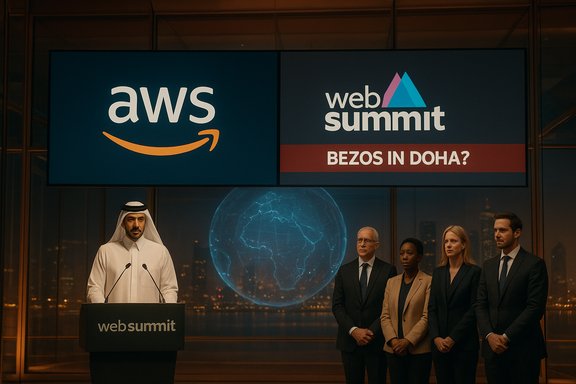
Web Summit stage with AWS branding and a presenter at the podium alongside a diverse team.
The brief Qatar Tribune item reporting that the Prime Minister “received the Amazon founder and executive chairman” landed in many inboxes as a tidy, attention-grabbing line — but the available evidence to fully substantiate that specific claim is thin. What is verifiable: Qatar’s Prime Minister and Minister of Foreign Affairs, HE Sheikh Mohammed bin Abdulrahman bin Jassim Al Thani, actively engaged global tech leaders and company delegations at major technology events in Doha in 2025, including visits and one‑on‑one meetings on the sidelines of Web Summit Qatar 2025. Those meetings were documented by the Government Communications Office and local press as part of Qatar’s wider push to incubate a regional technology hub. At the same time, an attempt to fetch the specific Qatar Tribune story at the URL provided returned an error and the independent trail that would tie Jeff Bezos — the high-profile “Amazon founder and executive chairman” mentioned in the headline — directly to a private meeting with the Prime Minister is incomplete or not publicly corroborated. The Qatar Tribune link could not be retrieved. ([] Independent reporting from Doha’s major outlets and official press releases confirm PM briefings and meetings with founders and company executives at Web Summit, but none of the readily accessible sources that document the PM’s meetings explicitly name Jeff Bezos as a participant in a bilateral reception with the Prime Minister. Additionally, a contemporaneous verification note compiled from local reporting flagged that the short Qatar Tribune item carried the headline in question but that the full copy and granular supporting details were inconsistent or unavailable to verifiers at the time. Treat the uncorroborated claim with caution.
This article unpacks what is verifiable, lays out the gaps and risks in the reporting, and analyses what a confirmed Bezos–Doha meeting would mean for Amazon, cloud strategy in the Gulf, and regional technology geopolitics. It also offers a practical checklist for IT leaders and WindowsForum readers who need to translate headlines into procurement, security, and architecture decisions.

Background / Overview​

Qatar doubled down on tech diplomacy in 2025 by hosting large international gatherings and inviting leaders across industry and government to engage directly with policymakers in Doha. Web Summit Qatar 2025 — a major regional edition of Europe’s flagship technology conference — drew tens of thousands of attendees, hundreds of startups, and prominent corporate partners. Qatar’s Government Communications Office (GCO) documented the Prime Minister’s role in inaugurating the summit, underscoring national aspirations to position Doha as a technology and innovation hub for the Middle East and North Africa. Official statements and local reporting note that the Prime Minister met “founders, chairpersons and directors of a number of companies” on the sidelines of the summit, discussing cooperation and topics of mutual interest. Web Summit’s partner roster included major global players — Amazon among them — but the partner list does not itself prove the attendance of any specific founder or chairman. In short: the stage for high-level meetings existed, and it is routine for hosting governments to receive delegations and company principals during such events. At the same time, this is precisely the environment where fast headlines and short wire items can outpace documentary detail. The difference between “Amazon (or Amazon-affiliated executives) were present as part of company representation” and “Jeff Bezos personally met with Qatar’s Prime Minister” is large and consequential. The public record currently supports the former (company engagement) but not the latter (a verifiable, named bilateral meeting).

What we can verify​

Prime Minister’s engagement at Web Summit and related events​

  • The Government Communications Office (GCO) states that HE Sheikh Mohammed bin Abdulrahman bin Jassim Al Thani inaugurated Web Summit Qatar 2025 and participated in high‑level discussions with global technology leaders, framing the event as part of Qatar’s strategic push to grow its digital economy. The GCO also documented meetings between the Prime Minister and visiting industry delegations.
  • Independent local outlets covering the summit repeatedly reported that the Prime Minister met with founders and company officials on the margins of the event — routine diplomatic and business engagement. That pattern is corroborated by The Peninsula and Doha News coverage.
  • Web Summit’s official partner and speaker pages list Amazon among corporate partners and show an agenda populated by founders, CEOs and investors from major global tech firms — providing context for why a report linking Amazon-level representation to the Prime Minister circulated. But partner lists and event rosters do not equate to confirmation of a named bilateral meeting with Jeff Bezos.

The direct Qatar Tribune item and retrieval failures​

  • Attempts to fetch the specific Qatar Tribune link supplied in the original prompt resulted in a failed retrieval (404). That absence matters. A single short headline without viewable text or a supporting photograph is weak evidentiary ground. ([]
  • Independently maintained verification notes and reporting that surveyed the local coverage flagged the Qatar Tribune item as a short headline whose underlying copy and attributions were not consistently available to verifiers when the item appeared. That caveat is why this piece treats the direct claim (a named Bezos meeting) as unverified pending additional documentary evidence.

Why the distinction matters: implications if the meeting was confirmed​

If Jeff Bezos — founder and (by title) executive chairman — had a private meeting with Qatar’s Prime Minister, the event would have three immediate vectors of significance:
  • Business and investment signal: A bilateral meeting between Bezos and the Prime Minister would send a market signal that Amazon’s leadership is actively evaluating or negotiating strategic investments or partnerships in Qatar — possibly in e‑commerce, logistics, cloud (AWS), AI, or media-related initiatives. Such a signal often precedes local accelerators of partnership conversations, data‑centre commitments, or marketplace entries.
  • Cloud and AI infrastructure ramifications: The Gulf has been an explicit battleground for cloud and AI infrastructure expansion. Microsoft’s recent announcement with G42 — adding 200 MW of datacentre capacity in the UAE as part of a broader multi‑billion dollar investment — illustrates how hyperscalers and regional partners are racing to establish in‑region AI compute and sovereign cloud offerings. A direct Bezos–PM meeting could be interpreted by markets as Amazon expressing similar interest in strengthening AWS capabilities, local marketplace footprint, or corporate services in the Gulf.
  • Geopolitical and reputational context: Qatar plays a distinctive diplomatic role in the region. Any high-profile commercial meeting with Qatari leadership will be read through geopolitical lenses — from mediation roles to human‑rights scrutiny and strategic alignment considerations. For global firms, this means balancing commercial opportunity with reputational risk and compliance responsibilities. Coverage of regional diplomatic activity (including the Prime Minister’s high‑level meetings with U.S. officials in 2025) underscores why governments and companies alike treat such visits as consequential.
But again: those implications are conditional on the meeting being verified. Headlines that convert “Amazon executive presence” into “Bezos personally met the PM” without corroborating evidence risk mischaracterising the level and scope of commercial commitment.

What the public record does not yet show (and why that matters)​

  • No contemporaneous, independently verified news report from major regional or international outlets identifies Jeff Bezos by name as meeting Sheikh Mohammed in Doha. The government and press material confirms meetings with “founders” and “company officials” but stops short of naming Bezos as attending such a reception. That gap matters for accuracy: a founder-level meeting with the Prime Minister is a different public event to an Amazon partnership booth or an executive presence at a conference.
  • The original Qatar Tribune URL supplied could not be retrieved, limiting the ability to review the full copy, any quoted attributions, or photographs that might provide direct evidence. A missing primary item cannot substitute for named confirmation from the other independent outlets that routinely cover high-level bilateral meetings in Doha. ([]
  • Event partner lists (Web Summit partners) show Amazon’s corporate engagement but not the presence of a named founder and executive chairman at a bilateral reception with the Prime Minister. Corporate partnership does not imply the CEO or founder personally conducted government meetings.
Because of these absences, any analysis of economic or strategic consequences must separate the widely documented fact of corporate engagement at Web Summit from the more specific and unverified claim about Jeff Bezos meeting the Prime Minister.

Regional cloud & AI context — why company‑head visits matter​

To assess the potential technical and business fallout from a confirmed Bezos–PM meeting, readers should view the event against the regional context where hyperscalers and national governments are actively building AI‑ready capacity:
  • Hyperscalers are competing to build local cloud and AI infrastructure. Microsoft’s announced 200 MW expansion in the UAE with G42 is one recent, documented example of major hyperscaler investment to host AI workloads and offer sovereign cloud services — an investment accompanied by regulatory negotiations, export control discussions and significant energy planning. These projects show the scale and complexity of what is required if Amazon were to increase AWS presence substantively in the Gulf.
  • Localised compute matters for latency, data‑residency and regulatory compliance. Government and regulated industries (finance, healthcare, energy) increasingly require auditable, in‑country processing for AI inference and sometimes model hosting. Large companies often negotiate product‑residency or data‑locality commitments in tandem with infrastructure deals. Any private meeting between an Amazon founder and Qatari leadership would likely be read as an opening to these conversations.
  • Export controls and geopolitics shape technical procurement. The availability of high‑end accelerators (NVIDIA GB/Blackwell class and similar) to facilities abroad requires export licenses and diplomatic alignment, as recent reporting around Gulf AI campus projects has shown. A company‑leader visit often intersects with such regulatory threads.

Strengths and opportunities (if engagement deepens)​

  • Economic diversification: Qatar’s push to grow the digital economy aligns with national strategy to reduce hydrocarbon dependence and create knowledge‑sector jobs. Partnerships with major global firms can accelerate skill transfer and startup funding flows.
  • Market access for Amazon: A stronger Amazon presence could boost local logistics, e‑commerce penetration, cloud services adoption (AWS), and marketplace growth — beneficial for consumers and enterprise customers if coupled with competitive, compliant offerings.
  • Infrastructure and skills development: Major cloud providers often couple infrastructure projects with local skilling programs and G2G agreements. Those investments can seed AI labs, engineering centers, and workforce initiatives that have long-term productivity benefits.

Risks, governance and reputational considerations​

  • Transparency and procurement accountability. Large-scale infrastructure or commercial arrangements must be transparent in terms, auditability, and vendor obligations. Governments and enterprise buyers should insist on contractual clarity for data residency, auditing, and exit provisions.
  • Human‑rights and geopolitical scrutiny. Corporate executives who meet with state actors in geopolitically sensitive regions face reputational risk, especially where public scrutiny over human‑rights records or regional tensions is high. Companies must weigh commercial upside against potential brand and regulatory fallout.
  • Operational and energy constraints. Delivering AI‑grade infrastructure requires reliable power, grid firming, and careful environmental planning. Microsoft‑G42 scale projects required explicit engineering and energy sourcing plans; any AWS expansion would face comparable constraints.
  • Export controls and national security review. Access to high‑end AI accelerators and other restricted technologies is governed by export controls and may require bilateral negotiation or US government approvals. Those approvals influence the timeline and feasibility of any major AWS hardware deployment in the region.

Practical takeaways for IT leaders, architects and WindowsForum readers​

If your organisation is watching headlines like “PM receives Amazon founder” and wondering whether to change procurement strategy, adopt these practical steps:
  1. Validate claims before acting.
    • Ask for named, signed confirmations and supporting press releases when a vendor cites government-level meetings as evidence of an imminent capability or preferential terms. The difference between a headline and a signed memorandum is operationally meaningful.
  2. Treat product‑residency promises as conditional.
    • If a vendor signals in‑country processing or sovereign cloud options, require contractual definitions: eligible services, data flows, audit rights, SLA details and exit/portability clauses.
  3. Design for multi‑cloud resilience.
    • Don’t assume a single hyperscaler will reliably deliver all capabilities in a new market. Build hybrid topologies and test cross‑region failover to avoid single‑vendor lock‑in.
  4. Insist on energy and sustainability disclosures for co‑located AI capacity.
    • Large AI facilities have major energy footprints. Require transparency on PPAs, firming arrangements, and lifecycle environmental impacts before committing to long‑dated capacity deals.
  5. Lock auditability and compliance into procurement.
    • Ensure contractual rights to audits, provenance reports, and third‑party attestations, particularly where public sector data or regulated workloads are involved.
  6. Factor reputational risk into vendor selection.
    • Map out the political and reputational exposure of potential partners. High‑level meetings with government figures can be positive commercially but risky if they conflict with corporate values or stakeholder expectations.

How to evaluate future reporting on this story​

When a local headline or short wire item reports a succinct claim (for example, “PM receives X founder”), apply this checklist to determine how much operational weight to assign to the news:
  • Is there an official government readout (GCO, ministry press release) confirming the meeting and providing minutes or a photo?
  • Do multiple independent outlets (regional wire services, major international media) report the meeting and name participants?
  • Are there supporting artifacts — signed MOUs, follow‑up statements from the company (Amazon or AWS), or visible logistical steps (announcements of RFPs, site searches, or workforce programs)?
  • Is the local reporting consistent across versions of the story (no disappeared pages or deleted copy)? If a provided link returns a 404, treat the original claim as provisional until corroborated. ([]
If the answer to any of the above is “no,” treat the headline as a potential signal but not as a basis for immediate capital allocation or architectural change.

Conclusion — verified facts, open questions, and the path forward​

Qatar’s Prime Minister played an active role hosting and meeting technology leaders at Web Summit Qatar 2025; that political‑business engagement is well documented and aligns with Doha’s strategic goal to grow its digital economy. What is not currently verifiable from the public record is the precise claim that Jeff Bezos, personally, held a named bilateral reception with the Prime Minister that materially alters Amazon’s operational posture in Qatar. The supplied Qatar Tribune link could not be retrieved and independent verification across major outlets is absent; contemporaneous verification notes also described the original headline as inconsistent with available granular documentation. That gap matters. Treat the specific Jeff Bezos meeting claim as unconfirmed until primary documentation — an official GCO readout, a named corporate statement from Amazon/AWS, or multiple independent news reports — appears. ([]
At the same time, the broader context is clear and consequential: global cloud and AI competition in the Gulf is real and intensifying. Microsoft’s recent multi‑hundred‑megawatt initiatives with regional partners illustrate the engineering, regulatory and diplomatic complexity of building sovereign AI capacity — and they offer a practical template for what any deeper Amazon engagement in the region would likely involve. For enterprise buyers, system architects and Windows enthusiasts, the practical response is to convert headline energy into disciplined procurement and resilience planning: require documentation, define audit rights, design hybrid cloud, and treat political signals as potential leads rather than completed deals. The short version: Doha is open for business and the Prime Minister is meeting tech leaders — but the specific claim that the country welcomed Jeff Bezos in a named bilateral reception with the Prime Minister remains unverified in public sources. Until that verification appears, the prudent approach is skeptical interest: watch closely, demand documentary proof, and plan for both the upside and the operational constraints that any real investment or infrastructure development would entail.

Source: Qatar Tribune https://www.qatar-tribune.com/artic...es-amazon-founder-and-executive-chairman/amp/
 

Back
Top