

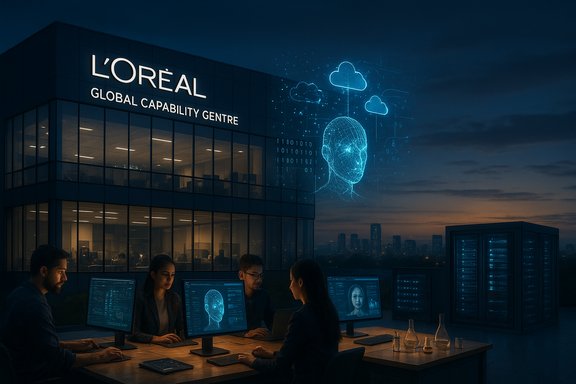
L’Oréal’s decision to establish one of its largest Global Capability Centres (GCCs) in Hyderabad crystallizes a broader trend: multinational consumer goods firms are relocating strategic technology, research and operations capacity to India’s fastest-growing tech hubs to accelerate digital transformation, product innovation and regional market penetration.
Hyderabad has been quietly converting its historical strengths in IT services and life sciences into a full-spectrum GCC ecosystem. Over the past three years the city has attracted a steady pipeline of global capability centres — spanning financial services, healthcare, retail and technology — that now anchor engineering, cloud, AI, analytics and R&D workloads. These moves reflect a strategic shift: GCCs are no longer back-office cost centres but mission-critical hubs for product development, cloud-native engineering and AI operations. L’Oréal’s Hyderabad centre, reported as a new facility separate from its existing India research hubs in Mumbai and Bengaluru, will be positioned to drive global technology, innovation and research across the French group’s operations. The company has reportedly started scouting senior leadership for the project and elevated the initiative to a board-level agenda item during recent global visits. This feature examines what L’Oréal’s Hyderabad GCC will likely mean for technology teams, the local ecosystem and enterprise IT buyers. It verifies the headline claims against independent reporting, highlights the strategic and operational rationale, and assesses both the upside and the execution risks that matter for CIOs, Windows developers and regional planners.
For enterprise partners, Windows developers and IT leaders, the immediate takeaway is operational: design integrations for portability, insist on auditable governance for AI and data, and treat GCC announcements as strategic opportunities that nonetheless require contractual discipline and technical rigour. The region’s momentum is real; the question now is whether companies and local policymakers will convert intent into durable engineering platforms that produce global-grade products and resilient local ecosystems.
Source: Storyboard18 L’Oréal picks Hyderabad for one of its biggest GCCs
 Background and overview
Hyderabad has been quietly converting its historical strengths in IT services and life sciences into a full-spectrum GCC ecosystem. Over the past three years the city has attracted a steady pipeline of global capability centres — spanning financial services, healthcare, retail and technology — that now anchor engineering, cloud, AI, analytics and R&D workloads. These moves reflect a strategic shift: GCCs are no longer back-office cost centres but mission-critical hubs for product development, cloud-native engineering and AI operations. L’Oréal’s Hyderabad centre, reported as a new facility separate from its existing India research hubs in Mumbai and Bengaluru, will be positioned to drive global technology, innovation and research across the French group’s operations. The company has reportedly started scouting senior leadership for the project and elevated the initiative to a board-level agenda item during recent global visits. This feature examines what L’Oréal’s Hyderabad GCC will likely mean for technology teams, the local ecosystem and enterprise IT buyers. It verifies the headline claims against independent reporting, highlights the strategic and operational rationale, and assesses both the upside and the execution risks that matter for CIOs, Windows developers and regional planners.Why Hyderabad — the talent, infrastructure and policy case
A deep and fast-growing talent pool
Hyderabad’s labour market offers a mix of mid-to-senior engineering talent and large entry-level cohorts graduating from nearby universities and private colleges. That combination allows GCCs to staff both product engineering and high-volume support functions. Compared with legacy Indian hubs, Hyderabad’s supply of cloud engineers, data scientists and DevOps professionals has scaled rapidly — a key reason global firms choose to locate GCCs here.Cost, real estate and connectivity
Commercial rents in Hyderabad remain competitive versus Mumbai and Bengaluru for Grade-A office space, while the city now provides the connectivity and co-working ecosystems that major GCCs require. Recent investments in office parks and dedicated tech campuses have reduced the time-to-occupancy for enterprise teams and improved supplier access for managed services, real-time telemetry, and low-latency cloud peering.Government engagement and incentives
Telangana’s aggressive FDI outreach and single-window approval mechanisms have made Hyderabad a preferred landing spot for capability centre announcements. The state actively markets incentives, skilling partnerships and land-use clarity — factors that accelerate site selection and initial staffing. Multiple high-profile GCCs announced in the last 12–18 months have cited state-level cooperation as material to their decision.What L’Oréal’s GCC will likely deliver — functions and capabilities
While L’Oréal’s public disclosure has been limited, corporate patterns and the reported intent allow sensible inference about the GCC’s early and medium-term functions.Immediate focus areas (first 12–24 months)
- Digital product engineering: Mobile apps, e‑commerce platforms, CRM integrations and personalized recommendation engines to improve customer experience and conversion rates.
- Data engineering and analytics: Master data management, SKU analytics, demand forecasting and pricing analytics built on cloud-native data platforms.
- Cloud engineering & SRE: Platform teams to orchestrate CI/CD, containerized deployments and global rollout pipelines.
- AI/ML research and applied data science: Model development for consumer personalization, ingredient science analytics and automated visual merchandising.
- Business operations & shared services: Finance, procurement analytics and supply-chain optimization leveraging automation and RPA.
Longer-term ambitions (24–60 months)
- Product R&D for markets beyond India: Work on formulation analytics, green-chemistry simulations and packaging optimization that complement L’Oréal’s French R&D hubs.
- Regional export and supply-chain integration: Operationalizing India-based manufacturing and logistics to serve neighbouring markets in South Asia and the Gulf.
- Advanced compute and rendering: Investing in GPU-backed infrastructure for high-fidelity product imaging, AR/VR try-on experiences and VFX for global campaigns.
What this means for Windows developers, IT teams and system integrators
Opportunity vectors
- Platform and API work: Expect demand for .NET, C#, and cross-platform services that integrate L’Oréal’s global commerce, ERP and telemetry endpoints.
- Cloud-native skills: Kubernetes, Docker, Terraform and managed services (Azure/AWS/GCP) will be in demand as the GCC drives CI/CD standardization across global product lines.
- Edge and device integration: Teams building AR/VR try-on, Microsoft-powered retail kiosks or Windows client apps that consume AI services will need SDKs, telemetry and robust versioning patterns.
- Data and model governance: Enterprises integrating L’Oréal-hosted services must align on model-versioning, logging and explainability, creating roles for MLOps engineers and compliance specialists.
Practical integration advice for partners
- Design service contracts with clear SLAs for cross-border APIs and named escalation paths.
- Implement model-agnostic abstraction layers so Windows applications can switch inference endpoints without a major refactor.
- Instrument telemetry and model-version logs in both client and server code to satisfy audit and governance goals.
- Plan hybrid deployment patterns: local inference for latency‑sensitive endpoints; cloud inference for heavy‑compute tasks.
Economic and employment impact for Telangana and Hyderabad
L’Oréal’s entry would add to a growing roster of global companies choosing Hyderabad for capability centres. The cumulative effect is measurable:- Creation of thousands of direct jobs in engineering, analytics and product roles.
- Follow-on opportunities in recruiting, training, managed services and real estate.
- Upskilling gains as local staff move from implementation tasks to product and research roles.
Strategic strengths and upside for L’Oréal
- Proximity to regional markets: India’s vast and diverse consumer base is a natural laboratory for product innovation, particularly for haircare and skincare where formulation and climate adaptations matter.
- Scale for AI and personalization: Data from millions of consumers can accelerate model training for recommendation engines, demand forecasting and fraud detection — with the GCC providing the operational bandwidth to run iterative experiments.
- Cost-efficient R&D scaling: Compared to Western research campuses, Hyderabad can deliver cost-effective engineering cycles while retaining high-quality output.
- Supply-chain and manufacturing synergies: With a large share of L’Oréal’s India production already local, a GCC here helps close the loop between R&D, manufacturing and distribution for the region.
Execution risks and governance caveats
Every strategic GCC announcement carries execution risk. The following are the most important to monitor:- Announcement vs. operational reality: Politically-backed announcements often precede staffed operations. Lease signing, senior hires, and public hiring pages are key milestones that convert intent into reality. Until L’Oréal publishes operational milestones, some details remain unverified.
- Talent competition and wage inflation: Hyderabad’s GCC boom intensifies demand for senior engineers, product managers and ML specialists. Competition can raise hiring costs and increase churn risk for local startups.
- Regulatory and data-residency complexity: If the GCC handles personal or sensitive consumer data, clear governance — tenant-level encryption, customer consent frameworks, and explicit data-processing agreements — is non-negotiable.
- Vendor and cloud concentration: Rapid infrastructure commitments can create supplier concentration risk; procurement teams should insist on multi-cloud flexibility or exit rights for critical workloads.
- Operational debt from rapid scaling: Fast hiring without robust onboarding and runbooks risks inconsistent engineering outcomes. Standardized playbooks and measurable KPIs are essential to maintain quality at scale.
Technical architecture and security considerations (what enterprise IT should demand)
For companies integrating services from L’Oréal’s Hyderabad GCC, the following technical controls and contractual protections should be mandatory:- Data flow diagrams and auditability: Obtain a signed end-to-end data flow diagram showing where PII is ingested, transformed, stored and exported.
- Customer-managed keys (CMK): Require CMK for encryption-at-rest to ensure keys remain in client control when appropriate.
- Model-version logging and telemetry: Include model-version identifiers and inference logs in API responses to support audit and troubleshooting.
- SLA and capacity guarantees: Define volume-based SLAs and failover policy, including cross-region recovery plans for critical endpoints.
- Least-privilege and human-in-the-loop: Enforce strict role-based access controls and human approvals for consequential changes to production models or policies.
- Third-party validation: Require independent security and compliance attestations (SOC 2, ISO 27001) and penetration-testing reports as part of procurement.
Policy and ecosystem moves Hyderabad should prioritize to capture full value
To make each new GCC a net-positive for the local economy and innovation ecosystem, Telangana and city partners should focus on these pragmatic steps:- Create public MoUs with clear milestones, reporting cadence and dispute resolution clauses to convert announcements into verifiable commitments.
- Tie skilling programs to GCC role profiles: cloud engineering, MLOps, SRE, data engineering and UX/product design.
- Publish transparency metrics: number of hires, local procurement spend, and training outcomes to measure performance against promises.
- Invest in micro-infrastructure that matters for AI: deterministic leased fiber, affordable GPU capacity pools, and power PPA clarity for compute campuses.
- Encourage university-company partnerships for applied research that can feed into both local startups and the residence-based R&D pipelines of multinational GCCs.
Competitive landscape — who else is moving to Hyderabad
Hyderabad’s GCC story is not unique to L’Oréal. The city has recently attracted or announced large capability centres from asset managers, pharma firms, retailers and tech vendors. That inflow creates both opportunity and friction: an expanding vendor ecosystem for managed services, but also a heated recruiting market for senior engineering talent. GCCs that arrive earlier with a clear skilling and campus strategy will have a competitive advantage in building durable engineering culture and local partnerships.Practical checklist for CIOs, recruitment leads and Windows developers
- Verify corporate milestones: lease documents, senior leadership hires and published hiring targets before engaging in large procurement or partnership commitments.
- Insist on playbooks: procurement should require vendor playbooks that limit data access for forward‑deployed engineers and specify sandboxing approaches.
- Build portability: design client and server code to decouple business logic from vendor-specific model APIs.
- Focus on observability: require consistent telemetry, cost‑monitoring and version logging to avoid surprise operating costs as inference usage grows.
- Prioritise governance: incorporate privacy-by-design, human oversight and rollback controls into any AI-enabled customer experiences.
Conclusion — strategic move, but milestones matter
L’Oréal’s plan to open a major Global Capability Centre in Hyderabad is a strategic milestone for both the company and Hyderabad’s technology ecosystem. If executed fully, the centre can accelerate L’Oréal’s product and digital roadmap, deepen regional R&D, and create high-value engineering jobs locally. Yet the promise of headline announcements must be converted into measurable, verifiable steps — site selection, published hiring plans, senior leadership appointments and transparent procurement terms — before the transformation can be fully judged.For enterprise partners, Windows developers and IT leaders, the immediate takeaway is operational: design integrations for portability, insist on auditable governance for AI and data, and treat GCC announcements as strategic opportunities that nonetheless require contractual discipline and technical rigour. The region’s momentum is real; the question now is whether companies and local policymakers will convert intent into durable engineering platforms that produce global-grade products and resilient local ecosystems.
Source: Storyboard18 L’Oréal picks Hyderabad for one of its biggest GCCs
