

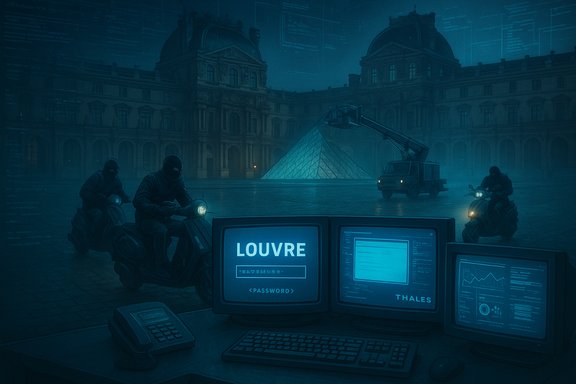
The image of masked men riding scooters away from the Musée du Louvre with jewel-encrusted relics is the cinematic part — the deeper, more unsettling story is the discovery that auditors once accessed the museum’s video‑surveillance server using the password “LOUVRE,” a finding that reframes the October daylight heist as not only a brazen physical breach but also an institutional failure to treat cyber‑physical security with the urgency its collections demand.
Shortly before 10:00 on October 19, a team of four individuals used a truck‑mounted lift to reach the Galerie d’Apollon, smashed display cases with power tools and fled on motorcycles after removing eight pieces of royal and imperial jewellery that together were publicly valued at roughly €88 million (about $100–$102 million). The operation took minutes; CCTV recorded much of the action and police later arrested multiple suspects. What turned an audacious smash‑and‑grab into a national scandal were the audit excerpts and procurement records that surfaced after the theft: confidential technical reviews dating back to 2014 warned that the museum’s surveillance and access‑control networks contained “numerous vulnerabilities,” and that basic credential hygiene and software lifecycles were being neglected. Those documents, obtained and reported by investigative journalists, explicitly recorded that a surveillance server accepted the password “LOUVRE” and at least one vendor system used “THALES” as an administrative credential.
Until the Louvre publishes a detailed remediation timeline with independent verification, the public must treat the audit excerpts as proof of exposure and the criminal investigation as a separate, ongoing forensic process. For any institution that mixes public access with irreplaceable assets, the imperative is clear: treat physical‑security IT as critical infrastructure, fund it accordingly, and convert occasional audits into continuous, funded lifecycle programs. The cost of inaction is no longer just monetary; it is cultural and irreversible.
Source: Futurism You Will Le Cringe When You Hear the Louvre Video Surveillance System's Actual Password
 Background
Shortly before 10:00 on October 19, a team of four individuals used a truck‑mounted lift to reach the Galerie d’Apollon, smashed display cases with power tools and fled on motorcycles after removing eight pieces of royal and imperial jewellery that together were publicly valued at roughly €88 million (about $100–$102 million). The operation took minutes; CCTV recorded much of the action and police later arrested multiple suspects. What turned an audacious smash‑and‑grab into a national scandal were the audit excerpts and procurement records that surfaced after the theft: confidential technical reviews dating back to 2014 warned that the museum’s surveillance and access‑control networks contained “numerous vulnerabilities,” and that basic credential hygiene and software lifecycles were being neglected. Those documents, obtained and reported by investigative journalists, explicitly recorded that a surveillance server accepted the password “LOUVRE” and at least one vendor system used “THALES” as an administrative credential. Overview of the technical failings that surfaced
Trivial credentials in critical places
The most humiliating detail — and the one that rapidly became shorthand for the broader failure — is the literal use of the museum’s name as a privileged password on a server that controlled or displayed camera feeds. Auditors from the French National Cybersecurity Agency (ANSSI) documented that simple strings such as “LOUVRE” and “THALES” would open administrative access during their 2014 penetration‑style review. Those findings were accompanied by blunt warnings: if an attacker gained control of that network, they would be able to “facilitate damage or even theft of artworks.” Credential hygiene is basic cyber‑hygiene. Using institutionally predictable passwords for systems that feed alarms and video is a textbook configuration error — one that allows automated guessers and human opportunists to gain administrative reach in seconds. The auditors’ evidence demonstrates that the problem was not merely hypothetical: testers could access administrative consoles and modify video or badge‑control logic during the engagement.Legacy operating systems and unsupported vendor stacks
Auditors found multiple workstations and security appliances still running operating systems from the Windows 2000 / Windows XP era and even vendor control software that required Windows Server 2003. Microsoft’s extended support for Windows Server 2003 ended on July 14, 2015, which means any system still running it years later has no routine vendor security patches or modern endpoint protections. Running security‑critical applications on unsupported platforms is an active and accumulating risk: known vulnerabilities remain unpatched, exploit code matures in the wild, and modern defensive tooling often cannot be installed.Poor network segmentation and lapse in procurement discipline
The audit excerpts and follow‑up reviews repeatedly flagged that the security network was not treated as an isolated, critical control plane. Administrative workstations could reach security servers in ways that permitted lateral movement; essential monitoring and logging were incomplete or misconfigured; and maintenance contracts or replacement plans for legacy security applications had lapsed or been deferred. In procurement terms, the museum repeatedly bought vendor-specific systems without funding or contract clauses guaranteeing lifecycle upgrades, creating permanent technical debt in a control plane that should be strictly time‑boxed and managed.What we can verify — and what remains unproven
- Verified: ANSSI performed a 2014 audit and documented serious vulnerabilities in the security network linking alarms, access control and CCTV; multiple investigative reports republished or summarized the audit findings.
- Verified: Audit materials and procurement records show long‑dated vendor software in the control plane and at least some endpoints running OSes that had passed vendor support end‑of‑life (notably Windows Server 2003 / Windows 2000 / XP). Microsoft’s lifecycle records confirm that Windows Server 2003 exited extended support in July 2015.
- Verified: The October theft removed eight objects from the Galerie d’Apollon and police have pursued suspects, including DNA evidence recovered at the scene; the stolen items’ financial valuation was widely reported as about €88 million.
- Not yet verified / caution: Public reporting has not produced a forensic trail proving the thieves used the “LOUVRE” credential or that they exploited network access to disable cameras during their operation. Investigative authorities and prosecutors have not released conclusive public forensic logs that tie a specific cyber compromise to the theft; the audit findings show exposure but do not, by themselves, prove exploitation during the event. Responsible reporting must keep that distinction explicit.
How this failure happened: governance, procurement, and the slow creep of technical debt
Where governance fell short
The audits reveal that technical deficits were symptoms of institutional choices: priorities skewed toward acquisitions and exhibitions, fragmented maintenance budgets, and multiple stakeholders with unclear security ownership. When responsibility is diffuse and budgets are projectized rather than lifecycle‑driven, security remediation becomes a series of ad‑hoc patches rather than an enforceable roadmap. That structural mismatch magnifies the risk of leaving legacy control systems in production long after their vendor support ends.Procurement without lifecycle clauses
Public procurement documentation reviewed by journalists showed systems purchased with little contractual guarantee of future updates. Without enforced vendor migration plans, critical security components become permanent liabilities. Effectively, the museum’s procurement model allowed single‑vendor applications to ossify in place instead of being periodically refreshed or replaced as part of a funded lifecycle program.Normalization of deviance
Over time, organizations can accept degraded security as “good enough” because daily operations continue to function. That normalization — when alarms still ring and cameras still stream, despite being unpatched or misconfigured — masks the fact that the underlying control plane is brittle and fragile in the face of focused adversary tradecraft. The auditors saw exactly that pattern: equipment that appeared operational while being exposed to known and remediable vulnerabilities.What the Louvre (and similar institutions) must do — a prioritized, practical remediation plan
The technical fixes are not exotic, but they are operationally demanding and politically sensitive because they require funding, vendor cooperation and a sustained governance commitment. The following sequence is pragmatic and hierarchical:- Immediate (hours to days)
- Force rotation of all administrative credentials on CCTV, alarm consoles and badge management systems; remove default and predictable strings and enforce unique, complex passwords. Implement multi‑factor authentication (MFA) where vendor software allows.
- Short term (weeks)
- Isolate the security VLAN: enforce strict firewall rules and host‑based filtering so that general administrative workstations cannot reach security consoles. Deploy compensating logging and tamper detection on video servers.
- Medium term (months)
- Replace or sandbox any remaining hardware or software demanding unsupported OS versions. If direct replacement is impossible, apply network isolation and compensating controls (virtual appliances, jump hosts, hardened management consoles).
- Strategic (6–24 months)
- Create a funded, rolling lifecycle budget for security appliances and an explicit migration plan with contractual guarantees from vendors. Appoint a senior security owner (a CISO‑equivalent) with budget authority and reporting lines to the board or equivalent oversight body.
- Continuous
- Schedule independent red‑team exercises that bridge digital and physical scenarios, condition staff on detection and lockdown procedures, and publish an institutional remediation timeline with independent verification.
Broader implications: why museums and other public institutions are uniquely exposed
Cultural institutions combine high physical value, broad public access and often constrained budgets and fragmented governance. That triad creates a high‑risk environment for cyber‑physical attacks:- High value: objects are unique, non‑fungible and irreplaceable; their theft has outsized cultural and diplomatic consequences.
- Public exposure: museums deliberately open facilities to the public, creating many points of ingress and large daily flows of visitors that complicate perimeter control.
- Fragmented funding and procurement: capital often flows to exhibitions, acquisitions and renovations while operational security is underfunded and deprioritized.
Critical analysis: strengths, weaknesses and the limits of public reporting
Notable strengths in the record
- Credible audits exist: ANSSI and later national institute reviews conducted external, expert assessments that produced concrete, actionable recommendations; that the museum engaged outside expertise is a positive governance step even if follow‑through was uneven.
- Law enforcement performed quickly: investigative teams arrested multiple suspects, recovered forensic evidence including DNA, and maintained active prosecutions — actions that demonstrate investigative capacity even if some aspects of the security posture were lacking.
Serious weaknesses and systemic risks
- Repeated warnings went inadequately executed: multiple audits across years documented the same classes of risk — trivial passwords, legacy OS, insufficient segmentation — yet procurement, budgeting and governance failed to deliver a durable remediation program. That is an institutional fault line.
- Overreliance on legacy vendor stacks: deploying control software that requires obsolete server stacks (Windows Server 2003 or older) without a funded migration path creates persistent attack surfaces that are difficult to patch or defend.
- Public disclosure risk: now that the archival audit excerpts and public reporting have become widely available, other institutions with similar patterns may be targeted by adversaries who will test for identical misconfigurations and unsupported stacks. This increases the urgency of transparent remediation.
Where reporting must be cautious
The symbolic power of finding the word “LOUVRE” on a password field risks conflating exposure with proven exploitation. Public materials show auditors could access servers during tests and that trivial credentials existed historically, but investigators have not publicly released a forensic log proving the thieves used that specific credential to conceal or facilitate the real‑time theft. Until prosecutors or independent forensic disclosures establish that chain, it remains an alarming indicator of exposure rather than incontrovertible proof of the theft method. That distinction matters for legal liability, regulatory response and defense planning.The political, insurance and policy ripples
Expect an immediate wave of administrative reviews, insurance disputes and political scrutiny. Public authorities are already promising security upgrades and parliamentary inquiries; insurers will demand proof of due diligence and may condition future coverage on demonstrable lifecycle and governance changes. For cultural policymakers, the Louvre episode reframes museum security as cultural infrastructure and shifts the policy conversation toward central support mechanisms, minimum standards and perhaps conditional funding linked to security modernization.Conclusion
The image of a password reading “LOUVRE” will be remembered because it is vivid and almost comic — but the deeper lesson is prosaic and uncomfortable: a world‑class museum allowed decades of technical debt and procurement choices to accumulate in the control plane that protects its most precious artifacts. The fixes are straightforward in principle — rotate credentials, enforce MFA, isolate security VLANs, replace unsupported platforms, fund lifecycle replacements and appoint accountable security leadership — but the organizational work is difficult and expensive.Until the Louvre publishes a detailed remediation timeline with independent verification, the public must treat the audit excerpts as proof of exposure and the criminal investigation as a separate, ongoing forensic process. For any institution that mixes public access with irreplaceable assets, the imperative is clear: treat physical‑security IT as critical infrastructure, fund it accordingly, and convert occasional audits into continuous, funded lifecycle programs. The cost of inaction is no longer just monetary; it is cultural and irreversible.
Source: Futurism You Will Le Cringe When You Hear the Louvre Video Surveillance System's Actual Password
