

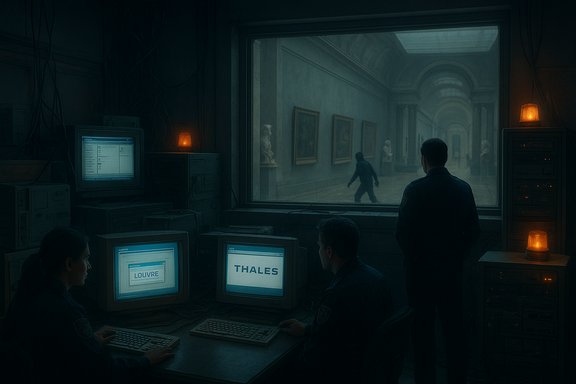
The Louvre’s security embarrassment boiled down to a single, humiliating detail: auditors reported that the server managing the museum’s video surveillance could be accessed with the password “LOUVRE,” and a separate Thales system used “THALES” — trivial credentials flagged years earlier in a 2014 audit that warned the museum about obsolete operating systems, weak passwords and poor segregation between critical networks and the public domain. This revelation has transformed the October daylight robbery that removed eight pieces of crown jewellery into not only a high‑profile criminal case but a wider institutional autopsy on how digital neglect multiplies physical risk.
Shortly before 10am on October 19, visitors and staff at the Musée du Louvre watched a rapid, coordinated theft unfold in the Galerie d’Apollon. Four individuals used a truck‑mounted lift to access an upper‑floor balcony, broke into display cases with power tools, and left in minutes; several suspects were later arrested. The loss — widely reported at roughly €88 million (≈$100–$102 million) — shocked France and provoked urgent government and parliamentary scrutiny. What followed the dramatic headlines was a cascade of leaked audit material and investigative reporting that re‑contextualised the incident. Confidential reports dating back to 2014 (and follow‑ups in 2017) documented persistent failings in the museum’s physical‑security control plane: default or trivial passwords on administrative consoles, security applications running on unsupported Microsoft operating systems such as Windows 2000 and Windows Server 2003, fragmented maintenance contracts, and insufficient network segmentation between the public/business LAN and the security VLAN. Journalists obtained these documents and reported that testers from the French cybersecurity agency (ANSSI) were able to access critical security servers during an audit — sometimes using obvious strings like “LOUVRE” and “THALES.”
Short term (hours–days)
Key institutional changes that matter:
For museums and institutions that hold the world’s shared cultural patrimony, digital security is not optional. The consequences of treating operational‑technology as an afterthought are immediate and irreparable when priceless, unique objects are at stake. The Louvre’s ordeal should be a hard lesson: defence in depth is no longer an IT abstraction; it is the last line between national heritage and permanent loss.
Source: The Times Password for Louvre’s video surveillance system was ‘Louvre’
 Background
Shortly before 10am on October 19, visitors and staff at the Musée du Louvre watched a rapid, coordinated theft unfold in the Galerie d’Apollon. Four individuals used a truck‑mounted lift to access an upper‑floor balcony, broke into display cases with power tools, and left in minutes; several suspects were later arrested. The loss — widely reported at roughly €88 million (≈$100–$102 million) — shocked France and provoked urgent government and parliamentary scrutiny. What followed the dramatic headlines was a cascade of leaked audit material and investigative reporting that re‑contextualised the incident. Confidential reports dating back to 2014 (and follow‑ups in 2017) documented persistent failings in the museum’s physical‑security control plane: default or trivial passwords on administrative consoles, security applications running on unsupported Microsoft operating systems such as Windows 2000 and Windows Server 2003, fragmented maintenance contracts, and insufficient network segmentation between the public/business LAN and the security VLAN. Journalists obtained these documents and reported that testers from the French cybersecurity agency (ANSSI) were able to access critical security servers during an audit — sometimes using obvious strings like “LOUVRE” and “THALES.” What the documents say: a concise summary
- ANSSI’s 2014 testing and later audits concluded that the museum’s security network presented “numerous vulnerabilities,” specifically calling out trivial password hygiene and obsolete systems that left alarms, CCTV and access control exposed.
- At least one surveillance server was reported as accessible with the password “LOUVRE,” and a Thales control application with the password “THALES,” according to the audit excerpts published by French outlets.
- Some security‑critical software originally deployed in the early 2000s — notably a Thales product identified in procurement and audit documents — required Windows Server 2003 to run. Microsoft ended extended support for Windows Server 2003 on July 14, 2015, meaning that by 2025 such systems no longer received vendor security patches.
- Follow‑up reviews and procurement records indicated that multiple control applications had not seen meaningful security updates for years and that maintenance contracts had lapsed or were incomplete.
Technical anatomy of the vulnerabilities
Legacy operating systems and unsupported stacks
Running physical‑security management software on end‑of‑life operating systems is a fundamental operational risk. Windows Server 2003’s extended support ended on July 14, 2015; Windows 2000 and Windows XP reached their end‑of‑support even earlier. Without vendor patches, newly discovered vulnerabilities accumulate and become trivially usable by automated exploit tooling. Put bluntly: a security console running on an unsupported OS is a timebomb.- Unsupported OS = no security patches for new CVEs.
- Unsupported vendor software = no vendor fixes or compatibility guarantees.
- In combination, the attack surface enlarges every month the software remains in production.
Credential hygiene and default strings
Default, shared or trivially guessable passwords are the single most repeated cause of high‑impact intrusions. The audits described instances where an operator could reach an administrative session by typing “LOUVRE” or “THALES.” That is not only poor practice — it is an operational failure at the level of basic configuration management. The risk is compounded when multi‑factor authentication is absent and when administrative consoles are reachable — even indirectly — from general‑purpose workstations or the internet‑facing perimeter.Network segmentation and blast radius
Physical‑security systems must be treated as critical infrastructure. That means strict VLAN isolation, firewall policies, hardened management interfaces and limited access paths for vendors. Audits said the Louvre’s architecture allowed administrative workstations to reach the security network in ways that would enable lateral movement — exactly the scenario that converts a single misconfiguration into a full control plane compromise. In a properly segmented environment, a compromised staff PC would not directly access camera consoles or badge databases.The chain the auditors warned about — and why it matters
Auditors and national CERT playbooks describe a straightforward adversary playbook that becomes possible under the documented conditions:- Reconnaissance: use public procurement documents, satellite imagery or on‑site observation to map vendor models and likely weak points.
- Initial access: exploit an exposed administrative interface or guess a trivial password.
- Lateral movement: pivot across poorly segregated networks to the CCTV and access‑control servers.
- Manipulation: blind cameras, alter recording schedules, or change badge permissions.
- Physical execution: perform a rapid in‑person theft while monitoring or delaying detection and response.
What is verified — and what remains uncertain
Verified by multiple independent outlets:- ANSSI performed an audit in 2014 that raised serious concerns about the museum’s security network and management systems.
- Audit excerpts and procurement records show legacy software and unsupported OS usage across some security systems.
- Public reporting has documented that at least one surveillance server was flagged as accessible with a simple credential like “LOUVRE,” as reported by Libération and picked up by international outlets.
- The October 19 heist occurred in daylight, was executed very quickly, and removed eight items valued at about €88 million (widely reported as ≈$100–$102 million).
- Whether the thieves actually used the “LOUVRE” or “THALES” credentials during the October operation.
- Whether cameras were actively disabled or recordings tampered with by remote actors in the lead‑up to or during the theft.
- The full remediation timeline between ANSSI’s 2014 recommendations and the pre‑heist state of the systems in 2025; official, detailed public documentation of remedial actions is limited.
Institutional failures beyond the console: procurement, budgets and governance
Several non‑technical governance failures amplify the technical risk:- Procurement without lifecycle planning: buying systems without funded replacement or migration paths turns often‑critical devices into permanent liabilities.
- Lapsed maintenance contracts: when vendor support ends and no compensating controls are funded, patches and vendor fixes vanish.
- Distributed responsibility and weak accountability: audits flagged unclear ownership and insufficiently empowered security leadership, making follow‑through patchy or slow.
Immediate technical remediation checklist (prioritised)
The auditors’ recommendations and industry best practices create a short, medium and long‑term roadmap any museum or public institution should adopt immediately.Short term (hours–days)
- Rotate and enforce unique, complex admin credentials on all security consoles; eliminate defaults immediately.
- Block external access to security management interfaces at the perimeter firewall.
- Isolate any unsupported servers in a hardened, air‑gapped segment until replacement is possible.
- Enable centralized logging and forward logs to an immutable, offsite SIEM to preserve forensic evidence.
- Replace or migrate vendor software that requires unsupported OS versions; where impossible immediately, re‑establish vendor maintenance or deploy virtual patches.
- Implement multi‑factor authentication (MFA) for all administrative and vendor access.
- Deploy endpoint detection and response (EDR) on administrative workstations and servers.
- Conduct independent penetration testing and adversary emulation focused on combined cyber‑physical attack chains.
- Build lifecycle funding into procurement contracts, requiring vendors to provide explicit end‑of‑life roadmaps.
- Institutionalise a CISO role (or equivalent) with explicit remediation responsibility and budget authority.
- Run regular cross‑disciplinary incident response exercises that include curators, guards, IT and local law enforcement.
Legal, insurance and reputational consequences
The reputational damage of a cultural theft at the Louvre is severe and sticky. Beyond that, the institution faces potential legal exposure if governing bodies are shown to have ignored repeated audit warnings. Insurers will demand evidence of due diligence; premiums could rise, or coverage be narrowed, if risk management is demonstrably lax. The audit trail from 2014 onward — if it shows recommendations were not executed — will be central to any civil or administrative review.Broader lesson: cyber‑physical criticality in public institutions
The Louvre case is a cautionary tale for any organisation that mixes public access with high‑value assets: museums, transport hubs, hospitals and utilities all operate in mixed OT/IT environments where digital neglect becomes a physical vulnerability. Treating building‑management systems, CCTV and access control as second‑class IT risks invites catastrophe.Key institutional changes that matter:
- Treat OT and physical‑security stacks as critical infrastructure with the same lifecycle discipline as servers and databases.
- Contractually require vendors to guarantee security updates and provide migration paths.
- Move from siloed upgrades to integrated security funding — one‑off capital buys are not enough.
Critical analysis: where the museum fell short — and where reporting must be cautious
Notable strengths in the public record:- The existence of independent audits (ANSSI and follow‑ups) shows the Louvre engaged external expertise and did not simply self‑certify. That created a documented baseline for action.
- Post‑incident response and the arrests made by police show law enforcement capacity and cross‑agency cooperation.
- Repeatedly flagged recommendations apparently lacked consistent follow‑through; either budget, governance or procurement practices failed to convert audit findings into durable remediation.
- Allowing legacy OS and unsupported vendor stacks to persist in the control plane increased the attack surface measurably. The lack of timely migration from Windows Server 2003 (end of extended support in July 2015) is emblematic.
- Equate existence of vulnerabilities with a proven causal method for the theft. Public sources confirm exposure; they do not yet publicly confirm that attackers used the “LOUVRE” credential or remote access to disable cameras during the theft. Until forensic logs and formal investigative filings are published, attribution beyond “the museum was vulnerable” is speculative.
What other institutions should do now — a practical, short list
- Run an immediate, prioritized inventory of all OT/physical‑security assets and flag anything running unsupported OS versions.
- Force emergency credential rotation on all security consoles and implement MFA.
- Segregate and restrict access to the security VLAN and vendor management interfaces.
- Purchase a fast, independent red‑team assessment that replicates adversary tradecraft bridging cyber and physical actions.
- Build a rolling capital line for security lifecycle management and require lifecycle clauses in every procurement.
Conclusion
The Louvre heist is cinematic in its execution and sobering in its lessons. The headlines about a password that read “LOUVRE” turned a broader audit finding into a symbolic shorthand for systemic neglect, but the underlying story is less about a single bad password and more about long‑term governance, procurement and lifecycle failures that left operational technology exposed. The technical fixes are straightforward in principle — eliminate defaults, isolate legacy servers, enforce MFA and contract for lifecycle support — but the institutional fixes require sustained investment, procurement discipline and accountability.For museums and institutions that hold the world’s shared cultural patrimony, digital security is not optional. The consequences of treating operational‑technology as an afterthought are immediate and irreparable when priceless, unique objects are at stake. The Louvre’s ordeal should be a hard lesson: defence in depth is no longer an IT abstraction; it is the last line between national heritage and permanent loss.
Source: The Times Password for Louvre’s video surveillance system was ‘Louvre’
