

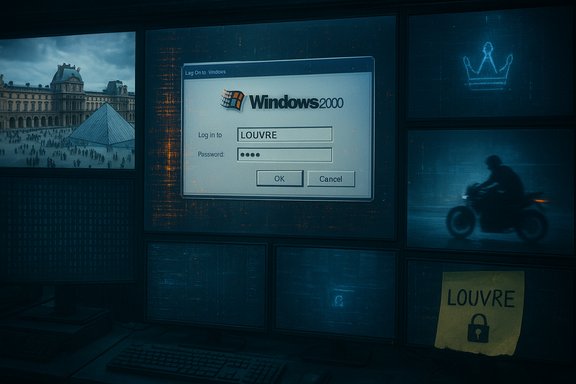
The image of masked thieves riding away from the Musée du Louvre with crown jewels in broad daylight was cinematic — the more damaging part is the audit trail and leaked excerpts showing that auditors once accessed the museum’s video‑surveillance server with the literal password LOUVRE, and that the institution carried a decade‑long technical debt of unsupported systems and incomplete surveillance coverage.
On 19 October 2025, a coordinated daytime raid on the Galerie d'Apollon resulted in the theft of eight pieces of historic jewellery publicly valued at roughly €88 million (about US$100–102 million). The operation lasted minutes; suspects were later arrested, but the heist triggered a wider institutional and national reckoning about museum security. Within days of the theft, investigative reporting and leaked administrative audits refocused attention on long‑standing IT and procurement failures that auditors had flagged years earlier. A 2014 penetration‑style review by France’s National Cybersecurity Agency (ANSSI) — and follow‑up inspections in subsequent years — documented numerous vulnerabilities in the systems that mediate alarms, badge control and video surveillance. Those findings included predictable credentials (notably the string “LOUVRE”), systems running end‑of‑life Microsoft operating systems, and a patchwork of maintenance contracts that left critical applications unpatched and unsupported. Importantly, public reporting has not produced a complete forensic chain showing the thieves used the “LOUVRE” credential during the October break‑in. The leaked audits document exposure and practical exploitability; they do not — at least not in publicly released forensic evidence — prove that the actual perpetrators exploited that specific credential at the time of the robbery. That distinction matters for both legal and technical accountability.
Insurance and indemnity questions will follow: insurers and legal counsel will examine whether the documented vulnerabilities constitute negligence under commercial policies or public stewardship obligations. That analysis turns partly on whether exploitation can be proven in the forensic record.
Fixing this requires a combination of immediate technical triage and long‑term governance reform: rotate credentials and enable MFA, replace unsupported servers, enforce segmentation, preserve forensic logs immutably, and — crucially — fund maintenance and lifecycle management as a first‑class institutional priority. The lessons are straightforward and widely known; what remains is institutional will and accountable delivery.
What the public and policymakers should take away is equally clear: cultural stewardship now includes cyber stewardship. The next high‑value target need not be a gallery to suffer the same sequence of neglect, but without hard organizational choices and funded remediation, other institutions remain exposed. The risk is not merely reputational — it is a material threat to national heritage and public trust.
Source: TechRadar No wonder it got hit - report claims password for the Louvre’s video surveillance system was...“LOUVRE”
 Background
On 19 October 2025, a coordinated daytime raid on the Galerie d'Apollon resulted in the theft of eight pieces of historic jewellery publicly valued at roughly €88 million (about US$100–102 million). The operation lasted minutes; suspects were later arrested, but the heist triggered a wider institutional and national reckoning about museum security. Within days of the theft, investigative reporting and leaked administrative audits refocused attention on long‑standing IT and procurement failures that auditors had flagged years earlier. A 2014 penetration‑style review by France’s National Cybersecurity Agency (ANSSI) — and follow‑up inspections in subsequent years — documented numerous vulnerabilities in the systems that mediate alarms, badge control and video surveillance. Those findings included predictable credentials (notably the string “LOUVRE”), systems running end‑of‑life Microsoft operating systems, and a patchwork of maintenance contracts that left critical applications unpatched and unsupported. Importantly, public reporting has not produced a complete forensic chain showing the thieves used the “LOUVRE” credential during the October break‑in. The leaked audits document exposure and practical exploitability; they do not — at least not in publicly released forensic evidence — prove that the actual perpetrators exploited that specific credential at the time of the robbery. That distinction matters for both legal and technical accountability. What the audits actually documented
ANSSI’s 2014 engagement: practical, not theoretical warnings
The 2014 ANSSI review examined the museum’s security VLAN — the control plane that ties together CCTV, intrusion detection and access control. Testers documented routes to administrative consoles and demonstrated access using trivial credentials as examples. The auditors reported they could obtain privileged sessions and warned that the control plane’s vulnerabilities could be used to facilitate damage or even theft of artworks. The audit explicitly cited the strings “LOUVRE” for a surveillance server and “THALES” for a vendor application as examples of weak credentials discovered during testing. ANSSI’s recommendations were standard and urgent: implement stronger credential and authentication policies, migrate critical control software off unsupported operating systems, isolate the security network from general administrative LANs, and restore lifecycle maintenance for vendor systems. Those are the same mitigations most IT security teams deploy for any cyber‑physical infrastructure; in the Louvre’s case, the auditors flagged both technical and governance failures that made practical exploitation realistic.Follow‑up reviews and the accumulation of technical debt
A 2017 follow‑up and subsequent administrative checks reiterated similar concerns: multiple workstations and appliances were still running end‑of‑life software such as Windows 2000 and Windows Server 2003, some security applications had no active maintenance, and camera rollouts were partial. Procurement records and audit excerpts show that several security applications had not been updated for years, and that a minority of public rooms were covered by cameras — contemporary reporting places camera coverage at roughly 39%. These findings expose a governance pattern: repeated recommendations, piecemeal remediation, and budget choices that prioritized exhibitions and renovation projects over sustained investment in security lifecycle management. The result is predictable: vulnerabilities persist, and institutional memory about technical debt degrades as staff and vendors change.The technical anatomy of the failure
Weak passwords are not a quaint embarrassment — they are active attack vectors
Using a trivial, institutionally obvious string like LOUVRE on an administrative account is textbook misconfiguration. Predictable credentials allow automated tools and low‑sophistication attackers to enumerate and access privileged consoles quickly. In cyber‑physical environments, credential compromise is a gateway to privilege chaining: once an adversary controls the video or badge servers, they can blind cameras, alter retention or timestamps, and delay or disguise alerts. Auditors explicitly warned that access to those consoles could let an attacker “facilitate damage or even theft of artworks.” It is essential to be precise: the audits show that such credentials were present when ANSSI tested the environment. Whether those exact strings were in place in October 2025 or were exploited during the heist is not publicly proven. Several reputable outlets emphasize this nuance: documented vulnerability ≠ demonstrated exploitation.Unsupported operating systems dramatically enlarge the attack surface
Running security‑critical appliances on Windows 2000 or Windows Server 2003 is not merely inconvenient — it is a persistent, accumulating risk. These OS versions reached end‑of‑support long ago (Windows Server 2003’s extended support ended in July 2015), which means new vulnerabilities discovered since then receive no vendor patches. Modern defensive tooling often cannot be installed on these platforms, and proof‑of‑concept exploit code for long‑known CVEs is widely available. The audits flagged such legacy stacks as amplifiers of risk.Poor network segmentation and oversight multiplies blast radius
ANSSI and later reviewers reported that the museum’s architecture permitted administrative workstations and vendor remote‑access paths to reach security servers in ways that lack strict isolation. Proper segmentation would have prevented a compromised office PC or vendor remote session from directly affecting CCTV or badge systems. Lacking that, a single foothold can turn into full control of the security control plane.Camera coverage and physical perimeter weaknesses
Technical failings were mirrored in physical gaps. Administrative audits and press reporting documented that a significant fraction of rooms were not under continuous camera observation. Contemporary figures cited by journalists put camera coverage at roughly 39%, and deployment programs to extend coverage were delayed. That combination — blind spots plus exploitable admin paths — converts a narrow physical operation into a plausible, low‑risk theft for prepared actors.What is verified — and what remains unproven
- Verified: ANSSI carried out a 2014 audit and documented weak credentials and obsolete systems in the museum’s security‑control environment. Multiple independent news outlets reported on the leaked excerpts and procurement records.
- Verified: The museum’s security estate included unsupported Windows platforms and applications lacking vendor maintenance, per follow‑up reviews and procurement documents.
- Verified: Camera coverage was incomplete and projects to modernize surveillance had been delayed, with contemporary reporting estimating coverage at around 39%.
- Not proven publicly: that the perpetrator(s) used the literal string LOUVRE to gain access during the October 2025 heist, or that cameras and logs were remotely manipulated at the time of the theft. Investigators have not publicly released a full forensic chain tying a named digital intrusion to the physical crime; while the audit shows what could have happened, published materials stop short of demonstrating what did happen. Proceed with caution when attributing causation.
How a cyber weakness converts into a physical crime: an adversary playbook
Auditors described a concise, realistic chain of operations that transforms administrative misconfigurations into real‑world theft. The playbook maps directly to the risks ANSSI outlined:- Reconnaissance: OSINT (procurement documents, satellite imagery, on‑site observation) to identify vendor models and known software.
- Initial access: guess or brute‑force trivial passwords, exploit known unpatched vulnerabilities on legacy OS.
- Lateral movement: move from compromised administrative hosts across poorly segmented networks to CCTV and badge servers.
- Manipulation: change camera orientations, disable or overwrite footage, modify alarm thresholds or badge permissions.
- Physical execution: execute a rapid, low‑signature break‑in while monitoring or delaying detection and exit routes.
Institutional failures that allowed the risk to persist
Two classes of institutional problems recur in the audit trail and public reporting:- Procurement and lifecycle neglect: Contracts and budgets focused on short‑term projects and acquisitions while deferring updates and vendor maintenance for control‑plane software. Records show several security applications with expired maintenance windows and no replacement roadmaps.
- Fragmented responsibility and governance: Oversight of IT, physical security, and vendor relationships lacked a unified ownership model capable of prioritizing defensive remediation across long procurement cycles. Repeated audit recommendations were not followed through comprehensively.
Legal, reputational and policy implications
The scandal has immediate legal and reputational consequences. French authorities and culture officials have treated it as a national embarrassment that also raises public‑safety questions for other cultural sites. France’s Minister of Culture announced plans for structural changes and a new security department, while the Louvre’s director acknowledged perimeter CCTV weaknesses. These political moves reflect the gravity of the failure beyond the immediate theft. From a policy standpoint, the episode spotlights the need for sector‑wide minimum standards for cyber‑physical protection of high‑value cultural assets: mandatory vulnerability assessments, enforced remediation timelines for critical control systems, and audit‑grade forensic logging requirements to preserve evidentiary trails in case of incidents.Insurance and indemnity questions will follow: insurers and legal counsel will examine whether the documented vulnerabilities constitute negligence under commercial policies or public stewardship obligations. That analysis turns partly on whether exploitation can be proven in the forensic record.
Practical roadmap: what museums and similar institutions must do now
The Louvre episode converts forensic lessons into immediate operational priorities. The following is a practical, prioritized roadmap for museums and institutions that manage cyber‑physical control planes:- Immediate triage
- Rotate and force change on all administrative and vendor credentials; require complex, non‑predictable passwords and enforce MFA for administrative access.
- Isolate and snapshot critical servers for forensic review; preserve logs in immutable storage and forward to an off‑site SIEM.
- Patch and replace
- Remove unsupported OS instances from the security VLAN; migrate control software to supported platforms or isolate them behind compensating controls until replacement is possible.
- Segmentation and hardening
- Implement strict VLAN segmentation, deny‑by‑default firewall rules between business and security networks, and restrict vendor remote access to MFA‑protected jump hosts.
- Observability and forensic readiness
- Ensure cameras, access logs and administrative actions are logged to an immutable, centralized service with coherent retention and chain‑of‑custody controls. Use tamper‑evident logging and clock synchronization for forensics.
- Governance fixes
- Assign clear lifecycle ownership with ring‑fenced budgets for maintenance of safety‑critical systems; require periodic third‑party penetration tests and public remediation statements for critical findings.
- Physical mitigations
- Close camera blind spots, improve perimeter hardening, and review staff and contractor access policies (IDs, uniforms, vehicle management). Combine physical upgrades with technical controls for layered protection.
Broader lessons for cyber‑physical security
This episode is a cautionary tale that resonates far beyond a single museum.- Cybersecurity for control systems is national critical infrastructure: when what looks like IT controls alarms, cameras and badge systems, it is literally the institution’s nervous system. Neglecting those systems produces tangible cultural and financial risk.
- Culture and procurement incentives matter: when visible acquisitions and renovations outcompete invisible maintenance in budgeting decisions, technical debt grows into risk that will eventually be exploited or fail at the worst possible moment.
- Public reporting and forensic transparency are essential: to learn lessons, institutions must publish redacted audit summaries and remediation timelines; without them, the sector cannot measure progress or hold stewards accountable. The public interest in cultural heritage demands greater transparency about remedial steps after a systemic failure.
Risks and caveats in public narrative
The image of a password reading “LOUVRE” circulating on social media is powerful and humiliating — and it has understandably become shorthand for institutional negligence. But the record requires careful parsing:- The leaked audits show that the string appeared in a 2014 test; multiple outlets reported this. That is verified by the documents journalists obtained.
- Whether that exact credential was in use or exploited on 19 October 2025 is not publicly proven; investigators have not released a complete forensic affidavit tying a digital intrusion to the physical theft. Public discussion should avoid conflating discovery with proven exploitation.
- There is also a reputational hazard in turning audit excerpts into meme‑driven narratives that obscure the deeper governance lessons: the danger is to laugh at the password instead of fixing the lifecycle and segmentation problems that made such a configuration possible in the first place.
Conclusion
The Louvre heist was a wake‑up call for every institution that treats cyber‑physical controls as an afterthought. The leaked audits and reporting reveal a predictable cascade of failures — trivial credentials, unsupported operating systems, partial camera coverage, and governance gaps — that together created an environment where a daylight smash‑and‑grab could succeed and where the public narrative would reduce institutional failure to a single humiliating password.Fixing this requires a combination of immediate technical triage and long‑term governance reform: rotate credentials and enable MFA, replace unsupported servers, enforce segmentation, preserve forensic logs immutably, and — crucially — fund maintenance and lifecycle management as a first‑class institutional priority. The lessons are straightforward and widely known; what remains is institutional will and accountable delivery.
What the public and policymakers should take away is equally clear: cultural stewardship now includes cyber stewardship. The next high‑value target need not be a gallery to suffer the same sequence of neglect, but without hard organizational choices and funded remediation, other institutions remain exposed. The risk is not merely reputational — it is a material threat to national heritage and public trust.
Source: TechRadar No wonder it got hit - report claims password for the Louvre’s video surveillance system was...“LOUVRE”
