

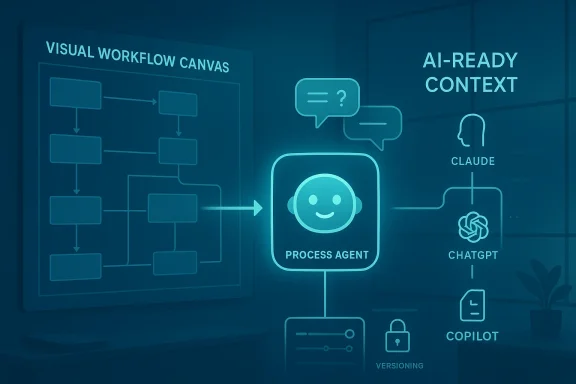
Lucid’s latest AI push is less about flashy generation and more about a familiar enterprise problem: most organizations still do not have their knowledge, workflows, and decision rules captured well enough for AI to be consistently useful. The company’s new Process Agent, expanded Model Context Protocol (MCP) support, and upgrades to Lucid AI all point to the same strategic bet: teams need structured context before AI can become a dependable co-worker. That argument is backed by Lucid’s own AI readiness survey, which found that only 16% of knowledge workers say their workflows are extremely well documented.
Lucid has been building toward this moment for months. In late 2025, the company introduced its MCP server as a bridge between Lucid content and AI tools such as Claude and ChatGPT, positioning it as a way for AI clients to search and summarize Lucid diagrams and documents without forcing users to leave their AI environment. By January 2026, Lucid had extended that server to create diagrams from text descriptions and external data, which transformed MCP from a retrieval layer into a creation layer.
That matters because Lucid is not simply selling diagramming software anymore. It is selling an operating model for visual collaboration in an AI-heavy workplace, where process maps, system diagrams, and documentation become inputs for automation rather than static artifacts. Lucid’s own AI readiness material makes that point explicitly, arguing that if AI agents are to work effectively inside enterprises, they need context about how the business actually runs.
The company’s research also helps explain why this pitch lands now. In its 2025 AI readiness report, Lucid says it surveyed roughly 2,200 knowledge workers and found a persistent gap between AI ambition and operational maturity. The headline numbers are telling: only 16% say workflows are extremely well documented, 61% say their AI strategy is not well aligned with operational capabilities, and 39% report that their organization has implemented AI agents, while only 26% describe those efforts as completely successful.
That is the real backdrop for the Process Agent. The feature is not just another chatbot wrapper. Lucid is trying to insert a guided, questioning layer into documentation generation so the output reflects the organization’s actual processes, permissions, and approval logic. In practice, that pushes Lucid further into the “system of action” category it has been describing for months, where a visual workspace becomes a live operational hub rather than a passive archive.
A basic diagram generator can help you draft a flowchart. A Process Agent can interrogate assumptions, ask follow-up questions, and surface gaps before the documentation becomes official. That makes the output more useful for enterprise use cases where compliance, handoffs, and accountability matter more than speed alone.
The company is effectively arguing that the next frontier in AI adoption is not model quality alone, but organizational legibility. If the business cannot explain itself clearly enough to a machine, then automation will remain partial and brittle. That is a powerful thesis, and it gives Lucid a differentiated story compared with generic AI writing tools.
Key implications include:
By January 2026, Lucid expanded the server’s capabilities so AI tools could create diagrams directly from descriptions or datasets. That update is significant because it moves the server from passive access to active creation, which is a much more ambitious role for enterprise AI infrastructure. It also helps explain why Lucid keeps emphasizing platforms like ChatGPT, Microsoft Copilot, and GitHub Copilot as entry points rather than endpoints.
The practical benefit is that employees can remain in the AI environment they already use while still interacting with diagrams, documents, and workflows that live in Lucid. That reduces friction, but it also creates a more defensible enterprise story: the platform becomes a backend for operational knowledge, not just a front-end workspace.
Lucid’s MCP evolution also hints at the company’s broader ambition. It is not trying to build the best standalone AI assistant. It is trying to become the visual context layer that other AI assistants need in order to be useful inside the enterprise. That is a strong position if customers accept the premise that context, not merely generation, is the scarce resource.
In a consumer chatbot, the goal is often to answer quickly. In an enterprise documentation system, the goal is to avoid being confidently wrong. The Process Agent’s questioning behavior gives Lucid a way to capture missing details about approvals, exceptions, owners, and compliance requirements before those omissions are baked into a diagram or process document.
That matters for enterprise buyers because documentation failures are often not about missing tools. They are about missing nuance. If a generated workflow ignores an approval gate, a security review, or a regional exception, the document becomes a liability rather than an asset. Lucid is clearly positioning the Process Agent as a safeguard against that outcome.
This also helps explain Lucid’s “system of action” language. The company is trying to make the visual workspace conversational and iterative, where AI does not simply produce a deliverable but helps refine the underlying process logic. That is a more ambitious vision than static documentation, and it aligns well with how enterprises actually work.
The company is also making it easier to clean up and structure complex visualizations automatically. That is especially relevant because many teams start with rough process sketches and then spend too much time fixing layout, labels, and hierarchy before the work is usable. Lucid’s AI improvements aim to compress that friction.
The voice feature also hints at a broader design direction: Lucid wants AI to feel embedded in daily work rather than appended to it. If users can speak a process into existence, refine it with follow-up prompts, and then clean it up automatically, Lucid becomes less of a diagramming app and more of a collaborative drafting environment. That is a meaningful evolution.
The upside is obvious:
Lucid’s research argues that many companies are not there yet. The survey data suggests that institutional knowledge still dominates many workflows, and that organizations often rely on people remembering how things are done rather than documenting those decisions in a durable way. That is a classic efficiency problem, but in the age of agents, it also becomes an automation problem.
Lucid’s strongest argument is that visual context helps humans and machines converge on the same understanding faster. Flowcharts, diagrams, and process maps are often the missing middle between raw information and executable work. If Lucid can become the place where that middle gets created and maintained, it gains strategic relevance well beyond design use cases.
Enterprise buyers will likely evaluate this through three lenses: adoption, governance, and interoperability. Adoption is helped by the familiar integrations. Governance is strengthened by guided prompts and structured context. Interoperability improves because MCP keeps Lucid from feeling like a dead-end content island. That combination is what makes the announcement commercially meaningful.
That same logic applies to other ecosystem players, including Atlassian-style workflow tools and general-purpose AI platforms. Lucid is not trying to own every stage of work. It is trying to own the visual context layer that feeds work systems, which is a narrower but potentially stickier position.
That said, Lucid still needs to prove that its visual layer can add unique value beyond what general-purpose AI tools already do. If ChatGPT or Copilot can draft a service workflow quickly enough, Lucid must demonstrate that its structured canvas produces better reviewability, traceability, and reuse. That is where the Process Agent and MCP actions become important differentiators.
A likely outcome is that Lucid will keep winning where the work requires shared ownership. AI can generate text quickly, but teams still need a governed artifact to align around. Lucid’s advantage is that its canvas is already built for collaborative editing and visual consensus, which makes it more enterprise-friendly than a raw chat transcript.
For enterprise users, the implications are much bigger. The Process Agent and MCP expansion suggest that Lucid wants to sit closer to operational knowledge management, where diagramming, documentation, and AI-assisted process validation overlap. That makes Lucid more relevant to operations, compliance, HR, and IT teams that need repeatable workflows instead of just attractive visuals.
That balancing act is difficult. Too much automation can create hallucinated process maps that look polished but fail in practice. Too much caution can make the product feel slow and cumbersome. Lucid’s new features suggest it is trying to thread the needle by combining generative convenience with guided clarification and structured context.
For organizations already using Lucid, the latest update makes the platform more valuable as a shared repository of operational truth. For organizations not yet using it, the bar is higher: Lucid is now selling not just collaboration software, but a method for making AI-ready work visible, editable, and governable.
The opportunity is not just to speed up diagramming. It is to become the place where teams create the context that AI systems need to be useful, which could make Lucid strategically important inside larger software ecosystems.
There is also a competitive risk. Microsoft, Google, and other platform vendors are rapidly embedding AI into the tools employees already use. Lucid must keep proving that visual context is not a nice-to-have but a must-have. That means the product needs measurable outcomes, not just a compelling narrative.
Another concern is trust. AI-generated diagrams and process docs can look authoritative even when they are incomplete. Lucid’s questioning approach helps, but enterprises will still want controls, review steps, and permission-aware behavior before allowing AI-generated outputs into formal workflows.
Watch for Lucid to keep expanding the MCP server, because that is where much of the strategic leverage sits. The more actions AI clients can perform inside Lucid, the more central Lucid becomes to enterprise context sharing. At the same time, the company will need to make the user experience simple enough that non-technical teams actually adopt it.
Source: Techzine Global Lucid Introduces Process Agent and enhances AI integrations
 Overview
Lucid has been building toward this moment for months. In late 2025, the company introduced its MCP server as a bridge between Lucid content and AI tools such as Claude and ChatGPT, positioning it as a way for AI clients to search and summarize Lucid diagrams and documents without forcing users to leave their AI environment. By January 2026, Lucid had extended that server to create diagrams from text descriptions and external data, which transformed MCP from a retrieval layer into a creation layer.That matters because Lucid is not simply selling diagramming software anymore. It is selling an operating model for visual collaboration in an AI-heavy workplace, where process maps, system diagrams, and documentation become inputs for automation rather than static artifacts. Lucid’s own AI readiness material makes that point explicitly, arguing that if AI agents are to work effectively inside enterprises, they need context about how the business actually runs.
The company’s research also helps explain why this pitch lands now. In its 2025 AI readiness report, Lucid says it surveyed roughly 2,200 knowledge workers and found a persistent gap between AI ambition and operational maturity. The headline numbers are telling: only 16% say workflows are extremely well documented, 61% say their AI strategy is not well aligned with operational capabilities, and 39% report that their organization has implemented AI agents, while only 26% describe those efforts as completely successful.
That is the real backdrop for the Process Agent. The feature is not just another chatbot wrapper. Lucid is trying to insert a guided, questioning layer into documentation generation so the output reflects the organization’s actual processes, permissions, and approval logic. In practice, that pushes Lucid further into the “system of action” category it has been describing for months, where a visual workspace becomes a live operational hub rather than a passive archive.
Why Lucid Is Moving Beyond Simple Diagram Generation
The biggest shift in Lucid’s messaging is that it no longer treats AI as a faster way to draw boxes and arrows. Instead, it frames AI as a way to capture operational intelligence that organizations currently keep in people’s heads. That is a subtle but important distinction, because it changes the value proposition from productivity theater to process governance.A basic diagram generator can help you draft a flowchart. A Process Agent can interrogate assumptions, ask follow-up questions, and surface gaps before the documentation becomes official. That makes the output more useful for enterprise use cases where compliance, handoffs, and accountability matter more than speed alone.
The context gap is the real product problem
Lucid’s survey results show why this matters. A workforce can adopt AI tools quickly, yet still fail to turn them into durable business value if the underlying processes are vague, inconsistent, or tribal. Lucid says undocumented or ad hoc processes are already reducing efficiency for many teams, and that lack of structure is now a direct blocker to AI adoption.The company is effectively arguing that the next frontier in AI adoption is not model quality alone, but organizational legibility. If the business cannot explain itself clearly enough to a machine, then automation will remain partial and brittle. That is a powerful thesis, and it gives Lucid a differentiated story compared with generic AI writing tools.
Key implications include:
- Documentation quality is becoming a competitive input, not a back-office chore.
- Process clarity now affects AI accuracy and trust.
- Governance is increasingly tied to how well work is mapped and maintained.
- Visual context is no longer optional in agentic workflows.
- Enterprise AI will reward the companies that can explain themselves best.
The MCP Server Becomes Lucid’s Integration Spine
The updated MCP server is the technical foundation of Lucid’s broader AI strategy. Lucid first introduced the server in November 2025 as a way for AI tools to interact with Lucid documents and data through a structured protocol designed for large language models. In that framing, MCP is not just an integration API; it is the connective tissue that lets an AI client understand what actions are possible inside Lucid and how to execute them.By January 2026, Lucid expanded the server’s capabilities so AI tools could create diagrams directly from descriptions or datasets. That update is significant because it moves the server from passive access to active creation, which is a much more ambitious role for enterprise AI infrastructure. It also helps explain why Lucid keeps emphasizing platforms like ChatGPT, Microsoft Copilot, and GitHub Copilot as entry points rather than endpoints.
Why MCP matters more than a standard connector
A connector moves data. MCP can move context and intent. That distinction is central to Lucid’s strategy because AI systems are only as useful as the structure they receive, and plain-text retrieval often lacks the semantics needed for reliable action. Lucid is trying to make the AI environment more aware of what the user actually wants to do with a Lucid artifact.The practical benefit is that employees can remain in the AI environment they already use while still interacting with diagrams, documents, and workflows that live in Lucid. That reduces friction, but it also creates a more defensible enterprise story: the platform becomes a backend for operational knowledge, not just a front-end workspace.
Lucid’s MCP evolution also hints at the company’s broader ambition. It is not trying to build the best standalone AI assistant. It is trying to become the visual context layer that other AI assistants need in order to be useful inside the enterprise. That is a strong position if customers accept the premise that context, not merely generation, is the scarce resource.
- The server is now used for search, summarization, and creation.
- It supports cross-tool AI workflows instead of a single app experience.
- It lowers switching costs by keeping users inside their preferred AI client.
- It increases Lucid’s strategic relevance as AI orchestration becomes more common.
Process Agent: Guided AI for Real-World Workflows
The most interesting addition is the Process Agent, because it reflects a more mature view of enterprise AI. Instead of treating the user’s first prompt as complete, the agent asks questions to gather more context before generating output. That sounds simple, but it is actually one of the most important design choices for enterprise workflow tooling.In a consumer chatbot, the goal is often to answer quickly. In an enterprise documentation system, the goal is to avoid being confidently wrong. The Process Agent’s questioning behavior gives Lucid a way to capture missing details about approvals, exceptions, owners, and compliance requirements before those omissions are baked into a diagram or process document.
Why questioning improves documentation quality
A process map generated from a one-line prompt may look polished while still being operationally useless. The Process Agent is meant to bridge that gap by surfacing hidden assumptions before they harden into documentation. In other words, it is an AI feature that behaves a bit like a good analyst, not a quick-content engine.That matters for enterprise buyers because documentation failures are often not about missing tools. They are about missing nuance. If a generated workflow ignores an approval gate, a security review, or a regional exception, the document becomes a liability rather than an asset. Lucid is clearly positioning the Process Agent as a safeguard against that outcome.
This also helps explain Lucid’s “system of action” language. The company is trying to make the visual workspace conversational and iterative, where AI does not simply produce a deliverable but helps refine the underlying process logic. That is a more ambitious vision than static documentation, and it aligns well with how enterprises actually work.
Lucid AI Is Becoming More Natural to Use
Lucid is also polishing the front-end AI experience itself. One of the most visible updates is voice input for Lucid AI, which lets users dictate prompts rather than type them. That seems modest on paper, but it lowers the barrier for quick ideation, especially in environments where users want to capture thoughts before they become structured work.The company is also making it easier to clean up and structure complex visualizations automatically. That is especially relevant because many teams start with rough process sketches and then spend too much time fixing layout, labels, and hierarchy before the work is usable. Lucid’s AI improvements aim to compress that friction.
From rough ideas to usable artifacts
This matters because most organizations do not fail at ideation. They fail at turning loose ideas into shared artifacts that can be discussed, reviewed, and executed. A better AI assistant inside Lucid can shorten that transformation from first thought to formal documentation, which is where a lot of real productivity gain lives.The voice feature also hints at a broader design direction: Lucid wants AI to feel embedded in daily work rather than appended to it. If users can speak a process into existence, refine it with follow-up prompts, and then clean it up automatically, Lucid becomes less of a diagramming app and more of a collaborative drafting environment. That is a meaningful evolution.
The upside is obvious:
- Faster capture of ideas before they are forgotten.
- Lower friction for non-technical users.
- Better accessibility for some workflows.
- Quicker movement from draft to review-ready documentation.
- Less time spent on manual diagram housekeeping.
Enterprise Collaboration Is Now a Context Problem
What makes Lucid’s announcement relevant beyond its own product line is that it captures a broader enterprise trend. The challenge is no longer simply whether organizations can generate content with AI. The challenge is whether their content, workflows, and permissions are structured enough for AI to act on safely.Lucid’s research argues that many companies are not there yet. The survey data suggests that institutional knowledge still dominates many workflows, and that organizations often rely on people remembering how things are done rather than documenting those decisions in a durable way. That is a classic efficiency problem, but in the age of agents, it also becomes an automation problem.
Why the “system of action” framing matters
The phrase system of action is important because it describes a workplace where AI is not just reading documents but participating in the flow of work. That is the next logical step after retrieval-oriented copilots. Once AI can see context, ask for clarification, and create structured outputs, the collaboration model changes.Lucid’s strongest argument is that visual context helps humans and machines converge on the same understanding faster. Flowcharts, diagrams, and process maps are often the missing middle between raw information and executable work. If Lucid can become the place where that middle gets created and maintained, it gains strategic relevance well beyond design use cases.
Enterprise buyers will likely evaluate this through three lenses: adoption, governance, and interoperability. Adoption is helped by the familiar integrations. Governance is strengthened by guided prompts and structured context. Interoperability improves because MCP keeps Lucid from feeling like a dead-end content island. That combination is what makes the announcement commercially meaningful.
Competitive Pressure on Microsoft, Atlassian, and the AI Stack
Lucid’s AI strategy inevitably overlaps with other parts of the enterprise software stack. Microsoft Copilot is the obvious comparison because Microsoft is pushing AI across productivity, collaboration, and business applications. Lucid’s Copilot integration suggests the company does not want to fight Microsoft head-on; it wants to make Lucid useful inside the Microsoft world.That same logic applies to other ecosystem players, including Atlassian-style workflow tools and general-purpose AI platforms. Lucid is not trying to own every stage of work. It is trying to own the visual context layer that feeds work systems, which is a narrower but potentially stickier position.
The strategic logic of staying neutral
The integration-first strategy is smart because enterprise customers rarely want another isolated AI destination. They want AI to appear inside the tools they already use, without forcing a platform migration. By making Lucid available through external AI clients, the company can benefit from the adoption of those clients rather than competing with them directly.That said, Lucid still needs to prove that its visual layer can add unique value beyond what general-purpose AI tools already do. If ChatGPT or Copilot can draft a service workflow quickly enough, Lucid must demonstrate that its structured canvas produces better reviewability, traceability, and reuse. That is where the Process Agent and MCP actions become important differentiators.
A likely outcome is that Lucid will keep winning where the work requires shared ownership. AI can generate text quickly, but teams still need a governed artifact to align around. Lucid’s advantage is that its canvas is already built for collaborative editing and visual consensus, which makes it more enterprise-friendly than a raw chat transcript.
What This Means for Consumers and Enterprise Users
For everyday users, the updates mostly translate into speed and convenience. Voice input, automatic structure cleanup, and prompt-driven diagram creation all reduce the cost of getting ideas into a format other people can understand. That is useful whether someone is mapping a team process, documenting a project, or sketching a new service flow.For enterprise users, the implications are much bigger. The Process Agent and MCP expansion suggest that Lucid wants to sit closer to operational knowledge management, where diagramming, documentation, and AI-assisted process validation overlap. That makes Lucid more relevant to operations, compliance, HR, and IT teams that need repeatable workflows instead of just attractive visuals.
Consumer ease, enterprise control
The consumer-facing story is about making AI feel effortless. The enterprise story is about making AI feel trustworthy. Those are related goals, but they require different product choices, and Lucid appears to be trying to satisfy both without splitting the platform in two.That balancing act is difficult. Too much automation can create hallucinated process maps that look polished but fail in practice. Too much caution can make the product feel slow and cumbersome. Lucid’s new features suggest it is trying to thread the needle by combining generative convenience with guided clarification and structured context.
For organizations already using Lucid, the latest update makes the platform more valuable as a shared repository of operational truth. For organizations not yet using it, the bar is higher: Lucid is now selling not just collaboration software, but a method for making AI-ready work visible, editable, and governable.
Strengths and Opportunities
Lucid’s announcement is strongest when viewed as a response to an enterprise readiness gap rather than as a narrow product release. The company has identified a real pain point: most organizations want AI benefits without doing the documentation work required to support them. By combining MCP, guided AI, and visual workflow generation, Lucid is offering a practical bridge between ambition and operational reality.The opportunity is not just to speed up diagramming. It is to become the place where teams create the context that AI systems need to be useful, which could make Lucid strategically important inside larger software ecosystems.
- Better enterprise fit for teams that need governance and traceability.
- Stronger AI context through structured visual artifacts.
- Lower friction for users moving from ideas to formal documentation.
- More useful integrations with major AI platforms.
- Higher retention potential if Lucid becomes the system where knowledge is captured.
- Expanded relevance beyond design into operations and process excellence.
- A differentiated story versus generic chat-based AI tools.
Risks and Concerns
The biggest risk is that Lucid’s AI story could become too dependent on the promise of context while underestimating the difficulty of maintaining that context over time. Documentation decays, processes change, and diagrams drift from reality unless organizations actively manage them. If Lucid cannot help customers keep artifacts current, the Process Agent will only solve the first draft problem.There is also a competitive risk. Microsoft, Google, and other platform vendors are rapidly embedding AI into the tools employees already use. Lucid must keep proving that visual context is not a nice-to-have but a must-have. That means the product needs measurable outcomes, not just a compelling narrative.
Another concern is trust. AI-generated diagrams and process docs can look authoritative even when they are incomplete. Lucid’s questioning approach helps, but enterprises will still want controls, review steps, and permission-aware behavior before allowing AI-generated outputs into formal workflows.
- Hallucination risk if generated workflows are taken as fact too quickly.
- Maintenance burden as documentation must stay synchronized with reality.
- Adoption friction if users prefer simpler chat-based tools.
- Governance complexity around permissions and compliance.
- Integration dependency on third-party AI platforms and their changing policies.
- Feature overlap with larger suite vendors that already own the workspace.
- Change management challenges for teams not used to structured documentation.
Looking Ahead
The next phase will be about proving whether Lucid can turn AI-enhanced diagrams into living operational assets. If the company can show that Process Agent-driven workflows lead to better compliance, faster approvals, or fewer handoff errors, the market will pay attention. If not, the release will risk being seen as a polished but incremental upgrade.Watch for Lucid to keep expanding the MCP server, because that is where much of the strategic leverage sits. The more actions AI clients can perform inside Lucid, the more central Lucid becomes to enterprise context sharing. At the same time, the company will need to make the user experience simple enough that non-technical teams actually adopt it.
What to watch next
- Deeper MCP actions that move beyond diagram creation into broader workflow operations.
- More enterprise safeguards for permissions, approvals, and document governance.
- Tighter Microsoft integration as Copilot becomes more central in workplaces.
- Metrics from early adopters showing whether Process Agent improves documentation quality.
- Feature expansion that helps teams keep process artifacts current after creation.
- Competitive responses from other collaboration and productivity platforms.
Source: Techzine Global Lucid Introduces Process Agent and enhances AI integrations
