

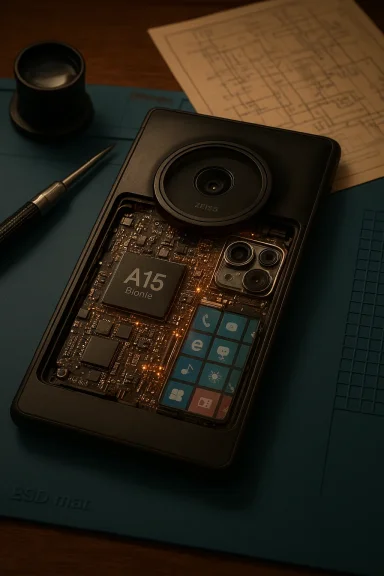
A one-off hardware hack has reminded the tech world that Windows Phone isn't entirely gone — at least not in the imaginations and garage workshops of enthusiasts. An enterprising hobbyist took the hulking shell of a classic Lumia 1020 and transplanted the internals of a modern iPhone SE (3rd generation) into it, producing a functioning handset that looks like a time-capsule from the past but runs a contemporary mobile OS. The result is equal parts nostalgia and technical showpiece: the Lumia’s iconic exterior lives on while nearly every original component underneath has been replaced with current Apple hardware and software. The build has reignited conversations about the legacy of Windows Phone, the limits of hardware modding, and what a true “revival” of Microsoft’s mobile platform would actually require.
Windows Phone — later rebranded Windows 10 Mobile — dominated headlines a decade ago for its bold tile-first UI and tight Microsoft-Nokia hardware partnership. Market momentum faded, app support dwindled, and official development and support ended years ago. Despite that, the platform has never completely evaporated from online communities. Enthusiasts still tinker with old Lumia hardware, port Windows builds to new platforms, and imagine what a modern Windows Phone might look like.
The recent hybrid Lumia-iPhone project sits squarely in that tradition. Rather than attempting to resurrect the original mobile OS, the builder preserved the Lumia’s exterior and display glass, then fitted the internal motherboard, modem, camera, and storage of a 2022 iPhone SE into the case. The finished device runs modern iOS, retains mobile connectivity, and even accepts over-the-air updates for the installed OS — albeit with a few functional compromises born of the physical grafting.
What the build does do — vividly — is remind us of the emotional and design legacy of Windows Phone. It provokes useful questions about why platforms succeed or fail and what would be necessary to bring something genuinely new (or renewed) to the mobile market. For enthusiasts who still carry Lumia-shaped memories, the mod offers a satisfying visual and tactile echo; for platform strategists and developers, it’s a prompt to analyze the systemic requirements of any mobile revival.
In short: the Lumia is back in shape, cosmetically and theatrically. The operating system and ecosystem that once defined Windows Phone remain, for now, a separate and much harder problem to resurrect.
Source: Neowin https://www.neowin.net/news/windows-phone-is-back-from-the-dead-kind-of/
 Background
Windows Phone — later rebranded Windows 10 Mobile — dominated headlines a decade ago for its bold tile-first UI and tight Microsoft-Nokia hardware partnership. Market momentum faded, app support dwindled, and official development and support ended years ago. Despite that, the platform has never completely evaporated from online communities. Enthusiasts still tinker with old Lumia hardware, port Windows builds to new platforms, and imagine what a modern Windows Phone might look like.The recent hybrid Lumia-iPhone project sits squarely in that tradition. Rather than attempting to resurrect the original mobile OS, the builder preserved the Lumia’s exterior and display glass, then fitted the internal motherboard, modem, camera, and storage of a 2022 iPhone SE into the case. The finished device runs modern iOS, retains mobile connectivity, and even accepts over-the-air updates for the installed OS — albeit with a few functional compromises born of the physical grafting.
What exactly was done: anatomy of the mod
This is not a software port, emulator, or UI re-skin. It’s a hardware transplant with precise surgical changes to make two generations and ecosystems of smartphone hardware coexist inside one chassis.Key elements of the build
- The Lumia 1020 shell and front glass were retained as the visible exterior. The original display electronics and internal components were removed to make space.
- The internals came from an iPhone SE (3rd generation): A15 Bionic chip, modern modem and radio components, and the iPhone’s storage and cameras were used to provide up-to-date functionality.
- The original 41 MP PureView camera on the Lumia — the hallmark feature that made that model famous — was removed. The iPhone’s 12 MP camera replaces it.
- Touch ID (the iPhone’s fingerprint sensor/home button) was physically relocated to the rear of the chassis, underneath the new camera position, because the iPhone’s original front button cannot be accommodated in the Lumia face without extensive rework.
- The Lightning port of the iPhone internals was routed so it looks like a micro‑USB opening in the Lumia’s bottom edge; the headphone jack opening was sealed.
- The SIM tray, antenna connections, and many physical interfaces were adapted so the iPhone modem could maintain cellular connectivity — which the builder reports functions on modern networks, including 5G where the donor hardware supports it.
- Some features that rely on precise hardware pairings — notably contactless payments and wireless charging — were not functional after the transplant.
High-level sequence (what the builder reportedly did)
- Strip the Lumia 1020 to a bare shell, preserving the display glass and front face.
- Prepare the iPhone SE donor board: remove and re-route connectors and relocate the Touch ID assembly.
- Modify the Lumia chassis to accommodate different board dimensions, mounting points, and camera placement.
- Physically secure the donor board, laminate the iPhone display glass to the Lumia front, and fabricate adapter cables as needed.
- Reconnect antennas and test cellular, Wi‑Fi, Bluetooth, and sensors; iterate until the device boots and functions.
- Final cosmetic refinements: seal unused ports, align camera aperture, and reattach external buttons.
Verifiable technical details
Several technical claims about the hardware and software used in this project are straightforward to confirm:- The Lumia 1020 is a 2013 device originally shipped with Windows Phone 8 and notable for a 41 MP rear sensor, Carl Zeiss optics, and a prominent camera bulge. Its official specifications and historic reviews document the sensor size and PureView processing approach that produced extremely high-resolution stills.
- The iPhone SE (3rd generation), introduced by Apple in 2022, uses the A15 Bionic system-on-chip and supports modern cellular standards present in that device family. Apple’s own technical specs list the A15 chip and storage configurations that align with what the donor hardware would contribute to such a transplant.
- Multiple independent reports about the build confirm the transplant used the iPhone SE 3’s components and that the modified device boots into a recent version of the iPhone operating system. The builder shared images and details about the physical rework and the functional trade-offs (for example, wireless charging and Apple Pay remaining nonfunctional).
Why this matters: nostalgia, technical craft, and the optics of revival
The build works as three overlapping cultural statements.- As a nostalgia artifact, it’s a vivid reminder of what made Windows Phone memorable: bold industrial design and a distinctive aesthetic. The Lumia 1020’s exterior is an instantly recognizable relic for people who followed Microsoft and Nokia’s mobile era.
- As a technical craft proof, it showcases the ingenuity and skill of modern modders. Creating usable, update-capable hardware from incompatible donor components is a nontrivial engineering achievement that demands mechanical skill, electrical knowledge, and patient iteration.
- As a conversation starter about revival, it prompts discussion about what “bringing Windows Phone back” would actually require. The superficial answer — redesigning the look and feel — is trivial. The hard parts are app ecosystems, developer tools, carrier relationships, and supporting a secure, modern platform at scale.
The technical and practical limits of hardware resurrection
Hobbyist builds like this one are fun, but they also expose the practical reasons the original platform failed and the obstacles to any viable comeback.App ecosystem and developer momentum
- The historical collapse of Windows Phone was less about hardware than about ecosystem: developers prioritized iOS and Android because of user market share and monetization. Recreating the tile-based UI today would not magically restore developer interest unless users and revenue followed.
- Modern alternatives for delivering Windows-style experiences involve adaptingg or wrapping Android apps, progressive web apps, or running virtualization layers — none of which are a drop-in substitute for a healthy native ecosystem.
Security and proprietary hardware bindings
- Features such as contactless payments are tied to hardware-backed security modules and cryptographic pairing with a device’s secure element. A mismatched or relocated Secure Enclave/SE often breaks these services.
- Device swaps may preserve over‑the‑air updates if donor internals remain intact and genuine. However, certain platform services can detect hardware inconsistencies and limit functionality for security reasons.
Radio and antenna work
- Cellular performance depends on antenna placement and RF tuning. Rehousing a modern modem in a chassis designed for different radio paths can lead to degraded reception, band incompatibilities, or surprising interference — unless the builder carefully adapts antenna routing.
- The builder reported cellular connectivity, including 5G where supported by the donor hardware, but this requires that the donor modem and antenna bands align with local carrier networks.
Repairability, durability, and safety
- Such a mod is inherently fragile compared to an OEM device: adhesives, custom mounts, and hand‑soldered connections are more likely to fail with drops or thermal cycling.
- Battery safety is a concern. Mixing battery, charging circuits, and charging port routing between hardware designed for different enclosures can be risky without proper testing.
Legal, ethical, and warranty considerations
- Modifying and owning such a device is legal in most jurisdictions when the builder uses legitimately acquired hardware parts for personal use. However, selling or distributing devices that incorporate proprietary hardware or software may raise legal issues, especially around licensing and manufacturer terms.
- Warranty coverage from either manufacturer is obviously voided; neither company will support a hybrid handset.
- Trying to monetize or mass-produce a mod that depends on proprietary software keys or closed-source firmware would almost certainly encounter legal pushback.
What this does — and doesn’t — say about a “Windows Phone revival”
- The build demonstrates there’s still enthusiasm for the idea of Windows Phone. Fans love the design language, the live tiles concept, and the different take on a home screen.
- Enthusiast projects and modern UI concepts show that the interface still inspires people. Designers reimagine live tiles for modern devices, and fans build launcher skins and themes that mimic the look.
- But a single mod or a set of concepts does not equal a commercially viable revival. For Microsoft (or any large player) to re-enter the mobile OS market, the company would need strategic purpose: carrier partnerships, a sustainable developer story, clear differentiation against Android/iOS, and a long-term commitment to updates and security.
The broader context: how platforms evolve and why nostalgia persists
It’s useful to situate this hack in the broader arc of platform cycles.- Mobile platforms are defined by network effects. Developers build for platforms where users are, and users choose platforms where apps are abundant. Breaking into that cycle now would require a radically new value proposition or huge incentives to shift developer time and user attention.
- Nostalgia projects — from concept phones to UI reimaginings — often catalyze useful conversations about design choices that were distinctive and worth revisiting, such as clarity of information, typography, and homescreen affordances.
- Some ideas from Windows Phone have shown up elsewhere: modern operating systems borrow concepts and controls freely. Live tiles’ emphasis on glanceable information has analogues in today’s widgets and notification cards.
Practical takeaways for Windows enthusiasts and modders
- This project reaffirms that hardware modding can produce surprising results, but it’s a niche pursuit requiring specialized skills and patience.
- For collectors and fans: preserving original hardware is valuable. The Lumia 1020’s camera module is a unique artifact; removing or destroying it for novelty builds sacrifices an iconic piece of mobile history.
- For anyone tempted to reproduce similar work, consider the trade-offs: loss of manufacturer support, potential safety concerns, and intimate knowledge required to adapt RF and power systems safely.
Risks and caveats to reported claims
Some of the build’s outcomes were reported by the creator and then amplified across several outlets. Those reports are credible and accompanied by images, but a few points merit caution:- Claims about secure services — specifically contactless payments — should be treated as plausible but not fully audited. Payment systems often rely on tied hardware security elements and remote attestation; lack of payment functionality after a transplant can stem from many subtle causes.
- The reported ability to receive OTA updates for the transplanted OS is consistent with using intact donor internals. That said, ongoing compatibility with future updates is not guaranteed; vendors may add hardware attestation or checks that break unusual configurations.
- Network performance, battery endurance, and long-term reliability depend heavily on the quality of the mechanical work and RF adaptation; real-world long-term use may reveal issues unseen in short demos.
What a realistic “Windows Phone revival” would require
If the goal is to revive Windows Phone in any meaningful way — beyond fan concepts and one-off builds — the practical checklist is long:- A modern, secure, and actively maintained mobile OS stack with clear upgrade paths.
- A developer story that makes it simple to port or build apps, plus robust tooling and monetization options.
- Carrier partnerships and hardware vendor support to ensure global connectivity and certification for payments and compliance.
- A unique value proposition that differentiates the platform from Android and iOS in a way that matters to users — not just nostalgia.
- Long-term commitment to security updates, privacy features, and user support.
Conclusion
The hybrid Lumia-iPhone project is a remarkable piece of modern gadgetry theater: it resurrects the recognizable shell of a classic Windows Phone model and pairs it with contemporary computing power. As a craft project, it is impressive and instructive. As evidence that Windows Phone has returned, it is performative rather than substantive.What the build does do — vividly — is remind us of the emotional and design legacy of Windows Phone. It provokes useful questions about why platforms succeed or fail and what would be necessary to bring something genuinely new (or renewed) to the mobile market. For enthusiasts who still carry Lumia-shaped memories, the mod offers a satisfying visual and tactile echo; for platform strategists and developers, it’s a prompt to analyze the systemic requirements of any mobile revival.
In short: the Lumia is back in shape, cosmetically and theatrically. The operating system and ecosystem that once defined Windows Phone remain, for now, a separate and much harder problem to resurrect.
Source: Neowin https://www.neowin.net/news/windows-phone-is-back-from-the-dead-kind-of/
