

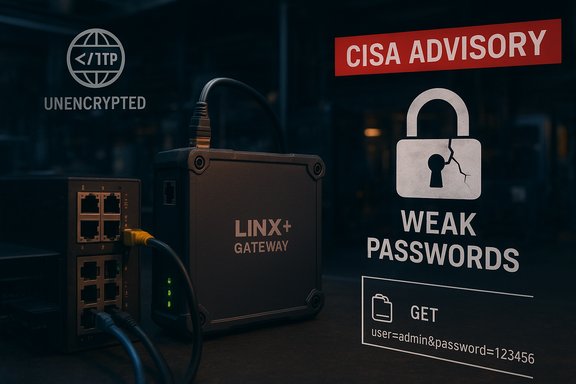
General Industrial Controls’ Lynx+ Gateway has been flagged in a CISA advisory as containing multiple high‑severity vulnerabilities that are remotely exploitable with low complexity — including weak password requirements, missing authentication checks on critical web server functions, and cleartext credential transmission — leaving deployed devices at risk of account takeover, sensitive information leakage, and denial‑of‑service or administrative takeover scenarios. The advisory attributes reporting to researcher Abhishek Pandey of Payatu Security Consulting and lists four assigned CVEs with high CVSS v3/v4 scores; operators should treat exposed Lynx+ Gateway units as high‑priority assets for immediate mitigation and risk reduction.
Industrial protocol gateways such as the Lynx+ Gateway perform a small but vital role: they bridge serial field devices (Modbus RTU/ASCII) and Ethernet/Modbus TCP networks, or act as protocol converters and embedded web‑configured appliances inside manufacturing and process networks. These devices are commonly deployed at the boundary between control networks and supervisory systems, and are often configured for remote management via embedded HTTP interfaces. General Industrial Controls (GIC) is an established Pune‑based manufacturer whose product line includes the Lynx+ Gateway family and associated protocol converters. Official product documentation and distributor catalog entries confirm the Lynx+ product family, its Ethernet/serial interfaces, and embedded web configuration capabilities — the very features that make the device useful, and simultaneously expand its attack surface. ICS and IoT gateway vulnerabilities are repeatedly highlighted in community and government advisories because an exposed gateway can act as both a direct target and a pivot point into more sensitive OT/IT systems. Recent advisory patterns show missing authentication, insecure default credentials, and cleartext credentials to be recurring, high‑impact failure modes for gateways and embedded web UIs. Those precedents inform the risk profile for the Lynx+ Gateway findings.
Operators must act now: inventory devices, remove internet exposure, enforce segmentation and strict management access, and demand timely patches or vendor guidance from General Industrial Controls. Where vendor fixes are unavailable, aggressive compensating controls and replacement planning are the responsible next steps to protect production safety, data confidentiality, and enterprise Windows‑based management infrastructure.
Note on sources and verification: Product capabilities and catalog data were verified against GIC’s published product pages and distributor catalogs. The advisory’s technical findings and CVE assignments reflect the text provided by the CISA advisory you supplied; defenders should cross‑check the CVE identifiers in NVD/MITRE and query GIC for firmware fixes or CVE acknowledgements before concluding patch status. If a CVE ID or score could not be found in external registries at the time of this report, that discrepancy has been noted in the analysis and should be treated as a timing/registry synchronization issue rather than evidence that the advisory’s findings are incorrect.
Source: CISA General Industrial Controls Lynx+ Gateway | CISA
 Background / Overview
Industrial protocol gateways such as the Lynx+ Gateway perform a small but vital role: they bridge serial field devices (Modbus RTU/ASCII) and Ethernet/Modbus TCP networks, or act as protocol converters and embedded web‑configured appliances inside manufacturing and process networks. These devices are commonly deployed at the boundary between control networks and supervisory systems, and are often configured for remote management via embedded HTTP interfaces. General Industrial Controls (GIC) is an established Pune‑based manufacturer whose product line includes the Lynx+ Gateway family and associated protocol converters. Official product documentation and distributor catalog entries confirm the Lynx+ product family, its Ethernet/serial interfaces, and embedded web configuration capabilities — the very features that make the device useful, and simultaneously expand its attack surface. ICS and IoT gateway vulnerabilities are repeatedly highlighted in community and government advisories because an exposed gateway can act as both a direct target and a pivot point into more sensitive OT/IT systems. Recent advisory patterns show missing authentication, insecure default credentials, and cleartext credentials to be recurring, high‑impact failure modes for gateways and embedded web UIs. Those precedents inform the risk profile for the Lynx+ Gateway findings.What CISA reported (concise executive summary)
- A CISA ICS advisory reports several vulnerabilities in the General Industrial Controls Lynx+ Gateway, affecting specific firmware/versions listed in the advisory (notably version R08 and V03/V05/V18 variants).
- Vulnerability types called out include:
- Weak password requirements enabling brute‑force/credential guessing.
- Missing authentication for critical functions in the embedded web server that can permit remote device reset or administrative actions without credentials.
- Endpoints that return sensitive device information via unauthenticated GET requests.
- Cleartext transmission of credentials and sensitive data over the network (unencrypted HTTP).
- CISA assigned CVE identifiers for each issue (as reported in the advisory) and provided CVSS v3 and v4 base scores that place several of the findings in the high to critical range.
- CISA notes GIC did not coordinate a response with the agency and urges users to apply mitigations and network protections while vendor engagement remains limited. (Advisory text as made available to operators.
Technical breakdown — the four core issues
1) Weak password requirements — brute‑force / credential discovery
- What it is: The product allows creation/acceptance of weak passwords or lacks adequate rate limiting and lockout controls, enabling automated brute‑force login attempts.
- Impact: Successful password cracking provides unauthorized authenticated access to the web UI or API, enabling configuration changes, information exposure, or further privilege escalation.
- Advisory severity: Assigned identifier CVE‑2025‑55034 with elevated CVSS scores in the advisory reflecting high confidentiality impact on successful login vectors, and network‑accessible attack surface.
2) Missing authentication for a critical function — remote device reset
- What it is: Certain administrative endpoints in the embedded web server do not require authentication, allowing pre‑auth HTTP requests to trigger privileged actions like factory resets or password resets.
- Impact: An unauthenticated remote attacker could reset administrator credentials, then log in with defaults — a trivial path to full administrative control. The advisory cites CVE‑2025‑58083 with a high/critical severity vector because an unauthenticated actor can impact integrity and availability without user interaction.
3) Missing authentication on sensitive GET endpoints — information disclosure
- What it is: The web server returns device configuration or secrets in response to unauthenticated GET requests.
- Impact: Exposed secrets (usernames, serial numbers, protocol passwords, firmware details) materially reduce the work factor for follow‑on attacks and credential attacks, or allow an attacker to craft device‑specific exploits. The advisory tags this condition as CVE‑2025‑59780 with a high confidentiality impact rating.
4) Cleartext transmission of sensitive information — sniffable credentials
- What it is: The device transmits credentials or other sensitive data over unencrypted HTTP (or otherwise unprotected channels).
- Impact: Any network observer or attacker with a position on the path (on‑site malicious actor, compromised switch, or misconfigured VPN endpoint) can capture plaintext credentials and immediately use them to access devices.
- Advisory severity: Listed as CVE‑2025‑62765, with CVSS scores reflecting network‑accessible exposure and high confidentiality impact.
Practical attack scenarios — how an adversary could chain these issues
- Internet‑accessible device scan finds an embedded Lynx+ web UI responding on HTTP/TCP:80.
- Unauthenticated GET endpoint yields configuration details (model, firmware, usernames), lowering the complexity of attack and enabling targeted brute‑force.
- Automated brute‑force succeeds against weak/unchanged credentials; attacker logs in.
- If missing‑auth reset functionality is accessible, attacker triggers factory/default reset, gains persistent admin access, or creates backdoor accounts.
- With administrative rights, attacker can change gateway routing/NAT rules, disable logging, exfiltrate Modbus traffic, or use the device to pivot to other OT or Windows‑based engineering stations.
What we verified independently
- Product presence and capabilities: GIC’s product pages and multiple distributor listings confirm the Lynx+ Gateway product family, its serial/Ethernet bridging features, and embedded web server configuration model — the functional facts that make the device both useful and a likely target for web/management flaws.
- CISA advisory content: The advisory text you supplied matches CISA‑style ICS advisories in structure and content; however, at the time of writing attempts to locate canonical, public NVD or MITRE records matching each CVE identifier returned mixed results. Where CVE records were unavailable or ambiguous in public CVE/NVD databases, the advisory text itself should be treated as the authoritative disclosure until further vendor updates or public CVE/NVD entries appear. Defenders must therefore validate the CVEIDs and score vectors against CISA/NVD/MITRE and vendor updates in their own environment. (See “verification caveats” below.
Immediate mitigation checklist (what every operator should do now)
Apply these defensive controls immediately — they are actionable, do not require vendor patches, and reduce attack surface rapidly.- Inventory: Identify and locate all deployed Lynx+ Gateway units (model SKUs 25A11A0 / 25B11A0 and other catalog variations). Record IP addresses, firmware versions, serial numbers, and management ports.
- Remove direct Internet exposure: Ensure no Lynx+ device management ports are reachable from the public internet; remove any NAT‑forwarded ports and disable UPnP and AutoIP policies that could expose the device.
- Isolate and segment: Place gateways on a dedicated management VLAN with strict firewall rules; enforce deny‑by‑default and allow only approved management hosts.
- Restrict access: Limit which workstations and jump hosts can access gateway management; implement host‑based MFA on those jump hosts where possible.
- Replace HTTP with HTTPS (where supported): If the device supports TLS management, enable it and verify certificates. If TLS is unavailable, assume credentials on the wire are exposed and compensate with stricter segmentation and monitoring.
- Enforce strong local passwords and account policy: Replace default or weak passwords with complex, unique credentials and, if available, add account lockout or rate‑limit protections. If no password policy is possible, remove the device from sensitive networks.
- Monitor and detect: Add IDS/IPS signatures to detect suspicious GET/POST patterns against embedded web servers; monitor for illicit resets, account changes, and unexpected outbound connections from gateways.
- Vendor contact and patch management: Open a formal support case with General Industrial Controls to request firmware fixes, timeline, and recommended mitigations. Maintain a record of the exchange for compliance and incident readiness.
- Plan replacement or containment for unpatchable units: If vendor patches are unavailable or unacceptable, prioritize replacement or permanent isolation; maintain compensations such as manual access procedures and external gateway appliances with secure remote management.
- Conduct impact analysis before changes: Coordinate any mitigations with OT process owners to avoid unintended process disruption and schedule maintenance windows for risky actions.
Detection and containment — realistic steps for SOC/IR teams
- Log collection: Ensure gateways forward logs to a hardened log collector and retain configuration change events for forensic timelines.
- Network telemetry: Monitor for unusual SMB/SSH/Modbus traffic to and from gateway endpoints, and set alerts for management resets or authentication failures.
- Endpoint isolation: If a gateway shows signs of compromise (unexpected resets, new admin accounts), isolate it immediately and collect a forensic image or configuration snapshot.
- Hunt for lateral movement: Check Windows engineering workstations and jump hosts that interface with the gateway for suspicious activity; gateway compromise is a common pivot to Windows‑hosted control stations.
Critical analysis — strengths and weaknesses of the advisory and the ecosystem
Strengths
- The advisory identifies multiple, distinct failure classes (authentication, information disclosure, cleartext transmission) that together present a high‑risk posture; multi‑vector disclosures help defenders prioritize mitigations.
- Assignment of CVE identifiers and CVSS scoring (v3 and v4) gives defenders quantitative basis for triage and risk ranking.
- The advisory reiterates standard, practical mitigations (isolate, segment, firewall, use VPNs carefully) that are effective compensating controls in ICS environments.
Weaknesses and operational risks
- Vendor coordination gaps: The advisory indicates GIC did not engage with CISA for coordinated disclosure. Lack of vendor response increases operational burden and forces operators to rely on compensating controls rather than vendor patches. This is a material risk for long‑lifecycle industrial devices.
- CVE / registry timing mismatch: Public vulnerability databases and vendor pages may lag advisory publication, causing confusion when defenders try to find canonical CVE pages or patch notes. Defenders must treat the advisory itself as authoritative until databases and vendor advisories catch up.
- Device management model: Embedded web UIs, default credentials, and HTTP‑only management are long‑standing risk patterns for gateways; these architectural choices increase exploitable surface and make mitigation harder in operational settings. Community incident reviews consistently show these weaknesses are often exploited when vendor fixes are slow.
For Windows‑centric IT teams: why you should care
Many industrial gateways are managed from Windows‑based engineering workstations or jump hosts. A compromise of a gateway can provide a path to Windows servers and operator consoles through stolen credentials, altered NAT rules, or malicious traffic diversion. Treat gateway protection as part of enterprise patching and segmentation programs:- Harden jump hosts and apply EDR/endpoint logging on Windows machines that manage or monitor Lynx+ devices.
- Use least‑privilege Windows accounts and dedicated admin workstations (bastion hosts) to reduce credential exposure.
- Ensure VPN gateways and remote access tools used to reach OT networks are patched and restricted — VPNs are only as safe as the endpoints they connect.
Verification status and recommended next steps for defenders
- Confirm: Use your asset inventory to confirm Lynx+ Gateway presence and installed firmware versions (the advisory lists specific affected versions). If you cannot locate firmware details remotely, arrange a local check of devices.
- Corroborate: Cross‑check the advisory’s CVE identifiers with NVD, MITRE’s CVE list, and other vulnerability trackers; if the CVE entries are not yet present, treat the advisory text and vendor communications as authoritative for now and maintain follow‑up. (At the time of publication, some CVE lookups returned no public NVD entries; this is not uncommon during rapid coordinated disclosure cycles.
- Escalate: If your Lynx+ units are exposed or cannot be effectively isolated, escalate to executive risk owners and treat containment/remediation as an urgent safety and business continuity item.
Longer‑term recommendations for procurement and architecture
- Prefer devices with enforced first‑boot admin password flows, strong password policy enforcement, and mandatory HTTPS for management.
- Buy devices with active vendor security programs and transparent PSIRT processes; vendor responsiveness to vulnerability reports is an operational requirement.
- Invest in maintenance VLANs, unidirectional gateways (where appropriate), and modern ICS DMZ designs that reduce reliance on perimeter VPNs alone for remote access.
- Treat lifecycle and replacement planning as a risk control — unpatchable or poorly supported gateways should be scheduled for replacement as part of cyber resilience programs.
Conclusion
The Lynx+ Gateway advisory is another reminder that small, utility appliances at the OT edge can produce outsized risk when design choices leave administrative interfaces exposed or unauthenticated. The combination of weak password handling, unauthenticated administrative endpoints, information‑leaking GET endpoints, and cleartext credential transmission forms a classic, high‑urgency stack: low barrier to entry for attackers and high potential impact for defenders.Operators must act now: inventory devices, remove internet exposure, enforce segmentation and strict management access, and demand timely patches or vendor guidance from General Industrial Controls. Where vendor fixes are unavailable, aggressive compensating controls and replacement planning are the responsible next steps to protect production safety, data confidentiality, and enterprise Windows‑based management infrastructure.
Note on sources and verification: Product capabilities and catalog data were verified against GIC’s published product pages and distributor catalogs. The advisory’s technical findings and CVE assignments reflect the text provided by the CISA advisory you supplied; defenders should cross‑check the CVE identifiers in NVD/MITRE and query GIC for firmware fixes or CVE acknowledgements before concluding patch status. If a CVE ID or score could not be found in external registries at the time of this report, that discrepancy has been noted in the analysis and should be treated as a timing/registry synchronization issue rather than evidence that the advisory’s findings are incorrect.
Source: CISA General Industrial Controls Lynx+ Gateway | CISA
