

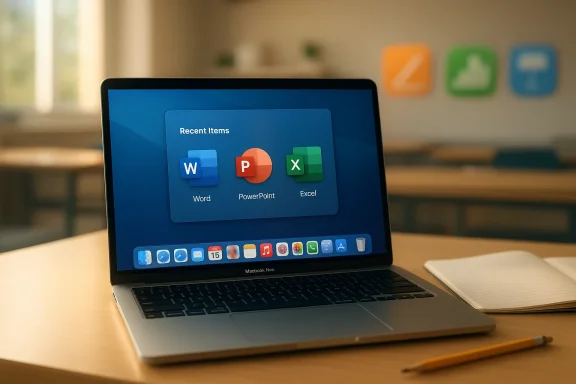
Apple's new MacBook Neo demo quietly does what product teams and PR scripts rarely admit out loud: it shows Microsoft Word, Excel, and PowerPoint among the most recently used apps, then drags Word onto the Dock — a small cinematic choice that reads like a wink acknowledging Microsoft 365’s hold on everyday productivity workflows.
Apple introduced the MacBook Neo at its March 4, 2026 product event and followed up with the official "Hello, MacBook Neo" introduction video used in product pages and social channels. The Neo arrives as Apple’s new entry-level Mac, positioned at a breakthrough price point (announced at $599) and aimed explicitly at students and budget-conscious buyers. In the promo footage Apple uses familiar UI moments — the macOS Recent Items view, the Dock, and app-window choreography — to tell a visual story about who the Neo is for.
At the same time, Windows-focused outlets noticed what many viewers probably skimmed over: the recently used apps and Dock placement in the longer demo contain Microsoft Office icons prominently, while Apple’s own iWork icons (Pages, Numbers, Keynote) are absent from the same shot. That detail sparked a flurry of coverage framing Apple’s edit as either a subtle admission of Microsoft Office’s dominance or simply a pragmatic nod to cross-platform realities.
This is marketing realism rather than a confession. Apple knows that many new Mac buyers will need Office compatibility on day one — for school assignments, internships, corporate workflows, and cross-platform collaboration. Showing Word and Excel in a “daily” view reassures potential buyers more effectively than a line of text ever could.
Why that matters:
That reality favors Microsoft in the productivity layer while leaving platform competition — price, hardware selection, services, and long-term ecosystem lock-in — very much alive. The Neo itself is the main story for hardware buyers: a $599 Mac that targets budget and education segments. The Office cameo is a useful footnote that tells us about how Apple wants to remove friction for real buyers without pretending the world of productivity apps belongs solely to Cupertino.
In short: Apple didn’t "admit" defeat; it showed the world a realistic configuration for a product meant to be useful on day one. For anyone deciding between the Neo and a low-cost Windows notebook, the question remains practical: which device best fits your apps, collaborations, and wallet? The Neo’s promo simply makes one clear argument: if you want a low-cost Mac that works with the tools you already use, Apple understands that and will show you it’s true.
Source: Windows Central Did Apple just hint that Microsoft's apps are more popular than its own?
 Background
Apple introduced the MacBook Neo at its March 4, 2026 product event and followed up with the official "Hello, MacBook Neo" introduction video used in product pages and social channels. The Neo arrives as Apple’s new entry-level Mac, positioned at a breakthrough price point (announced at $599) and aimed explicitly at students and budget-conscious buyers. In the promo footage Apple uses familiar UI moments — the macOS Recent Items view, the Dock, and app-window choreography — to tell a visual story about who the Neo is for.At the same time, Windows-focused outlets noticed what many viewers probably skimmed over: the recently used apps and Dock placement in the longer demo contain Microsoft Office icons prominently, while Apple’s own iWork icons (Pages, Numbers, Keynote) are absent from the same shot. That detail sparked a flurry of coverage framing Apple’s edit as either a subtle admission of Microsoft Office’s dominance or simply a pragmatic nod to cross-platform realities.
What actually appeared in the video
- The official MacBook Neo intro video and longer demo include a desktop view showing “recent” app usage. In that shot, Microsoft Word, PowerPoint, and Excel appear among the most-used items, and Word is shown being dragged to the Dock in a persistent placement.
- Shorter TV-length edits of the same spot replace those Office icons with Apple’s iWork icons, which indicates the creative team produced multiple cuts with slightly different app palettes depending on the audience and runtime.
Why the Office-shot matters (and why it probably isn’t an accident)
1) Visual shorthand and real-world realism
Apple’s product videos are carefully staged — every icon, window, and mouse cursor usually serves a purpose. Including Microsoft Office apps in “recently used” does two things at once: it signals compatibility (Mac runs the apps users expect) and it signals relevance (students and professionals use Office). The choice is economical: no exposition, just a single frame that communicates both capability and audience fit.This is marketing realism rather than a confession. Apple knows that many new Mac buyers will need Office compatibility on day one — for school assignments, internships, corporate workflows, and cross-platform collaboration. Showing Word and Excel in a “daily” view reassures potential buyers more effectively than a line of text ever could.
2) Education and institutional momentum
Microsoft 365 remains deeply embedded in education (K–12 and higher ed) and in enterprise procurement. Many universities and school systems supply Office access for students, or require submission in .docx/.xlsx/.pptx formats, which means the path of least friction for compatibility is Microsoft’s suite. For a device Apple is selling to students at a lower price, demonstrating that “this Mac can run the apps you need” is pragmatic messaging. Windows Central explicitly flagged the student-targeting angle in its coverage of the Neo demo.3) Cross-platform survival of market leaders
The dominance of Office is not a new phenomenon; it’s a decades-old incumbency advantage. Microsoft’s ecosystem, file formats, and corporate integrations create high switching costs. Apple’s iWork apps are capable and free on macOS, but the inertia of existing workflows, templates, macros, and corporate provisioning keeps Office in the center of productivity for many users. Showing Office on-screen is tantamount to saying “the Mac plays nicely with what matters to you.” This is less concession and more sales hygiene.What this says about iWork, Apple, and messaging choices
Apple has always played two cards in productivity: make great first-party tools (Pages/Numbers/Keynote) and ensure the Mac is a seamless platform for third-party leaders. The Neo video underscores a consistency in that approach rather than a renunciation of iWork.- iWork is still part of Apple’s ecosystem and remains available out of the box on macOS for casual and many professional users.
- Apple’s video edits — longer cuts showing Office, 35-second TV edits emphasizing iWork — suggest targeted messaging rather than ideological surrender. The company tailored each cut to different media and audience expectations.
Cross-checking the claims: what independent sources confirm
- The MacBook Neo launch and the official “Hello, MacBook Neo” video were published by Apple and widely syndicated; MacRumors and other Apple-focused outlets embedded the video and described the same on-screen scenes. This gives us the primary visual evidence.
- Windows Central’s writeup called out the Office icons specifically and compared the long-form and short-form cuts to draw attention to the substitution of Office vs iWork between edits. Their story provides media analysis context and quotes the exact on-screen behavior.
- Historical context — the rivalry and competitive posture between Apple and Microsoft — has been recurrent in public discussion and internal PR choices over the years. Community archives and earlier forum threads show how the two companies have played marketing and product theatre around each other; that history helps explain why a small edit in a product video generates headlines.
The strategic logic: Apple’s trade-offs and a timeline of signals
Apple’s move can be interpreted along several strategic axes:- Ecosystem penetration: The Neo is a gateway product. Lower entry price increases the probability that users will add other Apple services and hardware later. Demonstrating immediate compatibility with Office reduces friction for adoption and lowers buyer hesitation.
- Channel and creative pragmatism: Different ad cuts for online vs broadcast allow nuanced messaging without changing the product. Showing iWork in TV spots preserves Apple’s brand message; showing Office in a longer demo demonstrates realistic workflows for informed buyers.
- Competitive posture vs Windows: If anything, Neo’s price and Apple’s marketing nudges are aimed squarely at low-cost Windows laptops and Chromebooks — not at conceding productivity to Microsoft. Apple wants those buyers to perceive a macOS alternative that doesn’t force them into retooling their entire workflow.
Strengths and opportunities exposed by the demo
- Clarity of buyer reassurance: Consumers who need Office will feel less anxious buying a $599 MacBook Neo if they see Word and Excel in the demo. That removes friction at the conversion moment.
- Institutional alignment: Apple signals that Neo is ready for student and enterprise contexts where Office is expected, increasing its appeal to schools and budget-minded IT buyers.
- Flexible messaging strategy: By producing multiple ad cuts, Apple can emphasize either iWork or Office depending on placement, audience, and runtime — a smart marketing playbook that balances aspiration and realism.
Risks, blind spots, and potential backlash
- Perception risk among brand loyalists: Some Apple purists may read the Office cameo as a tacit admission that Apple’s productivity suite lacks the adoption of Microsoft’s — that could bother users who expect Apple to keep the brand narrative tightly focused on its own apps.
- Competitive signal to Microsoft: The shot reads as an acknowledgement of Microsoft’s runway in productivity, and Microsoft could use that rhetorical space to promote Office-on-Mac compatibility and entrench its lead further.
- Overtrust in visual shorthand: Promo videos are persuasive but not definitive. Relying on a single frame as proof of widespread app preference would be poor analysis; the reality of app usage is measured by telemetry, installs, and enterprise contracts, not by ad edits.
- Potential for misinterpretation: The presence of Office icons could be a simple reflexive choice by a creative team with access to a machine configured with those apps. Without internal confirmation from Apple’s marketing team, attributing motive — “Apple admits Office is more popular” — is speculation and should be labeled as such.
What this means for Microsoft and the Windows laptop market
- Microsoft’s Office remains a strategic asset — its ubiquity across platforms is a selling point Microsoft can and will continue to exploit. Showing Word in Apple marketing only reinforces Office’s cross-platform dominance.
- The Windows laptop market should be read with nuance. Neo’s price and Apple's expansion into entry-level segments do increase competitive pressure on low-cost Windows OEMs, but Microsoft’s Windows ecosystem still has advantages in price elasticity, hardware variety, and enterprise control. The Office cameo does not flip the market overnight; it shows how platform and app ecosystems intertwine in buyer decisions.
Three concrete takeaways for readers and buyers
- If you rely on Microsoft 365 (Word, Excel, PowerPoint, Teams), a MacBook Neo will be familiar territory from day one. Apple’s promo confirms that compatibility — and Apple’s product pages and support materials also document how to run Office on macOS.
- iWork remains a viable alternative for many use cases, especially for users who value Apple-first templates, simplicity, and iCloud sync. But for institutional and collaborative contexts that depend on Microsoft formats, Office remains the path of least resistance.
- Marketing choices are not neutral; they are curated. The presence of Office in the long demo and iWork in the short cut shows Apple tailoring messages to audiences — desktop realism for informed buyers, brand reinforcement for mass broadcast. Read the creative cuts, but don’t overread the corporate intent behind a single shot.
How credible is the “Apple admitted Office is more popular” claim?
Short answer: The evidence supports a narrow claim — Apple showed Office in the long-form demo and iWork in the short-form spot — but it does not establish a corporate admission about relative popularity. The marketing choice is better interpreted as audience-focused pragmatism than as an executive-level concession.Why that matters:
- Ad edits are made by creative directors and product marketers to achieve specific goals across placements.
- Popularity is quantifiable through installs, telemetry, and enterprise licensing; a single ad-frame is anecdotal by comparison.
- Multiple independent outlets embedded the official video and reported the same visual, which makes the observation factual; reading motive into it requires caution.
What to watch next (practical signals that would change the story)
- Institutional procurement shifts: If education or enterprise customers switch materially from Office-first provisioning to iWork or Apple-only stacks, that would be measurable and significant. So far there’s no evidence of that kind of shift.
- Apple product pages and downloads: If Apple begins to de-emphasize Office compatibility in technical marketing or changes how iWork is packaged, that would indicate a strategic pivot. For now Apple continues to include productivity apps in macOS bundles and to update Pages/Numbers/Keynote.
- Microsoft’s response: Watch whether Microsoft amplifies Office-for-Mac messaging or offers new education bundles aimed at Neo buyers. Microsoft historically promotes Office availability on Apple hardware when it suits its commercial aims.
Final analysis and journalistic verdict
Apple’s decision to show Microsoft Office in the MacBook Neo long-form video is a small, telling marketing maneuver: it’s a pragmatic recognition of how people actually work, not a capitulation or confession. The move underscores a larger, ongoing reality — dominant productivity ecosystems outlast product feints — and Apple is choosing to meet customers where they are while preserving its aspirational brand messaging in ad formats targeted at other audiences.That reality favors Microsoft in the productivity layer while leaving platform competition — price, hardware selection, services, and long-term ecosystem lock-in — very much alive. The Neo itself is the main story for hardware buyers: a $599 Mac that targets budget and education segments. The Office cameo is a useful footnote that tells us about how Apple wants to remove friction for real buyers without pretending the world of productivity apps belongs solely to Cupertino.
In short: Apple didn’t "admit" defeat; it showed the world a realistic configuration for a product meant to be useful on day one. For anyone deciding between the Neo and a low-cost Windows notebook, the question remains practical: which device best fits your apps, collaborations, and wallet? The Neo’s promo simply makes one clear argument: if you want a low-cost Mac that works with the tools you already use, Apple understands that and will show you it’s true.
Source: Windows Central Did Apple just hint that Microsoft's apps are more popular than its own?
