

MacBook Neo’s weird little Halo performance story is more than a novelty clip. It is a reminder that modern mobile silicon has become powerful enough to push far older AAA games into a playable range, even through a compatibility layer, on a machine that is not even trying to be a gaming laptop. But the bigger question is not whether Halo: Combat Evolved Anniversary can run; it is what this says about the future of cross-platform PC gaming, the continuing relevance of Microsoft’s oldest blockbuster franchise, and the expanding overlap between handheld, mobile, and desktop gaming ecosystems.
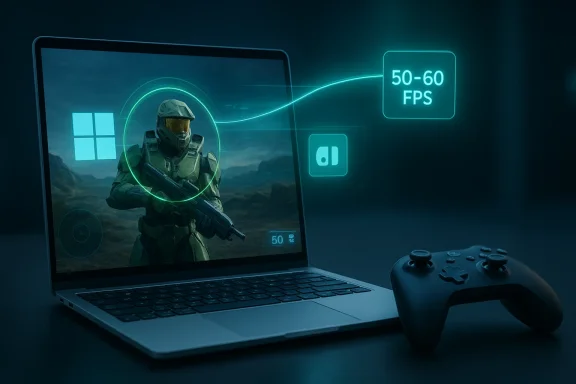
The headline here sounds almost absurd at first glance: a 12-year-old Halo game running at roughly 50 to 60 FPS on a MacBook Neo powered by Apple’s A18 Pro chip. Yet once you unpack the details, the result is less like magic and more like a snapshot of where the industry has been heading for years. Modern mobile processors are no longer underpowered secondary parts; they are serious compute platforms capable of handling demanding workloads when the software stack cooperates.
That matters because the game in question is not some lightweight indie title. Halo: Combat Evolved Anniversary is the remastered version of the original Halo, first released in 2011 as a tribute to the 10-year anniversary of the franchise. Microsoft later brought the game to PC as part of Halo: The Master Chief Collection in 2020, giving Windows players a refreshed version of the iconic campaign with higher fidelity, broader system support, and modern PC features.
What makes the MacBook Neo test noteworthy is the route the game takes to get there. macOS is not running Halo natively. Instead, the setup uses CrossOver, CodeWeavers’ compatibility layer that translates Windows instructions for macOS and other platforms without requiring a full Windows installation. In practical terms, that places this experiment in the same broad category as Valve’s Proton strategy on Linux: not emulation in the old, slow sense, but translation and adaptation designed to make Windows games feasible outside Windows.
The broader significance is that Apple’s latest low-power silicon is now being judged against game behavior rather than only productivity benchmarks. Apple itself positions the A18 Pro as a high-efficiency chip with a strong GPU, a 16-core Neural Engine, and enough headroom for gaming and AI tasks in a fanless machine. That positioning turns the MacBook Neo into something more provocative than a niche ultraportable: it becomes a symbol of how far mobile-class silicon has come, and how close consumer devices are getting to a usable “just run the game” experience without the traditional PC hardware stack.
That is an impressive result, but it is not miraculous in the context of old PC games. Halo: Combat Evolved Anniversary is over a decade old, and the underlying rendering demands are modest compared with today’s big-budget releases. The surprising part is not the age of the game alone; it is that the game is being translated through compatibility software on a fanless mobile chip and still landing near the sweet spot that most players would consider comfortable.
This also reflects the larger transformation in the GPU and translation landscape. Ten years ago, compatibility layers could often run older DirectX-era titles, but the results were inconsistent and heavily dependent on hardware, drivers, and launch configuration. Today, tools like CrossOver are more capable, and modern chips are designed with enough efficiency and graphics throughput to absorb overhead that would have been prohibitive on older low-power systems. The result is a better experience for games that were never designed for macOS or ARM-first devices.
That makes the MacBook Neo clip particularly ironic. If Microsoft’s own goal has been broad reach for Halo, then a compatibility-layer run on Apple hardware is a kind of accidental proof-of-concept. It demonstrates that the audience for Halo is no longer locked to a single machine class, even if official support remains tightly controlled.
That distinction matters for consumers because it changes what “enough performance” means. A device does not need to beat a gaming laptop to be useful for gaming. It only needs to cross the threshold where older, less demanding, or well-optimized titles feel smooth and reliable. For a huge slice of the market, that threshold is around 30 FPS for campaign play and 60 FPS for competitive or high-comfort play.
Apple’s A18 Pro helps explain why that threshold is now reachable. Apple describes the chip as a high-efficiency platform with a strong GPU and enough memory bandwidth and neural capability for demanding consumer workloads, including games. That is consistent with the broader trend toward mobile-first performance scaling up rather than down. The old assumption that a “mobile chip” automatically meant “casual-only” is no longer valid.
There is also an efficiency angle. Because the MacBook Neo is fanless, it is presumably prioritizing sustained low-power operation over aggressive burst behavior. That means the result is not merely “can it spike high for a moment?” but “can it hold up in a real scenario?” That distinction is crucial for thin-and-light devices.
This matters because compatibility layers are now one of the most important hidden technologies in PC gaming. They reduce friction for players who want access to large libraries without being tied to a single operating system. They also put pressure on developers and publishers to think more carefully about portability, engine abstraction, and anti-cheat design.
Halo on Mac via CrossOver is thus not a curiosity isolated from the industry. It is a concrete example of where the software stack is headed. A growing share of gaming access is becoming platform-flexible, and the hardware underneath is increasingly good enough to make that flexibility matter.
Still, anti-cheat remains the biggest obstacle to frictionless cross-platform gaming. If a game depends on kernel-level trust, hardware attestation, or platform-specific anti-tamper systems, then compatibility layers often become secondary citizens at best. That is why the distinction between campaign and multiplayer access keeps coming back.
The Halo test, however, exposes a valuable side effect of that strategy: a low-power chip with sufficient graphics muscle can become unexpectedly capable when asked to run older PC titles. The GPU does not need to dominate the market to matter here. It only needs enough shader throughput, memory behavior, and driver support to clear the hurdle imposed by the game.
This is why the result feels more consequential than a simple “look what I got running” clip. It suggests that the best low-power laptop silicon may now be good enough for broad legacy game compatibility, especially when paired with translation software designed to minimize overhead. That is a meaningful shift for both Apple and the broader PC market.
For consumers, this means there are now three practical tiers of gaming hardware:
That historical loop helps explain why the clip has resonated beyond performance nerds. It touches brand memory, platform rivalry, and gaming nostalgia all at once. Few franchises carry this kind of cross-platform symbolism, and fewer still have been around long enough for the irony to feel earned.
At the same time, Halo’s modern status is more complex than its legacy suggests. The series still matters, but its cultural center has shifted. Microsoft now has to balance nostalgia, competitive multiplayer expectations, and the reality that many players discover or revisit Halo through collection-style packaging rather than through one new blockbuster launch.
This does not mean Microsoft will rush to a native mobile port, or that such a port would make strategic sense in every case. But it does mean the hardware barrier is less intimidating than before. The real question becomes whether Microsoft wants to embrace more aggressive platform expansion or keep Halo tied to more traditional PC and console channels.
The biggest beneficiary is likely the player who wants broad library access without buying a second machine. If you own a laptop for work or school and can still comfortably run Halo: Combat Evolved Anniversary or similar titles, the machine suddenly has a second life. That kind of versatility is one reason compatibility layers have become so influential.
There is also a psychological benefit. A device that can do “serious gaming” on the side feels more valuable, and value perception matters in consumer tech. People forgive more if the machine can surprise them.
If a Windows game can run on macOS through CrossOver, that reinforces the value of software translation as a business tool. The same approach that enables a game to launch can also help older productivity apps remain usable as organizations transition away from legacy Windows-only workflows. That is why the modern compatibility layer ecosystem is worth watching even outside gaming.
For platform holders, the implications are more delicate. Every improvement in translation technology weakens some of the old assumptions about OS lock-in. That does not eliminate the importance of native support, but it does make walls more permeable. In the long run, that is good for users and challenging for gatekeepers.
That creates a strategic tension:
The MacBook Neo result reinforces that trend from another angle. It demonstrates that a general-purpose consumer device can enter the conversation with a little help from software translation. That is not a direct challenge to top-tier gaming systems, but it does pressure the lower and middle tiers of the market, where buying decisions are often about whether a device can play enough of what you own.
For rivals, that means the competitive battlefield is no longer confined to benchmark charts. It is increasingly about ecosystem breadth, software support, and how little effort is needed to move from one device to another. That is where platform value is won or lost.
The real opportunity is not a single frame-rate clip. It is the normalization of mixed-OS gaming as an ordinary expectation rather than a nerdy workaround.
That distinction is important. It keeps the story exciting without turning it into a misleading promise.
It is also worth watching how publishers respond to the rise of compatibility-driven play. If enough players use translation layers to access older libraries, publishers may become more open to explicit compatibility support, cleaner anti-cheat separation, or even renewed interest in native ports. The market usually notices when a workaround becomes a demand signal.
If that trend continues, the surprise will not be that Halo runs on a Mac. The surprise will be when it stops being news.
Source: Windows Central MacBook Neo runs a 12-year-old Halo game at almost 60 FPS
 Background
The headline here sounds almost absurd at first glance: a 12-year-old Halo game running at roughly 50 to 60 FPS on a MacBook Neo powered by Apple’s A18 Pro chip. Yet once you unpack the details, the result is less like magic and more like a snapshot of where the industry has been heading for years. Modern mobile processors are no longer underpowered secondary parts; they are serious compute platforms capable of handling demanding workloads when the software stack cooperates.That matters because the game in question is not some lightweight indie title. Halo: Combat Evolved Anniversary is the remastered version of the original Halo, first released in 2011 as a tribute to the 10-year anniversary of the franchise. Microsoft later brought the game to PC as part of Halo: The Master Chief Collection in 2020, giving Windows players a refreshed version of the iconic campaign with higher fidelity, broader system support, and modern PC features.
What makes the MacBook Neo test noteworthy is the route the game takes to get there. macOS is not running Halo natively. Instead, the setup uses CrossOver, CodeWeavers’ compatibility layer that translates Windows instructions for macOS and other platforms without requiring a full Windows installation. In practical terms, that places this experiment in the same broad category as Valve’s Proton strategy on Linux: not emulation in the old, slow sense, but translation and adaptation designed to make Windows games feasible outside Windows.
The broader significance is that Apple’s latest low-power silicon is now being judged against game behavior rather than only productivity benchmarks. Apple itself positions the A18 Pro as a high-efficiency chip with a strong GPU, a 16-core Neural Engine, and enough headroom for gaming and AI tasks in a fanless machine. That positioning turns the MacBook Neo into something more provocative than a niche ultraportable: it becomes a symbol of how far mobile-class silicon has come, and how close consumer devices are getting to a usable “just run the game” experience without the traditional PC hardware stack.
Why this clip resonates
There is also a cultural layer here that makes the result feel unusually neat. Halo has spent most of its life as one of Microsoft’s defining gaming properties, while the Mac platform has long represented the rival camp in the broader personal-computing war. Seeing the franchise run on Apple hardware through Windows compatibility tooling creates a small but striking what-if moment: the game that once helped define Microsoft’s gaming identity is now being stress-tested on a device running Apple’s mobile silicon.- The test is technically interesting because it mixes old game code, modern translation layers, and mobile CPU/GPU design.
- It is commercially interesting because it suggests more of the PC catalog may be reachable on non-Windows devices.
- It is culturally interesting because it places Halo on hardware that would once have seemed completely hostile to it.
Overview
To understand why this particular benchmark is making the rounds, it helps to look at the layers beneath the frame-rate number. The game is running through Steam, with anti-cheat disabled, at a resolution of 1900 x 1200, with FidelityFX Super Resolution set to Performance mode and the graphics preset tuned to High for stability. That combination is a clear sign the goal was not vanity benchmarking but practical playability. The result, according to the test, was performance around 50 to 60 FPS, with the expectation that a lower settings profile could plausibly hold a stable 60 FPS.That is an impressive result, but it is not miraculous in the context of old PC games. Halo: Combat Evolved Anniversary is over a decade old, and the underlying rendering demands are modest compared with today’s big-budget releases. The surprising part is not the age of the game alone; it is that the game is being translated through compatibility software on a fanless mobile chip and still landing near the sweet spot that most players would consider comfortable.
This also reflects the larger transformation in the GPU and translation landscape. Ten years ago, compatibility layers could often run older DirectX-era titles, but the results were inconsistent and heavily dependent on hardware, drivers, and launch configuration. Today, tools like CrossOver are more capable, and modern chips are designed with enough efficiency and graphics throughput to absorb overhead that would have been prohibitive on older low-power systems. The result is a better experience for games that were never designed for macOS or ARM-first devices.
The role of Halo in Microsoft’s gaming strategy
Halo is not just another old shooter that happens to benchmark well. It remains one of Microsoft’s most recognizable gaming properties, and its long PC journey is part of a much bigger strategy that now spans console, Windows, cloud, and subscription access. The franchise’s move into PC through The Master Chief Collection was a statement that Halo should live beyond the Xbox box, even if the path there was far slower than many fans wanted.That makes the MacBook Neo clip particularly ironic. If Microsoft’s own goal has been broad reach for Halo, then a compatibility-layer run on Apple hardware is a kind of accidental proof-of-concept. It demonstrates that the audience for Halo is no longer locked to a single machine class, even if official support remains tightly controlled.
- Halo’s legacy gives the benchmark extra visibility.
- Cross-platform ambitions make the test feel strategically relevant rather than merely amusing.
- The result underlines how far PC game portability has progressed.
Why the Performance Matters
The raw FPS number matters less than the platform implications behind it. When a fanless machine with a mobile chip can approach 60 FPS in a moderately old AAA game through translation software, it tells us the main constraint is increasingly software interoperability rather than pure compute. In other words, the question is shifting from can the chip do it? to will the game and platform stack cooperate?That distinction matters for consumers because it changes what “enough performance” means. A device does not need to beat a gaming laptop to be useful for gaming. It only needs to cross the threshold where older, less demanding, or well-optimized titles feel smooth and reliable. For a huge slice of the market, that threshold is around 30 FPS for campaign play and 60 FPS for competitive or high-comfort play.
Apple’s A18 Pro helps explain why that threshold is now reachable. Apple describes the chip as a high-efficiency platform with a strong GPU and enough memory bandwidth and neural capability for demanding consumer workloads, including games. That is consistent with the broader trend toward mobile-first performance scaling up rather than down. The old assumption that a “mobile chip” automatically meant “casual-only” is no longer valid.
The significance of 50 to 60 FPS
A number like 50 to 60 FPS may sound modest to enthusiasts who live in 120 Hz or 240 Hz territory, but it is actually an important performance band. It is close enough to 60 to feel fluid, and it creates enough margin to absorb occasional stutters without the game dropping into visibly uncomfortable territory. If a game can hover there on a translated setup, that suggests the underlying workload has meaningful headroom.There is also an efficiency angle. Because the MacBook Neo is fanless, it is presumably prioritizing sustained low-power operation over aggressive burst behavior. That means the result is not merely “can it spike high for a moment?” but “can it hold up in a real scenario?” That distinction is crucial for thin-and-light devices.
- 50 to 60 FPS implies real playability, not a mere slideshow benchmark.
- The result suggests translation overhead is manageable for older titles.
- Fanless operation makes sustained performance more impressive than a short burst.
CrossOver and the Compatibility Layer Story
CrossOver is central to this entire story because it is the bridge that makes the result possible. CodeWeavers’ documentation describes CrossOver as a way to run Windows software on Mac, including on Apple Silicon systems, and highlights graphics translation technologies that help Windows games work on non-Windows operating systems. That architecture mirrors the broader compatibility philosophy behind Proton: translate, adapt, and optimize rather than fully emulate.This matters because compatibility layers are now one of the most important hidden technologies in PC gaming. They reduce friction for players who want access to large libraries without being tied to a single operating system. They also put pressure on developers and publishers to think more carefully about portability, engine abstraction, and anti-cheat design.
Halo on Mac via CrossOver is thus not a curiosity isolated from the industry. It is a concrete example of where the software stack is headed. A growing share of gaming access is becoming platform-flexible, and the hardware underneath is increasingly good enough to make that flexibility matter.
Why anti-cheat is the catch
The anti-cheat-disabled launch option is the key reason this test is relevant but not universal. Halo support documents explicitly explain how to launch Halo: The Master Chief Collection with Easy Anti-Cheat disabled on Steam or the Xbox app for PC. That means the path used in the MacBook Neo test is not an exploit or a workaround in the dark corner sense; it is a supported boot path for certain game modes.Still, anti-cheat remains the biggest obstacle to frictionless cross-platform gaming. If a game depends on kernel-level trust, hardware attestation, or platform-specific anti-tamper systems, then compatibility layers often become secondary citizens at best. That is why the distinction between campaign and multiplayer access keeps coming back.
- Compatibility layers make older single-player games increasingly portable.
- Anti-cheat systems are still the biggest barrier to full-featured online play.
- Official launch options can make the difference between usable and unusable.
What the Result Says About Apple Silicon
Apple’s strategy has been to make the Mac look less like a traditional PC substitute and more like a self-contained, power-efficient computing platform that happens to support some gaming. The A18 Pro in MacBook Neo pushes that idea further by borrowing the same silicon family associated with iPhone-class design and pairing it with laptop ergonomics. That creates a machine whose identity is defined by efficiency first and gaming compatibility second.The Halo test, however, exposes a valuable side effect of that strategy: a low-power chip with sufficient graphics muscle can become unexpectedly capable when asked to run older PC titles. The GPU does not need to dominate the market to matter here. It only needs enough shader throughput, memory behavior, and driver support to clear the hurdle imposed by the game.
This is why the result feels more consequential than a simple “look what I got running” clip. It suggests that the best low-power laptop silicon may now be good enough for broad legacy game compatibility, especially when paired with translation software designed to minimize overhead. That is a meaningful shift for both Apple and the broader PC market.
Gaming without a gaming laptop
One of the quiet breakthroughs in the last few years is that people no longer need a thick dedicated gaming chassis to enjoy a meaningful subset of PC games. This is especially relevant for players who care more about portability, battery life, or quiet operation than maximum frame rates. The MacBook Neo result fits that pattern neatly.For consumers, this means there are now three practical tiers of gaming hardware:
- High-end gaming rigs for modern demanding AAA titles.
- Handheld and ultraportable systems for flexible play and older or optimized games.
- General-purpose laptops and mobile devices that can handle many classic PC titles surprisingly well.
- Portability can now coexist with credible game performance.
- Silent operation makes the device attractive for mixed-use buyers.
- Legacy titles are becoming the most obvious beneficiaries.
The Halo Franchise Angle
There is an almost poetic quality to Halo appearing on a Mac again. The franchise’s public debut was famously tied to a Macworld introduction in 1999, which makes the modern MacBook Neo test feel like a strange full-circle moment. The symbolism is hard to miss: a Microsoft-owned icon that once had early Mac associations is now being tested on Apple hardware through a Windows translation layer.That historical loop helps explain why the clip has resonated beyond performance nerds. It touches brand memory, platform rivalry, and gaming nostalgia all at once. Few franchises carry this kind of cross-platform symbolism, and fewer still have been around long enough for the irony to feel earned.
At the same time, Halo’s modern status is more complex than its legacy suggests. The series still matters, but its cultural center has shifted. Microsoft now has to balance nostalgia, competitive multiplayer expectations, and the reality that many players discover or revisit Halo through collection-style packaging rather than through one new blockbuster launch.
Why Halo on mobile-style silicon is plausible
A Halo-on-mobile conversation was once a fantasy reserved for modified hardware or cloud streaming. Now it feels more plausible because the underlying games are older, the engines are more efficient, and the devices are simply more capable. If a remastered 2011 title can hold near-60 FPS through translation, then a more modest Halo entry or an even lighter build becomes far less absurd.This does not mean Microsoft will rush to a native mobile port, or that such a port would make strategic sense in every case. But it does mean the hardware barrier is less intimidating than before. The real question becomes whether Microsoft wants to embrace more aggressive platform expansion or keep Halo tied to more traditional PC and console channels.
- Halo’s history with Mac adds a layer of irony and symmetry.
- Older Halo titles are increasingly within reach of low-power hardware.
- The franchise remains a useful case study in platform evolution.
Consumer Impact
For consumers, the practical meaning of this benchmark is straightforward: more of the older Windows game catalog may be usable on devices that were never marketed as gaming PCs. That includes laptops with power-efficient chips, mixed-use portables, and systems built primarily for productivity or creativity. It also helps normalize the idea that gaming quality is not binary.The biggest beneficiary is likely the player who wants broad library access without buying a second machine. If you own a laptop for work or school and can still comfortably run Halo: Combat Evolved Anniversary or similar titles, the machine suddenly has a second life. That kind of versatility is one reason compatibility layers have become so influential.
There is also a psychological benefit. A device that can do “serious gaming” on the side feels more valuable, and value perception matters in consumer tech. People forgive more if the machine can surprise them.
What players should keep in mind
Of course, benchmark clips can oversell the experience if they ignore context. A single game in a controlled scene does not guarantee that every title in a collection will behave the same way. Different engines, different anti-cheat systems, and different GPU paths can produce wildly different results even on the same machine.- Older games are the easiest wins.
- Compatibility layers vary by title and by update.
- Multiplayer support is usually the first area to break down.
Enterprise and Platform Implications
From an enterprise perspective, this story also says something about the future of cross-platform software management. Companies increasingly want to standardize on fewer device types while still allowing workers access to specialized applications. While gaming is not enterprise software, the underlying principle is similar: compatibility layers reduce the cost of heterogeneity.If a Windows game can run on macOS through CrossOver, that reinforces the value of software translation as a business tool. The same approach that enables a game to launch can also help older productivity apps remain usable as organizations transition away from legacy Windows-only workflows. That is why the modern compatibility layer ecosystem is worth watching even outside gaming.
For platform holders, the implications are more delicate. Every improvement in translation technology weakens some of the old assumptions about OS lock-in. That does not eliminate the importance of native support, but it does make walls more permeable. In the long run, that is good for users and challenging for gatekeepers.
The strategic lesson for Microsoft
For Microsoft specifically, Halo running well on a Mac via CrossOver is both flattering and awkward. It flatters the company because it demonstrates how deeply embedded its game library is in broader computing culture. It is awkward because it also shows that enthusiasts are increasingly willing to route around platform boundaries rather than wait for first-party solutions.That creates a strategic tension:
- More reach is good for the Halo brand.
- Platform neutrality can increase audience size.
- But controlled ecosystems still matter for monetization and security.
Competitive Landscape
This benchmark also has competitive implications beyond Apple and Microsoft. The broader handheld and portable-PC market has been steadily normalizing the idea that powerful gaming can happen outside a classic desktop tower. Devices like handheld gaming PCs have already shown that players value flexibility and decent performance more than raw technical supremacy in many everyday use cases.The MacBook Neo result reinforces that trend from another angle. It demonstrates that a general-purpose consumer device can enter the conversation with a little help from software translation. That is not a direct challenge to top-tier gaming systems, but it does pressure the lower and middle tiers of the market, where buying decisions are often about whether a device can play enough of what you own.
For rivals, that means the competitive battlefield is no longer confined to benchmark charts. It is increasingly about ecosystem breadth, software support, and how little effort is needed to move from one device to another. That is where platform value is won or lost.
Why the “good enough” tier matters
A lot of tech discussion focuses on extremes: ultra-high-end performance or complete inability. But the real market is often decided by the middle. If a machine can run a beloved older shooter, a few indie games, and a backlog of mid-era PC titles smoothly, many consumers will regard it as a winner.- “Good enough” gaming broadens the addressable market.
- Compatibility can matter more than peak frame rates.
- Library portability is becoming a selling point in its own right.
Strengths and Opportunities
The strongest takeaway from the MacBook Neo Halo test is that it showcases how far low-power silicon, compatibility software, and legacy PC gaming have all advanced at once. It also gives Microsoft, Apple, and CodeWeavers an inadvertent marketing case study in what modern software layering can achieve when the title and hardware both fall into the right part of the compatibility curve.- Proves portability is real for many older PC games.
- Highlights Apple silicon’s efficiency without needing a heavyweight chassis.
- Strengthens the case for CrossOver-style tools in both gaming and productivity.
- Shows Halo’s legacy still has pull across platform boundaries.
- Supports the idea of “one device, many use cases” for consumers.
- Creates a favorable comparison point for thin-and-light devices versus bulkier gaming laptops.
- Demonstrates the value of older back catalogs, which are often more reachable than new AAA releases.
Why this matters beyond the benchmark
This is also a messaging opportunity. Apple can point to gaming as a legitimate side benefit; Microsoft can point to Halo’s enduring relevance; and consumers can see compatibility layers as practical rather than experimental. When those three narratives align, the market usually follows.The real opportunity is not a single frame-rate clip. It is the normalization of mixed-OS gaming as an ordinary expectation rather than a nerdy workaround.
Risks and Concerns
The danger in benchmark virality is that it can make an edge-case result look more universal than it really is. This test succeeded under specific conditions, and those conditions matter: a particular game, a particular launch path, a specific compatibility tool, and an anti-cheat-disabled mode. The broader user experience may be far less consistent.- Anti-cheat limitations block full-featured multiplayer in many cases.
- Compatibility variability can make one title work and the next fail.
- Thermal and power constraints may change behavior over longer play sessions.
- Driver and update churn can break a once-working setup.
- Marketing overreach can lead buyers to expect too much from non-gaming hardware.
- Publisher policy changes could alter what modes are accessible through translation layers.
- Community anecdotes can outpace verified, reproducible testing.
The consumer expectation trap
There is also a risk that people will take this as proof that any Mac, or any mobile chip, can suddenly run a large swath of modern PC gaming without compromise. That is not what the evidence says. It says that some games, especially older ones, can perform surprisingly well when the software stack cooperates.That distinction is important. It keeps the story exciting without turning it into a misleading promise.
Looking Ahead
The most interesting next step is not whether this exact game keeps running well. It is whether more older PC titles begin crossing the same threshold on compact, efficient hardware. If that happens, then devices like the MacBook Neo become more relevant to gaming buyers than their industrial design alone would suggest. That would be a meaningful shift in how we define the “gaming-capable” laptop category.It is also worth watching how publishers respond to the rise of compatibility-driven play. If enough players use translation layers to access older libraries, publishers may become more open to explicit compatibility support, cleaner anti-cheat separation, or even renewed interest in native ports. The market usually notices when a workaround becomes a demand signal.
Things to watch next
- More tests of other Halo titles on the same hardware.
- Whether Halo 3 or Halo 4 shows similar frame-rate stability.
- Changes in CrossOver and related translation tools that improve game support.
- Any broader push from Microsoft toward additional platform reach.
- Whether Apple leans harder into gaming as a feature of Apple silicon.
- How anti-cheat vendors adapt to compatibility-layer environments.
If that trend continues, the surprise will not be that Halo runs on a Mac. The surprise will be when it stops being news.
Source: Windows Central MacBook Neo runs a 12-year-old Halo game at almost 60 FPS
