

The Tasmanian Government and Cricket Tasmania have sealed a formal deal that locks elite cricket into the planned Macquarie Point Stadium precinct — a development that promises to move major Tasmanian cricket fixtures from Bellerive’s recently rebranded Ninja Stadium to Hobart’s waterfront while simultaneously committing to community-level infrastructure including a Seven Mile Beach Cricket Academy and the installation of drop-in pitches required for multi‑use operation.
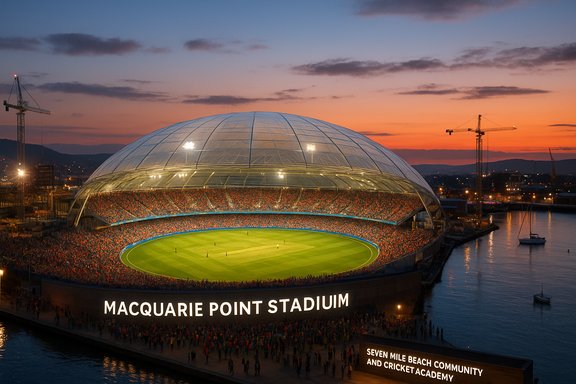
Australia’s smallest state has been at the centre of one of the country’s most contentious stadium debates over the past three years. The Macquarie Point Stadium project — billed by the Tasmanian Government as a 23,000‑seat, multipurpose, domed venue intended to anchor an AFL team and host large concerts and conferences — has been the subject of fierce public scrutiny over cost, planning powers and sporting compatibility since its concept release. The stadium’s proposed domed roof and urban location triggered particular controversy because of technical concerns raised by cricket authorities about daylight, shadowing and playing conditions. For Tasmanian cricket fans the immediate question has been simple: will international and top‑level domestic cricket migrate with the state’s multi‑purpose stadium, or remain at Bellerive Oval (now operating under a naming‑rights agreement as Ninja Stadium)? Bellerive — Tasmanian cricket’s traditional home — was rebranded following a sponsorship deal with SharkNinja in late 2024, and remains the island’s established venue for Tests, internationals and domestic fixtures. The announcement that a second Heads of Agreement between the Tasmanian Government and Cricket Tasmania has been signed marks the end of a protracted negotiation period and signals a clear, government-backed pathway for cricket content to transfer to Macquarie Point — subject to technical and operational conditions that both parties have now agreed to explore and resource.
Source: psnews.com.au Pitch perfect: Tasmanian cricket finds future home at Macquarie Point Stadium | PS News
 Background
Australia’s smallest state has been at the centre of one of the country’s most contentious stadium debates over the past three years. The Macquarie Point Stadium project — billed by the Tasmanian Government as a 23,000‑seat, multipurpose, domed venue intended to anchor an AFL team and host large concerts and conferences — has been the subject of fierce public scrutiny over cost, planning powers and sporting compatibility since its concept release. The stadium’s proposed domed roof and urban location triggered particular controversy because of technical concerns raised by cricket authorities about daylight, shadowing and playing conditions. For Tasmanian cricket fans the immediate question has been simple: will international and top‑level domestic cricket migrate with the state’s multi‑purpose stadium, or remain at Bellerive Oval (now operating under a naming‑rights agreement as Ninja Stadium)? Bellerive — Tasmanian cricket’s traditional home — was rebranded following a sponsorship deal with SharkNinja in late 2024, and remains the island’s established venue for Tests, internationals and domestic fixtures. The announcement that a second Heads of Agreement between the Tasmanian Government and Cricket Tasmania has been signed marks the end of a protracted negotiation period and signals a clear, government-backed pathway for cricket content to transfer to Macquarie Point — subject to technical and operational conditions that both parties have now agreed to explore and resource. What the new Heads of Agreement actually says
The headline commitments
The second Heads of Agreement sets out three interlocking commitments:- The transition of elite‑level cricket from Ninja Stadium (Bellerive Oval) to Macquarie Point Stadium;
- Government and Cricket Tasmania support to establish drop‑in pitches needed for the new stadium to host cricket; and
- A joint focus on growing participation statewide, with explicit support for a Community and Cricket Academy at Seven Mile Beach as a grassroots and pathway facility.
What is being left implicit (and why that matters)
The Heads of Agreement is intentionally high‑level. It records intent and provides a framework for joint work rather than fixing every technical parameter. It does not, for example, publish the final engineering specifications of the roof, the exact delivery schedule for drop‑in pitch nurseries, or a detailed funding envelope for Cricket Tasmania’s operational transition. Those specifics will determine whether Test cricket, limited‑overs internationals, state matches and broadcast partners will be fully comfortable shifting their commitments away from the tried‑and‑tested conditions at Bellerive/Ninja. Because the stadium remains a high‑profile, politically significant project — and because past planning materials flagged substantial cost and design revisions — the devil will be in the technical and commercial detail that follows the Heads of Agreement.Technical anatomy: roof design, drop‑in pitches and playing conditions
The roof question — why it dominated negotiations
The design focus that caused the most public and technical debate has been the stadium’s roof. The original Macquarie Point concept proposed a translucent, fully enclosed dome — a major selling point for the project’s all‑weather promise and acoustic control for concerts. However, Cricket Australia and Cricket Tasmania registered significant concerns about the fixed roof design, arguing shadows, glare and roof geometry could compromise playing conditions and broadcast standards. That disagreement escalated into formal submissions during the planning process and was a key reason cricket’s future at Macquarie Point was uncertain. The new Heads of Agreement signals that the roof design problem has been moved from a point of impasse to one of resolvable detail — but it does not mean every technical issue has been solved. A transparent dome was pitched as a way to permit daylight play while preserving an enclosed environment, but independent experts and cricket administrators raised practical objections over moving shadow patterns and the height/shape envelope necessary to avoid ball‑roof contacts or unpredictable visibility for batsmen and fielders. The government’s announcement that a “shared agreement on the roof design” has been reached must therefore be read as an agreement to continue technical work that satisfies cricket’s playing and broadcast standards, rather than a turnkey engineering sign‑off.Drop‑in pitches: the pragmatic solution for a multi‑use ground
To make cricket playable in multi‑purpose stadia, venues worldwide increasingly rely on drop‑in pitches — prefabricated wicket trays cultivated in specialised nurseries, transported and lowered into the playing surface for matches. This approach allows stadiums to switch between sports and events without permanently dedicating the central square to cricket. Well‑known Australian examples include the Melbourne Cricket Ground and Adelaide Oval, and drop‑in technology has been deployed internationally for temporary or multi‑use venues. Advantages of drop‑in pitches include controlled pitch preparation, protection of the outfield during non‑cricket events, and the ability to maintain several ready wickets in a dedicated nursery. Disadvantages — which Cricket NSW and other stakeholders have previously flagged — include potential playing‑quality concerns (some drop‑ins have been criticised for producing dull or inconsistent cricket), high establishment and logistics costs, and the need for storage and transport infrastructure. The Heads of Agreement’s explicit commitment to support drop‑in pitch establishment acknowledges both the practical necessity and the technical challenge of delivering international‑grade playing surfaces at Macquarie Point.What this means for broadcast and the ICC
Broadcast partners and the International Cricket Council evaluate venues against strict standards for lighting, sightlines, pitch behaviour and safety. Any new stadium that seeks to host Test cricket must be demonstrably consistent with those standards; the roof and pitch solutions will therefore be reviewed not only by state bodies but by national and international authorities. The Heads of Agreement reduces political risk by aligning the state government with Cricket Tasmania on the pathway to compliance, but formal ICC acceptance remains a separate process that will require documented testing and independent sign‑off.The practical logistics of transition: timing, turf, and calendar integrity
Staging the move without losing fixtures
A move of elite content from an existing stadium to a new venue involves complex sequencing. Cricket Tasmania will need to ensure:- A completed and certified drop‑in pitch nursery and sufficient ready wickets;
- Testing of roof geometry and lighting against match play and ball‑tracking models; and
- A coordinated transition plan that protects scheduled domestic and international fixtures — including the BBL, Women’s internationals, Sheffield Shield and potential touring internationals.
Nursery, storage and transport: hidden infrastructure costs
Drop‑in wickets demand purpose‑built nurseries where trays are cultivated and matured over seasons, plus secure storage and heavy‑lift transport infrastructure to move pitch trays into and out of the stadium. Older case studies show governments and venue operators must budget for cranes, tramlines, bespoke trucks and specialised handling equipment, together with ongoing nursery maintenance. The Heads of Agreement’s reference to supporting drop‑in pitches is therefore significant because it implies the government will underwrite these non‑glamour but essential technical costs.Turf science and local conditions
Tasmania’s climate, soil types and micro‑weather patterns mean pitch cultivation will need to be carefully tuned. If the state intends to host top‑level cricket year‑round, the pitch program must replicate or intentionally vary playing characteristics in a way that supports competitive balance and broadcast expectations. There is also an argument for curating pitches that showcase Tasmanian cricket’s advantages — but that requires long lead times and investment in agronomy expertise.The politics and economics: a stadium to anchor renewal or a fiscal risk?
Revenue expectations — a fragile assumption
Early business cases for Macquarie Point factored in additional revenue streams from cricket content — notably the prospect of a Test match and multiple BBL fixtures — to underpin long‑term economics. That assumption has been politically sensitive because the stadium’s viability degrades if cricket does not transfer as planned. The new Heads of Agreement mitigates that particular risk by making the transition a jointly supported objective, but it does not remove fiscal risk entirely. Unresolved questions include final construction costs, operating subsidies, and whether the stadium’s mixed‑use calendar will consistently deliver the projected visitation and hospitality returns. Recent reporting has flagged budget revisions and cost pressures previously estimated at figures ranging into the high hundreds of millions; until the final funding model is released, those numbers remain projections rather than settled commitments.Political cover and public expectations
The government has framed the agreement as a delivered promise and a milestone for the Macquarie Point project. For ministers, locking cricket into Mac Point is a tangible political success — it removes one public objection and enables boosters to argue the stadium will host a full sporting calendar. Yet the project’s critics will, reasonably, demand scrutiny of the technical evidence that underpins cricket’s acceptance into the stadium — especially the independent testing and third‑party assessments that will be necessary to persuade national cricket administrators and broadcasters. The Heads of Agreement buys time and cooperation, but not unconditional public confidence.Community return: the Seven Mile Beach academy
Arguably the most future‑oriented element of the deal is the commitment to the Community and Cricket Academy at Seven Mile Beach. Investing in a pathway facility could be transformational for grassroots participation and talent development across the state, providing coaching hubs, talent ID and community health benefits. This component shifts some of the public conversation away from stadium spectacle to long‑term community uplift — a point the government emphasised in the announcement. The actual design, funding and governance of the academy will be worth watching; it will be judged on accessibility, program design, and integration with schools and club networks.Stakeholder perspectives: who benefits, who remains wary
Winners
- Cricket Tasmania: Gains a formalised route into the new stadium, state support for technical requirements, and a seat at design decisions that previously risked sidelining cricket content.
- Tasmanian Government: Achieves a headline outcome that strengthens the stadium business case and reduces a politically awkward conflict with a major national sporting body.
- Young players and grassroots clubs: Stand to benefit from dedicated academy infrastructure at Seven Mile Beach designed to boost participation and talent pathways.
Caution flags and remaining opponents
- Traditional stadium advocates / local neighbours: The continued impact on Bellerive/Ninja Stadium’s calendar, precinct economy and local amenity will require careful transition planning. Expect stakeholders around Bellerive to press for clarity on future scheduling and community access.
- Technical sceptics: Independent turf scientists, broadcast engineers and some cricket administrations previously warned that roof shadows and fixed roof geometry create genuinely hard technical problems — issues that remain subject to engineering verification despite the new agreement. Where those technical reviews are absent or incomplete, sceptics will continue to voice resistance.
What to watch next — milestones that will determine success or failure
- Published technical design variations and engineering tests for the roof — independent, peer‑reviewed modelling of shadows, glare and ball trajectory will be required to reassure Cricket Australia, broadcasters and the ICC.
- Concrete timelines and budgets for drop‑in pitch nursery construction — including the number of trays, nursery capacity, transport mechanisms and cost allocations.
- A formal fixture program transition plan — a season‑by‑season schedule showing which elite matches will move, when Bellerive will cede fixtures, and contingency plans should testing reveal unforeseen problems.
- Public disclosure of the operational support package for Cricket Tasmania — staffing, funding envelopes and contractual obligations will show how the state intends to underwrite the transition.
- Independent assurance from the ICC or Cricket Australia that Macquarie Point can meet match standards for televised international cricket. This remains the ultimate arbiter for Test and ODI authorization.
Risks and mitigation — practical recommendations
- Invest in early, independent ball‑tracking and daylight modelling using multiple manufacturers’ data to stress‑test any roof solution against match conditions and broadcast camera positions. This reduces rework risk later and helps speed ICC approvals.
- Stage the transition on a phased basis: pilot a limited number of domestic fixtures at Macquarie Point once pitch and roof tests pass, before shifting marquee internationals. This preserves calendar integrity and provides real‑world data.
- Create a publicly visible governance body comprising government, Cricket Tasmania, player representatives, broadcaster technical leads and independent engineers — to build public confidence and provide transparent audit trails during testing and commissioning.
- Fund an adequately resourced drop‑in nursery and maintenance program before any major fixtures are scheduled at Macquarie Point; underinvestment here is a recurring cause of performance shortfalls in multi‑use venues.
- Maintain a clear contingency footprint for Ninja Stadium (Bellerive) to host fixtures on short notice during the transition window; contractual certainty for stakeholders is essential to protect revenue and fan experience.
Final assessment — what the agreement means for Tasmanian cricket and the stadium narrative
The Heads of Agreement between the Tasmanian Government and Cricket Tasmania is a meaningful political and operational milestone. It resolves a major point of friction in the Macquarie Point project by aligning government resources with cricket’s technical demands and by committing to concrete infrastructure such as drop‑in pitch capability and a community academy. In short, it swaps public gridlock for a staged program of technical delivery and risk‑sharing. That said, the agreement is not a technical panacea. The earlier, very public dispute over the stadium roof was not resolved by politics alone — it required engineering validation, turf science, and buy‑in from broadcasters and the ICC. The new Heads of Agreement is best read as an enabling instrument: it unlocks resources and sets the pathway for the hard work that will follow. Its success will be judged on the coming months’ technical reviews, pilot fixtures and the government's delivery of promised operational support. If those engineering and pitch challenges are handled professionally, Macquarie Point could become a successful multi‑use venue that hosts world‑class cricket while generating broader civic benefits. If they are underestimated, the state risks expensive rework, fixture uncertainty and reputational cost. The new agreement narrows the gap between aspiration and delivery — but it does not eliminate the practical, technical and financial tests that remain ahead.Quick reference — what readers should remember
- The Tasmanian Government and Cricket Tasmania have signed a second Heads of Agreement committing to move elite cricket to Macquarie Point and to back the technical work required, including drop‑in pitches and a Seven Mile Beach Community and Cricket Academy.
- Bellerive Oval operates under naming rights as Ninja Stadium and will remain central to Tasmanian cricket during the transition; the new deal sets out a staged shift rather than an abrupt relocation.
- The most technically sensitive issue remains the stadium roof design: earlier concern from Cricket Australia and Cricket Tasmania about shadows and playing conditions prompted the negotiations that led to this agreement. The current pact signals progress but requires testing and third‑party validation before international cricket can be fully committed to the new venue.
- Practicalities — nurseries, pitch transport, heavy‑lift infrastructure and rigorous test fixtures — will determine whether Macquarie Point can host high‑standard cricket; these are now on the public work program.
Source: psnews.com.au Pitch perfect: Tasmanian cricket finds future home at Macquarie Point Stadium | PS News
