

The Maharashtra government has rolled out MahaCrimeOS AI — an AI-powered cybercrime investigation platform developed with Microsoft and cybersecurity firm CyberEye — marking a major push to digitize and accelerate criminal investigations across the state. The system, unveiled at the Microsoft AI Tour in Mumbai, is already live in a Nagpur pilot covering 23 police stations and is being slated for a phased expansion to all 1,100 police stations in Maharashtra.
Maharashtra’s MahaCrimeOS AI is a purpose-built AI-driven cybercrime investigation platform intended to speed up digital evidence processing, automate routine investigative tasks, and surface links between related complaints. The platform was developed in partnership between the Maharashtra government (through its MARVEL special-purpose vehicle), Microsoft India Development Center, and CyberEye. Microsoft’s Azure OpenAI Service and Microsoft Foundry are reported to provide the AI backbone and cloud infrastructure. The launch is set against a steep national rise in online fraud and cyber offences that has overwhelmed conventional investigative capacity. Central reporting and coordination mechanisms such as the National Cyber Crime Reporting Portal and the Indian Cyber Crime Coordination Centre (I4C) are already in place, but state police forces have struggled with backlog, inconsistent data formats, and low technical capacity at the frontline. MahaCrimeOS positions itself as a practical, operational response to those systemic bottlenecks.
Publicly available transparency reports, regular independent audits, and accessible complaint mechanisms will reduce the political and civil-liberty backlash that often follows opaque deployments. The state should also publish model cards and system documentation that outline intended use, limitations, training data provenance (to the extent possible without exposing sensitive sources), and known failure modes.
Source: Lapaas Voice Maharashtra govt announce MahaCrimeOS
 Background / Overview
Maharashtra’s MahaCrimeOS AI is a purpose-built AI-driven cybercrime investigation platform intended to speed up digital evidence processing, automate routine investigative tasks, and surface links between related complaints. The platform was developed in partnership between the Maharashtra government (through its MARVEL special-purpose vehicle), Microsoft India Development Center, and CyberEye. Microsoft’s Azure OpenAI Service and Microsoft Foundry are reported to provide the AI backbone and cloud infrastructure. The launch is set against a steep national rise in online fraud and cyber offences that has overwhelmed conventional investigative capacity. Central reporting and coordination mechanisms such as the National Cyber Crime Reporting Portal and the Indian Cyber Crime Coordination Centre (I4C) are already in place, but state police forces have struggled with backlog, inconsistent data formats, and low technical capacity at the frontline. MahaCrimeOS positions itself as a practical, operational response to those systemic bottlenecks. What MahaCrimeOS AI does — a technical and operational summary
Core capabilities
MahaCrimeOS combines cloud-hosted services, generative AI models, and investigative workflow automation to deliver a suite of capabilities aimed at law enforcement:- Multimodal evidence ingestion: accepts PDF documents, screenshots, audio notes, images, and handwritten content and extracts structured metadata.
- Multilingual extraction and normalization: processes inputs in English, Hindi and Marathi, converting varied sources into a common case record.
- Automated legal and procedural templates: auto-drafts letters, summons and requests (for CDRs, bank statements, takedown requests) that comply with local procedures.
- Case linking and pattern detection: uses entity recognition and graphing to find links across different complaints and jurisdictions.
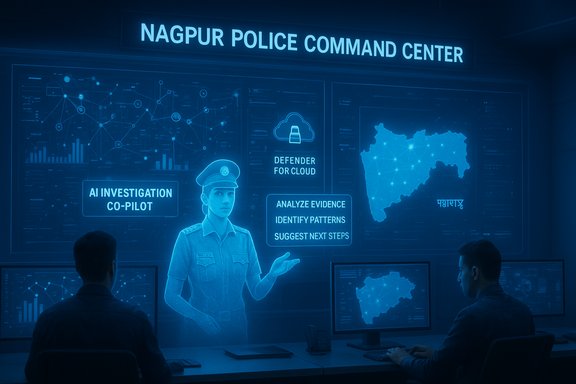
- AI investigation copilot: an agentic assistance layer that proposes investigative steps, suggests evidence to pursue, and recommends legal pathways based on ingested facts.
Architecture and security building blocks
The platform is described as being built on Microsoft Azure, using the Azure OpenAI Service and Microsoft Foundry for model orchestration and governance. Reported security layers include Defender for Cloud and role-based access, with MARVEL responsible for embedding state-specific investigative protocols and local language configurations. These design choices point to a cloud-native, governed AI deployment model with integrated compliance and audit capabilities.Deployment status and early results
MahaCrimeOS has been piloted in Nagpur since April, operating in a concentrated set of police stations (reported as 23 stations in multiple outlets). Maharashtra officials say the pilot produced striking time savings — in some public comments Nagpur police claimed an 80% reduction in average investigation time for certain cybercrime and fraud cases. Those claims are being used to justify a proposed statewide roll-out. The anecdotal, on-the-ground examples circulated at launch illustrate the intended value: complaints that once required weeks or months of manual collection and verification—drafting bank letters, pulling CDRs, collating screenshots—were handled in days using MahaCrimeOS workflows, enabling arrested suspects and some recoveries in shorter windows. Officials note increases in individual investigator productivity and faster service for victims. Caveat: the headline “80% reduction” figure is self-reported by Nagpur police and appears in media coverage; independent third‑party audits or published performance metrics have not yet been disclosed in the public domain. That caveat is important for public transparency and for auditing claims when the system scales.Why the state and Microsoft are investing in this approach
Operational pressure and a national problem
India experienced a surge in digital fraud and cyber complaints in recent years. Central data cited at the launch shows millions of complaints and substantial financial losses, underscoring the mismatch between rising case volumes and investigator capacity. MahaCrimeOS is framed as an operational tool to manage caseload growth, standardize processes, and enable faster tactical response.Policy alignment and capability building
The Maharashtra government created MARVEL (Maharashtra Advanced Research and Vigilance for Enhanced Law Enforcement) as a vehicle to integrate AI into policing and governance workflows. The MahaCrimeOS project aligns with a broader state strategy to create AI Centers of Excellence and standardize investigator training, with Microsoft providing cloud services and partner support for capacity building. That ecosystem view is intended to lock in not only a specific product but an institutional capability for digital investigations.Vendor partnership model
CyberEye — identified in coverage as the startup partner that customized the solution for local workflows and language — worked with MARVEL and Microsoft India’s teams to configure the product for real investigations. Microsoft’s involvement provides scale, governance tooling and cloud security, while the local partner supplies domain-specific logic and field integration. This hybrid vendor model is consistent with many public sector AI deployments worldwide.Strengths: where MahaCrimeOS could meaningfully help
- Faster triage and throughput: automating tedious evidence extraction and draft requests reduces administrative bottlenecks that historically slow investigations. Early reports show investigators handling multiple times as many cases per month.
- Standardized, auditable processes: a unified case file format and preconfigured investigative pathways can reduce procedural errors, improve chain-of-custody records and produce auditable logs for courts.
- Scaling investigator capacity: rather than hiring proportionate numbers of specialist cyber-investigators, software augmentation can bring more generalist officers to effective levels faster through embedded guidance.
- Language and local legal context: by embedding Marathi and local legal templates, MahaCrimeOS addresses real-world language and procedural barriers that often slow casework.
- Potential national model: if validated, a working state-level deployment could become a replicable blueprint for other states facing similar cybercrime backlogs.
Risks, unknowns and critical challenges
1) Data protection, privacy and legal boundaries
MahaCrimeOS will handle extremely sensitive data—financial records, personal communications, identity documents and investigation notes. While Microsoft’s cloud provides enterprise-grade security controls, the fundamental risk is policy and governance: who can access what, how long data is retained, and what oversight ensures adherence to legal warrants and privacy rules. Absent transparent, published data governance policies and retention schedules, there is a real risk of mission creep and privacy violations.2) Evidence integrity and admissibility in court
Automated extraction and AI-generated summaries will need rigorous chain-of-custody safeguards to ensure evidence remains admissible. Courts rely on human-authenticated trails; if investigators depend on AI outputs without preserving original artifacts and documented manual steps, prosecutions could be jeopardized. The platform’s logging and tamper-evidence mechanisms must be demonstrable in legal contexts.3) Over-reliance and deskilling risks
Introducing a powerful copilot changes investigator workflows. Over time, there is a risk that junior officers might defer critical thinking to the system or that skills needed for manual forensic analysis could atrophy. The operational model must mandate human-in-the-loop verification for key investigative decisions.4) Algorithmic bias and false positives
AI linking and profiling can produce spurious associations—especially when training data contains historical biases or incomplete records. A false-positive linkage can lead to misdirected raids, reputational harm or wrongful arrests. The system needs thresholds, explainability features, and independent audits to detect and mitigate biased outputs.5) Transparency and independent validation
Current performance claims (for example, the quoted “80% reduction in investigation time”) are reported by police and media; they have not yet been corroborated by independent third-party audits or published metrics. For public trust and policymaking, independent performance evaluations—covering accuracy, false positive rates, time savings, and court outcomes—are essential.6) Vendor lock-in and interoperability
A platform constructed on proprietary cloud services and a specific set of governance tools raises questions about long-term portability, costs, and interoperability with national systems and other states. Maharashtra must ensure standards-based APIs, exportable data formats, and contractual terms that preserve public control and competitive options in future procurement cycles.How to mitigate the risks — practical recommendations
To responsibly scale MahaCrimeOS across 1,100 stations while preserving civil liberties and legal integrity, the following measures are advisable:- Publish a clear, public data governance charter that specifies data types processed, retention periods, access controls, audit trails, and redress mechanisms.
- Establish an independent audit and oversight committee with legal experts, civil society representatives and forensic specialists to review performance claims and algorithmic behavior.
- Require human-in-the-loop confirmation for all AI-suggested arrests, warrants, or high‑value actions; maintain manual sign-off logs tied to personnel identities.
- Run regular bias and fairness audits on entity-linking and profiling modules; publish summary metrics on false positive/negative rates.
- Create forensic evidence handling protocols that preserve original artifacts, store AI-generated summaries as derivative artifacts, and ensure court admissibility.
- Implement security posture reviews and red-teaming by third-party cybersecurity firms to validate cloud configurations, threat models, and adversarial-resilience of the AI modules.
- Invest in sustained training programs and certification (including Microsoft and in-house curriculum) to institutionalize skills and prevent deskilling.
- Insist on standards-based interoperability: exportable data, documented APIs, and avoidance of proprietary locks that impede future migration or cross-jurisdictional integration.
Governance, accountability and public trust
Any AI used in policing must be accompanied by governance that ensures accountability. Maharashtra’s MARVEL SPV provides an institutional vehicle, but the public-facing accountability mechanisms must be robust. Transparent reporting—on usage volumes, incident types, correction rates and oversight activities—will be essential to maintain citizen trust.Publicly available transparency reports, regular independent audits, and accessible complaint mechanisms will reduce the political and civil-liberty backlash that often follows opaque deployments. The state should also publish model cards and system documentation that outline intended use, limitations, training data provenance (to the extent possible without exposing sensitive sources), and known failure modes.
The practicalities of statewide scale: logistics and capacity
Expanding from a pilot in 23 Nagpur stations to 1,100 stations is not just a software rollout; it is an organizational transformation.- Connectivity & offline resilience: many rural police stations have intermittent broadband. The platform must provide robust offline workflows with secure sync capabilities for limited-bandwidth environments.
- Training & change management: trainers, field coaches and sustained refresher courses will determine adoption success. A frontloaded classroom session is insufficient; long-term mentorship and measurable competency targets are needed.
- Integration with banks, telcos and national portals: automated legal notice generation is valuable only if recipient institutions have fast compliance workflows. The state should coordinate SLAs with banks and telecom providers to keep time-to-response low.
- Sustaining budget & operations: cloud service costs, licensing, and SOC operations require multi-year funding commitments beyond initial pilot budgets. Procurement contracts should include clear TCO forecasts and exit strategies.
Broader implications: AI in public safety and the policy horizon
Microsoft’s public statements positioned the launch as a blueprint for responsible AI in public services and suggested the same model could be adapted for healthcare, education, and agriculture. While those cross-sector possibilities are real, policing carries unique legal, ethical and human rights dimensions that demand stricter guardrails than many other domains. The Maharashtra rollout will therefore be watched closely as an early test-case of scaled, state-level AI in law enforcement. If MahaCrimeOS genuinely delivers sustained, audited improvements in investigation time and case outcomes while maintaining legal safeguards, it could become a replicable model across other Indian states and comparable jurisdictions globally. Conversely, rushed or opaque scaling could produce harms—false arrests, privacy breaches, and erosion of public trust—that will be far harder to reverse.Bottom line: pragmatic tools require principled governance
MahaCrimeOS AI represents a pragmatic response to a pressing operational problem: exploding cybercrime volumes and the need to deliver faster relief to victims. Early reports from Nagpur suggest meaningful productivity gains and faster case processing. The use of established cloud governance tools (Azure OpenAI Service, Microsoft Foundry, Defender for Cloud) and a local partner for domain customization are positive design signals. However, the program’s long-term success depends on three non-technical factors as much as on software: transparent performance validation, strong data governance and legal safeguards, and continuous investment in human capacity. The “80% reduction” headline — widely reported — should be treated as a promising pilot claim that requires independent verification and published metrics before it becomes a policy benchmark for nationwide replication. MahaCrimeOS AI can accelerate investigations and make police work more effective — but the same acceleration that helps victims must not circumvent judicial safeguards or public accountability. With the right governance, Maharashtra’s experiment could show how AI-powered policing is done responsibly; without it, the project risks becoming another high-profile technology deployment that raises as many questions as it solves.Source: Lapaas Voice Maharashtra govt announce MahaCrimeOS
