

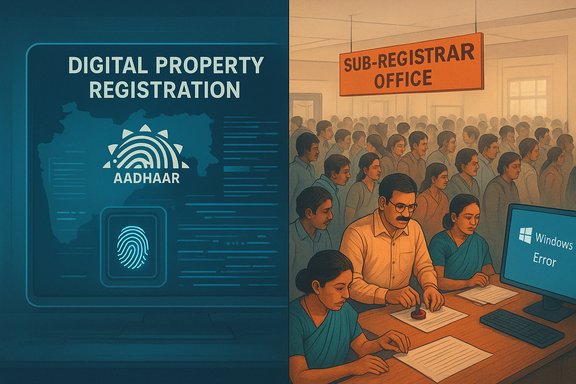
A week-long Aadhaar authentication outage has effectively frozen the state’s e-registration pipeline, forcing homebuyers, tenants and builders across Maharashtra to abandon online property registrations and head to sub-registrar offices in person — a disruption officials trace not to UIDAI but to a technical failure inside the state’s IT stack.
Background / Overview
Maharashtra was an early adopter of Aadhaar-enabled property registration: an amendment to Section 32A of the Registration Act, 1908, approved in 2018, allowed Aadhaar verification to stand in for the traditional requirement of two witnesses from March 2019 onward. The policy aimed to streamline processes, cut queues at sub-registrar offices and enable true digital property registration. The state’s modern property workflow now relies on real-time Aadhaar authentication for several core activities:- Online leave-and-licence (rental) registrations completed remotely by lessor and lessee.
- First-sale registrations executed from developers’ offices where biometric authentication confirms buyer identity.
- Routine property sale and transfer registrations where Aadhaar is used to reduce witness overhead and speed verification.
What happened: the outage, the immediate impact
The outage manifested as failed Aadhaar authentication calls inside the registration system, with the state’s Inspector General of Registration (IGR) confirming an active investigation and daily follow-ups with the state Directorate of Information Technology (DIT). Officials told press that the root cause was a Windows Server-related problem at DIT — not a failure in UIDAI’s public-facing systems — and that restoration was being prioritized. Practical effects across Maharashtra included:- Halted online leave-and-licence (rental) registration services for the past week, leaving tenants and landlords unable to renew or register contracts from home.
- Suspension of first-sale registrations executed from developers’ offices in big cities such as Pune and Mumbai, halting closings that depend on biometric Aadhaar authentication.
- Surge of visitors at sub-registrar offices as applicants were advised to complete registrations in person with two witnesses, reversing years of digital crowd-reduction efforts.
Who said what: the official narrative and industry response
The registration department’s public line is that UIDAI’s infrastructure was not at fault — instead the authentication failure originated within the state’s own IT delivery layer, specifically a Windows Server issue at DIT that broke the chain between the registration application and the Aadhaar auth endpoint. The IGR has been coordinating with DIT to restore service. Service providers and real-estate industry associations reported immediate business disruption. Representatives said:- Developers could not complete first-sale registrations at their sales offices due to biometric verification failing.
- Authorized Service Providers (ASPs) and other intermediaries saw appointment cancellations and mounting backlogs, and submitted lists of suggested fallbacks, ranging from email verification to alternate biometric modalities.
Technical anatomy: how Aadhaar-powered registration normally works — and how it can fail
At a high level, Aadhaar-based property registration usually operates like this:- The registration front-end collects document metadata and the citizen’s Aadhaar number.
- The front-end sends an authentication request to a local middleware or state IT gateway (in Maharashtra this role sits with DIT or a state integration layer).
- The middleware routes the request to UIDAI’s Aadhaar Authentication APIs, which return success, failure, or a timed response. Successful auth yields a verification token and (optionally) a UIDAI-signed photo/print reference for printing on the final document.
- The registration transition completes once the token is accepted and the system persists a verifiable audit trail against the registration record.
- Local middleware or server outages (e.g., Windows Server crashes or misconfigurations) that prevent outbound API calls or collapse the queueing layer.
- Network connectivity issues between the state gateway and UIDAI endpoints.
- Capacity throttling or API key/service-level problems with UIDAI (not the case here, per officials).
- Certificate/cryptographic problems, or software updates that break compatibility.
- Integration bugs in the registration application or payment gateway.
Why this is more than an inconvenience: operational and policy risks
This outage is symptomatic of three structural issues in digital public-service design.- Single points of dependency
- A service architecture that funnels all Aadhaar requests through a single departmental gateway creates an operational single point of failure. When that gateway fails, multiple downstream services — tenancy registration, first-sale closings, witnessless registration — all stop.
- Weak fallback options
- The fallback to the old witnesses-based process is legal and functional, but it is also a blunt instrument that undermines the objectives of digital property registration. It forces citizens back into queues and increases the attack surface for fraud (paper manipulation, coerced witnesses, proxies).
- Operational cascading and revenue exposure
- Governments and businesses depend on these registrations for fee collection and legal finality. An extended outage stalls stamp-duty revenue, affects builder cash flows, and delays legal possession transfers.
What’s been suggested — and what should be implemented
Service providers and industry bodies have presented a menu of practical workarounds and resilience measures; many of these are sensible and low-friction:- Short-term fallbacks (operational within days)
- Allow notarized e-sign or digitally signed declarations using Aadhaar’s e-KYC token where biometric auth fails.
- Enable email/OTP verification tied to the Aadhaar-registered mobile for a conditional acceptance path, logged with higher scrutiny.
- Establish a dedicated temporary helpline and escalation desk at IGR and DIT for transactions stuck mid-flow to triage manual alternatives and record exceptions.
- Defer non-critical validation steps for urgent registries (with a documented manual audit after restoration) to prevent backlogs from stalling life-critical closings.
- Medium-term architectural changes (weeks to months)
- Implement multi-path authentication: route Aadhaar auth requests via more than one gateway and add direct fallback to UIDAI endpoints if the middleware is unreachable.
- Add circuit-breaker logic and degraded-mode UX that tells users the expected behavior and suggests immediate alternatives rather than exposing opaque failures.
- Publish SLAs and real-time incident dashboards for registration uptime so citizens and developers can plan closures accordingly.
- Long-term resilience (policy and procurement)
- Contractual SLAs with DIT/NIC and any cloud or data-centre operators that include capacity, patching windows, incident notification timelines and independent audits.
- Establish a state-level secondary authentication registry — an auditable set of alternative identity verification methods (iris biometrics, digital signatures, national e-ID tokens) that can be invoked when Aadhaar endpoints are unavailable.
- Formalize a “digital continuity plan” for high-volume citizen services that must remain available (property registration, vehicle taxes, welfare disbursals).
Security, privacy and fraud considerations
Every fallback increases an attack surface. Key safeguarding principles for any temporary or permanent workaround:- Maintain auditable, immutable logs for every authentication decision and any manual override. These logs must be cryptographically signed or time-stamped to preserve legal evidentiary weight.
- Avoid introducing low-assurance channels (for example, unsecured email) as a permanent substitute for biometric verification. Where email/OTP is permitted, restrict it to low-value transactions and enforce post-recovery reconciliation.
- Harden citizen education and anti-phishing measures during outages: fraudsters frequently exploit system failures by offering “fast linking” or paid help for identity recovery. Use official helplines and publish step-by-step, government-verified guidance.
- If alternate biometrics (e.g., iris) are used, ensure templates and matching thresholds are documented and subject to privacy-impact assessment.
The accountability gap and the need for transparent incident reporting
Public trust in a digital service depends on clear, timely communication. In this incident, citizens and service providers cited a lack of prior warning and limited guidance on offline alternatives. That information vacuum worsened operational pain and trust erosion.A minimal public incident protocol should include:
- Immediate acknowledgement of service degradation and expected ETA for resolution.
- Clear instructions for citizens (how to process urgent registrations, what documents are acceptable, where to queue).
- A post-incident technical report that states the root cause, time-to-fix, and steps taken to prevent recurrence.
- A helpline escalation matrix that includes contact points at IGR, DIT and UIDAI (if UIDAI is implicated) to speed cross-agency remediation.
Practical guidance for citizens and developers right now
If you are affected by the outage, these steps will reduce risk and preserve evidence:- Capture screenshots and receipts of any failed online attempts and of portal errors.
- If you must revert to in-person registration, take original ID documents and two witnesses as required; request an acknowledgement slip for any manual filing.
- For developers and buyers caught mid-transaction, record the stage of processing and request deferred registration authorizations or conditional allotment letters from developers.
- Do not share OTPs, passwords or sensitive details with third-party “fix-it” operators claiming they can restore registrations; use official helplines only.
Strengths revealed — and weaknesses exposed
This incident underscores the upside of Aadhaar-enabled registration: when working, the system removes friction, speeds transactions and reduces in-person queues. It also shows the downside: centralized digital convenience is fragile without engineered redundancy.Strengths:
- Aadhaar-based flows replaced the need for two witnesses, simplifying legal formalities and reducing opportunities for documentation fraud. This has demonstrably eased many routine transactions since rollout.
- Centralized dependency on a single state gateway without robust failover creates brittle service availability.
- Communications and operational playbooks for outages are often underdeveloped in public services, leaving citizens to fend for themselves when digital channels break.
Conclusion: what Maharashtra must do next
The outage is a practical reminder that digital reform is more than policy: it is an ongoing program of engineering, resilience planning, procurement and accountability. Maharashtra’s Aadhaar-based registration system delivered clear efficiency gains, but that dividend requires hardening.Priority actions for the state:
- Publish a technical incident report and timeline for the current outage, and confirm whether the Windows Server diagnosis is final.
- Implement immediate fallbacks (typed/OTP-assisted verification, e-signing, helplines) and codify them into emergency SOPs so citizens are not forced into long in-person waits.
- Architect multi-path Aadhaar authentication with active-active gateways, meaningful SLAs, monitoring and on-call rotations to prevent single-point failures.
- Expand alternative verification modalities (iris, e-KYC tokens, digital signatures) and clarify their legal acceptance to reduce dependency on a single biometric channel.
The outage has highlighted both why Aadhaar-based digital property registration matters, and why it requires clear redundancy, rapid incident reporting and practical fallback options to protect citizens, developers and state revenue when systems fail.
Source: Pune Mirror Aadhaar Verification Glitch Disrupts Property Registration Across Maharashtra
