

AI becomes decisive not when models merely compute faster, but when human imagination, domain context, and scalable engineering meet at the point of delivery — a theme that surfaced repeatedly at TechSparks 2025 in the panel “Making AI Real: Where Creativity Meets Intelligence and Scale,” and one that Microsoft’s Copilot has been cast to demonstrate in live, real-world workflows. The conversation — which paired Microsoft’s onstage Copilot assistant with four Indian founders and product leaders — sketched a practical roadmap: combine generative creativity with enterprise-grade grounding, instrument discovery for an AI-first buyer journey, and design governance and operational plumbing that move solutions from proofs to production at scale.
Why this changes strategy:
The practical implication is immediate. Shorten the feedback loop between idea and prototype using vibe-coding and copilots for concept work; simultaneously, harden the delivery path with RAG, identity-bound agents, and observability for scaled deployments. Track and optimize your brand’s presence inside AI answers through GEO; and finally, preserve human judgment where it matters most.
The panel’s message was clear and implementable: use AI to expand human creativity, but make outcomes auditable, useful, and safe. The technology has moved beyond novelty; the work now is engineering, governance, and organizational design to ensure the creative potential of AI translates into reliable business outcomes — at scale.
Source: YourStory.com https://yourstory.com/2025/11/prompts-products-copilot-ai-delivers/
 Background
What the TechSparks panel distilled
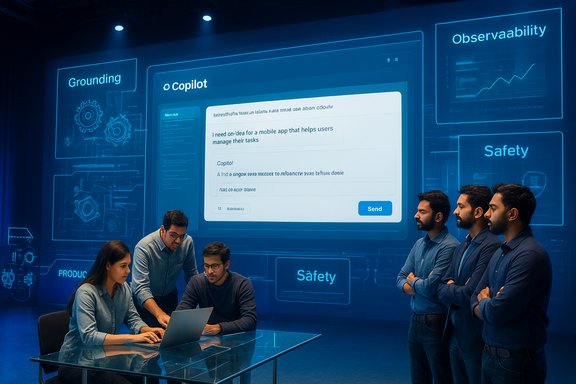
At the heart of the TechSparks session was a pragmatic thesis: generative models generate possibilities; impact comes when those possibilities are threaded through workflows, data grounding, and operational controls. Moderated by Sandeep Alur of Microsoft’s Innovation Hub, the panel included Mathangi Sri Ramachandran (YuVerse), Rahul Regulapati (Galleri5), Samanyou Garg (Writesonic), and Vishal Virani (Rocket), and ran a live demonstration where Copilot itself asked questions and summarized outcomes onstage. That live loop — prompts, AI output, human steering, and operational tooling — was used as a concrete case for the claim that AI needs productization and governance to deliver enterprise value.Why this matters now
Two broad shifts make this discussion urgent. First, model capability and availability have reached a point where creative exploration is cheap and immediate. Second, buyers and users increasingly consult AI assistants as a first step in discovery and decision-making — a change that forces products and brands to appear correctly inside AI-driven conversations rather than simply on search-engine result pages. For product teams and IT leaders, that means adapting not only interfaces but also metrics, observability, and content strategy to an AI-first world. Independent coverage of Copilot-related product pushes and partner activations in 2025 confirms the industry shift from demo to repeatable production patterns.From prompts to products: the panel’s central claims
1) Vibe coding and rapid ideation — a reality, not a promise
Panelists framed “vibe coding” — the practice of using natural language and AI to assemble software ideas quickly — as real and useful for early-stage work but not yet a substitute for robust, production-grade engineering. Rocket’s Vishal Virani stressed that current tools accelerate concept exploration and prototype creation (e.g., building front-end flows, wiring Postman API collections, and plugging into design systems in days), but that production-grade delivery still needs human systems and engineering. The distinction between ideation speed and production readiness was a recurring theme: AI shortens the “idea to mock” loop but does not auto-produce hardened, audited systems without engineering and governance.- What works now:
- Rapid prototyping and UX exploration.
- Creating multiple variant concepts (audience segments, tone, or UX flows) for quick A/B-style human testing.
- What still needs human work:
- Security-first code hardening and dependency management.
- Compliance and observability for enterprise deployments.
2) Generative Engine Optimization (GEO) — the new marketing frontier
Writesonic’s Samanyou Garg articulated a sharp shift in product discovery: users increasingly query AI assistants rather than traditional search engines. As a result, brand visibility must now be earned inside model outputs and AI-assisted conversations. Writesonic’s approach — tracking how brands surface inside AI answers and optimizing content to improve those outcomes — reframes discovery as an interpretive, model-aware discipline. Garg also highlighted that models often weight independent, third-party sources (Reddit, Wikipedia, reviews) more heavily than brand-owned pages, meaning reputation management and third-party content orchestration become central to being discoverable in AI-mediated buying flows.Why this changes strategy:
- Content tailored purely for SEO may not surface in AI answers absent the right citations, reputation signals, and freshness.
- Organizations must consider GEO: optimizing how generative models interpret, rank, and assemble responses that include or recommend their products.
3) AI as creative infrastructure — production acceleration in media
Galleri5’s Rahul Regulapati laid out the economics and timeline impacts of AI-as-production-infrastructure. His firm used AI pipelines to power a modern Mahabharat series, combining a traditional creative team with AI capabilities to expand production options, reduce physical shoot complexity, shorten timelines (months instead of years), and dramatically cut budgets. Crucially, Regulapati emphasized that creative control stayed human-led; directors, cinematographers, and stunt choreographers still determined vision and tone, while AI acted as a production multiplier.- This pattern — AI for scale, humans for aesthetic direction — appears rapidly in media and design-heavy industries.
- Expect most content to become partially AI-enabled in the next 12–24 months when the right governance and tooling exist to integrate AI into production pipelines.
Verifying the facts: what’s supported, what’s company‑reported, and what’s speculative
A responsible reading separates three classes of claims: independently verifiable market metrics, company-reported performance figures, and forward-looking predictions.- Independently verifiable: public usage metrics for major models and dictionary/lexicon decisions. For instance, multiple outlets reported OpenAI’s claim that ChatGPT reached roughly 700 million weekly active users in mid‑2025 — a scale that explains the tidal shift toward AI-mediated discovery. Likewise, Collins Dictionary’s choice of “vibe coding” as Word of the Year for 2025 is publicly documented by major news outlets.
- Company-reported operational metrics: numbers shared by startups and panelists (e.g., YuVerse’s claim of handling ~30 million calls per month via conversational bots and YuVin’s “millions” of personalized videos) derive from company disclosures and interviews. These are important as operational indicators, but they are company-reported and should be treated as such until independently audited or corroborated. The TechSparks discussion explicitly framed many such metrics as proof points rather than third-party audits.
- Forward-looking or speculative claims: predictions about when generative systems will reliably produce “pure, secure code” (e.g., expectations set for GPT-5 or speculative “Sonnet 5/6” generations) are projections, not verifiable facts. They should be considered product roadmap-level optimism rather than guarantees.
From proof-of-concept to scale: engineering and governance realities
The tolerance problem: accuracy vs. cost of error
A central operational friction is tolerance for error. Panelists noted that while modern bots can report 98–99% accuracy on controlled tasks, enterprises still require dozens of iterations to clear a proof-of-concept because even infrequent errors can carry high cost. The pragmatic reframing — focus on cost of error rather than raw error rate — is a way to accelerate deployment: if the consequence of a misstep is low, move faster; if it’s high, introduce additional checks, human review, and circuit breakers.Key operational primitives for scaling AI copilots
- Grounding: retrieval-augmented generation (RAG) patterns that link models to curated, up‑to‑date corpora.
- Identity and access control: identity-bound agents and tenant scoping to prevent data leakage.
- Observability: logging, audit trails, and telemetry across prompt inputs, model invocations, and outputs.
- Safety filters: content and policy enforcement layers for context-sensitive outputs.
- Continuous evaluation: human-in-the-loop metrics and drift detection to maintain matched expectations.
The new product playbook: design, discovery, delivery
Design: human-led, AI-augmented creativity
- Start with human intent and use AI to expand the design space; maintain human authorship, editorial control, and creative veto power.
- Create clear roles: AI for exploration, humans for curation and judgement.
- For media and creative fields, use AI to reduce repetitive production costs while keeping aesthetic control with directors and designers.
Discovery: plan for a GEO-first marketing stack
- Audit how your brand surfaces in AI assistants and treat third-party sentiment sites, forums, and knowledge bases as first-class assets.
- Treat content as model-grounding material. Freshness, factual accuracy, and structured knowledge (schema, knowledge graphs, FAQs) will influence whether models cite or surface your content.
- Invest in monitoring: track prompts, model outputs that reference your brand, and competitive positioning inside AI-generated answers.
Delivery: ship with circuits that reduce deployment risk
- Define the cost of error for each use case and match guardrails accordingly.
- Implement monitoring and rollback mechanisms for live copilots.
- Keep humans-in-the-loop for high-cost decisions and progressively automate low-cost actions after rigorous testing.
- Invest in model provenance, traceability, and the ability to reproduce outputs — necessary both for debugging and for regulatory compliance.
Strengths exposed by the panel — and the real opportunities
- Rapid ideation and lowered experimentation cost. AI collapses cycles between hypothesis and experiment; product managers can test dozens of concepts in the time it once took to code one.
- New discovery channels. With buyers using generative AI for research, brands that master GEO will gain an outsized advantage in consideration sets.
- Creative scale for media. AI pipelines lower the marginal cost of visual and motion content, enabling new forms of serialized storytelling and personalization.
- Platform primitives maturing. The availability of tools like Copilot Studio and enterprise-grade hosting/observability makes operationalizing agents more feasible for large organizations.
Risks and blind spots to manage
- Hallucination and factual drift. Models will still hallucinate; the risk is business-critical if outputs feed automated decisions. Grounding and fact‑checks are mandatory for high-stakes flows.
- Brand and reputation vulnerability. If third‑party signals dominate AI outputs, a single viral complaint or out-of-date review can misrepresent your offering inside assistant answers.
- Security, IP, and compliance gaps. Automated code generation, content generation, or customer interactions can expose intellectual property or violate data residency and privacy requirements if not constrained.
- Skill and mindset mismatch. The panel noted adoption is often blocked by organizations trying to fit new tools into old workflows rather than reshaping workflows to match tools’ strengths.
- Over‑automation of judgement. Replacing human decision-makers with AI for nuanced contexts where ethics, policy, or complex trade‑offs matter can yield significant downstream risk.
Practical playbook: how to “make AI real” at your company
- Start by mapping outcomes, not features. Identify small but measurable business outcomes (time saved, response accuracy, engagement lift) and design pilots against them.
- Measure cost-of-error and instrument guardrails proportionally. Not every loss requires the absolute highest accuracy target.
- Build a GEO readiness plan: catalog third-party sources that matter for your domain, and prioritize managing and updating the most influential ones.
- Create a Copilot governance checklist:
- Data grounding and retrieval policies
- Access controls and tenant scoping
- Audit logs and explainability trails
- Human review pathways for sensitive outputs
- Shift mindsets: run rapid prompt-and-iterate sessions with cross-functional teams to reveal new workflows that AI invites, instead of shoehorning AI into old processes.
- Invest in observability: instrument prompts, inputs, outputs, and downstream actions so product teams can analyze failures and tune systems continuously.
Strategic implications for Microsoft, partners, and product teams
The TechSparks discussion placed Copilot at the center of an ecosystem that includes model providers, platform vendors, and vertical integrators. For Microsoft and platform providers, the priority is clear: provide reliable, auditable primitives that enterprises can trust and integrate. For partners and startups, the opportunity is to build verticalized copilots, governance artifacts, and GEO tooling that help customers appear in AI-mediated buying flows while operating within enterprise risk profiles. For product teams, the action is operational: rewire discovery, measurement, and production processes for an AI-first user journey.Conclusion
TechSparks’ “Making AI Real” conversation and the live Copilot demonstration framed a simple but consequential thesis: models are accelerants, not answers; the real product is the scaffolding you build around them. That scaffolding includes grounding, governance, observability, and a reimagined product and marketing playbook that accepts AI as a discovery channel. It also requires cultural change: product teams must be ready to reshape workflows around new tooling, and leadership must treat the cost of error as the central risk metric rather than an absolute error rate.The practical implication is immediate. Shorten the feedback loop between idea and prototype using vibe-coding and copilots for concept work; simultaneously, harden the delivery path with RAG, identity-bound agents, and observability for scaled deployments. Track and optimize your brand’s presence inside AI answers through GEO; and finally, preserve human judgment where it matters most.
The panel’s message was clear and implementable: use AI to expand human creativity, but make outcomes auditable, useful, and safe. The technology has moved beyond novelty; the work now is engineering, governance, and organizational design to ensure the creative potential of AI translates into reliable business outcomes — at scale.
Source: YourStory.com https://yourstory.com/2025/11/prompts-products-copilot-ai-delivers/
