

Just weeks after multiple security firms began sounding the alarm, research and reporting now show that seemingly benign Chrome extensions have been weaponized to intercept and exfiltrate credentials, session cookies and full conversation contents — a supply‑chain style attack that has exposed millions of users and left enterprise defenders scrambling to contain fallout.
The Chrome extension ecosystem is built around convenience: small, installable packages that request permissions to read or modify web pages, intercept requests, and integrate with site content. Those same permissions — host access, webRequest hooks and background network privileges — make extensions powerful tools for productivity, but they also create a high‑impact attack surface when abused. Recent disclosures show adversaries either trojanized legitimate publishers or published malicious extensions that abuse those permissions to harvest high‑value secrets at scale. Multiple independent investigations describe two related attack patterns that have dominated reporting:
Key technical points reproduced across multiple analyses:
The flood of recent disclosures is a watershed for how browser extension ecosystems are regulated and governed. Convenience and powerful APIs unlocked great productivity, but they also created a path for mass‑scale credential exfiltration and privacy harvesting. For Windows users, enterprises and platform operators alike, the imperative is clear: treat extension governance as first‑class security, audit installed code aggressively, and demand stronger marketplace controls that prevent a single malicious update from converting trust into wholesale data leakage.
Source: SC Media Illicit Chrome extensions facilitate widespread credential exfiltration
 Background
The Chrome extension ecosystem is built around convenience: small, installable packages that request permissions to read or modify web pages, intercept requests, and integrate with site content. Those same permissions — host access, webRequest hooks and background network privileges — make extensions powerful tools for productivity, but they also create a high‑impact attack surface when abused. Recent disclosures show adversaries either trojanized legitimate publishers or published malicious extensions that abuse those permissions to harvest high‑value secrets at scale. Multiple independent investigations describe two related attack patterns that have dominated reporting:- Large‑scale harvesting of AI chat conversations and web sessions via injected page‑context scripts (a pattern revealed by Koi Security and reproduced by other researchers). These executor scripts detect when a user opens an AI assistant or other targeted site, hook page APIs, capture prompts and responses, and forward the content to remote analytics endpoints.
- Proxy hijacking and credential‑injection via the webRequest/onAuthRequired APIs. In these cases the extension forces traffic for targeted domains through attacker‑controlled proxies using hardcoded credentials, creating a persistent man‑in‑the‑middle that can capture credentials and session tokens. Socket’s Phantom Shuttle analysis is a prominent example.
What the research actually shows (technical summary)
Executor scripts and page‑context interception
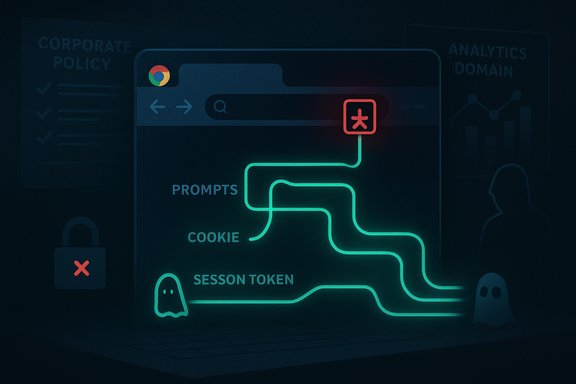
Researchers examined extension code that deploys per‑platform executor scripts — small JavaScript modules triggered only when a user visits a supported AI assistant or web app. These scripts are injected into the page context and wrap native networking APIs (notably fetch and XMLHttpRequest) so the extension sees plaintext prompts and responses before they are encrypted or after they are decrypted by the browser. Because the code runs inside the page, TLS offers no protection: the data is captured at the point of rendering. The captured payloads are then packaged and sent to background workers that compress and exfiltrate the data to analytics domains.Key technical points reproduced across multiple analyses:
- Page injection hooks fetch/XHR and intercept request/response bodies.
- Data flows from content script → window.postMessage → extension background worker → external analytics/C2 endpoints.
- Exfiltrated items include full prompts, assistant outputs, conversation IDs, timestamps, and sometimes cookies/localStorage items depending on permissions.
Proxy authentication hijack (Phantom Shuttle)
A separate but related technique abuses the webRequest onAuthRequired API to inject authentication credentials into HTTP authentication challenges. By prepending malicious payloads to otherwise legitimate libraries and forcing selected domain traffic through attacker proxies with hardcoded credentials, the extension effectively creates an on‑device proxy that can capture credentials and session tokens for high‑value sites. Socket’s investigators found this technique in extensions posing as VPN/proxy utilities and traced payment and C2 infrastructure associated with the campaign.Supply‑chain and developer account compromise
Some incidents appear to have begun with phishing attacks against developer accounts, permitting attackers to upload malicious updates directly to the Chrome Web Store under legitimate extension identities. Other cases involve publishers intentionally adding data‑harvesting behavior and burying notice in privacy policies. The common amplification vector is the Chrome/Edge auto‑update mechanism. Security teams observed malicious updates distributed broadly and silently, which turned trusted installs into telemetry collectors with no runtime opt‑out.Scope, scale and confidence in the numbers
Public reporting has used different metrics and produced varying totals, but several independent sources converge on a multi‑million potential reach for the broad campaigns:- GitLab Threat Intelligence identified at least 16 malicious Chrome extensions used in one cluster and estimated impact at ~3.2 million users.
- Independent trackers and media reported a broader set of compromised extensions numbering in the dozens, with combined store install counts often cited in the low millions (2–8 million range depending on the aggregation and time window).
- Koi Security’s ShadyPanda disclosure and follow‑ups documented clusters that, when combined, suggested millions of installs affected on Chrome and Edge — reporting that aggregate figures in some clusters approached 4.3 million. Public store install counts are used as proxies for exposure, but they are imperfect (they include inactive installs, multi‑device syncs, etc..
Real‑world impacts and high‑risk scenarios
The consequences of extension‑level exfiltration are immediate and material:- Credential theft and account takeover: Exfiltrated cookies, session tokens and authentication flows enable account takeover even when passwords and 2FA are present. Proxy‑level interception can capture HTTP auth challenges and cookies directly.
- Corporate data leakage: Employees routinely paste source code, API keys, corporate credentials and confidential text into AI assistants and web forms. Exfiltration of that content exposes trade secrets, PII and regulated data. Enterprise installs of extensions amplify impact.
- Patient and healthcare exposure: Reports explicitly flagged healthcare use cases where stolen session tokens and cookies could enable access to EHR portals and PHI — a sector with immediate regulatory consequences.
- Large‑scale privacy monetization: Harvested AI chats — containing intimate questions, legal drafts and personal health information — are high‑value for behavioral analytics, fraud and targeted social engineering. Multiple reports trace exfiltration to analytics backends and allege ties to data‑broker ecosystems. Those downstream commerce links are plausible but not exhaustively proven in public forensic artifacts to date.
What Windows users and IT administrators must do now
Short, prioritized remediation checklist for individuals and IT teams. These are practical, immediate steps designed to reduce exposure quickly.- Immediately review installed extensions in every Chrome and Edge profile and uninstall anything you don’t recognize — especially free VPNs, ad blockers or “browser guard” tools you installed casually. Pay special attention to the families named in recent disclosures.
- Rotate credentials and service tokens that may have been pasted into AI chats or entered while suspicious extensions were installed. Treat any secrets typed into suspect profiles as compromised until proven otherwise.
- Enforce multi‑factor authentication (MFA) and prefer hardware or platform passkeys where supported; consider Device‑Bound Session Credentials (DBSC) and similar vendor mitigations that tie session tokens to devices. Google has begun rolling device‑bound session protections to reduce token‑replay attacks.
- For managed Windows environments, implement an extension allowlist and blocklist via Group Policy or Intune (ExtensionInstallAllowlist / ExtensionInstallBlocklist). Do not rely on store takedowns to remediate already‑installed instances.
- Use separate browser profiles — at minimum: a locked‑down work profile with allowlisted extensions and a personal profile for lower‑risk browsing. Avoid installing general‑purpose “privacy” extensions in work profiles.
- Monitor outbound network traffic and DNS for connections to suspicious analytics domains mentioned in disclosures; block known C2/exfil endpoints at the network edge. Investigate unusual proxy configurations or onAuthRequired hooks.
- Require forced re‑consent for extensions that add or materially change data collection behaviors.
- Deploy runtime extension analysis that simulates visits to sensitive domains (AI assistants, banking, EHR) during store reviews and internal audits.
- Integrate extension hygiene into threat hunting and endpoint detection playbooks (scan chrome.storage.sync for persistent identifiers, check for unusual update timestamps).
Platform responsibility and recommended policy changes
The disclosures expose structural gaps in extension marketplace governance. Practical platform improvements that would reduce future abuse include:- Forced re‑consent / permission prompts when updates add host permissions or new data‑collection capabilities. Auto‑updates should not be able to change data‑handling guarantees without an explicit user or admin opt‑in.
- Dynamic, domain‑triggered runtime analysis in store review processes. Simulate visits to high‑risk domains (AI chat domains, financial portals, EHR systems) and instrument extension runtime hooks to detect page‑triggered exfiltration.
- Enterprise controls for sensitive domains, either via built‑in allowlists (prevent extensions from injecting into domains in a high‑risk class) or via managed policies that block extension activity on specific hostnames.
- Transparency and machine‑readable disclosures for high‑risk extension categories (VPNs, privacy tools, ad injectors) and mandatory periodic audits for extensions with large install bases.
Strengths of the public disclosures — and remaining blind spots
Strengths:- Multiple independent researchers reproduced the core technical findings (page injection, fetch/XHR hooking, exfiltration to analytics endpoints), increasing confidence in the technical story.
- Concrete indicators — extension IDs, update versions, analytics domains — allow defenders to triage and block at scale quickly.
- The incidents forced immediate action by store operators and public advisories, raising awareness of a latent but serious attack vector.
- Downstream buyers and exact monetization chains are less well documented in public forensic artifacts; claims about specific purchasers should be treated with caution until audit trails or legal disclosures are available.
- Active infections persist in installed profiles even after store takedowns; automated removal is not guaranteed and many users will remain exposed unless they actively uninstall.
- Attribution of operators is uncertain in many threads of reporting — while operational infrastructure and payment traces exist, conclusive ties to named threat actors or nation‑state groups require deeper forensic and law‑enforcement work.
Legal, regulatory and compliance considerations
Organizations must assume regulatory scrutiny where exfiltrated material contains personal data, health information, financial data or other regulated categories. Potential obligations include:- Notification under data breach laws (GDPR/CCPA equivalents) if personal data was reasonably likely to be accessed.
- Incident response and forensics to establish exposure scope and remediation timelines.
- Contractual breach assessments for third‑party SaaS and vendor environments where credentials or session tokens were exposed.
Final assessment and what to watch next
This class of extension abuse demonstrates a mature adversary model: weaponize trusted software, use auto‑update mechanisms for scale, and monetize harvested high‑value telemetry. The attack surface is not theoretical — multiple independent technical analyses reproduce the same core mechanics and provide actionable indicators for mitigation. What defenders should watch for in the coming months:- New copycat extensions using AI or VPN branding as cover. Expect bad actors to rapidly iterate on monetization models.
- Platform responses: look for tighter extension review rules, forced re‑consent mechanisms and enterprise APIs to block extension injections into sensitive domains.
- Evidence of downstream sales or misuse of harvested conversation logs — forensic and regulatory disclosures will be the definitive source to confirm those claims. Until such disclosures appear, treat downstream buyer claims as probable but not conclusively proven.
Actionable checklist (summary for Windows users and admins)
- Uninstall suspicious extensions now; check every profile.
- Rotate secrets and service tokens typed into AI chats or web forms.
- Enforce MFA/passkeys and consider device‑bound session protections where available.
- Apply extension allowlists and blocklists via GPO/Intune for managed devices.
- Monitor network egress for connections to known analytics/C2 domains and block suspicious endpoints.
The flood of recent disclosures is a watershed for how browser extension ecosystems are regulated and governed. Convenience and powerful APIs unlocked great productivity, but they also created a path for mass‑scale credential exfiltration and privacy harvesting. For Windows users, enterprises and platform operators alike, the imperative is clear: treat extension governance as first‑class security, audit installed code aggressively, and demand stronger marketplace controls that prevent a single malicious update from converting trust into wholesale data leakage.
Source: SC Media Illicit Chrome extensions facilitate widespread credential exfiltration
