

The surge of classroom talk about “AI tools” isn’t just a new homework helper — it’s a live experiment in how young people learn, judge information, and protect their privacy. Last week’s opinion in the Minnesota Daily warned students to be cautious when the AI bubble bursts, arguing that overreliance on flashy generative systems can leave learners exposed to misinformation, academic risk, and sudden market corrections. ols across the United States are now moving past panic and prohibition toward managed adoption of AI: pilot programs, teacher professional development, and carefully scoped classroom uses that emphasize evaluation, attribution, and ethics. Districts and state education offices have launched formal AI literacy initiatives that treat AI as a skill set — not a plug‑and‑play curriculum replacement — and stress prompt literacy, source verification, and human oversight as core competencies.
At the same time, cybersecurity researchers continue to uncover how generative assistants can be manipulated in ways that ordinary users — and students in particular — are unlikely to spot. In January 2026, security teams publicized a one‑click exploit against Microsoft Copilot Personal that allowed an attacker to use a manipulated URL to inject prompts and siphon data from an authenticated session. The vulnerability, labeled “Reprompt” by Varonis Threat Labs, was patched quickly, but it crystallized a persistent truth: AI’s convenience features often create new, unexpected attack surfaces.
This tension — earnest, beneficial classroom pilots on one side and brittle, evolving attack vectors on the other — is the practical hinge for the Minnesota Daily’s warning. Students need usable rules, and institutions need defensible policies, because the risks are both technical and social.
The editorial’s central point — that students should avoid uncritical dependency on generative AI while the market and tech continue to mature — rests on three interlocking realities:
Practical takeaways for graduates:
If the AI bubble bursts tomorrow, students who practiced verification, saved their sources, and used institutionally supported tools will not be the ones left scrambling — they will be the ones best prepared to adapt.
Source: The Minnesota Daily Opinion: Students need to be careful when the AI bubble bursts
At the same time, cybersecurity researchers continue to uncover how generative assistants can be manipulated in ways that ordinary users — and students in particular — are unlikely to spot. In January 2026, security teams publicized a one‑click exploit against Microsoft Copilot Personal that allowed an attacker to use a manipulated URL to inject prompts and siphon data from an authenticated session. The vulnerability, labeled “Reprompt” by Varonis Threat Labs, was patched quickly, but it crystallized a persistent truth: AI’s convenience features often create new, unexpected attack surfaces.
This tension — earnest, beneficial classroom pilots on one side and brittle, evolving attack vectors on the other — is the practical hinge for the Minnesota Daily’s warning. Students need usable rules, and institutions need defensible policies, because the risks are both technical and social.
 Why the Minnesota Daily is right to urge caution
The editorial’s central point — that students should avoid uncritical dependency on generative AI while the market and tech continue to mature — rests on three interlocking realities:- AI systems are rapidly changing. What is safe or reliable one month can be revised by vendor updates, patches, or feature removals the next.
- The business model incentives of many consumer AI services prioritize engagement and feature rollout over transparent, verifiable audit trails.
- Students are uniquely exposed: they often use mixed accounts (personal + school), share devices, and are still learning critical source‑evaluation habits.
Overview of the current K–12 AI adoption landscape
From bans to managed pilots
A year ago many districts reacted to ChatGPT and early public chatbots with blunt bans and plagiarism policing. In 2025–2026 the trend has shifted: more districts are launching guided pilots that pair teacher professional development with grade‑gated student access, tool inventories, and assessment redesign. These programs stress:- Professional development for teachers so they can model prompt design, verification, and ethical use.
- Procurement and privacy vetting of vendors and contracts.
- Redesign of assessments to value process, source logs, and reflective student work over a single deliverable.
Why literacy — not prohibition — is the dominant strategy
Education leaders increasingly view AI literacy as akin to media literacy: a set of lenses and practices that make students resilient against errors and manipulation. State education offices and nonprofit organizations are offering frameworks and trainings that treat AI as a tool for augmenting instruction while protecting equity and data privacy. These programs prioritize teacher ownership and ethical scaffolding rather than handing students unmoderated access.The technical wake‑up call: Reprompt and the limits of “convenience features”
The Reprompt discovery by Varonis Threat Labs is a compact case study in how convenience can become a vector for privacy erosion.What Reprompt did, in plain terms
Security researchers discovered that Copilot Personal accepted user prompts via a URL parameter (the “q” parameter). An attacker could craft a legitimate‑looking Copilot link that prefilled the assistant with a hidden instruction chain. When a user clicked that single link — even if they quickly closed the Copilot window — the attacker’s commands could run inside the user’s authenticated session and continue to request and exfiltrate data, step by step, without obvious indications to the user. This relied on three techniques researchers called P2P injection, a double‑request bypass, and chain‑request persistence. Microsoft patched the issue in January 2026 after responsible disclosure.Why students are especially vulnerable
- Students frequently click links in messages from classmates or email threads without checking for provenance.
- Mixed use of personal and school data (example: logged in to a personal Copilot while working on school documents) creates pivot points where a vulnerability in a consumer AI product can leak school information.
- Classroom settings can foster a low‑friction attitude toward tooling — teachers may encourage exploring new features, and students may feel pressure to adopt whatever boosts grades or speed.
The “AI bubble” framing: hype, market cycles, and what “bursting” might look like
When commentators talk about an “AI bubble,” they generally mean a market and cultural moment where expectations outpace underlying capabilities. Bubbles end in different ways:- A sharp market correction that deflates valuations and slows investment.
- A technology plateau where incremental improvements continue but revolutionary promises don’t materialize quickly.
- Regulatory pushback that constrains some business models until compliance is solved.
- Vendors may restrict free access, making formerly free study aids paywalled.
- Enterprise controls could be tightened, disabling consumer features (and leaving students who relied on them scrambling).
- A reputational backlash could cause educational institutions trict a given product in a short period, undermining the continuity of classroom plans.
What students should do now: practical, defensible habits
Students don’t need to be LLM engineers to be safe and responsible users. Below are specific, short‑term practices that make a measurable difference.Immediate habits (daily)
- Always treat AI output as draft material. Verify facts separately, cite original sources, and annotate where you used AI assistance.
- Use separate accounts: don’t mix personal AI profiles with school accounts that access institutional files.
- Never paste or upload personally identifying or school‑sensitive data into public AI services.
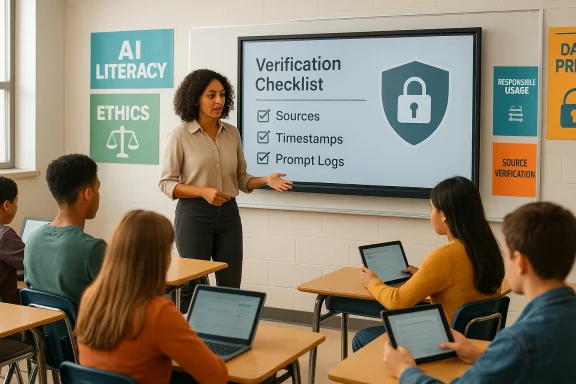
Verification checklist (every time you use AI for research)
- Ask: Is this claim verifiable by a primary source? If yes, find and record that primary source.
- Cross‑check: Use at least two independent sources for core facts or statistics.
- Timestamp: Record the date you asked the AI and include it in notes for assignments — AI knowledge cutoffs and model updates matter.
Security hygiene for links and deep features
- Don’t click deep Copilot/assistant links from untrusted sources; hover to inspect link behavior.
- If your device is managed by school IT, report unexpected prompts or tabs to IT rather than attempting to “fix” them yourself.
What schools and IT teams must do (beyond training students)
Students cannot carry the full burden of risk mitigation. Districts must do the heavy lifting in five areas:- Procurement and contract hygiene: insist on clear data‑use terms, auditability, and breach notification clauses.
- Managed access: where possible, provide education‑specific AI instances that keep data within the school’s control and offer admin audit trails.
- Device policy clarity: define when and how Copilot/assistant features are allowed on managed devices, and provide a supported “sandbox” for experimentation.
- Incident response playbooks: include AI‑specific checks in phishing and compromise SOPs.
- Assessment redesign: adjust rubrics to value documented process and source validation, making it harder to game an assignment with a blunt AI output.
Academic integrity and the ethics of AI use
Warnings about “cheating” are common, but ethical AI use is broader than enforcement. Good policy distinguishes:- Unauthorized outsourcing (passing off AI output as original work).
- Legitimate augmentation (using AI for drafting and then critically editing and sourcing).
- Misuse that harms privacy or safety (e.g., asking an assistant to locate private student records or to synthesize personal data in ways that expose third parties).
Employer and labor-market realities — why the Minnesota Daily’s bubble worry matters beyond campus
Students are right to be mindful of the labor market. Employers are rapidly adopting AI in workflows, but adoption is uneven and skill signals can be ephemeral. If students rely on a proprietary workflow that disappears when a vendor pivots or a bubble cools, they may find that the credential they thought they had — mastery of a particular assistant’s quirks — doesn’t translate.Practical takeaways for graduates:
- Prioritize transferable skills: critical thinking, data literacy, and domain knowledge remain the core assets employers value.
- Learn multiple tools and fundamentals (e.g., prompt engineering principles, not just one vendor’s interface).
- Keep records of your problem‑solving process so you can demonstrate real understanding during interviews and on the job.
Policy and regulation: external forces that will shape the next phase
Regulators are paying attention. States and education agencies are issuing guidance that emphasizes privacy, bias mitigation, and human oversight. These policies are likely to produce a patchwork of rules — meaning vendors, districts, and students could face different constraints depending on jurisdiction. For students, the practical implication is the same: assume change and preserve por and data.Strengths and limitations of the Minnesota Daily argument — a critical assessment
Notable strengths
- The piece is timely: it connects classroom practice to real exploits and market dynamics.
- It centers student responsibility while implicitly acknowledging institutional roles — a balanced approach that avoids blame.
- It calls for sober reflection, not moral panic, which is constructive in an educational context.
Potential blind spots and risks
- Overemphasizing individual caution can let institutions off the hook. Students can only do so much when the platforms they use are poorly designed for privacy.
- The opinion leans heavily on the bubble metaphor, which risks conflating market cycles with technical safety. Even if valuations cool, security and privacy issues remain urgent.
- It could understate equity issues: students without reliable alternative study aids, or those with limited access to vetted educational AI, may be unfairly penalized by restrictive school policies.
Recommendations: a practical roadmap for the next 12 months
For students- Adopt the verification checklist and the immediate habits above.
- Keep clean separation of accounts and devices.
- When in doubt, ask your instructor and document your process.
- Run short, documented pilots that prioritize teacher PD and measurable outcomes.
- Design assignments that reward process and citation, and require prompt transparency.
- Require vendor contracts to provide data‑handling assurances and audit logs.
- Provide managed, education‑grade AI instances where possible (or alternatives with local data control).
- Ensure patch management and endpoint controls that can disable risky consumer features on managed devices.
- Publish clear guidance for parents and students about AI usage in classrooms.
- Fund teacher professional development in AI literacy and assessment design.
Conclusion
The Minnesota Daily’s plea for student caution is a useful corrective: generative AI is powerful and promising, but it is not an infallible allyhows that seemingly benign convenience features can create real and stealthy privacy risks. The right response is neither wholesale rejection nor naive adoption. Instead, schools should pair responsible access with rigorous literacy, and students should pair practical caution with documented process. That combination preserves the pedagogical benefits of AI while protecting learners from the sudden shocks that come with shifting markets, emergent vulnerabilities, and changing vendor practices.If the AI bubble bursts tomorrow, students who practiced verification, saved their sources, and used institutionally supported tools will not be the ones left scrambling — they will be the ones best prepared to adapt.
Source: The Minnesota Daily Opinion: Students need to be careful when the AI bubble bursts
