

Manchester University NHS Foundation Trust’s decision to expand Microsoft’s AI tools is best understood as more than another software rollout. It signals a deeper shift in how one of England’s largest NHS trusts wants to run clinical and corporate operations, with ambient voice technology, Microsoft 365 Copilot, and newly formalised AI agent development now moving from pilots into broader deployment. The move comes at a moment when NHS England is actively backing AI notetaking and ambient scribing as a way to free up clinician time, making Manchester’s announcement look less like an isolated experiment and more like an early test case for a model other trusts may follow.
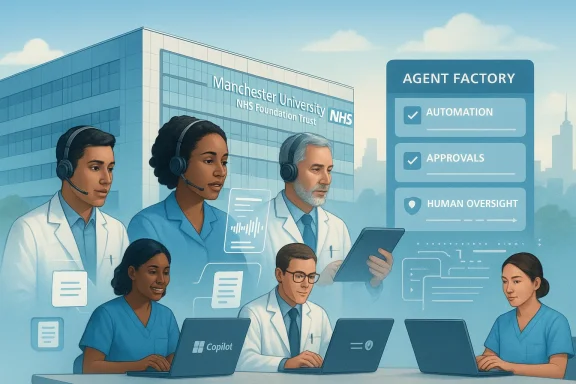
The Manchester trust’s latest phase builds on roughly 18 months of work with Microsoft, during which staff began using Dragon Copilot and Microsoft 365 Copilot in selected areas. According to Microsoft, hundreds of clinicians have already used Dragon Copilot ambient voice tools, while around 1,500 Microsoft 365 Copilot licences were previously issued to staff. The trust now plans to widen access and establish an “Agent Factory” to help teams build automation for routine tasks across services.
That matters because healthcare AI adoption in the UK has moved from abstract promise to operational policy. NHS England published guidance and a supplier registry for ambient voice technologies in January 2026, explicitly framing the category as a way to save clinicians a few minutes per consultation and return time to patient care. In other words, the Manchester announcement lands in a policy environment that is already more permissive, more structured, and more ambitious than it was even a year ago.
The trust is also unusually large and operationally complex, which makes it a meaningful proving ground. Manchester University NHS Foundation Trust runs multiple hospitals and a wide range of corporate and frontline services, so even modest efficiency gains can scale into large workforce impacts. That scale is exactly why the trust’s leadership has been talking about responsible rollout, human oversight, and the need to reinvest saved time into direct care rather than merely extracting more output from overstretched staff.
There is also a broader competitive story here. Microsoft has been steadily building a healthcare AI stack that spans clinical documentation, productivity software, and workflow automation. The company’s own public materials describe Dragon Copilot as combining speech capabilities with generative AI, while external healthcare partners continue to showcase the same value proposition: less admin, faster documentation, and more face time with patients. Manchester is now moving beyond basic copilots toward a model where staff can build their own agents for operational work.
The trust’s leadership is also making a strategic argument that goes beyond convenience. Mark Cubbon has framed the collaboration as a way to streamline administrative work, reduce human error in high-volume tasks, and reinvest capacity into patient care. That is a familiar healthcare technology pitch, but it becomes more persuasive when tied to specific use cases like HR queries, finance forecasting, and recruitment workflows. The promise is not just speed; it is reallocation of scarce staff attention.
That scale also changes the economics of the project. Small productivity gains can compound quickly in a trust of this size, especially in back-office operations where repetitive tasks dominate. But scale cuts both ways, because any error, bias, or workflow weakness can also spread faster once AI becomes embedded in daily routines. This is where the governance question becomes central rather than optional.
Even so, adoption will depend on whether staff actually experience the tools as useful. A system that promises to save time but adds verification burden, workflow friction, or poor integration will quickly lose credibility. In healthcare, perceived usefulness is not a soft metric; it is often the difference between permanent uptake and quiet abandonment.
This is important because Copilot in a healthcare trust is not a clinical decision engine. It is an augmentation layer for email, document drafting, meeting summaries, and information retrieval. That means its biggest value may not be dramatic but cumulative, shaving minutes from dozens of small tasks rather than minutes from a single heroic workflow. In a stretched organisation, that can still be transformative.
The upside is not just speed but consistency. Corporate teams often spend a surprising amount of time formatting documents, collating updates, and rewriting information into new templates for different audiences. Copilot can standardise the first draft, leaving humans to check, edit, and approve. That is a meaningful change, even if it sounds mundane.
It is also why deployment quality matters as much as licensing volume. A broad roll-out with poor training can create hidden risk, because staff may assume the tool is more reliable than it really is. The real win is not ubiquity; it is disciplined, informed use.
This matters because ambient voice technology is becoming one of the clearest, most tangible healthcare AI use cases. Instead of forcing clinicians to type notes after consultations, the software listens, drafts structured notes, and lets the clinician verify the result. NHS England’s January guidance and supplier registry suggest the technology is moving from novelty to supported category, with explicit attention to safety, data protection, and expected time savings.
But the difference between promise and actual impact remains substantial. Ambient systems vary in accuracy by accent, environment, specialty, and conversation style. They also depend on clinician trust, because a note that must be heavily corrected can erase the hoped-for efficiency gain.
Still, the operational details will decide whether the system becomes part of everyday practice. Documentation quality, template fit, turnaround time, and integration with existing clinical systems will all shape adoption. A good ambient product can feel invisible; a bad one becomes another item on the cognitive to-do list.
This is a significant organisational shift. Copilot as a personal assistant helps individuals work faster; an agent factory tries to remodel workflows themselves. That is a much more ambitious proposition because it affects process design, governance, and departmental accountability at the same time. In effect, the trust is trying to industrialise routine decision support.
That approach reflects a broader enterprise trend. Organisations increasingly want AI that can do narrow, repeated tasks inside clearly defined boundaries rather than open-ended chatbots that sound clever but are hard to trust. In a healthcare trust, that preference is not just sensible; it is necessary.
It also suggests a deeper cultural change. Staff are not simply consumers of AI; they become co-designers of it. That can improve fit and acceptance, but only if the organisation invests in training and avoids turning frontline teams into unpaid software testers.
In healthcare, governance is more than a compliance checklist. It is the mechanism that protects both patients and staff from avoidable harm. The trust’s reference to human-in-the-loop protections is consistent with NHS England’s wider guidance around ambient voice tools, which emphasises clinical safety, technology controls, and data protection.
There is also an important reputational dimension. If Manchester demonstrates that AI can be deployed with strong safeguards in a demanding clinical environment, it strengthens the case for wider NHS adoption. If it stumbles, the opposite will be true. This is why governance is part of the product, not merely a box to tick.
That kind of maturity is difficult to build quickly, but the trust’s phased rollout suggests it understands the stakes. The question is whether scale can be matched by oversight at the same pace.
That distinction is important. A national deal would imply centralised buying power and standardised rollout. A trust-level expansion, by contrast, shows that individual organisations are already willing to commit budget and leadership attention without waiting for a single umbrella contract. In practice, that may prove more realistic in a fragmented NHS procurement landscape.
For rivals, the challenge is not just matching functionality. They must match trust, integration depth, governance assurances, and the ability to fit into NHS working patterns. That is a higher bar than a polished demo.
That is a notable shift. The debate is no longer whether AI belongs in healthcare administration at all; it is about what level of automation, what degree of oversight, and what kinds of tasks should be allowed first.
That difference explains why the initial use cases are not identical. Finance forecasting, HR queries, and recruitment are safer places to test automation because the consequences of errors are easier to catch and correct. Clinical documentation demands far greater care, but it also touches the core of the clinician experience. If the tooling saves time without reducing quality, that is a powerful combination.
The risk is complacency. A successful HR or finance pilot can create the impression that all AI use cases will be equally straightforward, when frontline and clinical scenarios are much more sensitive. The governance lessons from corporate work should inform clinical adoption, not be assumed to transfer automatically.
Yet frontline adoption will remain fragile unless staff trust the output. Clinicians will not use a tool that forces them to retype, over-correct, or second-guess every transcript. The user experience must feel like leverage, not surveillance.
Microsoft is also benefiting from timing. The company’s healthcare messaging arrives as NHS England itself is validating ambient voice as a category and encouraging organisations to adopt it safely. That kind of policy alignment gives Microsoft a stronger story than a vendor pushing innovation into a vacuum.
It also helps Microsoft compete on organisational fit, not just features. In healthcare, features are necessary but not sufficient. Buyers want vendor support, admin controls, auditability, and the confidence that the tools can be managed within an existing enterprise estate.
This is where smaller vendors often struggle. They may lead on one dimension, such as documentation quality or specialty-specific workflows, but lose ground when an NHS trust wants a unified platform that covers office productivity, clinical capture, and agent automation. In that sense, Manchester’s move is also a market consolidation signal.
Over the coming months, the most important signals will be practical ones: how quickly the added licences are activated, how widely agents are used, whether frontline clinicians keep trusting ambient documentation, and whether the trust can show time savings without hidden downstream costs. If those things hold, Manchester could become one of the NHS’s most influential reference sites for responsible AI adoption.
Source: Home | Digital Health Manchester trust to expand use of Microsoft's AI tools
 Background
The Manchester trust’s latest phase builds on roughly 18 months of work with Microsoft, during which staff began using Dragon Copilot and Microsoft 365 Copilot in selected areas. According to Microsoft, hundreds of clinicians have already used Dragon Copilot ambient voice tools, while around 1,500 Microsoft 365 Copilot licences were previously issued to staff. The trust now plans to widen access and establish an “Agent Factory” to help teams build automation for routine tasks across services.That matters because healthcare AI adoption in the UK has moved from abstract promise to operational policy. NHS England published guidance and a supplier registry for ambient voice technologies in January 2026, explicitly framing the category as a way to save clinicians a few minutes per consultation and return time to patient care. In other words, the Manchester announcement lands in a policy environment that is already more permissive, more structured, and more ambitious than it was even a year ago.
The trust is also unusually large and operationally complex, which makes it a meaningful proving ground. Manchester University NHS Foundation Trust runs multiple hospitals and a wide range of corporate and frontline services, so even modest efficiency gains can scale into large workforce impacts. That scale is exactly why the trust’s leadership has been talking about responsible rollout, human oversight, and the need to reinvest saved time into direct care rather than merely extracting more output from overstretched staff.
There is also a broader competitive story here. Microsoft has been steadily building a healthcare AI stack that spans clinical documentation, productivity software, and workflow automation. The company’s own public materials describe Dragon Copilot as combining speech capabilities with generative AI, while external healthcare partners continue to showcase the same value proposition: less admin, faster documentation, and more face time with patients. Manchester is now moving beyond basic copilots toward a model where staff can build their own agents for operational work.
Why Manchester Matters
Manchester is not a small pilot site tinkering at the edges. It is one of England’s biggest trusts, which means any successful productivity model could influence policy discussions, procurement decisions, and implementation expectations across the NHS. When a trust of this size says AI is beginning to reduce administrative time, others listen. That is especially true when the message is attached to a named enterprise agreement and a multi-year rollout rather than a one-off experiment.The trust’s leadership is also making a strategic argument that goes beyond convenience. Mark Cubbon has framed the collaboration as a way to streamline administrative work, reduce human error in high-volume tasks, and reinvest capacity into patient care. That is a familiar healthcare technology pitch, but it becomes more persuasive when tied to specific use cases like HR queries, finance forecasting, and recruitment workflows. The promise is not just speed; it is reallocation of scarce staff attention.
Scale as Strategy
At Manchester, scale is the point. The trust says its new enterprise agreement will add 6,500 Microsoft Copilot licences each year for three years, covering all corporate staff and about 1,600 frontline staff. In practical terms, that means AI is no longer confined to tech-savvy teams or a handful of early adopters; it becomes a workforce layer.That scale also changes the economics of the project. Small productivity gains can compound quickly in a trust of this size, especially in back-office operations where repetitive tasks dominate. But scale cuts both ways, because any error, bias, or workflow weakness can also spread faster once AI becomes embedded in daily routines. This is where the governance question becomes central rather than optional.
- Large trusts can realise bigger cumulative gains from modest time savings.
- Corporate functions are often the easiest place to prove value first.
- Frontline adoption raises the bar for safety, usability, and trust.
- Repeated tasks are the clearest candidates for automation.
- Operational scale makes standardisation both attractive and risky.
The Human Case
The trust’s narrative is carefully built around staff relief rather than staff replacement. That distinction matters in an NHS environment where workforce pressure, burnout, and administrative overload are persistent themes. AI that can reduce typing, summarisation, triage, and repetitive query handling is easier to defend than AI that appears to be substituting for professional judgment.Even so, adoption will depend on whether staff actually experience the tools as useful. A system that promises to save time but adds verification burden, workflow friction, or poor integration will quickly lose credibility. In healthcare, perceived usefulness is not a soft metric; it is often the difference between permanent uptake and quiet abandonment.
The Copilot Expansion
The expansion of Microsoft 365 Copilot is arguably the most visible part of the announcement because it touches a broad range of office work. The new deal gives the trust significantly more licences over the next three years, with access extended to all corporate staff and selected frontline staff. Microsoft says the trust has already seen enough impact to justify scaling rather than waiting for a more conventional end-state review.This is important because Copilot in a healthcare trust is not a clinical decision engine. It is an augmentation layer for email, document drafting, meeting summaries, and information retrieval. That means its biggest value may not be dramatic but cumulative, shaving minutes from dozens of small tasks rather than minutes from a single heroic workflow. In a stretched organisation, that can still be transformative.
What Copilot Can Actually Do
The practical appeal lies in reducing friction in routine knowledge work. Staff can draft responses, summarise notes, extract themes from documents, and organise information more quickly than they would using manual methods alone. In a trust the size of Manchester, those tasks are spread across HR, finance, governance, programme management, and service leadership.The upside is not just speed but consistency. Corporate teams often spend a surprising amount of time formatting documents, collating updates, and rewriting information into new templates for different audiences. Copilot can standardise the first draft, leaving humans to check, edit, and approve. That is a meaningful change, even if it sounds mundane.
- Drafting routine communications faster
- Summarising meetings and lengthy documents
- Reformatting information for reports and updates
- Retrieving relevant information more quickly
- Reducing repetitive copy-and-paste work
The Limits of the Model
There is a danger, however, in overestimating what a productivity copilot can safely do in a regulated healthcare environment. Copilot can assist with content generation, but it cannot be allowed to become a substitute for accuracy checks, policy compliance, or sensitive judgment. That is why the trust’s emphasis on safeguards and human oversight is so important.It is also why deployment quality matters as much as licensing volume. A broad roll-out with poor training can create hidden risk, because staff may assume the tool is more reliable than it really is. The real win is not ubiquity; it is disciplined, informed use.
Dragon Copilot and Clinical Workflow
The clinical side of the story is driven by Dragon Copilot, Microsoft’s AI clinical assistant that combines ambient voice capture and documentation support. Microsoft says the tool helps clinicians streamline clinical documentation, surface information, and automate tasks, while Manchester clinicians have already been using it in real settings. The trust’s cardiology and other clinical teams have been featured in Microsoft’s own reporting as early adopters.This matters because ambient voice technology is becoming one of the clearest, most tangible healthcare AI use cases. Instead of forcing clinicians to type notes after consultations, the software listens, drafts structured notes, and lets the clinician verify the result. NHS England’s January guidance and supplier registry suggest the technology is moving from novelty to supported category, with explicit attention to safety, data protection, and expected time savings.
Why Ambient Voice Is Different
Ambient voice is more politically and operationally acceptable than many other forms of healthcare AI because it works as a documentation assistant rather than an autonomous decision-maker. That makes it easier to position as productivity infrastructure rather than clinical automation. It also aligns with a broader NHS desire to reduce clerical burden without compromising professional accountability.But the difference between promise and actual impact remains substantial. Ambient systems vary in accuracy by accent, environment, specialty, and conversation style. They also depend on clinician trust, because a note that must be heavily corrected can erase the hoped-for efficiency gain.
What Could Improve
If used well, the benefits could be meaningful. Clinicians may spend more time making eye contact, less time toggling between screens, and fewer late evenings catching up on notes. The trust and Microsoft both stress that this is about time back, not just technology for its own sake.Still, the operational details will decide whether the system becomes part of everyday practice. Documentation quality, template fit, turnaround time, and integration with existing clinical systems will all shape adoption. A good ambient product can feel invisible; a bad one becomes another item on the cognitive to-do list.
- Less typing after consultations
- Faster note drafting and letter generation
- Potentially better patient attention during visits
- Reduced after-hours documentation pressure
- More consistent clinical summaries
The Agent Factory
The most forward-looking part of the Manchester announcement is the proposed Agent Factory. That phrase suggests the trust wants to move beyond passive AI tools toward a controlled environment where staff can design and deploy agents that automate routine operational tasks. The initial examples already mentioned include finance forecasting, HR query handling, and recruitment support.This is a significant organisational shift. Copilot as a personal assistant helps individuals work faster; an agent factory tries to remodel workflows themselves. That is a much more ambitious proposition because it affects process design, governance, and departmental accountability at the same time. In effect, the trust is trying to industrialise routine decision support.
From Copilot to Agents
Agentic AI in this setting should not be confused with a free-roaming autonomous system. The trust says human-in-the-loop protections will remain in place, which is essential if agents are touching information governance, finance, or recruitment processes. The real model is one of constrained automation under supervision.That approach reflects a broader enterprise trend. Organisations increasingly want AI that can do narrow, repeated tasks inside clearly defined boundaries rather than open-ended chatbots that sound clever but are hard to trust. In a healthcare trust, that preference is not just sensible; it is necessary.
Why the Factory Idea Matters
The phrase “agent factory” implies repeatability and internal capability building. Instead of buying isolated automation products for each department, the trust is trying to create a shared way to identify, build, test, and deploy use cases. That can lower long-term costs and speed up experimentation if the governance is strong enough.It also suggests a deeper cultural change. Staff are not simply consumers of AI; they become co-designers of it. That can improve fit and acceptance, but only if the organisation invests in training and avoids turning frontline teams into unpaid software testers.
- Internal use-case development
- Department-level automation experiments
- Governed deployment pipelines
- Human oversight and approvals
- Reusable patterns across services
Training, Governance, and Safety
Manchester’s rollout is not being presented as a purely technical exercise. The trust says it is investing in training and development to build confidence and ensure responsible use of AI-enabled tools. That is a crucial part of the story, because the best enterprise AI systems still fail if the workforce does not understand what the tools are for, where they are weak, and when they should be ignored.In healthcare, governance is more than a compliance checklist. It is the mechanism that protects both patients and staff from avoidable harm. The trust’s reference to human-in-the-loop protections is consistent with NHS England’s wider guidance around ambient voice tools, which emphasises clinical safety, technology controls, and data protection.
Responsible Use as a Competitive Advantage
A well-governed rollout can actually increase adoption because it lowers anxiety. Staff are more likely to engage with a tool when they know who is accountable for its outputs and how exceptions are handled. That is especially true in a trust where frontline teams may already be wary of technology that feels imposed from above.There is also an important reputational dimension. If Manchester demonstrates that AI can be deployed with strong safeguards in a demanding clinical environment, it strengthens the case for wider NHS adoption. If it stumbles, the opposite will be true. This is why governance is part of the product, not merely a box to tick.
What Good Governance Likely Requires
A credible AI governance framework in a trust like this would need more than policy language. It would need role-based access, audit trails, clear escalation routes, and well-defined boundaries for data use. It would also need recurring review as tools, models, and regulatory expectations evolve.That kind of maturity is difficult to build quickly, but the trust’s phased rollout suggests it understands the stakes. The question is whether scale can be matched by oversight at the same pace.
National NHS Implications
The Manchester story is attracting attention partly because it sits alongside speculation about a possible wider NHS relationship with Microsoft. Digital Health reported talk in the sector about a national deal for ambient voice technology, though Microsoft has denied those rumours. Even without that national arrangement, the Manchester deployment can still act as a reference point for other trusts evaluating similar procurements.That distinction is important. A national deal would imply centralised buying power and standardised rollout. A trust-level expansion, by contrast, shows that individual organisations are already willing to commit budget and leadership attention without waiting for a single umbrella contract. In practice, that may prove more realistic in a fragmented NHS procurement landscape.
Procurement Pressure and Market Signals
The announcement also reinforces Microsoft’s position in a crowded healthcare AI market. Vendors offering ambient documentation, AI copilots, and workflow automation are racing to establish themselves as safe, approved, and integrated options for NHS buyers. Once a large trust visibly expands an enterprise agreement and names specific deployment areas, that becomes a commercial signal as much as an operational one.For rivals, the challenge is not just matching functionality. They must match trust, integration depth, governance assurances, and the ability to fit into NHS working patterns. That is a higher bar than a polished demo.
A Model Others May Copy
Manchester’s approach is likely to influence other organisations in at least three ways. First, it normalises the idea that copilot-style tools are part of the corporate standard kit. Second, it gives ambient voice technology a more concrete NHS workflow identity. Third, it pushes the conversation toward agentic automation inside controlled enterprise environments.That is a notable shift. The debate is no longer whether AI belongs in healthcare administration at all; it is about what level of automation, what degree of oversight, and what kinds of tasks should be allowed first.
- More NHS trusts may replicate the model
- Procurement teams will compare governance as well as price
- Vendor competition will intensify around ambient AI
- Central policy may increasingly follow local success
- Clinical and corporate AI will be judged together
Enterprise vs Frontline Impact
The trust’s deployment splits naturally into two worlds: corporate services and frontline care. In corporate teams, Copilot and agents can target repetitive administrative tasks where the return on investment is relatively easy to measure. In frontline settings, the promise is subtler but potentially more valuable, because even a few reclaimed minutes in a clinical consultation can improve patient flow and reduce pressure on staff.That difference explains why the initial use cases are not identical. Finance forecasting, HR queries, and recruitment are safer places to test automation because the consequences of errors are easier to catch and correct. Clinical documentation demands far greater care, but it also touches the core of the clinician experience. If the tooling saves time without reducing quality, that is a powerful combination.
Corporate Services: Easier Wins, Faster Feedback
Corporate teams usually have clearer processes, better-defined workflows, and more repeated tasks than some clinical departments. That makes them ideal for AI experimentation because success can be measured in turnaround times, reduced ticket volume, or fewer manual handoffs. It also means the trust can learn quickly before extending more ambitious use cases.The risk is complacency. A successful HR or finance pilot can create the impression that all AI use cases will be equally straightforward, when frontline and clinical scenarios are much more sensitive. The governance lessons from corporate work should inform clinical adoption, not be assumed to transfer automatically.
Frontline Care: Higher Stakes, Higher Value
Frontline impact is harder to quantify and harder to govern, but potentially more meaningful. If ambient voice tools genuinely reduce documentation burden in clinics, the effect can cascade through appointment lengths, clinician fatigue, and patient experience. That is why NHS England’s support for ambient voice technology is so important: it offers a policy umbrella that trusts can lean on while still making local decisions.Yet frontline adoption will remain fragile unless staff trust the output. Clinicians will not use a tool that forces them to retype, over-correct, or second-guess every transcript. The user experience must feel like leverage, not surveillance.
- Corporate AI is easier to standardise
- Clinical AI requires tighter safeguards
- Frontline adoption depends on trust
- Time savings must be visible to staff
- Patient experience remains the ultimate test
Competitive Context for Microsoft
For Microsoft, the Manchester expansion is strategically useful because it showcases a full-stack healthcare AI narrative. The company can point to clinician-facing ambient technology, broad productivity licences, and custom agent creation under one partnership umbrella. That breadth is important in a market where buyers increasingly prefer platforms that do several things well rather than point products that solve only one problem.Microsoft is also benefiting from timing. The company’s healthcare messaging arrives as NHS England itself is validating ambient voice as a category and encouraging organisations to adopt it safely. That kind of policy alignment gives Microsoft a stronger story than a vendor pushing innovation into a vacuum.
Why the Platform Story Is Strong
The platform narrative matters because it suggests integration rather than fragmentation. A trust that already uses Microsoft identity, collaboration tools, and productivity software may find it easier to extend into Copilot and Dragon Copilot than to stitch together multiple vendors with different governance models. That kind of internal coherence is extremely attractive to public-sector buyers.It also helps Microsoft compete on organisational fit, not just features. In healthcare, features are necessary but not sufficient. Buyers want vendor support, admin controls, auditability, and the confidence that the tools can be managed within an existing enterprise estate.
The Rival Challenge
Competitors now face a higher bar. To displace Microsoft, they need to show not only clinical accuracy but also enterprise credibility and rollout maturity. That includes procurement compatibility, information governance, and the ability to scale across departments without creating a maze of disconnected tools.This is where smaller vendors often struggle. They may lead on one dimension, such as documentation quality or specialty-specific workflows, but lose ground when an NHS trust wants a unified platform that covers office productivity, clinical capture, and agent automation. In that sense, Manchester’s move is also a market consolidation signal.
- Platform breadth is becoming a differentiator
- Integration beats isolated point solutions
- NHS buyers want governance built in
- Vendor scale matters in public procurement
- Multi-use AI estates are easier to justify
Strengths and Opportunities
The strongest part of this story is that it is grounded in actual operational use, not hype. Manchester is already seeing enough value from Copilot and Dragon Copilot to justify wider rollout, and it is pairing that with training, safeguards, and internal capability building. That combination gives the trust a better chance of turning AI from a pilot program into durable infrastructure.- Time savings in administration and documentation
- Better clinician focus during patient encounters
- Reduced repetitive work in HR and finance
- Stronger internal capability through the Agent Factory
- Improved consistency in routine tasks
- Scalable learning across a large trust
- Better alignment with NHS-wide AI policy
Risks and Concerns
The risks are equally real, and they start with overpromising. AI can reduce administrative friction, but it can also create new review burdens, new failure modes, and new dependency on vendor tooling. If staff feel the system adds complexity rather than removing it, adoption will stall.- Accuracy errors in clinical or corporate outputs
- Hidden review burden that offsets time savings
- Data governance concerns around sensitive information
- Uneven staff adoption due to training gaps
- Vendor lock-in if workflows become too dependent
- Overconfidence in automation without sufficient human oversight
- Cultural resistance if tools feel imposed rather than co-designed
Looking Ahead
The next test is whether Manchester can turn a strong announcement into measurable operational change. The trust has the advantage of a clear policy tailwind, a large internal workforce, and an existing relationship with Microsoft. But the real proof will come from whether staff actually experience the promised gains in daily work, not from how impressive the rollout sounds in a press release.Over the coming months, the most important signals will be practical ones: how quickly the added licences are activated, how widely agents are used, whether frontline clinicians keep trusting ambient documentation, and whether the trust can show time savings without hidden downstream costs. If those things hold, Manchester could become one of the NHS’s most influential reference sites for responsible AI adoption.
- Licence uptake and active usage
- Clinical accuracy and correction rates
- Staff satisfaction after training
- Evidence of time returned to care
- Governance performance under real workloads
Source: Home | Digital Health Manchester trust to expand use of Microsoft's AI tools
