

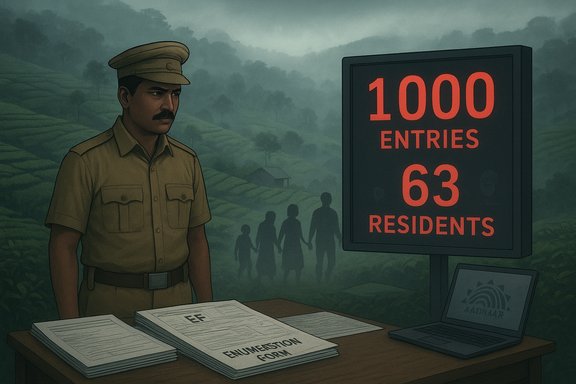
A startling electoral anomaly reported from the Manjolai hills has exposed a fault line in India’s voter-list revision exercise: an article alleges that over 1,000 voter enumeration forms were uploaded for the Maanjolai tea estate area even though only 63 persons currently live there, triggering formal petitions from a major political party and a notice to a Booth Level Officer (BLO). This discrepancy — if accurate — would not be an isolated administrative slip but a textbook example of how weaknesses in enumeration processes, notional addresses, and the large-scale Special Intensive Revision (SIR) drives can be weaponized to create “ghost” or bulk-added voters that distort electoral rolls and undermine public confidence. The reporting also situates this incident in a wider context: Manjolai’s tea estate population has been shrinking after estate operations wound down, and the community’s precarious status has already drawn administrative and human-rights attention. The combination of a high-stakes revision, a vulnerable displaced population, and aggressive add/delete activity on voter lists makes this episode especially consequential.
Background / Overview
Manjolai — a cluster of hill tea estates including Manjolai, Oothu, Naalumukku and Kakachi in Tirunelveli district — has long been shaped by plantation economy dynamics. Recent years have seen a contraction in on-hill employment as estate operations slowed, prompting many families to migrate to plains settlements. Media reporting and activist interventions document the deep social impact of this unwinding: calls for the state to take over estate lands, NHRC complaints about forced shifting of families, and sustained public interest in the fate of estate workers. These broader developments are critical for understanding why a voter-roll anomaly in Manjolai has immediate political and human-rights significance. At a national level, the Election Commission’s Special Intensive Revision (SIR) programs — designed to refresh and verify elector details through door-to-door enumeration and pre-filled enumeration forms (EFs) — have been rolled out in waves across states. The SIR model entrusts local officials, notably Booth Level Officers (BLOs), with physically distributing and collecting enumeration forms; it also permits online submissions and uses a mix of paper-based and digital checks to match electors against earlier lists. While SIR is intended to improve roll hygiene, the scale and speed of these campaigns create operational vulnerabilities that bad actors — or simply negligent processes — can exploit.What was reported in Manjolai
- The central allegation, as reported, is that during the SIR exercise in the Maanjolai tea estate area, over 1,000 enumeration forms were submitted and uploaded by the booth system for booths that serve the erstwhile estate settlements — at a time when the actual resident population of those quarters is reported at 63 persons. The political fallout included a formal petition from the AIADMK to local administration and electoral officers, and a subsequent administrative notice asking the named BLO to explain how such uploads occurred.
- Authorities have sought explanation from the Booth Level Officer (identified in reporting by name) over alleged “bulk” or “fake enumeration forms,” and local election officials demanded a response within a specified timeframe.
How enumeration and BLO procedures work — and where failures occur
The SIR and enumeration mechanics
The Special Intensive Revision (SIR) is a large-scale operation that involves:- Pre-printing and issuing elector-specific Enumeration Forms (EFs) to every elector in a designated area.
- Deploying Booth Level Officers (BLOs) to conduct house-to-house distribution, assist electors in filling forms, and collect completed forms for digitisation and upload.
- Allowing online submission via the Election Commission’s portal and using Aadhaar authentication mechanisms where applicable for verification and linking.
- Publishing draft rolls and a claims-and-objections period before finalisation.
Typical safeguards
Designed safeguards include:- Pre-filled EFs that reduce manual entry errors and make bulk fraud more visible.
- Repeated home visits (BLOs instructed to attempt multiple times if a house is locked).
- Appointment of party-nominated Booth Level Agents (BLAs) who monitor and can raise objections.
- A claims and objections window that allows parties and electors to challenge additions or deletions.
Common operational failures and abuse vectors
Despite safeguards, several failure modes are commonly observed and were evident in other SIR implementations:- BLOs distributing or collecting forms in public places or through intermediaries, rather than conducting door-to-door verification, creates opportunities for assembling batches of forms without household verification. Complaints from other states have documented forms distributed at tea stalls, clubs, or handed en masse to migrants — practices that violate the spirit of home verification.
- Use of notional addresses or filling address fields with standard placeholders (or numeric zeros) can hide whether an elector actually lives at the listed house. An investigative piece on voter-list irregularities explains how non-standard addresses and mass registrations at the same address have been used to create bulk or “ghost” entries.
- High-volume uploads without granular auditing: when BLOs or EROs upload large batches, downstream checks can be weak or delayed, especially under tight deadlines.
- Migrant and displaced populations create record-keeping confusion: people who move seasonally or permanently often remain on older rolls or get added to multiple locations unless cross-checked against earlier lists.
Why Manjolai is a sensitive case
There are three compounding sensitivities here:- Depopulation after estate closure: Manjolai’s tea-plantation settlements have experienced out-migration and legal disputes over land and forest status, with many families already relocated to the plains. That shrinkage makes any sudden jump in enumerations more conspicuous and politically explosive.
- Migrant households and address ambiguity: Families that left the hills but retained sentimental or legal ties to the estate — or who live in multi-tenant housing in the plains — can inadvertently be registered twice or at notional addresses, introducing the risk of bulk entry at a single booth. The national problem of “notional house numbers” and bulk registrations has been documented as a recurring source of dispute in voter-list audits.
- Political stakes: The addition of hundreds of names to a small booth can change electoral math in marginal constituencies; hence the rapid politicisation of what might otherwise be an administrative irregularity. The immediate petition by a major party and an administrative notice to the BLO underscores the political sensitivity. This dynamic increases the risk of contestation and legal escalation — and raises pressure on electoral officers to respond quickly and visibly.
What we can verify and what remains unverified
- Verifiable: Manjolai has been the subject of repeated reporting about estate contraction, relocation of workers, and legal/human-rights interventions. The broader context of displacement and contested estate control is well-documented.
- Verifiable: The SIR process assigns BLOs to distribute and collect enumeration forms door-to-door, and several recent SIR rollouts have reported operational problems where forms were mishandled or distributed in public places — a pattern that shows how procedural lapses occur.
- Less or not verifiable (at time of writing): The specific numeric claim that “over 1,000 enumeration forms were uploaded” for Manjolai booths while “only 63 persons” live there is reported in a regional article. Administrative follow-ups (such as notices and petitions) were acknowledged, but a complete, independently published audit list matching each uploaded entry to a verified household was not publicly available in national or multiple local outlets at the time of this analysis. Therefore, the precise extent and nature (intentional fraud vs. procedural error) of the discrepancy remain officially under inquiry. Readers should treat the figure as an allegation subject to administrative verification.
Possible explanations (from least to most sinister)
- Clerical or procedural error: The BLO or an intermediary may have mis-filed or incorrectly uploaded duplicate or blank forms. Tight deadlines and bulk data-entry processes can produce large numeric anomalies without malicious intent.
- Misplaced forms collected from migrants: Many plantation workers relocate to flats/housing boards in plains. If BLOs accepted forms submitted by migrants at those locations and linked them to the estate booths (mistakenly or because forms were pre-printed for the estate), numbers could spike.
- Notional-address bulk additions: A single physical address used as a catch-all for many migrant names (e.g., "Reddiyarpatti Housing Board apartment" in other reporting) could create clusters of electors appearing to belong to one booth even though they do not reside there. The phenomenon of “bulk voters at a common address” has been documented in other roll-dispute episodes.
- Deliberate manipulation: Political operatives or colluding officials could submit and upload large sets of enumeration forms to pad a booth’s electorate, either to create future swing blocs or to be used opportunistically in election logistics or proxy voting schemes. This is the gravest scenario and would warrant criminal and electoral process investigations if substantiated.
Administrative, legal and electoral safeguards that should be used now
Immediate steps that election authorities and local administration should take — and that observers should demand — include:- Conduct a forensic booth-level audit:
- Match each uploaded enumeration entry against the pre-printed EF, Aadhaar-based authentication logs (where applied), and physical household verification records.
- A public, redacted register showing the set of newly added names (with identifying data masked for privacy) would allow parties and civil-society groups to run cross-checks.
- Freeze contested entries pending verification:
- Temporarily mark the disputed additions as ‘under inquiry’ so they are not included in any immediate pre-poll lists until verified.
- Review BLO activity logs and chain of custody:
- Examine distribution registers, GPS or supervisor sign-offs if available, and any third-party collection points to identify deviations from the door-to-door mandate.
- Use digital cross-linking where possible:
- Aadhaar-enabled e-verification (used selectively and with privacy safeguards) and cross-checks against existing voter IDs from earlier rolls reduce duplication risk.
- Hold accountable party-nominated booth-level agents (BLAs) and BLOs if negligence or collusion is found:
- Administrative suspension followed by a formal inquiry should be standard if procedural lapses are demonstrated.
- Fast-track a grievance redressal window in the constituency:
- Public hearings and an accessible complaints desk help citizens and parties file objections promptly.
- Consider independent oversight:
- Where trust is low, invite district-level judicial or retired-commissioner oversight to certify roll hygiene in contested booths.
Policy prescriptions to reduce recurrence
To strengthen electoral roll integrity beyond the immediate incident, policy reforms and operational refinements should be considered:- Mandatory digital audit trails for every EF distributed and collected (with minimal, privacy-safe telemetry such as timestamps and BLO ID).
- Enhanced training and certification for BLOs and EROs before SIR drives, with explicit sanctions for non-compliance.
- Clear rules to prohibit collection points other than the voter’s residence, and sanctions where forms were distributed at public venues.
- A national cross-constituency de-duplication engine that flags names with identical DOB/Aadhaar/parental names appearing in multiple booths for verification.
- Public transparency norms for post-SIR provisional lists (redacted to protect personal data) so parties and residents can run fast spot checks.
- Strengthen the role and independence of party-nominated BLAs so they can serve as effective local watchdogs rather than as instruments of tactical advantage.
Political and democratic risks
- Disenfranchisement or misallocation: Fraudulent or sloppy additions can later be used to challenge real electors’ rights, to claim turnout advantages, or to create lines of proxy influence.
- Erosion of trust: Repeated roll anomalies feed narratives of “vote-chori” (vote-theft) and reduce citizens’ confidence that the system treats all voters equally.
- Legal overload: If every suspicious patch of the country becomes litigated, the election administration could be overwhelmed, delaying polls or causing localized disenfranchisement.
- Targeted harm to vulnerable communities: Displaced or economically marginalised groups — like estate workers — are disproportionately affected because they lack documentation and political clout to quickly rectify records. Manjolai’s demographic fragility magnifies this harm.
What the evidence so far suggests (analysis)
- The Manjolai reporting aligns with a pattern seen elsewhere: a large SIR drive, a vulnerable displaced population, and complaints about BLO distribution practices together create fertile ground for bulk or invalid additions. That pattern increases the plausibility of the reported discrepancy even as it leaves open explanations ranging from honest negligence to deliberate manipulation.
- The administrative response (notice to the named BLO and acceptance of petitions by local officials) is an appropriate first-step control: it signals the electoral machinery is taking allegations seriously. However, a notice and a photo-op inquiry alone are insufficient; the real test is a transparent, verifiable audit, followed by corrective action if irregularities are confirmed.
- Without a publicly accessible, forensic audit of the uploaded forms and a reconciled count against verified resident households, the allegation will continue to fester and be weaponised politically. The absence of that audit in national and multiple local outlets at the time of writing means readers should be cautious in drawing conclusive judgments.
Practical checklist for investigators and civic monitors
- Request the list of uploaded enumeration entries for the contested booths (redacted for privacy), including timestamps and BLO IDs.
- Cross-check the uploaded names against the pre-existing roll and the 2003/older lists used for matching in SIR.
- Verify whether forms were collected in the field or at external collection points; obtain witness statements where possible.
- Seek evidence of Aadhaar-based e-auth logs for any online submissions.
- Obtain GPS or supervisor logs showing BLO door-to-door coverage for the affected booths.
- Interview the 63 residents reportedly still on hill to confirm households and to see whether they were visited and their forms were collected correctly.
Conclusion
The Manjolai episode must be read as a warning signal about the vulnerabilities that arise where large-scale voter-list revision meets social displacement. The specific allegation — a thousand-plus enumerations uploaded for an area with fewer than a hundred residents — is explosive because it connects a technical process (SIR/Electoral roll uploads) with social fragility (estate worker migration) and immediate political stakes (formal petitions and notices have already been filed). The responsible path forward is clear: a prompt, public, forensic audit; temporary freezing of contested additions; and systemic reforms to prevent repeat occurrences. Without those steps, the electoral process risks not merely procedural irregularity but the deeper erosion of democratic trust in affected communities.Readers should note that while the broader context and procedural mechanics described here are corroborated by multiple independent reports, the exact numeric claim about the Manjolai uploads versus resident count is currently an allegation pending administrative verification and should be treated as such until a public audit report confirms or revises those figures.
Source: The Hindu Uploading of 1,000 Manjolai voters shocks political parties as only 63 persons are now living there
