

MariaDB ships a subtle but dangerous crash in its query planner: CVE‑2023‑52971 causes servers running MariaDB 10.10 → 10.11. and 11.0 → 11.4. to abort when the planner’s JOIN rewriting routine enters a broken state inside JOIN::fix_all_splittings_in_plan, producing immediate and repeatable denial‑of‑service for affected instances.
MariaDB’s optimizer attempts aggressive join rewrites and split plans to produce efficient execution traces for complex queries. A logic error in the join splitting code path can be triggered by crafted JOINs and nested queries so that the server reaches an assertion or an invalid internal state; the result is a hard crash of the mysqld process rather than a graceful SQL error. Public tracking entries for CVE‑2023‑52971 record the issue as a crash in JOIN::fix_all_splittings_in_plan and assign a medium CVSS score (3.1) driven by a high availability impact. The public disclosure date for this CVE is 8 March 2025.
Affected versions listed in vendor and distribution trackers are:
Note: some secondary write‑ups and community posts attempted PoC code or suggested lower privilege thresholds; treat those reports carefully and verify the privileges required on your deployed package and build because vendor/distribution packaging or backports can change the exact surface. When in doubt, assume the worst‑case of elevated privileges.
Because a reproducible crash exists, automated scanners or misconfigured systems could be noisily triggered by routine health checks or query inspection tools; this raises the operational urgency for administrators even where direct remote exploitation is not trivial.
If you rely on a managed DB service or marketplace image, check the provider’s advisory and confirm whether and when their image or engine has been updated; many cloud DBaaS providers coordinate patches on a separate cadence and require customer action or scheduled maintenance windows.
Immediate (first hours)
If you manage MariaDB at scale, the recommended sequence is clear: discover instances, stage the upstream fixes, rebuild images, rotate credentials where appropriate, and turn your monitoring into an early‑warning system for any optimizer‑related crash patterns. Do that and you will convert a plausible availability catastrophe into a routine maintenance project.
Source: MSRC Security Update Guide - Microsoft Security Response Center
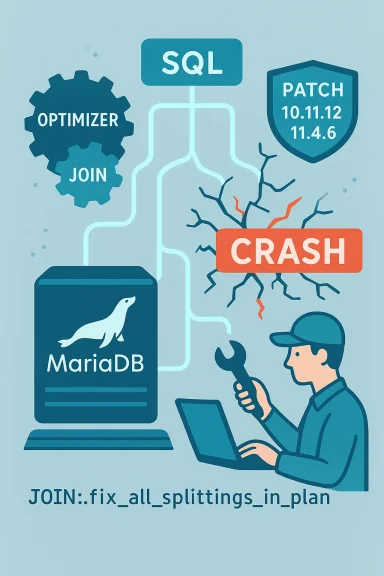 Background / Overview
MariaDB’s optimizer attempts aggressive join rewrites and split plans to produce efficient execution traces for complex queries. A logic error in the join splitting code path can be triggered by crafted JOINs and nested queries so that the server reaches an assertion or an invalid internal state; the result is a hard crash of the mysqld process rather than a graceful SQL error. Public tracking entries for CVE‑2023‑52971 record the issue as a crash in JOIN::fix_all_splittings_in_plan and assign a medium CVSS score (3.1) driven by a high availability impact. The public disclosure date for this CVE is 8 March 2025.Affected versions listed in vendor and distribution trackers are:
- MariaDB 10.10 through 10.11.*
- MariaDB 11.0 through 11.4.*.
What the bug actually does (technical summary)
The broken code path
The flaw sits in the optimizer’s JOIN splitting algorithm, specifically the method JOIN::fix_all_splittings_in_plan. During optimization the server attempts to enumerate and restructure join execution plans; in some pathological combinations of joins and subqueries the function can hit an unhandled condition (an assertion failure or an invalid pointer/logic path), causing mysqld to abort. The symptom is typically an immediate process termination or core dump rather than a recoverable SQL error.Why it matters operationally
When mysqld crashes all sessions are terminated, in‑flight transactions roll back, and any connected application tiers that aren’t tolerant to database outages fail. Repeated or programmatic triggering produces sustained denial‑of‑service: an attacker or a misbehaving script that can execute the triggering query will repeatedly bring the service down until the instance is patched or access is restricted. Because the failure is in planning, the crash can happen before any rows are returned — it is an availability problem, not a data leak.Typical log evidence
Operators reporting this crash see messages in the MySQL/MariaDB error log pointing to the optimizer stack and the opt_split.cc source, often ending with an assertion like:- sql/opt_split.cc:***: void JOIN::fix_all_splittings_in_plan(): Assertion `…' failed.
- mysqld: Aborted (core dumped)
Exploitability — threat model and prerequisites
Attack vector and complexity
- Attack vector: Network (the vulnerable code is reachable via SQL protocol).
- Attack complexity: Low once privileges are present; the crafted queries to provoke the planner are not highly complex.
Privileges required
Most authoritative trackers list Privileges Required = High in the CVSS vector, meaning the attacker must be able to authenticate with an account that has elevated rights (for example accounts that can create/execute complex stored procedures, or accounts with SUPER/administrative privileges). That classification places CVE‑2023‑52971 squarely in the “post‑compromise” or “insider/privileged misuse” threat model for many deployments.Note: some secondary write‑ups and community posts attempted PoC code or suggested lower privilege thresholds; treat those reports carefully and verify the privileges required on your deployed package and build because vendor/distribution packaging or backports can change the exact surface. When in doubt, assume the worst‑case of elevated privileges.
Real‑world attacker profiles of concern
- Compromised administrative credentials (phished DBAs, leaked service accounts).
- A malicious or compromised application/service with elevated rights.
- A rogue administrator or tenant in multi‑tenant control panels that share privileged access.
Evidence, PoCs, and public exploit availability
Multiple community write‑ups and vulnerability aggregators describe simple PoC queries that reproduce the crash on unpatched instances. These write‑ups responsibly avoid publishing weaponized scripts for broad use and focus on reproducible test cases for defenders. If you are assessing risk in your environment, reproduce only in isolated test instances — never on production infrastructure or systems you do not own. Public trackers indicate at least some PoC variants were circulated in the research community shortly after disclosure.Because a reproducible crash exists, automated scanners or misconfigured systems could be noisily triggered by routine health checks or query inspection tools; this raises the operational urgency for administrators even where direct remote exploitation is not trivial.
Verification: how to check if you're affected
- Confirm server version:
- From the shell: mysql --version
- Inside SQL: SELECT VERSION();
The version string should be compared to affected ranges: 10.10 → 10.11. and 11.0 → 11.4.. - Check your distribution’s security tracker:
- Debian, Ubuntu and other vendors have tracked the CVE and list the fixed package versions and release notes. Use your OS package manager to inspect installed package versions and vendor errata.
- Search logs for crash signatures:
- systemd/journald (journalctl -u mysqld), MySQL error log entries referencing opt_split.cc or JOIN::fix_all_splittings_in_plan, and recent core dumps. These are the primary operational indicators of exploitation or inadvertent triggering.
- If you use containers or marketplace images: verify the image tag and rebuild images from a fixed base — host package updates do not remediate embedded binaries inside immutable images.
The fix and vendor status
MariaDB upstream produced fixes that were backported into downstream vendor packages. Upstream and downstream notes indicate fixes were applied in upstream releases such as:- 10.11.12
- 11.4.6
- Later 11.x builds (check your exact stream).
If you rely on a managed DB service or marketplace image, check the provider’s advisory and confirm whether and when their image or engine has been updated; many cloud DBaaS providers coordinate patches on a separate cadence and require customer action or scheduled maintenance windows.
Remediation and operational playbook (practical steps)
Apply the vendor or distribution patch is the definitive remediation. The following sequence is a practical, prioritized playbook you can follow:Immediate (first hours)
- Inventory: discover all MariaDB instances (physical hosts, VMs, containers, cloud DB services). Use mysql --version, package manager queries, and image tags to capture exact version strings.
- If you cannot patch immediately, restrict network exposure: firewall or security‑group rules to allow MySQL access only from trusted management subnets and application hosts. Consider binding mysqld to management interfaces only (bind-address) while you schedule patches.
- Reduce privileged surface: temporarily revoke or rotate rarely used administrative credentials and remove unused SUPER/SYSTEM privileges from application accounts. Vault and rotate service credentials used in CI/CD and automation.
- Test in staging: upgrade a representative non‑production instance to the vendor patched build (e.g., 10.11.12 / 11.4.6) and run your standard workload tests, replication and failover checks.
- Apply patches in a controlled rollout: patch replicas first, promote patched replica to primary, then patch the former primary to reduce downtime risk. Validate backups and replication rejoin behavior post‑patch.
- Rebuild container images if you deploy MariaDB in containers — do not rely on host updates to fix embedded binaries. Rebase images on patched MariaDB builds and redeploy via your orchestration pipeline.
- Enforce least privilege for accounts that can define/execute stored procedures or run complex DML; reduce the number of accounts that can invoke optimizer‑heavy operations.
- Harden credential governance: secrets vaulting, MFA for management consoles, rotating shared credentials.
- Add crash/restart alerts: tune monitoring to alert on repeated mysqld restarts, core dumps, or InnoDB fatal messages. These indicators are the most actionable signals for this vulnerability class.
Detection, hunting and incident response specifics
- Alert rules to add immediately:
- N or more mysqld restarts within M minutes (example: 3 restarts in 10 minutes).
- New core dump creation under the MySQL data path.
- Error log lines matching optimizer/opt_split/Assertion entries.
- Forensic artifacts to preserve:
- MySQL error logs, general query logs, and binary logs (mysqlbinlog) capturing statements executed near crash times.
- mysqld core dumps and system diagnostics (top, vmstat, ulimit, systemd logs).
- Copies of container images or VM snapshots of affected hosts when investigating suspected exploitation.
- Correlation hunting:
- Look for repeated or unusual stored‑procedure creation/invocations tied to a small set of accounts or IP addresses prior to crash events.
- Correlate application logs and orchestration/controller events (e.g., Kubernetes liveness probe failures) with database crash timestamps to assess blast radius.
Strengths and caveats in the vendor/response ecosystem
Strengths:- The upstream project and major distributions produced patches and downstream errata in a typical coordinated fashion; fixed builds are available and widely distributed via vendor package systems. This means operators who maintain patch discipline can fully remediate the issue without risky workarounds.
- Container images, appliance binaries, or marketplace images that embed unpatched MariaDB remain vulnerable until rebuilt and redeployed. Host package updates do not fix those artifacts automatically.
- The CVSS numeric score (medium) can understate operational cost; a production database outage can have outsized business impact (SLAs, revenue loss), so prioritize remediation on business‑critical instances even if the nominal CVSS band is not “High.”
Practical mitigation checklist (one page, actionable)
- Inventory all MariaDB instances (hosts, containers, cloud DBs).
- Verify exact version strings: mysql --version and SELECT VERSION();.
- Apply vendor/distribution patches to reach fixed builds (e.g., 10.11.12, 11.4.6 or later).
- Rebuild and redeploy container images that include MariaDB.
- Temporarily restrict MySQL network access to trusted management hosts if patching is delayed.
- Audit and tighten privileges for accounts that can run stored procedures or complex joins.
- Add monitoring alerts for mysqld restarts, core dumps and InnoDB fatal errors.
Final assessment — how urgent is this for you?
Prioritize by exposure and criticality:- High urgency: publicly accessible MySQL/MariaDB endpoints, multi‑tenant control panels, hosted database offerings, and systems with many admin/service accounts in automation. These should be patched or isolated immediately.
- Medium urgency: internal databases with strict network segmentation and strong credential hygiene—but still patch and audit privileges promptly.
- Lower urgency: heavily segregated instances with minimal privileged accounts and tested high‑availability that can tolerate rolling upgrades—still patch on the next maintenance window and verify image rebuilds. ([security-tracke/security-tracker.debian.org/CVE-2023-52971)
Conclusion
CVE‑2023‑52971 is a clear example of how optimizer logic errors can convert a seemingly minor planner bug into a production‑stopping denial‑of‑service. The vulnerability is straightforward to describe — a crash in JOIN::fix_all_splittings_in_plan — and the remediation path is straightforward: apply the upstream and distribution patches, rebuild any immutable images that bundle the vulnerable binary, and harden privileged access to reduce the practical attack surface. Inventory, patch, and rebuild; where immediate patching isn’t possible, restrict network access and reduce the set of accounts that can execute complex join/optimizer‑heavy statements. Above all, treat repeated mysqld restarts and optimizer assertion logs as urgent incidents that require immediate investigation and containment.If you manage MariaDB at scale, the recommended sequence is clear: discover instances, stage the upstream fixes, rebuild images, rotate credentials where appropriate, and turn your monitoring into an early‑warning system for any optimizer‑related crash patterns. Do that and you will convert a plausible availability catastrophe into a routine maintenance project.
Source: MSRC Security Update Guide - Microsoft Security Response Center
