

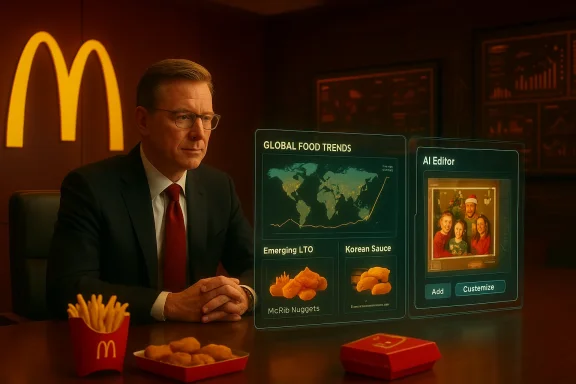
McDonald’s CEO Chris Kempczinski’s off‑hand Instagram reel — in which he calls himself a “supersubscriber to every AI tool out there” and describes using Google Gemini and a consumer image editor called Nano Banana to assemble a family Christmas card — is doing more than supplying a personable CEO moment. It’s a small, vivid signal that the world’s largest quick‑service restaurant chain is folding generative AI into both executive playbooks and product ideation: Kempczinski says he’s used Gemini to scan global food trends and propose ideas as varied as “McRib Nuggets” and Korean sauces for nuggets and burgers, then tossed those suggestions to McDonald’s menu team for possible testing.
McDonald’s has long balanced two competing imperatives: preserve the inviolable core (Big Mac, Quarter Pounder, fries) while keeping the menu culturally relevant through limited‑time offers (LTOs), regional flavors, and marketing collaborations. Under Chris Kempczinski’s leadership, the company has publicly committed to speeding product development cycles and leaning into digital + data to personalize the restaurant experience. That modernization push includes deeper experimentation with beverages, sauces and limited‑time chicken plays — areas where quick-turn experimentation can drive traffic without disturbing the global anchors of the brand.
What’s new in 2026 is not that McDonald’s is experimenting — it’s the explicit admission that generative AI now sits in the workflow that feeds those experiments. When a CEO publicly says he asks an LLM to “compare global food trends to the McDonald’s menu” and then forwards the AI’s suggestions to product teams, it raises practical, technical and governance questions about how ideas are generated, validated and scaled inside a massive physical supply chain — and about what it means for brand stewardship when a model trained on web data suggests menu gambits.
This two‑track usage illustrates a common CEO pattern today: use consumer‑grade generative tools for personal tasks (speed and convenience), and enterprise‑grade or API access to models (or the consumer app’s pro features) to support rapid ideation and trend hunting. It’s a strikingly public example of “CEO as early adopter” behavior — and it’s also a product‑management shortcut: rapid ideation from an LLM can seed dozens of experiments in hours instead of weeks.
Caveat: the model’s recommendations are only as reliable as the prompting, sources, and guardrails applied. Models can surface odd or previously tested ideas that failed for operational reasons, and they can overweight internet‑visible buzz versus hard sales data. So a credible product pipeline needs human triage, restaurant‑level feasibility checks, and food‑safety and supply‑chain validation before any national rollout.
Google’s product moves (Gemini upgrades and enterprise packaging) make these capabilities easier for large brands to adopt in a controlled way, but they do not absolve customers from implementing their own risk controls. Gemini’s enterprise design (connectors, agent workbench, governance tooling) explicitly targets the use cases fast‑moving consumer goods firms need — research, agentic workflows and data grounding — which explains why executives find the platform attractive for menu scouting.
Brands should consider transparent, consumer‑facing language about how new items were developed when it affects provenance or authenticity claims (e.g., “Inspired by Korean flavors” vs. “Authentic Korean recipe”). Where AI substantially shaped a menu, a forthright explanation of human validation steps can build trust rather than erode it.
If McDonald’s marries AI‑driven creativity with disciplined operational gates — the same discipline that has protected the Big Mac and the fries for decades — Kempczinski’s “maybe something” could turn into many small, smart wins: novel sauces that create buzz, snack formats that drive check size, and local experiments that teach the system how to choose winners. If not, the risk is iterative — a stream of half‑baked, culturally tone‑deaf ideas that fray franchisee patience and customer trust.
AI is a powerful new tool in the QSR playbook, but it is a tool nonetheless. The difference between a model’s suggestion and a customer‑facing product will still rest on the old, immovable pillars: kitchen feasibility, supplier reliability, food safety, and honest marketing. When CEOs publicly reveal the prompts they use, it’s an invitation to scrutinize both the creativity and the controls — a welcome transparency that should force better practices across the industry.
In short: McDonald’s embracing of Google Gemini for idea generation is sensible and potentially valuable — provided the company keeps people, kitchens and governance at the center of the innovation engine. The future of menu innovation will be human + AI, not AI alone; the restaurant that masters that balance will win the next era of quick‑service experimentation.
Source: The Economic Times From McRib nuggets to Korean sauces: McDonald’s CEO Chris Kempczinski reveals how he uses Google Gemini, AI tools to revamp menu ideas - The Economic Times
 Background / Overview
McDonald’s has long balanced two competing imperatives: preserve the inviolable core (Big Mac, Quarter Pounder, fries) while keeping the menu culturally relevant through limited‑time offers (LTOs), regional flavors, and marketing collaborations. Under Chris Kempczinski’s leadership, the company has publicly committed to speeding product development cycles and leaning into digital + data to personalize the restaurant experience. That modernization push includes deeper experimentation with beverages, sauces and limited‑time chicken plays — areas where quick-turn experimentation can drive traffic without disturbing the global anchors of the brand.What’s new in 2026 is not that McDonald’s is experimenting — it’s the explicit admission that generative AI now sits in the workflow that feeds those experiments. When a CEO publicly says he asks an LLM to “compare global food trends to the McDonald’s menu” and then forwards the AI’s suggestions to product teams, it raises practical, technical and governance questions about how ideas are generated, validated and scaled inside a massive physical supply chain — and about what it means for brand stewardship when a model trained on web data suggests menu gambits.
How Kempczinski says he’s using AI
From personal convenience to strategic scouting
Kempczinski’s Instagram reel — and the Fortune write‑up that amplified it — frames two uses of AI: highly personal, low‑risk tasks like compositing a family photo, and higher‑stakes product scouting that feeds McDonald’s menu pipeline. As he described it, he uploads individual photos to an image model/editor combo (Nano Banana and Google Gemini were named) to create a holiday card; separately, he prompts Gemini to synthesize global food trends and identify potential U.S. LTO concepts. Those meal ideas, he says, are thrown to the menu team for vetting.This two‑track usage illustrates a common CEO pattern today: use consumer‑grade generative tools for personal tasks (speed and convenience), and enterprise‑grade or API access to models (or the consumer app’s pro features) to support rapid ideation and trend hunting. It’s a strikingly public example of “CEO as early adopter” behavior — and it’s also a product‑management shortcut: rapid ideation from an LLM can seed dozens of experiments in hours instead of weeks.
What Gemini can — and can’t — do for product ideation
Google’s Gemini family, and its enterprise packaging via Gemini Enterprise, are designed to do two things that matter for a CPG or restaurant company: aggregate and synthesize large, multimodal datasets (text, images, even recipes and menu data) and present actionable suggestions via a conversational interface or agents. Gemini Enterprise is explicitly positioned to connect models to corporate data, analytic workflows and pre‑built agents, which accelerates the process of turning insight into an operational experiment. That capability makes it plausible for a CEO or innovation team to ask: “Show me trending sauces, flavors or formats globally that could be trialed as an LTO in the U.S.” — and get a prioritized list back in minutes.Caveat: the model’s recommendations are only as reliable as the prompting, sources, and guardrails applied. Models can surface odd or previously tested ideas that failed for operational reasons, and they can overweight internet‑visible buzz versus hard sales data. So a credible product pipeline needs human triage, restaurant‑level feasibility checks, and food‑safety and supply‑chain validation before any national rollout.
Menu experimentation: McRib nuggets and Korean sauces as a case study
The idea pipeline: seed → test → scale
When Kempczinski said Gemini suggested “McRib Nuggets” and more Korean sauces, he described the very top of a typical modern food innovation funnel: an idea seed generated from data and cultural signals, followed by internal feasibility screening and then small‑market tests if promising. The advantage of LTOs is they let a company test consumer response, SKU economics and operational impacts on a limited scale before broader deployment. Kempczinski’s public phrase — “I threw those ideas to the menu team. Who knows what they’re going to do with it, maybe nothing. But maybe something.” — is an honest depiction of that iterative process.Why sauces and nuggets matter strategically
- Sauces are low‑cost, high‑talkability add‑ons that can be localized and used in promotions to drive trial without massive capital investment.
- Nuggets and snackable formats map well to convenience and delivery behaviors — they travel, they pair with beverages, and they generate incremental check size.
- Both categories allow McDonald’s to be culturally relevant (e.g., Korean spicy‑sweet profiles) while containing risk.
Practical constraints: sourcing, operations, and food safety
An AI‑generated menu idea must clear three operational gates before reaching customers:- Ingredients and supplier capacity: Does the proposed sauce or nugget require new ingredients or new sourcing relationships? Can current suppliers scale to national demand?
- Kitchen fit and speed: Can franchise kitchens produce the item without harming core throughput? McDonald’s has emphasized simplicity; new SKUs that complicate drive‑thru service or require unique prep steps are harder to scale.
- Food safety and regulatory compliance: Novel flavors or imported ingredients may require labeling changes, shelf‑life studies, or regulatory review, especially in multiple jurisdictions.
The operational playbook: where AI delivers most value
Three practical use cases for AI in a global QSR
- Idea discovery and localization: Rapidly synthesize global social signals, menu data, and regional flavor lexicons to generate candidate LTOs tailored to markets.
- Personalization at point of sale: Use digital profiles and transaction data to present personalized offers or menu boards at the drive‑thru, which Kempczinski referenced as an ambition years ago. That mix of CRM data, transaction streams and real‑time menu rendering is precisely the use case enterprise versions of Gemini are built to serve.
- Supply and labor optimization: Predict demand for trial items to inform rolling production plans, reduce waste, and align inventory with promotion schedules.
Deployment model: human‑in‑the‑loop, not human‑out‑of‑the‑loop
Best practice for consumer brands is to keep humans central: product teams should use AI as an ideation catalyst, not a rollout decision‑maker. That means codifying review steps, assigning responsibility for safety and operational impact, and ensuring franchisee input before tests begin. Kempczinski’s language — “threw those ideas to the menu team” — implies that McDonald’s retains those human checks, at least in public messaging.Strengths: why this approach could work for McDonald’s
- Velocity: Generative AI cuts the time to gather trend intelligence from weeks of manual research to minutes, enabling more tests and faster learning cycles.
- Scale of data: McDonald’s has access to enormous transaction volumes and digital profiles; pairing that proprietary telemetry with large language models (LLMs) creates high‑value signals for personalization and experimentation. Kempczinski has referenced figures like 150 million people in McDonald’s digital ecosystem and up to 70 million transactions per day when discussing data‑driven personalization.
- Marketing lift: Novel, culturally tuned LTOs (e.g., Korean sauces) are social‑media friendly and can produce free earned media if executed well.
- Low‑cost creativity: Sauces and nugget formats are relatively low‑cost to prototype compared to full burgers that require new buns, patties or complex assembly.
Risks and blind spots — what executives and operators must guard against
1. Brand risk and cultural tone‑deafness
A model trained on global internet data can surface flavors or combinations that are trending online but tone‑deaf on the ground. Cultural appropriation, misrepresented cuisines, or faux‑authentic flavors can generate PR backlash. Human cultural expertise and sensitivity review must sit between model output and public launch.2. Food safety and regulatory exposure
AI cannot replace food‑safety testing. Suggesting a sauce that mixes a novel ingredient or emulates a regional fermented product requires lab validation, allergen reviews and shelf‑life studies.3. Operational complexity and franchisee burden
Franchise systems resist SKUs that increase complexity in small kitchens. AI‑driven proliferation of concepts could create “menu bloat” unless change is carefully shepherded. Past McDonald’s experience shows the value of limiting disruption to core kitchen flow.4. Hallucination and provenance problems
LLMs can “hallucinate” — invent facts, misattribute origins, or overstress the popularity of ephemeral trends. Relying on an ungrounded model for strategic product decisions risks awkward or costly choices. Organizations must require transparent grounding: models should cite the data sources or be paired with data‑retrieval layers that provide provenance.5. Privacy, data governance, and supplier confidentiality
When AI agents access internal sales, CRM and supplier data (as Gemini Enterprise explicitly enables), governance is crucial. Who can query which datasets? How are outputs audited? How are model updates controlled to avoid leaking proprietary patterns? Google’s enterprise messaging includes governance features, but implementation is the customer’s responsibility.How to build a safe, repeatable AI‑driven menu pipeline (recommended framework)
- Ideation guardrails
- Define allowable categories (e.g., sauces, LTO chicken) where rapid experimentation is permitted.
- Maintain a human reviewer list that includes culinary, supply chain, legal, and franchisee representation.
- Grounded data inputs
- Couple LLM prompts to verifiable public and private data sources (sales trends, social listening with provenance).
- Require the model to return source snippets or linked supporting evidence for each claim.
- Rapid micro‑testing
- Use local markets (one or a few cities) or digital channels for A/B tests before national rollout.
- Instrument tests with clear KPIs: incremental transactions, attach rate, kitchen time impact, and waste.
- Post‑test governance
- Maintain a “lessons learned” registry for each LTO to refine prompt patterns and supply estimates.
- Audit model‑informed decisions quarterly for bias, repeated failures, or supplier shocks.
- Continuous monitoring and rollback plans
- Have pre‑planned rollback triggers for safety, quality, or reputational signals.
Wider industry and competitive context
McDonald’s is not alone. The fast‑food sector has broadly embraced AI for operations, from voice drive‑thru pilots to predictive labor scheduling and dynamic pricing. CEOs across industries are publicly discussing personal and business uses of AI; Kempczinski’s candid examples align with a broader C‑suite trend where executives lean on AI for both productivity and creative ideation. That normalization reduces stigma but raises the bar for robust governance and disclosure.Google’s product moves (Gemini upgrades and enterprise packaging) make these capabilities easier for large brands to adopt in a controlled way, but they do not absolve customers from implementing their own risk controls. Gemini’s enterprise design (connectors, agent workbench, governance tooling) explicitly targets the use cases fast‑moving consumer goods firms need — research, agentic workflows and data grounding — which explains why executives find the platform attractive for menu scouting.
Ethics, disclosure and the optics of AI‑generated creativity
Consumers increasingly expect authenticity, but they are also primed for novelty. The optics of a CEO who photoshops a family card with AI while also using AI to seed product ideas will play differently across audiences: tech‑savvy customers might applaud the cleverness; privacy advocates and culinary purists could push back on the perceived mechanization of cultural flavors.Brands should consider transparent, consumer‑facing language about how new items were developed when it affects provenance or authenticity claims (e.g., “Inspired by Korean flavors” vs. “Authentic Korean recipe”). Where AI substantially shaped a menu, a forthright explanation of human validation steps can build trust rather than erode it.
What success looks like — metrics and signals to watch
- Experiment velocity: Number of LTOs seeded, shipped to test, and iterated per quarter.
- Operational friction score: Change in drive‑thru throughput or kitchen time attributable to new SKUs.
- Incremental revenue per test: Net new spend vs. cannibalization of core items.
- Social resonance: Earned‑media volume, sentiment, and repeat purchase rates post‑LTO.
- Governance compliance: Time from idea to legal/food‑safety signoff, and percentage of AI‑sourced ideas rejected on safety or operational grounds.
Final assessment: pragmatic innovation, but not magic
Chris Kempczinski’s public disclosure that he asks Google Gemini to scan trends and generate menu ideas is a credible, contemporaneous sign that major consumer brands are integrating generative AI into the earliest stages of product development. The upside is clear: faster ideation, larger idea sets, and a richer signal set for regional LTOs. The downside is also self‑evident: models are suggestion engines, not operational planners. A responsible rollout requires human judgment, supply‑chain rigor, food‑safety testing, and governance over data and model behavior.If McDonald’s marries AI‑driven creativity with disciplined operational gates — the same discipline that has protected the Big Mac and the fries for decades — Kempczinski’s “maybe something” could turn into many small, smart wins: novel sauces that create buzz, snack formats that drive check size, and local experiments that teach the system how to choose winners. If not, the risk is iterative — a stream of half‑baked, culturally tone‑deaf ideas that fray franchisee patience and customer trust.
AI is a powerful new tool in the QSR playbook, but it is a tool nonetheless. The difference between a model’s suggestion and a customer‑facing product will still rest on the old, immovable pillars: kitchen feasibility, supplier reliability, food safety, and honest marketing. When CEOs publicly reveal the prompts they use, it’s an invitation to scrutinize both the creativity and the controls — a welcome transparency that should force better practices across the industry.
In short: McDonald’s embracing of Google Gemini for idea generation is sensible and potentially valuable — provided the company keeps people, kitchens and governance at the center of the innovation engine. The future of menu innovation will be human + AI, not AI alone; the restaurant that masters that balance will win the next era of quick‑service experimentation.
Source: The Economic Times From McRib nuggets to Korean sauces: McDonald’s CEO Chris Kempczinski reveals how he uses Google Gemini, AI tools to revamp menu ideas - The Economic Times