

When Microsoft gave Microsoft 365 Copilot agents a simple, standard way to connect to tools and data using the Model Context Protocol (MCP), the payoff was immediate: answers sharpened, delivery accelerated, and new development patterns emerged—alongside a single, unavoidable question: if agents can speak to more systems, how do we make sure only the right voices are heard and nothing sensitive leaves the room? ps://www.microsoft.com/insidetrack/blog/protecting-ai-conversations-at-microsoft-with-model-context-protocol-security-and-governance/)
MCP is an open protocol designed to standardize how language models connect to external tools and data sources—an interoperability layer many describe as “USB‑C for AI.” That analogy matters: standard connectors reduce integration friction, but they also expand the attack surface by turning many previously isolated integrations into a single, repeatable pattern. Anthropic’s MCP documentation frames the protocol as a way to “provide context to LLMs” and lists SDKs and reference implementations that accelerate adoption.
Microsoft’s internal playbook responds directly to that trade‑off. By folding security and governance into MCP onboarding, vetting, and runtime controls, Microsoft aims to preserve the producamatically reducing configuration‑driven vulnerabilities—what one internal engineer summed up bluntly: a single misconfigured server can hand an AI “the keys to your data.”
What can go wrong
What can go wrong
What can go wrong
What can go wrong
These combined controls let makers discover approved servers and reuse connectors while providing security teams with a consistent playbook.
This balances speed and safety: the majority of use cases follow the fast path; high‑risk integrations follow a stricter, yet well‑defined path.
That caution is not theoretical. In recent months, security researchers flagged critical vulnerabilities in a widely used Git MCP server implementation—issues that could, when chained with a filesystem server, lead to remote code execution or file tampering. Those findings were patched, but they underscore the core thesis: even vetted server code can produce severe vulnerabilities when misused or combined in unexpected ways. Practical corporate controls—SBOMs, runtime egress pinning, container isolation, and active telemetry—directly address these classes of problems.
Industry coverage also shows MCP’s rapid momentum: multiple providers and toolmakers are integrating MCP, creating both opportunity (interoperability) and risk (diverse implementations and optional extensions). That makes Microsoft’s “single path, boring repetition” playbook a defensible operational choice, because centralized patterns scale better than ad‑hoc exceptions.
Reality checks remain. Smaller organizations may struggle with the telemetry and integration investments required to reach Microsoft’s operational ideal. The MCP ecosystem itself carries risk: open reference implementations accelerate adoption but can propagate vulnerabilities if used without appropriate hardening. Recent vulnerability disclosures in MCP reference servers are a reminder that protocol adoption must be paired with robust vetting and runtime protections.
For most enterprises, the pragmatic path forward is clear:
Source: Microsoft Protecting AI conversations at Microsoft with Model Context Protocol security and governance - Inside Track Blog
 Background
MCP is an open protocol designed to standardize how language models connect to external tools and data sources—an interoperability layer many describe as “USB‑C for AI.” That analogy matters: standard connectors reduce integration friction, but they also expand the attack surface by turning many previously isolated integrations into a single, repeatable pattern. Anthropic’s MCP documentation frames the protocol as a way to “provide context to LLMs” and lists SDKs and reference implementations that accelerate adoption.Microsoft’s internal playbook responds directly to that trade‑off. By folding security and governance into MCP onboarding, vetting, and runtime controls, Microsoft aims to preserve the producamatically reducing configuration‑driven vulnerabilities—what one internal engineer summed up bluntly: a single misconfigured server can hand an AI “the keys to your data.”
Why communications security matters for agentic AI
Most security frameworks treat integrations as discrete APIs; MCP flips that assumption. A single MCP server can expose multiple tools and data categories in one discovery flow, and agents can chain calls tha natural‑language-driven conversation. That combination changes the security question from “Is this API secure?” to “Is this a conversation we trust?”- Agents parse user intent, discover tools, and execute actions—so identity, metadata, content, and code all become part of the trust decision.
- Prompt injection, tool poisoning, and context oversharing are realistic, high‑impact threats because they can occur in production, in natural language, and with probabilistic triggers that standard testing does not always catch. Industry reporting and recent red‑team findings reinforce that auxiliary surfaces—plugins, connectors, file servers—are frequent attack vectors.
Four layers of MCP risk and the controls that matter
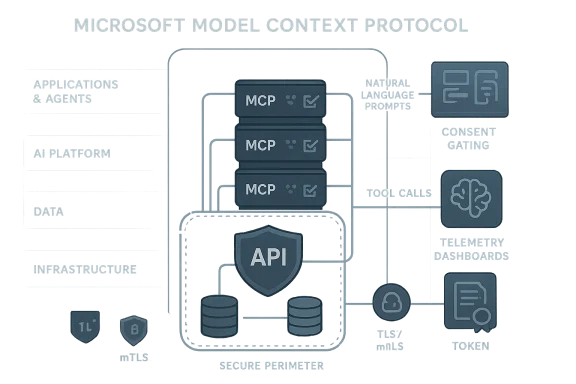
Microsoft organizes MCP risk into four concrete layers: Applications & Agents, AI Platform, Data, and Infrastructure. That framing helps map mitigations to where failures actually happen. Below, each layer is summarized with common failure modes and practical guardrails.1. Applications & Agents layer
This is the human-facing edge: agents, clients, and the decision logic that chooses tools and asks for consent.What can go wrong
- Tool poisoning or shadowing: a server advertises benign metadata but performs unsafe side effects.
- Silent swaps: a tool’s metadata changes and the client continues trusting it.
- No consent or weak sandboxing for writes and edits.
- Per‑tool allowlists and explicit “ask‑before‑write” UX by default.
- Liveness checks on tool metadata and automated pausing when a tool’s “voice” drifts from its approved contract.
2. AI Platform layer
This layer includes the model, the runtime that interprets prompts, and orchestration logic.What can go wrong
- Model supply‑chain drift: unvetted model updates or compromised fine‑tunes change agent behavior.
- Prompt injection embedded in tool responses steering the model to unsafe actions.
- Apply content safety and prompt shields as part of the execution runtime—not only in tests. Correlate model updates with behavioral drift and roll back quickly if needed.
3. Data layer
This covers files, business data, and secrets reachable during a conversation.What can go wrong
- Context oversharing: the model receives more sensitive context than necessary and that context is included in outbound calls.
- Over‑scoped credentials: long‑lived tokens or broad scopes enable lateral movement.
- Trim conequired for a task; prevent full transcripts from being sent to third‑party MCP servers by default.
- Enforce short‑lived, least‑privilege tokens, correct audience claims, and token proof‑of‑possession or binding where feasible.
4. Infrastructure layer
Compute, network, and runtime environments that host MCP servers and clients.What can go wrong
- Local developer servers with excessive access or cloud endpoints without a gateway allow open egress and blind spots.
- Missing TLS, absent rate limits, or no ceontrols that work
- Require MCP servers to register behind a centralized API gateway, enforce TLS/mTLS as necessary, pin outbound egress to approved hosts, and enable centralized telemetry and rate limiting.
Secure‑by‑default: Microsoft’s practical playbook
Microsoft’s approach emphasizes three foundational pillars: architecture, vetting, and inventory—each intentionally “boring” and repeatable so teams can move fast without creating fragile exceptions.Architecture: one choke point, consistent enforcement
Remote MCP servers are required to sit behind Microsoft’s API gateway. The gateway becomes the enforcement plane for authentication, authorization, rate limits, logging, and egress controls. Default requirements include TLS, short‑lived tokens, and per‑tool allowlists. ive endpoints, mutual TLS and proof‑of‑possession are recommended. These defaults reduce the number of places an attacker can slip in and centralize incident controls like kill switches.Vetting: declare, test, and certify before production
Before a server is allowed into the catalog, owners must describe the tools, data categories, authentication methods, runtime, and on‑call contacts. Vetting includes:- Static checks (manifest vs. contract, SBOM presence, no embedded credentials).
- Dynamic tests (probe for prompt injection, ensure consent gating for side‑effects).
- Resilience and egress validation (health checks, pinned hosts, containerget published only after security, privacy, and responsible‑AI reviews are complete. This reduces “connect and hope” risk and makes the path to production auditable.
Inventory: the single source of truth
Inventory is governance’s foundation. If you can’t see a server, you can’t control it. Microsoft aims to stitch telemetry from endpoints, repos, CI pipelines, IDEs, gateways, and low‑code environments into one living catalog. Each server has an owner, exposure score, last‑seen timestamp, and review history. High‑risktop for reviewers and automations can create registration stubs when unknown servers are detected—blocking direct calls until vetting completes.These combined controls let makers discover approved servers and reuse connectors while providing security teams with a consistent playbook.
Governing across low‑code and pro‑code flows
A key operational choice: put guardrails where makers actually work. In practice:- Copilot Studio and low‑code surfaces allow only vetted first‑party MCP servers in default dev flows so teams can prototype quickly without creating new risks.
- Pro‑code flows (VS Code, Foundry, custom environments) remain available for advanced connectors but require exps: service ownership, security and privacy reviews, responsible AI assessments, and consent gating for high‑impact actions.
This balances speed and safety: the majority of use cases follow the fast path; high‑risk integrations follow a stricter, yet well‑defined path.
Operating MCP at scale: observe, detect, respond, enable
Running MCP is an operational problem as much as an engineering one. Microsoft describes four repeatable motions:- Observe every tool call end‑to‑end
- Correlation IDs track calls from client → gateway → server and back.
- Logs capture prompts, tool selections, auth decisions, and resource access with consistent schemas.
-ncy, errors, saturation) are augmented with safety signals (unexpected egress, edits without consent). - Detect drift and abnormal behavior early
- Flag unusual tool selection patterns, spikes in write ops, or context sizes inconsistent with task intent.
- Compare a tool’s live “voice” at connect time to the approved snapshot; automatic pausing reduces blast radius.
- Respond with precision
- Response is graded: block destructive writes while allowing reads, throttle noisy clients, or revoke tokens selectively.
- Kill switches at both client and gateway levels enable rapid containment without wholesale downtime.
- Enable builders through templates and education
- Provide preflight checks, manifests with consent gates, and templates that make safe patterns the default.
Cross‑checks and industry context
Microsoft’s approach aligns with broader industry guidance and implements concrete mitigations for MCP’s known risks. Anthropic’s MCP documentation explains the protocol goals and reference implementations, which accelerates adoption but also highlights why careful vetting matters at scale: open reference servers can introduce vulnerabilities if used as‑is in production.That caution is not theoretical. In recent months, security researchers flagged critical vulnerabilities in a widely used Git MCP server implementation—issues that could, when chained with a filesystem server, lead to remote code execution or file tampering. Those findings were patched, but they underscore the core thesis: even vetted server code can produce severe vulnerabilities when misused or combined in unexpected ways. Practical corporate controls—SBOMs, runtime egress pinning, container isolation, and active telemetry—directly address these classes of problems.
Industry coverage also shows MCP’s rapid momentum: multiple providers and toolmakers are integrating MCP, creating both opportunity (interoperability) and risk (diverse implementations and optional extensions). That makes Microsoft’s “single path, boring repetition” playbook a defensible operational choice, because centralized patterns scale better than ad‑hoc exceptions.
Strengths of Microsoft’s program
- Practicality over purity. The program translates high‑level security goals into repeatable engineering work: registratioecycles, gateway enforcement, and telemetry.
- Operator‑friendly controls. Graded responses and kill switches prioritize precision in incident response instead of blunt shutdowns that disrupt business processes.
- Integrated governance. Inventory + vetting + architecture reduces shadow servers, improves reuse, and shortens incident time‑to‑contain through correlation IDs and shared dashboards.
- Developer ergonomics. By placing controls in maker tools (Copilot Studio, templates, preflight checks), Microsoft lowers the friction to adopt secure patterns.
Residual risks and gaps to watch
- Ecosystem heterogeneity. MCP is an oprty implementations and vendor extensions vary. Centralized governance must assume divergence and include conformance testing, version checks, and runtime guards.
- Telemetry integration complexity. Stitching telemetry across endpoints, CI, repos, and IDEs is expensive and technically challenging—mid‑market organizations may lack the resources to reach Microsoft’s ideal state.
- Probabilistic vulnerabilities. Unlike deterministic bugs, AI vulnerabilities can be emergent and context sensitive. Detection requires continuous behavioral telemetry and model‑aware signalsevolving discipline.
- Third‑party trust and procurement. Managed MCP connector vendors must be contractually constrained; written attestations, SBOMs, and data‑handling commitments are required for any connector that touches regulated drganizations should prefer self‑hosted servers for highly sensitive on‑prem data.
Practical checklist for IT leaders (operationally prioritized)
- Inventory and ownership (30–60 days)
- Launch a lightweight agent/server registry. Require owner, purpose, and scope metadata before any production registration.
- Least‑privilege tokens and short lifetimes (30–90 days)
- Audit connectors for broad scopes and long tokens. Move to short‑lived tokens, rotate keys, and use proof‑of‑possession (DPoP or mTLS) for high‑value endpoints.
- Extend DLP and telemetry (60–120 days)
- Include prompts, model calls, and outputs in data loss prevention and SIEM pipelines. Mask sensitive payloads by default.
- Harden UI affordances and prefilled prompts (60–120 days)
- Remove or vet public prefilled prompts that could seed memory or enable prompt injection.
- Incident playbook and drills (30–90 days)
- Define containment procedures (credential revocation, owner notification), and rehearse them with dry runs.
- Enforce architecture and vetting as code
- Make allowlists, consent rules, and egress boundaries policy‑as‑code and test them in CI before approval.
Roadmap: where to invest next
Microsoft emphasizes consolidation and automation: a single pane of glass for MCP governance, smarter preflight checks with environment awareness, and richer injection testing in CI. Organizaze:- Automated detection of unknown MCP servers on endpoints and notification to likely owners.
- CI‑level conformance checks for manifests, SBOMs, and consent flows.
- Runtime behavioural baselines to detect subtle model‑level drift tied to specific tools or updates.
Final analysis: governance that scales or a utopia for large orgs?
Microsoft’s MCP governance model is sensible, pragmatic, and built for scale. Its strengths—cons, repeatable vetting, and integrated telemetry—are precisely the features large enterprises need to manage agentic risk at volume. The program notably turns many security principles into developer‑friendly defaults rather than optional constraints.Reality checks remain. Smaller organizations may struggle with the telemetry and integration investments required to reach Microsoft’s operational ideal. The MCP ecosystem itself carries risk: open reference implementations accelerate adoption but can propagate vulnerabilities if used without appropriate hardening. Recent vulnerability disclosures in MCP reference servers are a reminder that protocol adoption must be paired with robust vetting and runtime protections.
For most enterprises, the pragmatic path forward is clear:
- Treat MCP servers like any critical backend service: CI/CD, SBOMs, staged deployments, and mandatory tracing.
and token lifecycles aggressively. - Build inventory first—then policy, detection, and automated responn, engineering, and security adopt a shared playbook, MCP’s productivity gains are achievable without accepting unacceptable risk.
Key takeaways
- Build governance into the maker flow so secure choices are the easiest choi
- Centralize approved MCP servers in a single catalog with owners, scopes, and data boundaries.
- Enforce short‑lived, scopault and bind tokens where possible.
- Monitor continuously and detect drift early with correlated telgateway → server.
- Automate incident response and controls (playbooks, kill switches, graded remediation) to act fast without breaking service.
- Design for privacy and auditability: mask sensitive data by default and keep audit trails role‑gated.
Source: Microsoft Protecting AI conversations at Microsoft with Model Context Protocol security and governance - Inside Track Blog
