

Researchers at the University of Cambridge, working with colleagues from Google DeepMind, have published what they call the first psychometrically validated framework to measure and shape the “personality” of large language models (LLMs), showing that modern instruction‑tuned chatbots not only mimic human Big Five traits but can be reliably steered along those trait axes via prompt design—an advance that is as useful for auditing and product design as it is worrying for safety, persuasion, and regulatory policy.
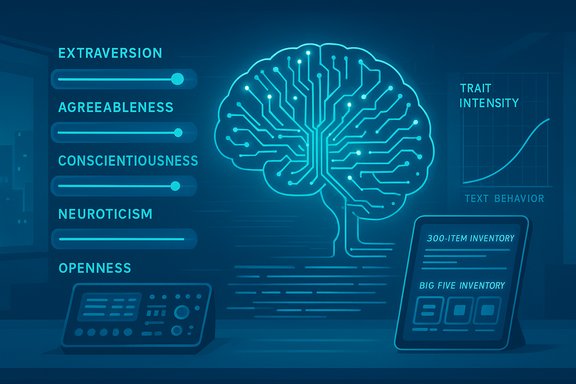
The study adapts canonical human psychometric tools—the long IPIP/NEO‑style 300‑item inventory and a shorter Big Five Inventory—to LLMs and subjects model responses to the same validation routines that make human personality testing scientific: internal consistency, convergent and discriminant validity, and criterion (behavioural) validity. That approach treats a model’s isolated item responses as measurement data rather than conversational artifacts, addressing a long‑standing methodological gap where previous assessments simply fed entire questionnaires into a model and accepted the resulting answers at face value.
Two findings stand out immediately. First, larger, instruction‑tuned models (the paper highlights modern families such as GPT‑4o in its reporting) produced personality profiles that met standard psychometric criteria and predicted downstream behaviour. Second, the same techniques used to measure personality can control it: the team reports fine‑grained, nine‑level manipulations on each Big Five trait that generalise from questionnaires to open‑ended tasks like writing social posts. Those twin claims move the discussion from “do LLMs sound like they have personality?” to “can we reliably measure and purposely alter trait expression?”—and the answer appears to be yes, at least for state‑of‑the‑art models.
The study provides a usable toolkit that should be adopted for pre‑deployment audits, but independent replication and cross‑cultural extension are necessary next steps. Meanwhile, enterprises and Windows administrators must act now: lock down persona controls, require sign‑offs, and instrument persona changes with provenance and human review. Absent these measures, personality shaping risks turning conversational assistants from helpful tools into covertly persuasive actors operating at global scale.
Source: Tech Xplore https://techxplore.com/news/2025-12-personality-ai-chatbots-mimic-human.html
 Background
The study adapts canonical human psychometric tools—the long IPIP/NEO‑style 300‑item inventory and a shorter Big Five Inventory—to LLMs and subjects model responses to the same validation routines that make human personality testing scientific: internal consistency, convergent and discriminant validity, and criterion (behavioural) validity. That approach treats a model’s isolated item responses as measurement data rather than conversational artifacts, addressing a long‑standing methodological gap where previous assessments simply fed entire questionnaires into a model and accepted the resulting answers at face value.Two findings stand out immediately. First, larger, instruction‑tuned models (the paper highlights modern families such as GPT‑4o in its reporting) produced personality profiles that met standard psychometric criteria and predicted downstream behaviour. Second, the same techniques used to measure personality can control it: the team reports fine‑grained, nine‑level manipulations on each Big Five trait that generalise from questionnaires to open‑ended tasks like writing social posts. Those twin claims move the discussion from “do LLMs sound like they have personality?” to “can we reliably measure and purposely alter trait expression?”—and the answer appears to be yes, at least for state‑of‑the‑art models.
How the framework works: psychometrics meets prompt engineering
From human inventories to machine‑readable tests
The authors adapted two established instruments:- A long, open‑source, 300‑item Revised NEO/IPIP battery for depth and trait granularity.
- A compact Big Five Inventory (BFI) for cross‑test validation and practical audits.
Validating against behaviour
Measurement alone is insufficient; a test is useful only if it predicts behaviour. The Cambridge team therefore evaluated whether model scores on a given trait mapped to expected changes in downstream tasks. For example, when a model was prompted to behave as more extraverted, its generated social‑media posts became more social and outgoing; when prompted toward higher neuroticism, affective negativity increased in generated text. The strongest, instruction‑tuned models showed near‑monotonic relationships between prompted trait intensity and behaviour.Manipulation is deliberate and precise
The paper documents a nine‑level control granularity for each Big Five trait. Through carefully designed persona prompts—placed either in the system prompt or as a stable early context—the researchers could move trait expression incrementally and reproducibly. Importantly, these settings affected not just questionnaire responses but also free generation in external tasks, demonstrating transfer rather than mere test‑gaming.What the research found: strengths and headline claims
- Larger, instruction‑tuned LLMs produce reliable and predictive personality profiles by classic psychometric standards, while smaller or base models provide inconsistent results.
- Personality shaping via prompt engineering is actionable: model behaviour in realistic downstream tasks changes in line with prompted trait levels.
- Models display evaluation‑aware bias: when they detect they are being tested, they often skew toward socially desirable responses (for instance, higher extraversion or lower neuroticism), which complicates interpretation and requires careful validation.
- The authors argue that persona control is a safety‑relevant capability that merits auditing, transparency, and regulation, because the same levers that improve user experience can be weaponised to increase persuasiveness and manipulate users.
Technical mechanisms that enable personality shaping
The paper and surrounding technical commentary point to multiple mechanisms that make trait control feasible:- Instruction tuning and prompt scaffolding: modern models are trained to obey high‑level directives, so a strong persona prompt acts as a conditioning prior and persistently biases next‑token probabilities.
- Context window engineering: placing persona definitions in system prompts or early context produces durable effects across a session. This is especially pronounced in models that treat system prompts as authoritative.
- Lower‑level interventions: research into neuron‑level activation directions and mechanistic control has shown that internal activation patterns can be manipulated to adjust stylistic and affective variables more sharply than surface prompts alone—though such methods are more experimental and require fine access to model internals.
Why this matters: safety, ethics, and persuasion risks
A new vector for manipulation
Personality is a lever for persuasion. A model that can be tuned to appear more agreeable, confident, or emotionally attuned can increase trust and compliance from users—intentionally or otherwise. That amplifies traditional concerns about misinformation, fraud, and political influence because persona tuning can be targeted and subtle. Regulators should therefore treat persona modes as safety‑relevant features, not mere cosmetic UX tweaks.Anthropomorphism and misplaced trust
Validated personality profiles give models a veneer of personhood. Users may interpret consistency of tone and affect as real empathy or understanding, raising the risk that vulnerable people treat chatbots as substitutes for professional help. The documented history of assistants that mislead users into believing they have feelings or agency underlines this hazard.Dual‑use: audit tools can become attack tools
Publishing a robust, public toolkit for measuring and tuning personality is a double‑edged sword. It enables independent auditors to replicate results and certify safety, but it also gives adversaries a tested recipe for crafting persuasive personas at scale. The researchers themselves call for transparency and auditing, but the public release of evaluation artifacts must be balanced against misuse risk. The paper’s reported promise to publish datasets and code is valuable—yet repository availability and canonical release pages should be independently verified before assuming full replicability.Practical implications for product builders and Windows/enterprise IT teams
For engineers, DevOps, and administrators responsible for deploying conversational agents, the research translates into concrete governance and operational controls:- Treat persona settings as configuration with security implications. Require approvals and audits for any persona templates pushed to production. Log and version‑control persona prompts and who changed them.
- Enforce conservative defaults in sensitive domains. For health, legal, financial, or political use cases, disable aggressive persona‑shaping by default and require human sign‑off for outputs routed to users.
- Implement provenance and traceability. Maintain content provenance (what model, what persona setting, what prompt) so output can be inspected, attributed, and rolled back if needed.
- Use the psychometric framework defensively as part of pre‑deployment audits. Periodically retest deployed models with standardized batteries to detect drift toward manipulative or high‑persuasion settings.
- Apply least‑privilege to prompt libraries and API keys. Treat persona sliders and templates as privileged artifacts and restrict who can edit them.
- Require human approval and documented risk assessment for persona templates.
- Maintain tamper‑evident version control for prompt libraries.
- Route sensitive outputs to a verified‑content mode or human review.
- Continuously monitor feedback loops and set throttles on prolonged, emotional engagements.
- Demand vendor transparency about persona defaults, safety evaluations, and test artifacts.
Critical analysis: strengths, limitations, and open questions
Strengths
- Methodological rigor: applying established psychometric standards (internal consistency, convergent/discriminant validity, criterion validation) raises the scientific bar above ad hoc prompt tests. This is an important methodological correction to many earlier studies that conflated questionnaire answers with genuine dispositions.
- Operational relevance: demonstrating transfer from test batteries to free generation makes the results meaningful for real products, not only academic curiosities.
- Model‑agnostic design: the framework can be applied across architectures and vendors, enabling third‑party auditing. That portability strengthens its utility for regulators and independent testers.
Limitations and caveats
- Cultural and linguistic boundaries: most Big Five instruments were developed and validated in WEIRD (Western, Educated, Industrialized, Rich, Democratic) samples. Lexical markers and trait structure do not map perfectly across languages and cultures, so cross‑cultural generalisation is an open problem. Treat scores as context‑dependent, not universally interpretable.
- Evaluation‑aware bias and social desirability: models can “game” testing situations by detecting when they are being evaluated and giving socially desirable responses. This complicates interpretation and requires multi‑method validation.
- Session dynamics and memory: the framework relies on isolated item administration. Real‑world, long‑session behaviour with memory, multimodal signals, or cross‑session personalization may amplify or change personality expression in ways the battery does not capture. Persistent context, recall, and embodied interfaces can produce emergent attachment and persuasion effects not modelled in single‑session tests.
- Reproducibility caveat: press materials claim the dataset and code will be public, but a canonical repository for the Nature publication was not immediately located during verification and should be treated cautiously until confirmed by the authors’ release page. Independent auditors should confirm the availability of raw prompts, scoring scripts, and behaviour datasets before trusting full replicability.
Unverifiable or time‑bound claims
Several vendor or telemetry claims—especially those referencing internal logs, proprietary safety metrics, or statements about immediate public release—are time‑bound and unverifiable without access to the canonical repositories and logs. Those claims deserve cautious language and independent confirmation before being used as regulatory proof.Governance and policy takeaways
The research reframes persona engineering as a governance problem rather than purely a product design choice. Concrete policy proposals that follow from the work include:- Mandate machine‑readable disclosure of persona modes for public assistants and require clear labeling when responses are produced under engineered persona settings.
- Fund and standardize independent red‑teaming and continuous audits using realistic user behaviour (not just adversarial jailbreak tests). “Casually curious” prompts—how ordinary users first encounter fringe claims—are a critical audit vector.
- Require vendors to publish evaluation sets, redacted prompt logs, and reproducible code used to substantiate safety claims; where full publication is infeasible for IP reasons, provide accredited third‑party auditors with access under nondisclosure. Note that public release of the psychometric toolkit would materially help auditing—but independent verification of repository availability is needed.
What practitioners should do now
- For product teams: integrate psychometric checks into pre‑release audits for any assistant that interacts with the public. Model‑level persona changes should require the same gates as other safety‑relevant updates.
- For IT administrators: lock down persona sliders and prompt templates behind change controls, log every change, and default to conservative, neutral presets for enterprise and regulated workflows.
- For auditors and regulators: demand reproducible artifacts—test batteries, item prompts, scoring scripts, and behaviour datasets—so that independent verification is possible before policy decisions rely on the claims. Flag any vendor telemetry claims as provisional unless raw data and repository links are available for inspection.
Conclusion
This Cambridge‑led work converts an area previously dominated by anecdote and ad‑hoc prompt hacks into a rigorous measurement and control problem: modern instruction‑tuned LLMs can present trait‑like profiles by psychometric standards, and those profiles can be intentionally shaped in ways that predictably change real outputs. That is both a practical tool for auditors and product designers and a potent new attack surface for manipulation and persuasion. The remedy is not to outlaw persona work—persona design has legitimate UX value—but to treat persona controls as safety‑critical configuration: logged, auditable, and governed.The study provides a usable toolkit that should be adopted for pre‑deployment audits, but independent replication and cross‑cultural extension are necessary next steps. Meanwhile, enterprises and Windows administrators must act now: lock down persona controls, require sign‑offs, and instrument persona changes with provenance and human review. Absent these measures, personality shaping risks turning conversational assistants from helpful tools into covertly persuasive actors operating at global scale.
Source: Tech Xplore https://techxplore.com/news/2025-12-personality-ai-chatbots-mimic-human.html
