

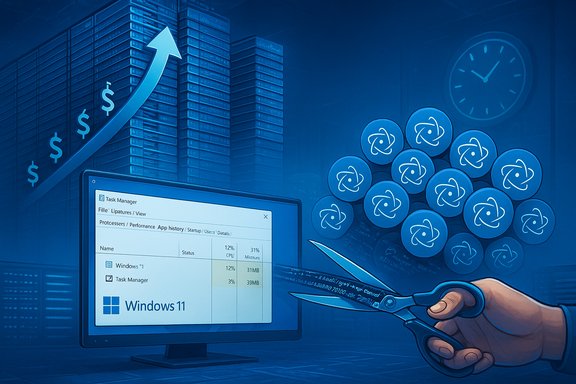
The sudden spike in memory prices driven by AI workloads has ripped the bandage off a long‑ignored problem: modern software — including Windows 11 and many flagship consumer apps — has grown complacently bloated, and the industry is finally being forced to pay for that inefficiency in real dollars and constrained hardware.
Background / Overview
The last 18 months have seen an unusual alignment of forces: hyperscalers and chipmakers racing to equip AI training clusters with high‑bandwidth, stacked DRAM (HBM), memory manufacturers prioritizing higher‑margin server and accelerator parts, and geopolitical and tariff pressures tightening wafer allocations. The practical result is fewer wafers available for commodity DDR modules and client flash, producing sustained upward pressure on DRAM and NAND prices and longer module lead times. Major memory vendors publicly described HBM capacity being fully allocated for calendar 2025, and market trackers documented sharp price moves in both DRAM and client SSDs. That supply shock reframes a perennial debate. For years the default fix to sluggish systems was: buy more RAM. That answer worked while memory was cheap and plentiful. Now, with spot and contract DRAM prices surging and HBM eating wafer capacity, “add RAM” is an increasingly expensive and often impossible option — so software inefficiency that once felt benign now has measurable economic consequences. Analysts at IDC warned of price‑driven slowdowns in device shipments and possible spec cuts from OEMs as memory costs bite margins.The AI‑Driven Memory Squeeze
HBM and the wafer trade‑off
High‑Bandwidth Memory (HBM) is the critical ingredient in modern AI accelerators. HBM stacks deliver orders of magnitude more bandwidth per package than commodity DDR, but they demand dramatically more wafer real estate per useful byte. In plain terms: building an HBM stack consumes the same manufacturing resources that could otherwise produce several DIMMs of DDR. Micron and industry analysts have repeatedly signalled that HBM allocations for 2025 were largely spoken for, and vendor comments imply HBM ramps will continue to crowd out commodity DRAM capacity in the near term. Why that matters: fabs don’t instantly rewire capacity. Moving a process node or retooling a line to produce a different product class takes quarters to years. While memory demand will eventually balance, the interim creates a “memory wall” for consumer and enterprise device makers who must either absorb higher BOM costs, reduce features, or pass price increases to buyers. TrendForce and multiple trade outlets reported planned price increases for NAND and DRAM through 2025 and into 2026.Contract and spot price moves
Observers recorded startling short windows where spot DRAM quotes doubled, and contract pricing moved substantially higher in 2025. Those jumps were not merely headline noise: they motivated OEMs to revise product mix and distribution plans, and analysts warned that average selling prices (ASPs) for phones and PCs could rise by several percentage points as a direct consequence. The practical impact is visible: some boutique PC vendors temporarily stopped selling standalone memory kits to avoid secondary‑market price inflation, and OEM roadmaps began to contemplate “memory‑sparse” SKUs for budget lines.Why the crisis exposes software bloat
From constraint to complacency — a historical arc
Software bloat didn’t start overnight. It’s the product of an era when hardware improvements were effectively free to developers: more CPU cores, cheaper RAM, and virtually unlimited storage reduced incentives to micro‑optimize. Over decades, feature creep, convenience‑first frameworks, single codebases for many platforms, and aggressive bundling have all added layers — both visible and invisible — to modern applications.Where networked super‑apps and platform lock‑in succeeded, they also accumulated modular subsystems, mini‑program stores, analytics, and payment rails that are convenient for business but costly for memory and storage footprints. The pattern shows up across ecosystems: messaging apps, productivity suites, and even OS inbox apps have grown to include services that many users will never need. This is a structural problem that becomes painful when hardware is scarce and expensive.
The runtime tax: Chromium, Electron and WebView2
One of the clearest modern vectors for bloat is the decision to ship desktop clients inside browser engines. Electron, WebView2 and other Chromium‑based hosts give teams cross‑platform parity and rapid development, but they also carry a persistent runtime tax: each instance brings renderer processes, GPU processes, JavaScript heaps, and native bindings into memory. Multiply that by several always‑on agents (messaging clients, background updaters, sync services) and the baseline RAM footprint can balloon rapidly.Independent tests and community telemetry in 2024–2025 repeatedly illustrated this: when formerly native apps were rewrapped as WebView2 or Electron builds, idle and active memory footprints rose materially. Developers traded engineering time for shipping speed; the market now faces the bill.
Windows 11: symptom and lightning rod
Windows 11 sits at the center of the conversation because Microsoft has aggressively embedded AI features — Copilot, agentic automation, and new inbox experiences — into the default platform. Users and administrators report higher baseline memory usage, persistent background agents that keep models and telemetry pipelines warm, and a proliferation of inbox apps and suggestions that, cumulatively, push resource needs upward. Community projects that produce stripped‑down Windows images (tiny builds that remove Copilot and inbox apps) underscore the demand for a leaner default. Those projects are practical experiments that reveal what a more minimal Windows could look like, but they are not a panacea for mainstream users who need vendor support and security updates.A specific technical example cited in public commentary is the size of modern system utilities — the claim that the Task Manager executable alone has grown to over 100MB is widely repeated in forums as a symbol of excess. That particular figure is illustrative rather than definitive: executable footprint depends on packaging (native binary versus packaged UWP/WinUI container), associated runtime layers, and compression in shipping ISOs. Independent verification of the exact “100MB” claim did not produce a single authoritative registry entry; the underlying complaint — that previously tiny utilities are now packaged with shared runtime assets and larger resource envelopes — is, however, empirically observable in many contexts. (Treat specific single‑file size claims as anecdotal unless you inspect a given installation image directly.
Real‑world examples: apps, platforms and fallout
Messaging apps gone heavy
- WhatsApp’s Windows client reportedly shifted back to a WebView2‑based wrapper in 2025, with independent tests showing idle footprints and heavy‑use footprints far above the prior native UWP client. That migration produced loud user complaints and measurable memory increases in daily usage tests.
- Discord — built on Electron — has been a recurring poster child for desktop memory growth, with community traces showing idle and streaming states consuming gigabytes in long sessions. Discord has experimented with conservative automatic restarts as a short‑term mitigation while engineering work hunts down memory retention issues.
Cloud outages and systemic fragility
Bloated software matters beyond individual user discomfort. In 2025, several high‑profile cloud incidents (including wide AWS and Azure service degradations) underscored how fragile a tightly coupled, resource‑heavy ecosystem can be. When memory and compute are scarce at datacenter scale, marginal increases in workload per service magnify outage risk and recovery time. Public incidents in 2025 — including a holiday‑period wave of authentication and gaming platform disruptions traced to cloud backbone issues — illustrated how cascading failures can follow from concentrated dependencies. The cloud outages rekindled arguments for resilience through simplification: smaller, auditable components are easier to reason about and restart when problems appear.Industry responses and where optimization is happening
Hardware makers double down on HBM; software teams scramble
Memory suppliers have a commercial incentive to favor HBM and advanced server DRAM — margins are far higher than commodity DDR — and several vendors publicly noted HBM allocations sold out for calendar 2025. That shift is not purely speculative: companies like Micron reported meaningful HBM revenue ramps and allocation commitments, which in turn squeeze commodity supply. Software teams, in turn, are responding with a mix of triage and long‑term engineering:- Short‑term mitigations: aggressive caching policies, memory lifecycle fixes, periodic restarts for long‑running agents, and optional “lite” builds or settings that disable background AI features. These can reduce immediate pressure but often cost UX or require careful state management.
- Medium‑term moves: refactoring hot paths into native modules, adopting lighter runtimes (e.g., migrating away from full Electron bundling toward Tauri or native WebView integrations), and introducing modular feature flags so costly subsystems are optional rather than default.
- Long‑term discipline: reintroducing memory‑efficiency as a primary engineering metric rather than an afterthought. That includes measurable goals (p95/p99 memory footprints for standard use cases), toolchain investments, and procurement policies that make memory efficiency a first‑class RFP requirement for enterprise software. Community projects and open‑source audits have already shown that meaningful savings are possible when teams prioritize slim design.
Market and policy pressure
Analysts at IDC and others project that memory shortages will nudge OEMs to either raise device prices or cut specs on lower‑margin SKUs, which in turn may force software makers to consider lighter builds for constrained markets. For industries and regions where replacement cycles are slow, offering smaller, optional feature sets becomes not only a UX choice but a market necessity.Practical steps for Windows users and IT teams
If memory is becoming scarce and expensive, users and IT pros should act along two rails: immediate triage and longer‑term strategy.- Immediate triage (quick wins)
- Audit always‑on agents and background inbox services; disable or defer nonessential features such as persistent Copilot agents where policy allows.
- Replace heavy Electron/WebView2 clients with lighter web or native clients when available, or shift some work to web browsers that share a single engine instance.
- Use built‑in Windows tools (or community utilities) to identify large working sets and confirm whether memory growth is transient or monotonic.
- Medium‑term strategy (teams and enterprises)
- Establish memory‑budgets for key applications and include these budgets in vendor contracts.
- Instrument p95/p99 memory telemetry and require vendors to publish before/after metrics for major fixes.
- Prioritize refactors for long‑running agents (e.g., messaging daemons, sync services) that show monotonic memory growth.
- Consider modular OS images for constrained fleets — thin, vendor‑supported images reduce attack surface and resource use without sacrificing manageability.
- Developer guidance (engineering teams)
- Revisit framework choices: use shared runtime patterns (shared WebView2 where appropriate), prefer native bindings for hot loops, and adopt leak‑detector tooling early in CI.
- Treat efficiency as a product requirement: add shipping gates that fail builds which increase baseline memory beyond agreed thresholds.
- Explore model‑level optimizations for AI features: quantization, pruning, and offloading to cloud inference when on‑device costs are too steep.
Strengths, risks and trade‑offs
Strengths of the current model
- Developer velocity and cross‑platform parity are real benefits. Frameworks like Electron and WebView2 drastically reduce time‑to‑market and lower maintenance overhead for multi‑platform teams.
- Deep OS integration of AI features can deliver genuine productivity wins when properly engineered and optional for users who want them.
- HBM and AI infrastructure investments accelerate research and capability that power advances across healthcare, climate models, and scientific computing.
Real risks exposed by the memory crunch
- Economic: higher memory prices translate directly into higher device ASPs and potentially reduced device penetration in emerging markets.
- Operational: bloated, always‑on software increases attack surface, magnifies outage impact, and complicates incident recovery.
- Equity: spec cuts and price rises disproportionately hit entry‑level users and small organizations; the digital divide widens unless efficiency offsets hardware cost pressures.
- Vendor trust: if companies ship heavy features as defaults and force users to hunt through settings to reclaim resources, user trust erodes — and workarounds proliferate, increasing security and support risk.
What claims are solid — and where to be cautious
- Solidly supported claims:
- HBM allocations for 2024–2025 were tightly allocated and cited by major vendors; Micron and industry press reported sold‑out HBM supply and revenue ramps.
- Analysts including IDC and TrendForce warned of memory‑driven price pressure and potential PC/smartphone ASP increases in 2026.
- Multiple mainstream outlets and community telemetry documented significant RAM increases when apps migrate from native clients to Electron/WebView2 wrappers.
- Claims to treat cautiously:
- Precise per‑file sizes (for example, the Task Manager executable exceeding 100MB) are context‑sensitive and can vary by Windows edition, installer packaging, and whether the figure counts only the single EXE or a supporting package. Independent, repeatable measurement on a target image is the right way to verify such claims.
- Extrapolations like “memory prices will double everywhere for the next decade” are plausible scenarios in stress moments but depend on capacity ramps, policy changes, and fab investments; short‑term volatility is real, long‑term normalization is equally possible as fabs scale. Market forecasts vary by source and scenario.
Forging a leaner future
The memory squeeze could be a forcing function for an engineering culture reset: one that treats memory and storage efficiency as first‑class attributes, makes modularity frictionless, and returns to the discipline of designing with constraints. History shows that scarcity breeds innovation: compact runtimes, better AOT compilation, smaller model formats, and smarter offload strategies can reduce per‑device footprint dramatically while preserving utility.Key accelerants to watch:
- Better developer tooling that surfaces memory regressions earlier in the lifecycle.
- Wider adoption of lean alternatives to heavy browser wrappers (Tauri, native WebView patterns).
- OS vendors giving users clear, persistent controls to opt out of background AI agents and bloat features without needing deep registry hacks.
- Broader procurement practices that explicitly value memory efficiency in vendor selection.
In the short term, consumers will see higher BOMs, IT teams will be forced into tighter audits and triage, and developers will face renewed incentives to prioritize efficiency. The memory crisis is painful precisely because it reveals where technical debt and convenience‑driven choices quietly taxed the whole ecosystem. The opportunity is simple and pragmatic: slimmer software that delivers the same value with fewer resources benefits everyone — users, the planet, and the balance sheet.
Source: WebProNews AI’s 2025 Memory Demand Exposes Software Bloat in Windows 11
