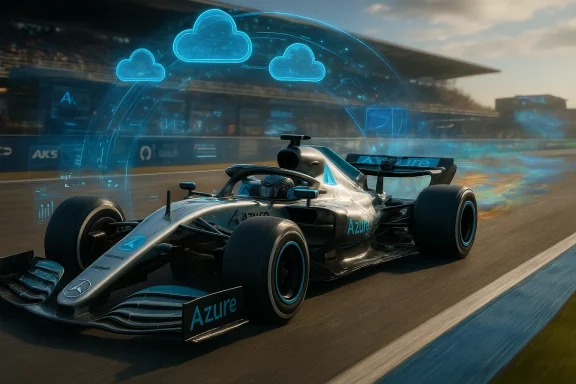
Microsoft’s decision to place Azure, GitHub aand Microsoft 365 at the center of Mercedes‑AMG PETRONAS F1 Team operations is more than a headline sponsorship — it’s a deliberate bet that cloud scale and enterprise AI will be decisive performance levers in the 2026 Formula 1 era.
Modern Formula 1 has evolved into a contest of sensors, models and compute. Each contemporary F1 car carries hundreds of sensors and produces telemetry measured in the hundreds of thousands to millions of data points per second; teams translate that torrent into simulation runs, strategy scenarios and software‑driven control logic. Microsoft and Mercedes framed their multi‑year relationship as an effort to “harness the power” of cloud and enterprise AI across the factory and paddock, explicitly nd Microsoft 365 as tools that will be expanded across engineering, simulation and race operations. This partnership represents a shift in optics and operations: Microsoft ended its long association with the Enstone‑based Lotus/Alpine lineage and is now aligning with Mercedes as the sponsorship resets — new power units, revised aero rules and a greater emphasis on electrification and efficiency for 2026. The deal couples visible branding on the new Mercedes W17 with deeper technical commitments.
Standardizing simulation code, model artifacts and deployment pipelines in GitHub enables reproducibility — a crucial requirement when small parameter changes can have outsized performance effects. Container orchestration (AKS) plus versioned GitHub workflows simulation and control software, reducing manual handoffs and the risk of divergence between factory code and trackside deployments. The team’s move to deepen GitHub usage is therefore a practical step to accelerate iteration.
Source: Windows Central Microsoft partners with one of F1's biggest teams for cloud and AI tech
 Background
Modern Formula 1 has evolved into a contest of sensors, models and compute. Each contemporary F1 car carries hundreds of sensors and produces telemetry measured in the hundreds of thousands to millions of data points per second; teams translate that torrent into simulation runs, strategy scenarios and software‑driven control logic. Microsoft and Mercedes framed their multi‑year relationship as an effort to “harness the power” of cloud and enterprise AI across the factory and paddock, explicitly nd Microsoft 365 as tools that will be expanded across engineering, simulation and race operations. This partnership represents a shift in optics and operations: Microsoft ended its long association with the Enstone‑based Lotus/Alpine lineage and is now aligning with Mercedes as the sponsorship resets — new power units, revised aero rules and a greater emphasis on electrification and efficiency for 2026. The deal couples visible branding on the new Mercedes W17 with deeper technical commitments.What Microsoft and Mercedes announced (the public facts)
- Microsoft has established a multi‑year commercial and technical partnership announced alongside Mercedes’ 2026 car reveal that places Microsoft branding on the W17 and team apparel.
- The partnership will expand Mercedes’ use of Azure for high‑performance computing (HPC), simulation workloads, model training and real‑time inference, and will use Azure Kubernetes Service (AKS) fornews.microsoft.
- GitHub will be used to development workflows, improving reproducibility and CI/CD for simulation and control software. Microsoft 365 will be extended to enhance cross‑team collaboration and operational efficiency.
- Mercedes and Microsoft cited pilot work using intelligent virtual sensors and cloud pilots that demonstrated the ability to test new telemetry‑driven features without adding on‑car hardware.
What remains unclear or unverified
- Neither Mercedes nor Microsoft disclosed financial terms. Industry reporting has circulated a widely quoted estimate of roughly USD 60 million per yearbut that figure is unconfirmed by either party and should be treated as an industry estimate rather than contractual fact.
- Specific operational details — such as service‑level agreements (SLAs) for telemetry handling, exact data governance clauses, or how cloud OpEx will be treated under the FIA budget cap regime — were not published in the joint announcement. Those contractual details will materially affect run and audited.
Why this matters: the technical case
Telemetry scale and compute elasticity
Formula 1 produces the time‑series data. Mercedes and Microsoft added detail to a familiar industry fact: modern F1 cars typically use more than 400 sensors and can generate over 1.1 million data points per second during operation. That level of throughput creates terabytes of data across a race weekend — a workload pattern ideally suited to elastic cloud compute for batch simulation and model training. Elasticity matters because on‑premises HPC is hard to build and maintain at the scale needed for spikes in simulation demand. By bursting into Azure, a team can run many more computational fluid dynamics (CFD), thermal and hybrid powertrain simulations in parallel and then tear down the capacity when it’s no longer needed. That shortens the “idea → validation → manufacture” loop and lets teams explore more variants before going to production.AI for strategy and inference
Race strategy has become an optimization and probabilistic‑modelling problem: tyre degradation, energy deployment, Safettop windows are all areas where machine learning models can provide faster re‑optimizations as conditions change. Cloud‑backed models can recompute large Monte Carlo scenario sets and feed strategists with near‑real‑time recommendations, improving decision quality during the critic races. Mercedes and Microsoft explicitly flagged strategy modelling and cross‑team analytics as priority use cases. ([mercedesamgf1.com](Mercedes-AMG F1 and Microsoft Unite to Drive Innovation From Factory to Circuit - Mercedes-AMG PETRONAS F1 Team tooling and reproducibilityStandardizing simulation code, model artifacts and deployment pipelines in GitHub enables reproducibility — a crucial requirement when small parameter changes can have outsized performance effects. Container orchestration (AKS) plus versioned GitHub workflows simulation and control software, reducing manual handoffs and the risk of divergence between factory code and trackside deployments. The team’s move to deepen GitHub usage is therefore a practical step to accelerate iteration.
The strategic fit: strengths and immediate upside
- Scalability without capital waste: Cloud bursting removes the need to buy and idle large HPC clusters. Teams can match spend to need and push more permutations through validation before committing to manufacturing.
- Faster time to insight: More simulation runs and faster model training compress development cycles, enabling aerodynamic and powertrain updates to reach the car earlier in the season. That is particularly valuable during 2026’s tighter regulatory windows.
- Unified toolchain: Owning the stack from development (GitHub) to compute (Azure) to collaboration (Microsoft 365) reduces integration overhead and produces a single source of truth for telemetry and models. This reduces friction when multiple engineering domains must collaborate quickly.
- C Centralized telemetry and AI can enable predictive maintenance, powertrain optimization and improved driver performance modeling — advantages that can feed both F1 performance and road‑car R&D. The partnership builds on a long history of Microsoft–Mercedes collaborations outside the sport.
Risks, operationance concerns
While the upside is real, cloud‑centric operations introduce non‑trivial risks that Mercedes will need to manage explicitly.1. Latency and trackside constraints
Real‑time race decisions require ultra‑low latency. Cloud backends add network hops and cannot replace dedicated high‑performance trackside systems for microsecond‑sensitive control loops. The partnership’s working model — heavy batch training and parallel simulation inference and mission‑critical decisions on hardened trackside hardware — is pragmatic, but expectations must be aligned: cloud is best for heavy compute and fast but not microsecond‑sensitive tasks.2. Data sovereignty and security
Telemetry and design IP are among a team’s most valuable assets. Moving models and data to a third‑party cloud raises questions about residency, encryption, access controls and the shared responsibility model. Mercedes will need strict vernance, tenant isolation, robust encryption at rest/in transit and prescriptive SLAs for incident response. Public announcements did not disclose those contractual guardrails.3. Vendor lock‑in and portability
Relying on managed services and proprietary accelerators can create migration friction. Containers and open standards mitigate risk, but if teams increasingly depend on a single provider’s specializationed services (unique AI acce lakes, proprietary tooling), moving workloads later will be costly. A defensible exit or multi‑cloud portability strategy should be part of any long‑term deal.4. Cost management and the FIA budget cap
Cloud OpEx is elastic and can grow quickly with thousands of simulation hours or large ML model training. Effective FinOps controls, tagginbook automation are necessary to avoid runaway costs — and to ensure transparency within the FIA’s cost cap environment. How cloud spending is treated under sporting financiastion that teams must resolve contractually and in regulatory filings.5. Regulatory scrutiny and sporting fairness
If cloud‑enabled virtual testing or high‑velocity ially accelerates development, regulators and rival teams could question whether competitive parity is preservall teams can economically match the same scale of cloud compute. The FIA may require disclosure of si or provenance of models used in homologation‑sensitive domains.How the partnership could play out across the 2026 season: practical milestones
The announcement is strategic; success will be judged on operational evidence. Key milestones to watch:- Trackside pilots appearing in live sessions — visible use of cloud‑augmented strategy tools or virtual‑sensor outputs during practice or qualifying.
- Public or indirect disclosures of increased simulation volume or reduced iteration times — measurable signals that Azure is materially changing the engineering cadence.
- Security and governance statements — explicit contractual language or public documentatiory IP is protected and segregated in cloud environments.
- Cost accounting disclosures — how Mercedes reports and manages cloud OpEx relative to the FIA cost cap.
Commercial and market implications
The move is both a commercial and strategic repositioning for Microsoft. Publicly, the partnership gives Microsoft high visibility flagship teams and a testbed for enterprise AI and Azure at extreme scale. For Mercedes, the partnership delivers both a financial and operational halo: potential sponsorship revenue and a single vendor ecosystem spanning compute, code and productivity tools. Industry reporting has sd be worth tens of millions annually, a figure that would rank among the grid’s larger partnerships — but again, that estimate is unconfirmed by the parties. Competitively, expect rivals to accelerate or publicize their own tech partnerships; the move effectively raises the bar for “cloud maturity” as a scouting criteria for sponsliers. Teams with less access to hyperscale compute may need to partner with ISVs or consortiums to close the gap, and teams will likely focus greater effort on proving the provenance and auditability of cloud‑derived models to satisfy regulcal analysis: what Microsoft and Mercedes must get right- Operational discipline around FinOps and observability. Elastic compute must be paired with cost governance to ensure innovation doesn’t become an unbudgeted expense that undermines long‑term sustainability.
- Clear, enforceable security & IP clauses. The team must define who owns models, where telemetries are stored, and how incidents are handled, especially given cross‑jurisdiction cloud operations.
- Portability and open standards. To avoid long‑term lock‑in, Mercedes should invest in containerized, standards‑based pipelines and maintain the ability to execute critical workloads on‑premise or on alternative cloud providers when needed.
- Measured expectations for latency‑sensitive domains. Leadership must be candid internally and publicly: cloud will accelerate heavy compute and model training, but it is not a substitute for specialized, low‑latency trackside hardware.
Broader significance for enterprise IT and the automotive industry
This partnership undnd: mission‑critical engineering domains view cloud and AI not as optional tools but as foundational platforms. The same patterns apply to automotive, aerospace and industrial engineering where rapid simulation, secure telemetry ingestion and short iteration cycles deliver measurable commercial value. Lessons learned in F1 often cascade to road‑car engineering and factory automation; cloud‑native AI experiments in the paddock could produce transferable gains for Mercedes‑Benz product development and manufacturing. For enterprise IT leaders, the move is a validation that integrated toolchains — versioned code, containerized workloads and elastic compute — are a proven path to faster engineering cycles. But the F1 case also serves as a caution: the governance, security and cost controls that work at hyperscale need to be deliberately applied in tightly regulated and IP‑sensitive contexts.Conclusion
Placing Microsoft technologies at the heart of Mercedes‑AMG PETRONAS’ operations is a logical response to Formula 1’s data‑driven evolution and the sport’s 2026 technical reset. The public partnership outlines a credible set of technical levers — Azure for elastic HPC and AI, GitHub for reproducible workflows, and Microsoft 365 for collaboration — that can shorten iteration cycles and deliver smarter race‑time decisions. The real test will be operational: visible in‑race usage of cloud‑derived insights, measurable increases in simulation throughput, clear governance of telemetry and IP, and disciplined cost management. Observers should treat commercial estimates like the widely reported ~$60M/year number as unconfirmed until either party publishes financial terms. If Mercedes and Microsoft execute the technical integration with strong governance, the partnership could become a blueprint for how elite engineering teams convert raw telemetry into seconds gained on track and transferable road‑car innovation off it. If they fail to address latency realities, data governance and cost discipline, the announcement will stand as an instructive example of the operational complexity that accompanies large‑scale digital transformation.Source: Windows Central Microsoft partners with one of F1's biggest teams for cloud and AI tech