

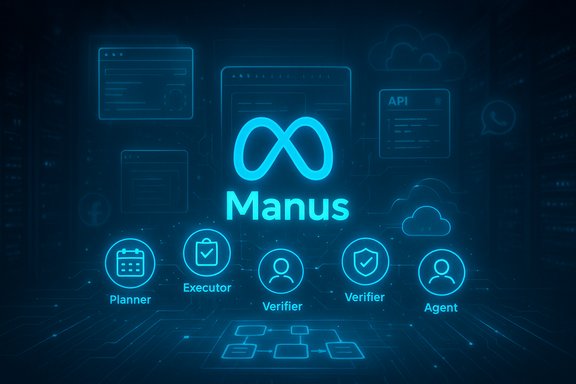
Meta’s purchase of Manus, a fast-growing Singapore-based startup that built a viral “general-purpose” autonomous agent, marks a decisive pivot in the company’s AI playbook and could reshape how intelligent assistants move from chat to real-world execution across billions of social-media users and millions of businesses.
Background / Overview
Meta announced it has acquired Manus — a startup that launched earlier in 2025 with a platform of agentic AI capable of planning, executing and iterating on multi-step tasks — and said the technology and team will be used to expand “general-purpose agents” across Meta’s consumer and business products, including Meta AI. The deal was described by multiple reports as large — commonly cited to be in the neighborhood of two billion dollars — though Meta’s public statements did not disclose exact financial terms and described the move primarily as strategic: bring a functioning agent platform and experienced team into Meta’s broader AI engine and product roadmap while allowing Manus to continue operating as a standalone service in the near term.Manus itself has moved fast in 2025. The company grew from zero to a reported north of $100 million in annual recurring revenue (ARR) within months of launch, claims sustained month-over-month growth above 20% since its 1.5 release, and attracted a high-profile $75 million funding round earlier in the year. The startup’s architecture is notable for agent orchestration — coordinating specialized sub-agents in sandboxed cloud environments to carry out research, coding, tool usage, browser automation and other complex workflows autonomously — and for running atop third-party foundation models rather than building a base LLM from scratch.
For Meta, the Manus acquisition sits alongside other high-profile AI moves in 2025, including a major strategic investment in a leading data-labeling company and a reorganization of internal AI research. Together, those moves reflect a company intent on transforming heavy infrastructure spending into revenue-generating, product-level AI features.
Why Manus matters: product, growth and the agent transition
From chatbots to executors: what Manus built
Manus’s product emphasized agentic autonomy — not just answering a user’s question but taking responsibility for multi-step tasks: executing web-based research, interacting with APIs, running local or cloud code, synthesizing results, creating documents or even building mobile applications from natural language instructions. The platform’s distinctive features include:- Multi-agent orchestration — a planner/executor/knowledge/verification split that permits parallel subtasks and internal verification loops.
- Sandboxed virtual compute environments — virtual “machines” Manus can spin up, run tasks in, and tear down without relying on the user’s device.
- Context Engineering — persistent, stateful context over long tasks enabling thousands of iterations of reasoning and tool use.
- Wide Research capability — agent swarms that scale research tasks across many sources and synthesize results.
Rapid revenue and viral adoption
Manus reported spectacular early revenue growth and usage metrics: reaching a major ARR milestone within months, processing massive token volumes, and sustaining high month-over-month growth after key product updates. This combination of revenue and viral adoption is rare among early AI startups and explained why a large tech buyer would choose acquisition over internal development: Meta gains an operational, monetized product and the team who built it.A practical route to agent scale
Where many large companies and labs are still focused on model architecture and raw capability, Manus delivered a working agent platform — a software stack that ties models to tools, state, orchestration and customer workflows. That practical glue is difficult to build and even harder to commercialize; Meta didn’t just buy algorithmic ideas, it bought a deployable product and the operational lessons for scaling agentic workloads.Technical anatomy and vendor stack
Not an LLM maker, but an integrator
A key technical characteristic of Manus is that it did not claim to be building a foundational LLM from scratch. Instead, Manus engineered an agent layer on top of existing high-quality language models and domestic models where needed, combining strengths from multiple vendors to deliver autonomy and toolfulness at scale. The result was a hybrid stack that:- Leveraged advanced third-party models for core planning and reasoning.
- Integrated fine-tuned or domestically hosted models (for certain regions or compliance scenarios).
- Orchestrated tool connectors to web browsers, cloud services, code execution environments, and storage.
Core innovations: Context Engineering and Wide Research
Two technical ideas associated with Manus have already entered industry conversations:- Context Engineering: pragmatic techniques and state-management systems that persist and reconstruct long-form agent memory and execution history, enabling agents to operate over days and across thousands of low-latency state transitions.
- Wide Research: scaling parallel agent instances to explore and synthesize information from vast sets of sources, enabling deeper factual grounding for multi-step tasks.
Model supply and dependencies: a double-edged sword
Manus’ architecture deliberately built on top of foundation models from multiple suppliers rather than attempting to train its own monolithic LLM. That reduced R&D and infrastructure cost but introduced vendor dependencies:- Benefits: speed to market, access to cutting-edge reasoning and safety capabilities, and the ability to swap models as better ones appear.
- Risks: reliance on third-party model availability, pricing, latency and commercial terms; geopolitical issues if models or services are embargoed or blocked in certain regions; and complexity in guaranteeing consistent behaviour when models change.
Strategic rationale for Meta
A working, monetized product — not just R&D
Meta’s infrastructure and model development investments have been massive. An urgent strategic need for the company is transforming those investments into profitable, consumer-facing products. Manus brings a revenue-generating product and a clear go-to-market model: subscriptions, usage-based billing and business workflows. That commercial maturity stands in contrast to many acquisitions that buy IP and talent without immediate monetization paths.Speed and experience: buy vs build
Building a fully integrated, agent-capable platform — encompassing tooling, orchestration, cloud compute patterns and commercial billing — would require time and risk. By acquiring Manus, Meta short-circuits development time, gains experienced operational teams, and obtains a blueprint for integrating agents into services like messaging, search, ads and business tools.Competing in the agent market
Autonomous agent systems are widely expected to be the next major product category beyond conversational assistants. Meta’s platforms (Facebook, Instagram, WhatsApp) are natural distribution channels for agents that can execute tasks for users and advertisers. Manus provides a head start in the race to embed agents across consumer and B2B flows and to monetize agent-driven workflows.Risks, friction points and regulatory exposures
Geopolitics and provenance
Manus originated in China and later moved to Singapore, and some of its earlier investors and development history have raised political scrutiny. Claims that Chinese ownership and operations will be severed following the acquisition aim to de-risk the transaction, but geopolitical sensitivities remain a factor:- Acquisition integration must address investor recapitalization and governance changes.
- Any lingering technical or personnel ties to China may attract political scrutiny in jurisdictions that are sensitive to national security concerns.
- The acquisition implicitly acknowledges the difficulty for a China-originated startup to scale a product that relies on Western model APIs without a global compliance strategy.
Data privacy and user safety
Agentic systems elevate privacy and safety concerns because they may interact with personal, financial or business systems autonomously. When an agent can read, act on and transmit sensitive data, the attack surface expands:- Privacy controls must be granular and enforceable: geo-fencing, consent flows, retention limits, and transparent audit trails.
- Verification and fallibility: agents make mistakes; robust human-in-the-loop safeguards, rollback mechanisms and verifiable audit logs are needed to limit harm.
- Third-party integrations: connecting to external services (banking, CRM, email) multiplies compliance responsibilities across jurisdictions.
Model provenance and vendor lock-in
Manus’s reliance on third-party models reduces the startup’s model-development burden but creates vulnerabilities:- If key model providers change pricing, restrict usage or alter model behaviour, product functionality could degrade.
- Meta may choose to migrate Manus to in-house models to control costs and behaviour; that migration is non-trivial and will require engineering and safety investment.
- Customers who adopted Manus because of specific model behaviours may be sensitive to model swaps or internal rehosting.
Integration complexity and user trust
Embedding agent capabilities across Meta’s billions of users is a major product and trust challenge. Agents that perform poorly, leak data or misbehave could cause broad reputational damage. Meta must balance ambitious rollout plans with conservative safety, testing and user control mechanisms.Competitive landscape and market implications
Where Meta sits: capabilities versus rivals
Meta’s acquisition places it more squarely in the agent race alongside other big tech players who are trying to combine models, tools and distribution. The competitive picture is:- Rivals with leading LLMs and cloud integrations (OpenAI, Google, Microsoft) continue to push agent features and platform-level integrations.
- Startups and niche players are innovating in vertical agent use-cases (legal, finance, research automation).
- Manus provided Meta with a ready-made agent product and a customer base; for Meta, the prize is integration into high-frequency engagement surfaces (messaging, content creation, ad targeting, business services).
Pricing and cost dynamics
Reports indicate Manus was competitively priced relative to some U.S. rivals, which may have contributed to user uptake. However, delivering agentic services at scale remains expensive: compute, storage for persistent state, tool hosting and verification layers all carry continual costs. Meta’s large-scale infrastructure and data-center investments give it an advantage in absorbing costs during product maturation and negotiating favourable model pricing where vertical integration occurs.Integration roadmap and product possibilities
Short-term: keep the business running independently
Meta has signalled Manus will continue to sell subscriptions independently in the near term and operate from Singapore with the existing team intact. That reduces immediate disruption for existing customers and preserves the product’s revenue stream while Meta engineers deeper integrations.Medium-term: embed agents into Meta AI and platform experiences
Planned integration paths include embedding Manus’s agent orchestration into Meta AI offerings and surface-level integrations across messaging and social experiences:- Agents running inside messaging apps to automate bookings, customer service work, or create content drafts.
- Business-facing agents to automate marketing workflows, campaign analysis and ad creative generation.
- Consumer agents that can plan trips, aggregate research and perform multi-step tasks without requiring users to learn complex tools.
Long-term: migrating to Meta-controlled models and infrastructure
Meta may be incentivized to migrate Manus’s agent stack onto Meta-developed foundation models to reduce vendor dependencies and better align safety, performance and monetization strategies. This would be a large engineering lift but fits the company’s broader investment in AI labs and compute infrastructure.Ethical and policy considerations
Auditability and explainability
Autonomous agents pose new questions for auditability: when an agent acts on behalf of a user, who is accountable for decisions? Meta will need to implement tooling that makes agent reasoning inspectable, records decision chains, and provides human-review workflows for high-risk activities.Regulatory alignment
Agencies and lawmakers are increasingly examining AI systems that make independent decisions, especially where personal data or financial outcomes are at risk. Manus’s agent technology intersects directly with areas many new AI laws are trying to govern:- The EU AI Act and similar frameworks emphasize risk-based controls for AI products that interact with personal or critical infrastructure.
- In the U.S., evolving federal guidance and state privacy laws will shape permissible integrations and user controls.
- International deployment will require careful geo-specific compliance: data residency, export controls and national security reviews.
Financial and corporate context
Capital scale and balance-sheet impact
Reporters and analysts widely characterize the Manus deal as material in strategic terms but not a balance-sheet stretch for a company of Meta’s size. Meta’s market capitalization has been well over the trillion-dollar mark in late-2025 trading windows, and the firm’s advertising revenues continue to generate substantial cash flow. For that reason, the acquisition is primarily strategic rather than an attempt at financial engineering.Monetization pathways
Manus’s subscription model and usage-based billing provide immediate revenue channels. Meta’s value-add will be distribution at scale: embedding agent features into apps that reach billions — which could convert free or low-cost users into revenue streams via premium agent features for businesses and power users, ad-linked automation, and new enterprise agent subscriptions.What remains uncertain (and what to watch)
Several important items remain fluid and require monitoring:- Deal terms and structure: public statements were intentionally vague. Multiple reports estimate deal value in the low billions, but precise financials and any retention or earn-out details have not been publicly confirmed.
- Model roadmap: Manus used third-party models for core reasoning; whether Meta will continue that approach or migrate Manus to Meta-developed LLMs is an open question.
- Regulatory approvals and political response: given Manus’s origin and earlier investor profile, regulatory scrutiny — especially in the U.S. and EU — could shape integration and deployment timelines.
- Data and privacy boundaries: exactly how Manus customer data will be handled, separated, or migrated — and what assurances customers will receive — is a material consideration.
- Product governance and safety: the degree to which Meta imposes its own safety controls, auditing, and human-review processes on Manus agents will be critical for risk management.
Bottom line: strategic lift balanced by new obligations
Meta’s acquisition of Manus is more than a trophy buy; it is a tactical attempt to convert infrastructure and research investment into a revenue-generating agent platform that can be distributed across Meta’s massive user base. Manus brings a working product, an architecture for agent orchestration, and a team steeped in building multi-step automation — precisely the capabilities needed to accelerate the next wave of AI-driven user experiences.At the same time, this deal spotlights the difficult trade-offs of modern AI strategy: speed vs independence, commercial traction vs vendor reliance, and product ambition vs regulatory responsibility. For users and businesses, the promise is real: agents that do rather than only tell. For regulators and privacy advocates, the stakes have climbed — agents that interact with personal, financial or professional systems demand explicit safeguards.
In pragmatic terms, the acquisition reduces Meta’s time-to-market for agentic features and gives the company a blueprint for commercializing automated workflows. The real test — and the measure of long-term success — will be whether Meta can integrate Manus’s technology while maintaining transparent controls, robust safety checks, and a commitment to user privacy, all while turning agentic experiences into sustained revenue streams across Meta’s platforms.
What to watch next
- Product moves: how soon Manus-style agents appear inside Meta AI, messaging apps, or ad tools.
- Model strategy: whether Manus remains multi-vendor or is migrated to Meta’s in-house models over time.
- Regulatory dynamics: any investigations, approvals, or restrictions tied to the acquisition or Manus deployments.
- Commercial signals: pricing changes, enterprise partnerships, or bundled offerings that reveal Meta’s monetization plan.
- Safety governance: published audits, transparency reports, or new user-control features that indicate how Meta will manage agent risk.
Source: Technobezz Meta Acquires AI Startup Manus to Boost Its Autonomous Agent Capabilities
