

Meta’s latest quarter delivered a clear, market-moving message: an ad-first AI playbook can produce fast, visible returns while the cloud‑centric, capex‑heavy route to AI scale still forces investors to be patient. Meta posted a blowout December quarter and set aggressive 2026 infrastructure plans; Microsoft also beat expectations but its Azure deceleration and record capital spending left traders uneasy. This earnings pair-off crystallizes a wider question for the AI era: which monetization model converts compute intensity into sustained cash flow fastest — attention and ads, or enterprise cloud and seat/consumption economics?
Tech giants entered 2024–2026 with vastly different AI playbooks. Meta doubled down on consumer attention — rebuilding recommendation systems and folding large models into ranking and creative tooling to increase time spent, impressions, and ad yield. Microsoft pursued a full‑stack enterprise strategy: invest in Azure and data center capacity, buy into OpenAI partnerships, and productize AI via Copilots and paid enterprise seats. Those divergent strategies informed investor reactions this earnings season: Meta’s ad metrics are proving immediate cash-flow leverage; Microsoft iel returns on an enormous hardware buildout.
Meta also reported 3.58 billion daily active users across its Family of Apps, and executives highlighted that AI‑driven recommendation systems and content generation features are materially increasing session length and ad attach rates. The company stated that Meta AI daily actives generating media tripled year‑over‑year — a useful signal that AI features are becoming part of user workflows and content creation.
The company also disclosed record capex for the period — roughly $37.5 billion — with a large share directed toward GPUs, memory, and short‑lived assets to support AI workloads. That spending pushed the first‑half capex total into the $70B+ range and underlined how expensive enterprise AI scale is. Investors were concerned that capex growth might be outpacing the speed at which those investments convert into durable incremental revenue.
This reaction underscores a broader investor preference in roof beats promise*. Public markets will favor companies that can point to immediate, attributable revenue growth driven by AI features. Companies that require multi‑year infrastructure absorption and complicated enterprise conversions must show credible milestones and transparent unit economics to maintain valuation support.
Source: WebProNews Meta’s Ad AI Triumph Eclipses Microsoft’s Cloud Hurdles
 Background
Tech giants entered 2024–2026 with vastly different AI playbooks. Meta doubled down on consumer attention — rebuilding recommendation systems and folding large models into ranking and creative tooling to increase time spent, impressions, and ad yield. Microsoft pursued a full‑stack enterprise strategy: invest in Azure and data center capacity, buy into OpenAI partnerships, and productize AI via Copilots and paid enterprise seats. Those divergent strategies informed investor reactions this earnings season: Meta’s ad metrics are proving immediate cash-flow leverage; Microsoft iel returns on an enormous hardware buildout.What happened this quarter — the headlines
- Meta reported Q4 revenue of $59.9 billion, up 24% year‑over‑year, with EPS of $8.88, beating expectations and prompting a strong after‑hours rally. Management guided Q1 revenue to a midpoint consistent with ~30% year‑over‑year growth and flagged a 2026 capital‑spending plan that soars well above 2025 levels.
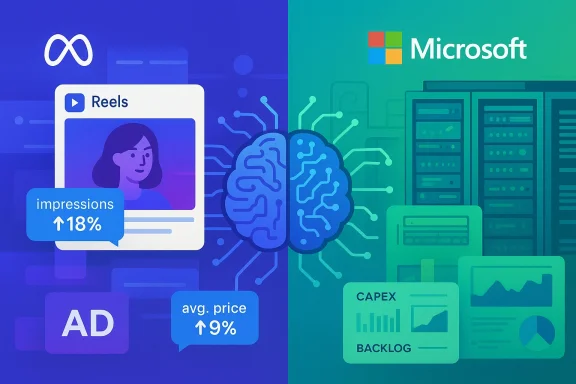
- Microsoft posted quarterly revenue of approximately $81.3 billion and reported Azure growth of 39%, a slight deceleration from the prior quarter’s ~40%. The company disclosed record capex of roughly $37.5 billion for the period and noted that remaining performance obligations (RPO/backlog) more than doubled to about $625 billion, with roughly 45% tied to OpenAI commitments — a concentration investors are scrutinizing. Microsoft shares dipped after hours.
Meta: how ad‑AI produced immediate receipts
Big, measurable ad gains
Meta’s Q4 beat was driven by an unusual combination of volume and price improvement: ad impressions rose ~18% while average ad price climbed ~9%, a rare double‑expansion that directly lifts top line and margins in an ad‑dominated model. Reels — Meta’s short‑form video product — saw U.S. watch time jump by about 30%, and newer in‑house creative tooling such as the Edits app is already responsible for a meaningful fraction of Reels consumption. Those engagement lifts translate to more monetizable inventory and higher CPMs.Meta also reported 3.58 billion daily active users across its Family of Apps, and executives highlighted that AI‑driven recommendation systems and content generation features are materially increasing session length and ad attach rates. The company stated that Meta AI daily actives generating media tripled year‑over‑year — a useful signal that AI features are becoming part of user workflows and content creation.
Why the ad model monetizes AI faster
- Focused inventory: Meta’s core product remains attention — a direct input for CPM auctions. When AI increases engagement, the platform can immediately monetize that attention with ads.
- Low friction to monetize: New features that increase watch time or content creation typically do not require enterprises to change procurement cycles; ad dollars flow through existing demand sources.
- High contribution margins: The Family of Apps reported robust operating margins that allow the company to invest in infrastructure without immediate margin collapse.
Microsoft: growth, but heavier friction
Azure growth vs. capacity constraints
Microsoft’s cloud story is complex. Azure grew 39% year‑over‑year in the reported quarter, a terrific rate by historical standards yet a slight deceleration from the prior quarter and below some investors’ “north of 40%” expectations. Management said that if every new GPU had been allocated to Azure instead of other internal needs, Azure’s growth would have exceeded 40%, indicating that capacity allocation to internal projects and partner commitments (notably OpenAI) materially affects reported cloud growth.The company also disclosed record capex for the period — roughly $37.5 billion — with a large share directed toward GPUs, memory, and short‑lived assets to support AI workloads. That spending pushed the first‑half capex total into the $70B+ range and underlined how expensive enterprise AI scale is. Investors were concerned that capex growth might be outpacing the speed at which those investments convert into durable incremental revenue.
Backlog concentration and execution risk
Microsoft’s backlog (remaining performance obligations) doubled to ≈$625 billion, but management acknowledged that ~45% of that figure is attributable to OpenAI commitments. While that represents a huge revenue funnel on paper, it concentrates conversion risk around one partner; OpenAI’s business decisions and multi‑cloud options can materially change Microsoft’s realized future revenue. That concentration, combined with capacity constraints, explains some of the market’s caution.Productization friction
Microsoft’s route to monetizing AI relies on enterprises agreeing to buy Copilot seats, Azure consumption, and packaged AI services — a process that takes procurement cycles, integration, governance, and proof‑of‑value. That complexity means even a world‑class enterprise sales machine requires more time to extract value compared with an ad platform that monetizes attention in real time. Analysts noted that Microsoft must demonstrate clear unit economics and conversion paths from capex to recurring revenue to restore investor confidence.Capex: the new battleground — and the math that matters
Both companies are dramatically increasing infrastructure spend, but their exposure differs.- Meta projected 2026 capital expenditures of $115–$135 billion, a near‑doubling from 2025’s ~$72 billion.* Management framed the spending as foundational: building model training and inference capacity, Meta Superintelligence Labs, and integrated AI systems for personalization and agent products. Meta expects operating income in 2026 to exceed 2025 despite higher capex, backed by projected productivity gains from AI tools.
- Microsoft’s capex surge — $37.5 billion in the quarter alone — is directed at hyperscale data centers and accelerators. Unlike Meta, Microsoft has a large external cloud business it can sell capacity into, but competing demands (partner commitments, internal product teams, customer workloads) complicate allocation decisions. The practical result: a large, near‑term cash outflow that will be judged by whether it produces accelerating Azure consumption and Copilot seat growth.
Business‑model contrast: why structure shapes outcomes
Meta — the lean, attention‑monetizer
- Strengths:
- Direct monetization loop: more engagement = more impressions = more ad revenue.
- Faster product-to-revenue cycles for consumer features.
- High contribution margins in the core apps business.
- Weaknesses:
- Heavy reliance on advertising (~98% of revenue), which exposes Meta to ad market cyclicality and privacy/regulatory risks.
- Limited ability to monetize excess compute via external cloud customers (no large public cloud business), which raises capex utilization risk.
Microsoft — the diversified enterprise platform
- Strengths:
- Multiple monetization levers: Azure consumption, Copilot seat revenue, M365 subscription premiums, enterprise contracts.
- Distribution into Fortune 500 procurement channels and long‑term enterprise relationships.
- Weaknesses:
- Longer sales cycles and integration friction slow payback.
- Heavy capex and supply chain dependence (notably on Nvidia GPUs) make near‑term returns sensitive to hardware availability and pricing.
Market reaction and investor psychology
The market response was instructive. Meta’s stock jumped on the Q4 beat and bullish guidance — traders rewarded clear evidence that AI was driving ad revenue. Microsoft’s shares fell after hours as analysts parsed the shift in growth cadence and the ballooning capex figure, which could compress returns until utilization improves. Social sentiment framed this as “Meta showed receipts; Microsoft presented the bill.”This reaction underscores a broader investor preference in roof beats promise*. Public markets will favor companies that can point to immediate, attributable revenue growth driven by AI features. Companies that require multi‑year infrastructure absorption and complicated enterprise conversions must show credible milestones and transparent unit economics to maintain valuation support.
Risks, unknowns, and what to watch next
No earnings call eliminates risk. Below are the most important watch items — each of which can materially change the race’s outcome.- Compute supply and pricing: GPU supply constraints and memory shortages (and vendor pricing power) directly affect both companies’ ability to scale models and host workloads at attractive costs. Watch ve capex cadence disclosures.
- Meta’s zero‑click risk: If AI answers reduce page views and impressions, ad monetization could be structurally impaired. Meta’sds into new AI surfaces or use intent signals, but execution is not guaranteed. This remains a real, measurable risk.
- Concentration of Microsoft backlog: The fact that roughly 45% of Microsoft’s backlog is tied to OpenAI is both an opportunity and a concentration risk. Any change in OpenAI’s cloud strategy or multi‑cloud agreements would affect Microsoft’s projected future revenue conversion. Investors should monitor contractual disclosures and OpenAI’s public positioning.
- Regulatory and privacy headwinds: Both companies could be affected by privacy rules, ad‑targeting restrictions, or antitrust remedies that alter default placements or cross‑product data flows. These are non‑trivial tail risks for ad‑dependent businesses and for firms that rely on cross‑product data integration.
- Product adoption friction for enterprise Copilots: Enterprises require governance, SLA guarantees, and predictable TCO. Copilot and agent adoption metrics (seat attach rates, churn, per‑seat pricing) will be decisive indicators for Microsoft’s ability to monetize AI broadly.
Tactical implications for IT leaders and investors
For IT decision makers and CIOs:- Reassess vendor lock‑in risk: if a huge share of future workloads will live with a single hyperscaler, consider multi‑cloud strategies and contractual protections to avoid future pricing or capacity shocks.
- Quantify proof‑of‑value: insist on pilot KPIs that map to financial outcomes (revenue lift, cost reduction, time saved) before broad rollouts.
- Plan for capacity variability: short‑term GPU bottlenecks mean some projects may need flexible architectures (hybrids, on‑prem burst, or model distillation strategies).
- Watch unit economics closely: metrics like price per inference, GPU utilization, ad CPMs, and Copilot seat ARPU will be the real signals for durable returns.
- Distinguish recency from durability: a single earnings beat that’s tied to holiday ad demand is positive but not definitive. Look for sustained sequential improvements.
- Manage concentration risks: heavy exposure to a single partner (e.g., Microsoft/OpenAI) or business (Meta/advertising) should be sized with an eye on regulatory and market cyclicality.
Why neither outcome is binary
It’s tempting to declare a winner and a loser from a single earnings cycle, but the reality is more nuanced. Meta’s ad engine is demonstrating that consumer‑facing AI can monetize faster if user behavior continues to be monetizable and privacy/regulatory dynamics don’t undermine targeting. Microsoft’s cloud approach could ultimately generate larger, more durable revenue streams — but only if the company converts its massive backlog into billed revenue without crippling margin pressure from capex. Both firms are investing heavily because scale matters in AI; those investments will either widen moats or expose margin fragility depending on execution and external factors.Conclusion — proof over promise, but execution still rules
The earnings episode framed a simple market preference: deliver measurable revenue growth from AI, or explain how future investments will reliably convert into it. Meta’s Q4 offered concrete examples of AI increasing engagement and ad monetization, which the market rewarded. Microsoft delivered durable growth and a pipeline of future revenue but raised legitimate questions about capex timing, capacity allocation, and concentration risk tied to OpenAI. Both companies remain central to the future of AI — one because it turns attention into immediate receipts, the other because it builds the infrastructure and enterprise pathways that could underpin a multi‑year AI economy. Investors and IT leaders should now focus less on rhetoric and more on the unit economics and operational KPIs that will ultimately determine which strategy scales profitably.Source: WebProNews Meta’s Ad AI Triumph Eclipses Microsoft’s Cloud Hurdles
