

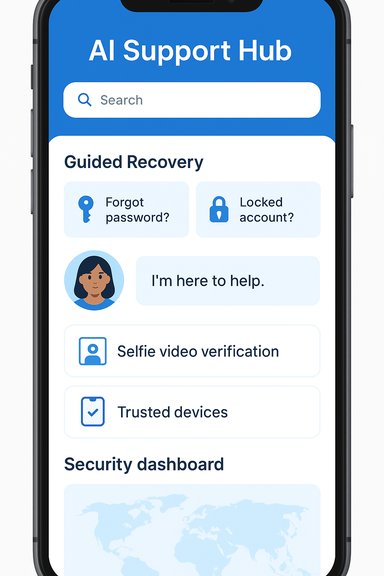
Meta has begun a sweeping overhaul of account support across Facebook, Instagram and WhatsApp, replacing scattered help pages and slow appeals with a centralized, AI-driven support hub and a new suite of business-facing AI tools — a move that promises faster recovery for hacked accounts but also escalates regulatory and privacy tensions in Europe.
Background
Meta’s announcement consolidates months of incremental product work into a single public push: a global support hub inside Facebook and Instagram that uses AI-powered search and an experimental AI support assistant to guide users through account recovery, profile management, and security settings. The company framed the changes as corrective: support “hasn’t always met expectations,” and AI can both speed answers and reduce fraud. At the same time, Meta has been building out Business AI—an automated agent for businesses that can handle customer conversations across Facebook, Instagram and WhatsApp, including purchases, returns, multilingual support and brand-toned replies. Meta positions these features as productivity multipliers for small and medium enterprises, enabling 24/7 customer coverage without hiring large human teams. These product moves collide with a rapidly intensifying regulatory environment. The European Commission has opened a formal antitrust investigation into Meta’s October policy update for the WhatsApp Business Solution, which restricts third-party AI assistants from using the Business API when the AI is the “primary” function offered — a change that effectively forces many consumer-facing assistants to leave WhatsApp by the enforcement date. European regulators say the policy could be an abuse of dominance if it prevents competitors from reaching users while Meta’s own assistant remains accessible on the platform.What Meta is rolling out — the details
A centralized support hub and AI assistant
- A single Support Hub inside the Facebook and Instagram apps that aggregates reporting tools, account recovery flows, and AI-assisted guidance. The hub is rolling out globally on iOS and Android.
- An AI-powered search engine inside the hub to surface relevant help articles and tailored instructions.
- An AI support assistant (initially tested on Facebook) capable of handling complex tasks such as stepwise account recovery and settings changes, with adaptive prompts and contextual guidance. The assistant is described as being more personalized than traditional chatbots.
New verification and recovery options
- A redesigned recovery experience that recognizes trusted devices and locations, sends more timely SMS/email alerts, and adapts flows to the user’s situation.
- An optional selfie-video verification method to establish identity during recovery, offered as an alternative to uploading government ID in some contexts. Meta says this approach improves recovery success without increasing friction.
Business AI for merchants and SMBs
- Business AI agents that can:
- Answer product questions, recommend items, and complete purchases in chat.
- Triage and route complex issues to live staff.
- Maintain a consistent brand voice by training on existing brand content.
- Offer multilingual support and reduce first-response times.
- Meta is positioning these agents as both a cost and capability win for small businesses: automation for routine, high-volume queries and a live fallback for edge cases. The company has run regional pilots and plans phased rollouts.
The company’s security claims — what’s verified and what’s still a claim
Meta publicly states that its AI-powered systems helped reduce new account hacks by more than 30% globally across Facebook and Instagram in the past year, and that hacked-account recovery success has increased by more than 30% in the U.S. and Canada. Those figures appear prominently in Meta’s newsroom post and are repeated in multiple outlets reporting on the rollout. Critical context and caveats:- These numbers are presented as company metrics in Meta’s release; they are company-reported and have not (at the time of writing) been independently audited or peer-reviewed by outside researchers.
- Independent reporting corroborates that Meta attributes measurable security improvements to new AI and behavioral systems, but a neutral, third-party verification of the precise percentage decline in hacks is not publicly available. Readers should treat the 30% number as Meta’s internal performance claim until external audits or regulatory filings provide independent confirmation.
Why the product shift matters — immediate benefits
Faster, more contextual recovery
Users who have been locked out or hacked will likely see a materially better experience:- AI can present the right recovery option at the right time, removing guesswork from a historically opaque appeals process.
- Selfie-video verification and smarter trusted-device recognition reduce reliance on brittle document uploads and can speed automated decisions when evidence is clear.
Reduced fraud surface and fewer false positives
Meta’s AI systems are being used to detect phishing, suspicious logins, and compromised accounts more rapidly, and the company claims the platform now disables legitimate accounts less often due to better discrimination. If sustained, this reduces downtime for creators, small businesses and everyday users who previously lost revenue or access because of false-positive enforcement.Business-level productivity and revenue gains
For small businesses that sell via DMs and chat, Business AI promises:- 24/7 coverage without the incremental cost of human staff.
- Fast lead qualification and automated follow-ups that keep conversion funnels warm.
- Multilingual and scale-ready handling of returns, shipping queries and common customer tasks, enabling smaller teams to compete with larger operations.
The regulatory and competitive storm: Europe takes notice
The EU’s antitrust investigation
The European Commission has opened a formal antitrust probe into Meta’s WhatsApp policy that restricts third-party “AI providers” from using the WhatsApp Business Solution when AI functionality is the primary service being offered. Regulators worry that the change — which already took effect for new providers in mid-October and applies to existing integrations from January 15, 2026 — may block rivals from reaching customers while leaving Meta’s own assistant available. The probe covers the EEA except Italy, and the Commission has indicated it will treat the matter as a priority.What the policy does in practice
- The updated WhatsApp Business Solution terms define “AI Providers” broadly (LLMs, generative platforms, and general-purpose assistants) and bar them from using the Business API when such AI is the primary offering.
- Meta preserves a carve-out for business-incidental AI (order updates, appointment confirmations, ticket triage), but consumer-facing assistants that are the main product are affected. Enforcement for existing integrations comes into force on January 15, 2026.
Market consequences already observed
Major third-party assistants — notably OpenAI’s ChatGPT and Microsoft’s Copilot — have publicly confirmed they will cease operating via WhatsApp by the January 15, 2026 deadline and have published user guidance for migration or account-linking to preserve chat history. That practical removal of rival assistants from WhatsApp is precisely the sort of outcome Brussels said it wanted to examine.Risks and fault lines — privacy, vendor lock-in, transparency, and security trade-offs
1) Company-reported metrics vs. independent verification
Meta’s security and recovery statistics are compelling but remain company-supplied. Without independent audits or published methodologies, those numbers cannot be treated as definitive. For journalists and policy makers, the correct posture is skepticism-plus-verification: take the improvement seriously, ask for data access and independent testing, and press Meta to publish sanitized samples for third-party validation.2) Increased automation can amplify opaque decisions
Automating account actions and appeals with AI can accelerate outcomes but also compound the problem of unexplained enforcement. Where a human reviewer might provide context, an opaque model can close an account or refuse recovery with little recourse. This is a well-documented pain point among creators and small businesses who say automated takedowns have led to lost income. Any scale-up of AI support must be matched with transparent appeal channels and human oversight for nuanced cases.3) Privacy and biometric concerns around selfie-video verification
Introducing selfie-video as a recovery mechanism raises two issues:- Data minimization: How long will these videos be stored, and for what purposes?
- De-identification and misuse risk: Even if videos are used only for immediate verification, storage policies, access controls and retention limits must be robust to prevent repurposing or data leaks.
4) Platform governance and competitive harm
The WhatsApp Business Solution policy that limits third-party AI on WhatsApp has a direct competitive effect: it preserves Meta’s ability to surface its own assistant on the messaging surface while curtailing rivals. That tactic triggers antitrust scrutiny in jurisdictions that prohibit dominant firms from foreclosing markets. If regulators find the policy anticompetitive, Meta could face remedies or be required to alter terms. The investigation’s outcome will be a bellwether for platform governance in the AI era.5) Data access and legal exposure for AI firms
Separately, discovery orders in U.S. litigation are widening the transparency demands on AI firms. For example, a court in New York has ordered OpenAI to produce a sample of 20 million de-identified ChatGPT conversation logs to plaintiffs in a consolidated publishers’ copyright suit — a decision that underscores how litigation can force AI companies to reveal how their models handle copyrighted content and user interactions. The order is constrained by privacy safeguards, but it raises the stakes for how companies preserve, de-identify and disclose user data.What this means for users, creators and small businesses — practical guidance
For everyday users
- Enable two-factor authentication (2FA) and adopt passkeys where available to reduce lockouts.
- If offered, review the optional selfie-video verification policy before submitting sensitive biometric material; ask how long it will be kept and whether it will be deleted after verification.
For creators and small businesses
- Back up important assets and keep alternate admin accounts for business pages where possible.
- For businesses using third-party AI chatbots on WhatsApp: start migration planning now — export conversations where feasible, and prepare to move chat surfaces to vendor-first apps or authenticated platforms before January 15, 2026.
- When deploying Business AI agents, maintain a clear escalation path to live support and monitor AI responses for brand and compliance risk.
For IT, security and legal teams
- Demand transparency from Meta and third-party vendors about the logic used to disable accounts or deny recovery.
- Negotiate data retention, deletion and audit rights when integrating Business AI into customer workflows.
- Track the EU antitrust probe and parallel national proceedings (e.g., Italy) — remedies could change contractual obligations and technical integrations across the EEA.
Developer and technical implications
Model behavior, latency and infrastructure costs
Meta cites infrastructure stress from open-ended AI chatbots as the practical reason for the WhatsApp restriction: long sessions, multimodal payloads and extensive context windows increase storage, compute and moderation workloads. Platform owners must decide whether to invest in heavier infrastructure or to gate functionality to protect performance and moderation budgets. The policy shows Meta opted for the latter on WhatsApp’s Business Solution.Identity and verification engineering
Selfie-video verification implies a backend pipeline for secure video capture, ephemeral verification tokens, and anti-spoofing checks. Security teams should assume:- Liveness detection is required to limit replay attacks.
- Strong encryption in transit and at rest is essential.
- Clear deletion policies and proof of deletion may be required to satisfy regulators and privacy-conscious users.
Integration patterns for Business AI
Designers should adopt hybrid flows:- AI handles routine interactions and can surface context for agents.
- Human-in-the-loop handoffs when confidence is low or where financial/legal consequences are material.
- Logging and audit trails to track decision rationales for compliance and dispute resolution.
What regulators and policy makers are likely to watch next
- Whether the European Commission’s probe leads to interim measures or structural remedies that force Meta to revise WhatsApp Business Solution terms.
- If courts or regulators require independent audits of platform safety metrics (e.g., the 30% reduction claim), which could become a standard for transparency in platform safety reporting.
- How data discovery orders in the U.S. (like the production of ChatGPT logs) affect companies’ willingness to retain or disclose internal logs, and whether de-identification standards are tightened across jurisdictions.
Strategic takeaways — balancing speed, safety and competition
- Meta’s AI-first support hub is a practical answer to a decades-old customer-support scalability problem: AI can materially reduce time-to-recovery and lower fraud if models are tuned conservatively and paired with human oversight.
- However, platform-control decisions (like the WhatsApp Business Solution restriction) convert product choices into competition questions. Limiting third-party access to a dominant messaging surface while running first-party AI there creates the precise market dynamic regulators will scrutinize.
- For businesses and creators, the near-term priority is resilience: prepare to export or migrate conversations, secure admin recovery options, and insist on contractual transparency when integrating Business AI.
- For regulators, the case will test three simultaneous demands: user protection, competition safeguards, and the need for innovation at scale. Finding a workable balance will require access to non-proprietary metrics, rigorous privacy safeguards and a regulatory playbook that can cope with rapidly evolving AI capabilities.
Conclusion
Meta’s centralized AI support hub and Business AI are consequential product moves that could finally make account recovery faster and more reliable for millions of users while giving small businesses powerful new automation tools. But the rollout also crystallizes the tensions that follow from platform centralization: privacy trade-offs around biometric verification, opacity in automated enforcement, and an antitrust debate over whether a platform can favor its own AI while cutting off rivals from a vital distribution channel. The outcomes of the EU probe into WhatsApp’s Business Solution policy and ongoing litigation that is forcing disclosure of AI logs will shape not only Meta’s product roadmap but the rules of the road for platform-based AI services worldwide. For readers and practitioners, the immediate practical priorities are clear: enable strong account protections, prepare for WhatsApp integration changes before January 15, 2026, demand transparent recovery processes, and treat company-statements about performance improvements as claims to be independently evaluated rather than settled facts. The next six months will determine whether AI-driven support becomes a user-facing triumph or a flashpoint in a broader contest over who controls AI distribution at scale.Source: eWeek https://www.eweek.com/news/meta-ai-support-facebook-instagram/
